Bio of Plants Lab 7 Quiz - (Leaves & Flowering Plants)
 Call Kai
 Learn
Learn Practice Test
 Spaced Repetition
 Match
Match Flashcards
 Knowt Play
1/26

There's no tags or description
Looks like no tags are added yet.
Name | Mastery | Learn | Test | Matching | Spaced | Call with Kai |
|---|
No analytics yet
Send a link to your students to track their progress
27 Terms
Leaves are the main plant ____ responsible for collecting______
organs; CO2 and energy from sunlight for photosynthesis
What is the formula for photosynthesis?
6CO2 + 6H2O + sunlight energy ---> 6O2 + sugar (C6H12O6)
Stipule (what is it and what is its function)
located at the base of the leaf petiole, attached to the stem; helps protect
bud/young leaf, usually in pairs
Mesophyll (what is it and what is its function)
specialized, photosynthetic ground tissue; found between upper & lower epidermis; main site of photosynthesis; consists of parenchyma
Simple leaves
whole, undivided leaves; each leaf has one blade
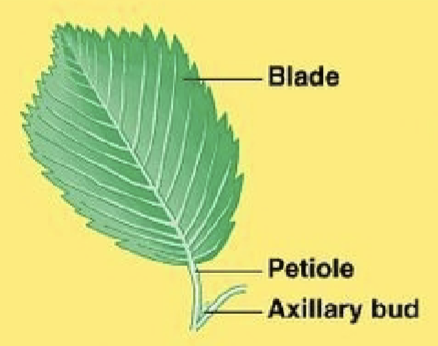
Compound leaves
leaves divided into leaflets; each leaf is made up of more than one blade (leaflets)
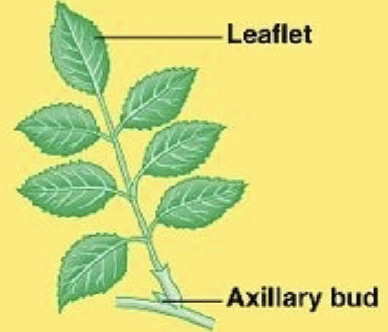
Axillary bud
embryonic shoot located in the axil of leaf; develop lateral branches, leaves, flower; always in the axils of the LEAF, never in the axils of the LEAFLETS
2 types of compound leaves & characteristics of each
palmately compound- leaflets arise from a common point
pinnately compound- leaflets arise at several locations along an elongate axis (the “rachis”)
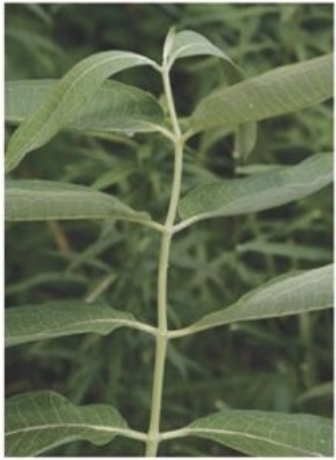
opposite leaves
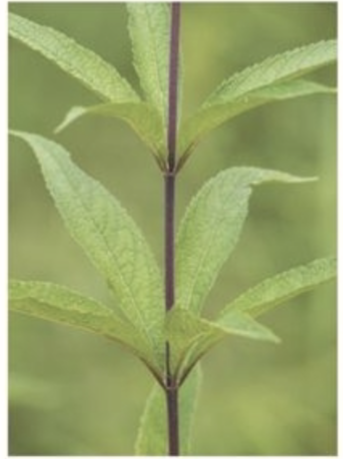
whorled leaves
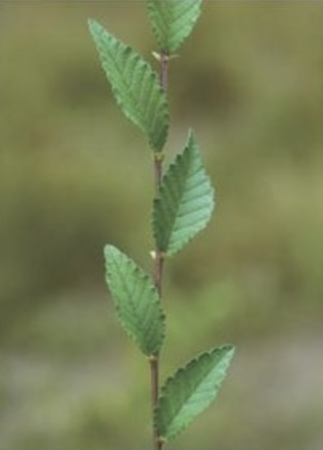
alternate leaves
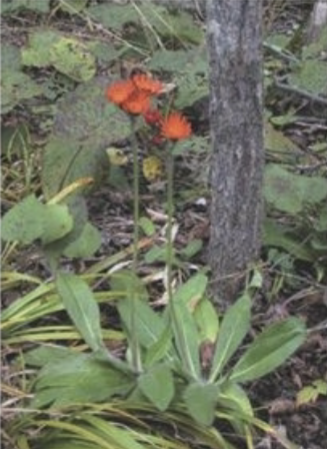
rosette
Alternate leaf arrangement
emerge one at a time, alternating sides along the stem
Opposite leaf arrangement
emerge in pairs directly across from one another at the same node
Dicot and Monocot leaf differences
Dicot- guard cells are kidney shaped, two types of mesophyll (palisade & spongy parenchyma), only have stomata on the lower epidermis
Monocot- guard cells are dumb-bell shaped, vascular bundles (veins) are more parallel, have stomata on upper and lower epidermis
Aquatic plants
(hydrophytes)- submerged, adapted for water:
leaves may lack the external protective tissues (cuticle)
required by land plants which prevents water loss
may lack stomata or only have them on upper surface
specialized leaf shapes (dissected or divided) allow for large SA for absorption & photosynthesis
leaves and stems tend to lack mechanical strengthening tissue allows plant to be flexible for changing water levels
roots adapted for anchorage and less water absorption
Arid plants
(xerophytes)-plants living in very hot or dry climates; adapted for storing water and limiting water loss:
leaves may be completely lacking, reducing water loss
leaves may be fleshy leaves for water storage/supply
leaves may have thick cuticle to prevent water loss and damage
sunken stomata
Thorns
modified stems: connected to vascular system, positioned over leaf scar
Prickles
modified hairs: part of epidermis, not connected/easy to remove, random positioning
Spines
modified leaves: connected to vascular system, positioned under leaf scar
Monocot vs. Dicot leaves (characteristics)
monocots have single cotyledons, dicots have 2
monocots leaves are long and narrow with parallel veins, dicots are broad with a network of veins
monocots vascular bundles are scattered, dicots have vascular bundles arranged in ring
monocots floral parts are in multiples of 3, dicots floral parts are in multiple 4 or 5
Bracts
modified leaves: look like petals (ex.poinsettas)
other parts of modified leaves (parts of flowers)
petals (corolla), stamens (androecium), and carpels or pistils (gynoecium) are also highly modified flowers
Bulb
modified leaf: onion bulb contains modified leaves – fleshy food storage leaves and scaly leaves that cover the bulb
Modified Leaves for Asexual Reproduction
succulent that produces numerous small plantlets on the ends of its leaves, which can easily
detach and grow into new plants
Tendrils
modified leaves of the common pea plant produce tendrils from their leaves and wrap around other objects to help the plant to grow vertically in their environment.

