Biology - Cell Cycle and Cell Division
 Studied by 0 people
 Call Kai
 Learn
Learn Practice Test
 Spaced Repetition
 Match
Match Flashcards
 Knowt Play
1/26

There's no tags or description
Looks like no tags are added yet.
Name | Mastery | Learn | Test | Matching | Spaced | Call with Kai |
|---|
No analytics yet
Send a link to your students to track their progress
27 Terms
Chromosomes
contain the genetic information (DNA) that is passed from parent to offspring.
Located in the Nucleus
Chromosomes have two parts:
Chromatid:
Contain genes for traits.
Chromosome has two identical copies. Separated during Mitosis
Centromere:
Holds chromatids together
How Chromosome Replication Works:
A chromatid makes an identical copy of itself called a sister chromatid
When there are pairs of these sister chromatids for the same trait, they are called Homologous Pairs
Human Chromosomes
Human diploid cells have 46 CHROMOSOMES – 2 COPIES OF 23 DIFFERENT CHROMOSOMES
Karyotype -chart that shows the physical features of chromosome pairs
46 … or … 23? (dip vs. hap)
Diploid (2n)
1. 23 homologous pairs of (human) chromosomes (46 total, full number)
2. Homologous Pairs- One copy from your mother, and one from your father
3. Somatic (body) cells (every cell except sperm and egg)
Haploid (n)
1. 23 individual chromosomes (half the full number)
2. Number of chromosomes in a gamete
3. Gametes (Sex Cells: sperm and egg)
Two Types of Cells In Organisms
Somatic Cells
Body Cells
Diploid (2n)
Divide by mitosis to make exact copies
Identical Cells
In every tissue except reproductive tissue
Germ Cells
I. “Germinating” (reproductive) cells;
first division by meiosis (Diploid->Haploid)
II. Divide by meiosis to make gametes; found in testes & ovaries
Diploid to Haploid!!!
Cells Multiply By Dividing
Cells Divide for:
Repair
Growth,
Volume Management
Eukaryotes Divide By:
Mitosis
Meiosis
Prokaryotes Divide By:
Prokaryotic (binary) fission
Why do cells divide?
They become too large
The volume of the cell increases faster than the surface area
Cells need large surface area (cell membranes) to move things in and out
2. To make more cells so the organism can grow
Example: a growing baby needs more skin cells!
3. To replace old, worn out cells
Cells reproduce at different times depending on cell jobs
The Cell Cycle for Somatic Cells
2 Main Parts
Interphase (life, growth)
Mitosis (division of nucleus)
Consider cytokinesis (division of cytoplasm) as part of mitosis
Interphase
What Happens:
Interphase is the phase the cell normally in, a “Living Phase”
1. DNA is Copied and prepares to divide
2. Longest phase of the cell cycle
DNA called “Chromatin” or uncondensed genetic material at this phase
Phases/Steps of Interphase
G0 Interphase (cell is at rest)
G1 (Gap1/Growth 1): First growth phase - proteins are created, mitochondria and chloroplasts divide, volume of cytoplasm increases
S (Synthesis): DNA is Synthesized and replicates
G2 (Gap 2/Growth): Phase -DNA is checked for errors; Cell is growing, getting ready for division
The Cell Cycle Control System
Cell control system has specific checkpoints where the cell cycle stops until a go-ahead signal is received.
G1 Checkpoint
G2 Checkpoint
M Checkpoint
For many cells the G1 (Gap1) checkpoint is most important
If the cell receives a go-ahead signal at the G1 checkpoint, it will usually complete the S, G2, and M phase and cell will divide.
If the cell does not receives the go-ahead signal. cell will exit the cycle, switch into a non-dividing state called G0
Cells that do not divide
Some cells do not divide in adults:
Brain cells
Nerve cells
Muscle cells
Stem Cells are the focus of much research to find ways to create new cells of these types. Stem cells are cells that can produce or become any type of cell.
Stages of Mitosis:
Prophase
1. Chromatin thickens into chromosomes
2. Nuclear envelope disintegrates
3. Centrioles migrate to opposite poles
4. Centrioles begin producing spindle fibers
Metaphase
1. Chromosomes line up along metaphase plate
2. Spindle fibers attach to centromere of chromosomes
Anaphase
1. Chromosomes are separated
2. Sister chromatids pulled apart to opposite poles
Telophase and Cytokinesis
1. Nucleus reforms
2. Chromosomes begin to relax into chromatin (back to G1)
1. After the Telophase occurs, the cell splits into two separate daughter cells.
Animal and Plant Cells do this in different ways.
Cytokinesis in Plant vs. Animal Cells:
Plant cells How it works:
Instead of the cell being torn in half, a new cell wall is created between the two nuclei
This is called a Cell Plate
Animal cells How it works:
The cytoplasm of the cell starts to pinch in the center
This is called a Cleavage Furrow
This continues until the cell splits in two
Cancer cells
In cancer, mitosis is uncontrolled
Cancer cells divide constantly and form clumps called tumors.
Benign tumors: remain clumped; can be removed.
Benign tumors are usually not life-threatening unless they interfere with vital processes.
Malignant tumors: break apart (metastasize) and can form tumors in other parts of the body.
How Cancers Develop and Spread
Cancer develops only in cells with damaged genes (mutations).
Mutations can be inherited or caused by exposure to:
–Low-dose radiation
–Drugs
–Toxic chemicals
–Infection with certain viruses(ex. HPV)can cause mutations.
Cancer screening
Cancer screening is an examination to detect cancer before a person has symptoms.
–Visual examination
–Self-examination
–Clinical (physician) examination
–Laboratory testing
–Scans (MRI, CAT)
Therapeutic Strategies for Treating Cancer
Slash – Surgical Removal
Burn – with Radiation
Poison – with Chemotherapy
Since cancer is uncontrolled cell division, all chemotherapeutic treatments involve the cell cycle.
· Phase-specific chemotherapies
· Prevent cells from entering S-phase
· Block the S-phase
· Block the M-phase (mitosis)
Reducing Cancer Risk
Don’t smoke or chew tobacco
Don’t drink excessive amounts of alcohol
Avoid unnecessary exposure to ionizing radiation, such as x-rays and UV light
Don’t lie in the sun or tanning beds
Avoid exposure to toxic chemicals and fumes
Avoid asbestos dust and radon gas
Cell Self Destruction/Death
Apoptosis is programmed cell death.
–It’s normal for healthy cells
–cell produces self-destructive enzymes
–Example:
Webbing between fingers in fetus
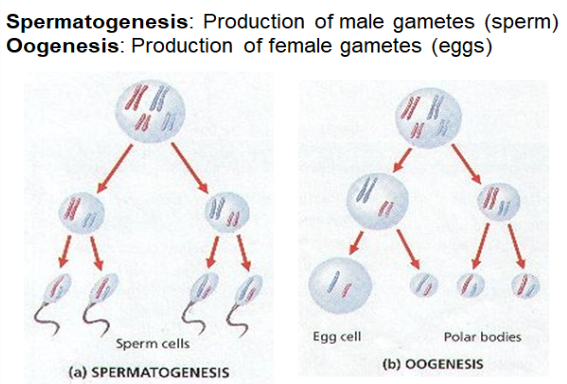
Meiosis Involves Two Divisions
In meiosis:
Start with one diploid germ cell and end with four haploid gamete daughter cells
Each cell has a different variation
Meiosis I
Splits homologous pairs of chromosomes
Meiosis II
Splits sister chromatids apart
Meiosis stages
PROPHASE I
1. Nuclear envelope disintegrates
2. Centrioles migrate, produce spindle fibers
3. Homologous chromosomes pair up
4. *** Homologous pairs CROSS OVER!(CROSSING OVER = Exchange of segments of genes between homologous chromosomes to create genetic variation)
METAPHASE I
1. Homologous pairs of chromosomes line up along metaphase plate
2. Spindle fibers attach to centromeres
ANAPHASE I
1. Homologous pairs pulled apart to opposite poles
2. This is done at random (note light blue and dark blue pairings)
TELOPHASE I
1. Chromosomes (no longer homologous pairs!) prepare for meiosis II
2. Cytoplasm begins to split into first 2 (of 4) daughter cells
3. At end of Meiosis I, cells are now haploid!
PROPHASE II
1. Centrioles migrate, produce spindle fibers
METAPHASE II
1. Chromosomes line up along metaphase plate
ANAPHASE II
1. Sister chromatids pulled apart to opposite poles
TELOPHASE II
1. Nuclear envelopes reform around daughter cells and is then divided into 4 separate daughter cells
2. Each of the 4 daughter cells is a new gamete with genetic information different from either parent!
Formation of Gametes
FERTILIZATION
Male and female gametes unite
Fusion of two haploid nuclei produces diploid nucleus
Egg + Sperm = Zygote (new life in one diploid cell)
n + n = 2n
MEIOSIS AND SEXUAL REPRODUCTION GUARANTEE VARIATION AND DIVERSITY! In Three Ways
1. Independent Assortment
Homologous Chromosomes separate randomly
2. Crossing Over
Homologous pairs exchange gene segments
3. Random Fertilization
Which sperm meets which egg? (game of chance)
Mitosis vs. Meiosis
Mitosis
Cell division of body cells (somatic)
Produces 2 diploid cells (2n)
Each new cell contains copies of all chromosomes
One cell division
All cells are identical (photocopies)
Meiosis
Cell division that produces gametes
Produces 4 haploid cells (n)
Each gamete contains just one chromosome of each pair
Two cell divisions
All cells are different (diversity)
 Note
Note  Flashcards (20)