Genetics
 Call Kai
 Learn
Learn Practice Test
 Spaced Repetition
 Match
Match Flashcards
 Knowt Play
1/76

Earn XP
Description and Tags
From year 10 science, looks at genes and chromosomes.
Name | Mastery | Learn | Test | Matching | Spaced | Call with Kai |
|---|
No analytics yet
Send a link to your students to track their progress
77 Terms
Genetics
The study of heredity
Heredity
The study of biological inheritance, the passing down of biological traits.
Biological inheritance
The passing down of genes
Genes
The blueprints of life, they instruct cells to build proteins which determine how we look and function.
DNA
A very long double chain molecule that looks like a spiral ladder, the structure of which is called a double helix.
What is DNA made of?
Repeating chemical units, nucleotides, that contain specific bases, which form the DNA code.
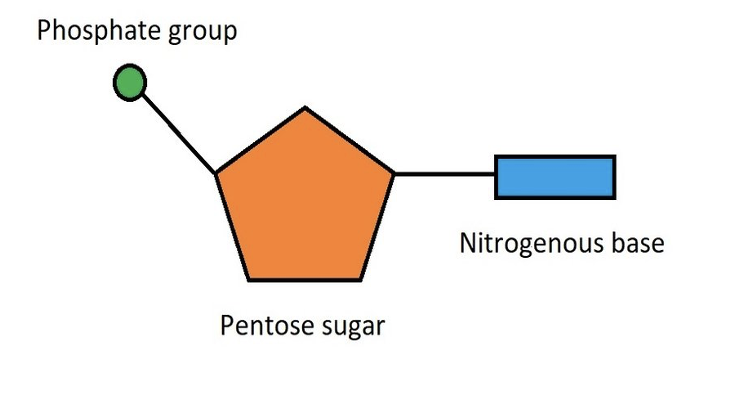
What are nucleotides made of?
A phosphate group, a pentose sugar and a nitrogenous base.
What are chromosomes?
Large bundled lengths of DNA that contain many genes.
What is non coding DNA used for?
DNA identification and species classification.
Where is DNA found?
In the nucleus of cells, in the chromosome.
How many chromosomes do human cells contain?
46
How many copies will each chromosome have?
2, one from mum and one from dad.
How many chromosomes does a child have from each parent?
23
What are the 4 nitrogenous bases?
Guanine, Cytosine, Adenine, Thymine
G
Guanine
C
Cytosine
A
Adenine
T
Thymine
Finish Sentence:
When 2 strands of DNA combine,
C and G join together and A and T join together. Called complementary base pairing.
What is the complementary sequence?
The sequence on the other strand of DNA, that is complementary.
What does the order of bases in a single strand of DNA do?
Instruct cells on which amino acids need to be joined together to make a particular protein.
How many bases does the code use to code for each individual amino acid?
3 bases, a triplet or a codon.
Amino acids
The building blocks of all proteins
Mitosis
When 1 body cell divides to make 2 identical copies of itself. Occurs every day and is needed for repair and growth.
Meiosis
When cells divide to form sex cells (sperm/egg cells). The copies made are not identical to the original cells.
What must cells do before they can divide?
Duplicate their DNA
Where does Mitosis occur? What does it result in?
Occurs in all body cells. Results in genetically identical diploid cells.
Diploid
Having a pair of each chromosome
What are sister chromatids?
Identical copies of a chromosome that are held together during replication and remain attached until they are separated during division.
When do sister chromatids occur?
When DNA molecules are copied in preparation for cell division. After division, they contain identical genetic information.
Somatic cells
Body cells
What happens in Mitosis?
The duplicated chromosomes are pulled apart into different ends, and then the cell membrane then cleaves in the middle to form 2 identical daughter cells
Why is Mitosis necessary?
For growth and repair
Which process are sex cells formed by?
Meiosis
Autosome
Any chromosome that is not a sex chromosome
What happens when an egg is fertilised by a sperm cell?
The two haploid sets of chromosomes combine to form a diploid cell with a mix of parental DNA
Haploid
Halved or single
Why do no two gametes carry exactly the same parental genes?
Meiosis involves a mix of a parent’s original chromosomes
A form of cell division used in sexual reproduction to ensure the next generation inherit copies of DNA from each parent.
Meiosis
Gametes
Sex cells
How much of each parent does a child inherit?
Inherit the one half of its chromosomes from the father, and the other half from the mother.
Why does meiosis occur?
To produce gametes.
What are the differences between mitosis and meiosis?
Mitosis produces two genetically identical daughter cells from a single parent cell, whereas meiosis produces cells that are genetically unique from the parent and contain only half as much DNA. Meiosis occurs in gametes and mitosis occurs in autosomes.
What happens when the cells don’t repair errors?
A mutation occurs, which then becomes a permanent change in the cell DNA sequence
What are the 2 major types of mutation?
Point mutations and chromosomal mutations
Finish the sentence:
Mutations can be…
spontaneous or induced.
Spontaneous mutations
Random mutations
Induced mutations
Caused by different factors
Mutagen
A factor that triggers mutations in cells
Mutagen examples
Radiation - ultraviolet or nuclear
Chemical substances, such as asbestos, tobacco
Where are chromosomes found?
In the nucleus of cells
Nucleotide
The building blocks of DNA
Sugar phosphate group
make up the backbone of DNA.
Nitrogenous base
Part of a nucleotide, A, T, G and C.
Codon
3 bases used to code for each individual amino acid
Centromere
A constricted region of a chromosome that separates it into a short arm and a long arm
Homologous chromosomes
A pair of chromosomes, one inherited from each parent.
DNA replication
is done through mitosis and meiosis.
Zygote
A fertilised egg cell.
Germline mutation
Mutations in germline cells that can be passed onto the next generations.
Germline cells
cells that divide into sperm and egg cells in meiosis.
Somatic mutation
Mutations in body cells that are not passed onto offspring
Beneficial mutation
Variations that increase the chances of the organism surviving and reproducing
Deleterious mutation
May cause death of the organism or issues that prevent it from passing on genetic information to the next generation.
Neutral mutation
Do not kill the organism or increase the chances of the genetics being passed on to the next generation, but they accumulate in the gene pool and lead to genetic variation in a population.
Point mutation
Occurs when there is a change to one of the nitrogenous bases and could result in a changed order of the amino acids in a protein
Substitution
Occurs when one nucleotide is swapped for another
Deletion point mutation
Occurs when a nucleotide is deleted from the sequence
Insertion point mutation
Occurs when an extra nucleotide is inserted into the DNA sequence
Chromosomal mutations
One affects multiple genes, different types, including duplication, inversion, deletion, insertion and translocation.
Duplication
Part of chromosome is copied, resulting in duplicate sections
Inversion
A segment of a chromosome is removed and then replaced within the chromosome in reverse order.
Deletion chromosomal mutation
A portion of the chromosome is removed along with any genes contained within this segment.
Insertion chromosomal mutations
A portion of one chromosome is removed and then replaced in a second chromosome.
Translocation
Segments of two chromosomes are exchanged which may interrupt gene sequences.
Dogs in denmark teach indonesian
Duplication, inversion, deletion, translocation, insertion
Allele
one form of a gene that has two or more alternative forms
Explore top notes

