šŸ– Topic 1: Anatomical Terms + Pig Structures

0.0(0)
studied byStudied by 0 people
0.0(0)
full-widthCall with Kai
learnLearn
examPractice Test
spaced repetitionSpaced Repetition
heart puzzleMatch
flashcardsFlashcards
GameKnowt Play
Card Sorting

1/24

encourage image

There's no tags or description

Looks like no tags are added yet.

Study Analytics
Name
Mastery
Learn
Test
Matching
Spaced
Call with Kai

No study sessions yet.

25 Terms

1
New cards

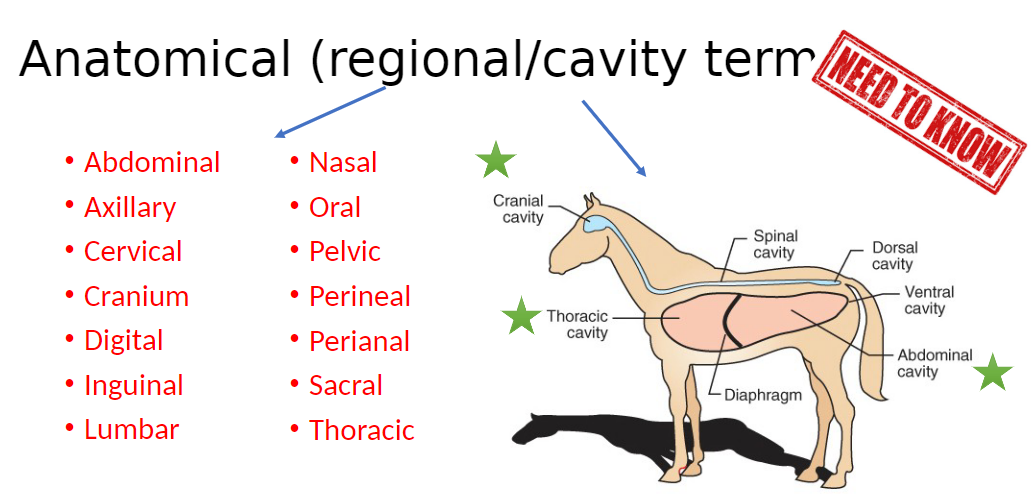
Anatomical Terms (Regional/Cavity) *MEMORIZE

Abdominal
ā€ƒRelating to the abdomen

Axillary
ā€ƒRelating to the armpit

Cervical
ā€ƒRelating to the neck

Cranium
ā€ƒRelating to the skull

Digital
ā€ƒRelating to the fingers or toes

Inguinal
ā€ƒRelating to the groin

Lumbar
ā€ƒRelating to the lower back

Nasal
ā€ƒRelating to the nose

Oral
ā€ƒRelating to the mouth

Pelvic
ā€ƒRelating to the pelvis

Perineal
ā€ƒRelating to the area between the anus and genitalia

Perianal
ā€ƒRelating to the area around the anus

Sacral
ā€ƒRelating to the sacrum (lower back above the tail)

Thoracic
ā€ƒRelating to the chest

<p><strong>Abdominal</strong><br>ā€ƒRelating to the abdomen</p><p><strong>Axillary</strong><br>ā€ƒRelating to the armpit</p><p><strong>Cervical</strong><br>ā€ƒRelating to the neck</p><p><strong>Cranium</strong><br>ā€ƒRelating to the skull</p><p><strong>Digital</strong><br>ā€ƒRelating to the fingers or toes</p><p><strong>Inguinal</strong><br>ā€ƒRelating to the groin</p><p><strong>Lumbar</strong><br>ā€ƒRelating to the lower back</p><p><strong>Nasal</strong><br>ā€ƒRelating to the nose</p><p><strong>Oral</strong><br>ā€ƒRelating to the mouth</p><p><strong>Pelvic</strong><br>ā€ƒRelating to the pelvis</p><p><strong>Perineal</strong><br>ā€ƒRelating to the area between the anus and genitalia</p><p><strong>Perianal</strong><br>ā€ƒRelating to the area around the anus</p><p><strong>Sacral</strong><br>ā€ƒRelating to the sacrum (lower back above the tail)</p><p><strong>Thoracic</strong><br>ā€ƒRelating to the chest</p>
2
New cards

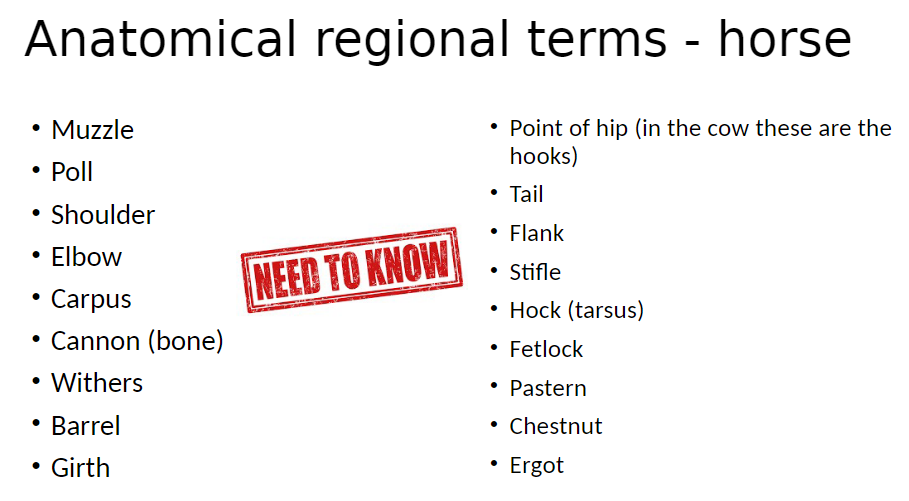
Anatomical Regional Terms – Horse *MEMORIZE

Muzzle
ā€ƒFront of the face including the nose and mouth

Poll
ā€ƒTop of the head between the ears

Shoulder
ā€ƒArea where the forelimb attaches to the body

Elbow
ā€ƒJoint between the upper and lower forelimb

Carpus
ā€ƒKnee of the horse (forelimb)

Cannon (Bone)
ā€ƒLong bone of the lower limb

Withers
ā€ƒTop of the shoulders where the neck meets the back

Barrel
ā€ƒMain body/trunk of the horse

Girth
ā€ƒArea behind the forelimbs where the saddle girth lies

Point of Hip
ā€ƒProminent hip bone (hooks in cows)

Tail
ā€ƒRear appendage of the horse

Flank
ā€ƒSide of the body between ribs and hip

Stifle
ā€ƒHindlimb joint equivalent to the human knee

Hock (Tarsus)
ā€ƒHindlimb joint equivalent to the human ankle

Fetlock
ā€ƒJoint above the hoof

Pastern
ā€ƒArea between fetlock and hoof

Chestnut
ā€ƒHorn-like growth on the inner leg

Ergot
ā€ƒSmall horn-like growth near the fetlock
<p><strong>Muzzle</strong><br>ā€ƒFront of the face including the nose and mouth</p><p><strong>Poll</strong><br>ā€ƒTop of the head between the ears</p><p><strong>Shoulder</strong><br>ā€ƒArea where the forelimb attaches to the body</p><p><strong>Elbow</strong><br>ā€ƒJoint between the upper and lower forelimb</p><p><strong>Carpus</strong><br>ā€ƒKnee of the horse (forelimb)</p><p><strong>Cannon (Bone)</strong><br>ā€ƒLong bone of the lower limb</p><p><strong>Withers</strong><br>ā€ƒTop of the shoulders where the neck meets the back</p><p><strong>Barrel</strong><br>ā€ƒMain body/trunk of the horse</p><p><strong>Girth</strong><br>ā€ƒArea behind the forelimbs where the saddle girth lies</p><p><strong>Point of Hip</strong><br>ā€ƒProminent hip bone (hooks in cows)</p><p><strong>Tail</strong><br>ā€ƒRear appendage of the horse</p><p><strong>Flank</strong><br>ā€ƒSide of the body between ribs and hip</p><p><strong>Stifle</strong><br>ā€ƒHindlimb joint equivalent to the human knee</p><p><strong>Hock (Tarsus)</strong><br>ā€ƒHindlimb joint equivalent to the human ankle</p><p><strong>Fetlock</strong><br>ā€ƒJoint above the hoof</p><p><strong>Pastern</strong><br>ā€ƒArea between fetlock and hoof</p><p><strong>Chestnut</strong><br>ā€ƒHorn-like growth on the inner leg</p><p><strong>Ergot</strong><br>ā€ƒSmall horn-like growth near the fetlock</p>
3
New cards

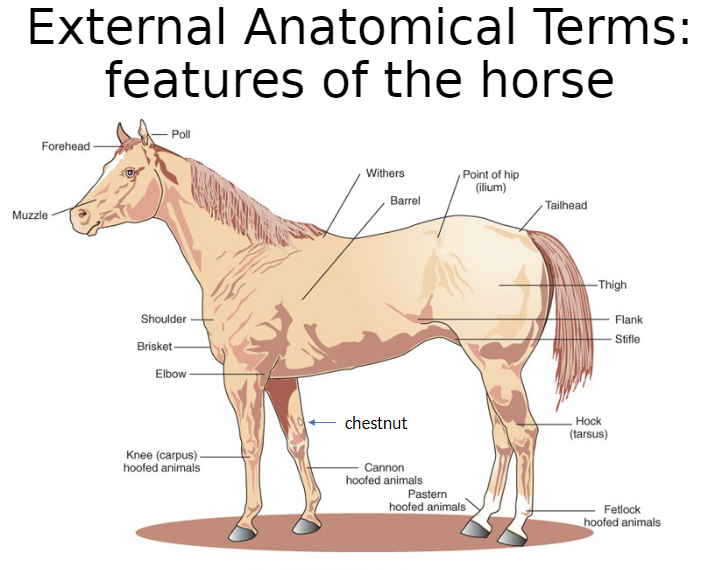
External Anatomical Terms – Horse

Chestnut
ā€ƒHorn-like, roughened growth on the inner side of the leg
ā€ƒLocated above the knee on forelimbs and above the hock on hindlimbs
<p><strong>Chestnut</strong><br>ā€ƒHorn-like, roughened growth on the inner side of the leg<br>ā€ƒLocated above the knee on forelimbs and above the hock on hindlimbs</p>
4
New cards

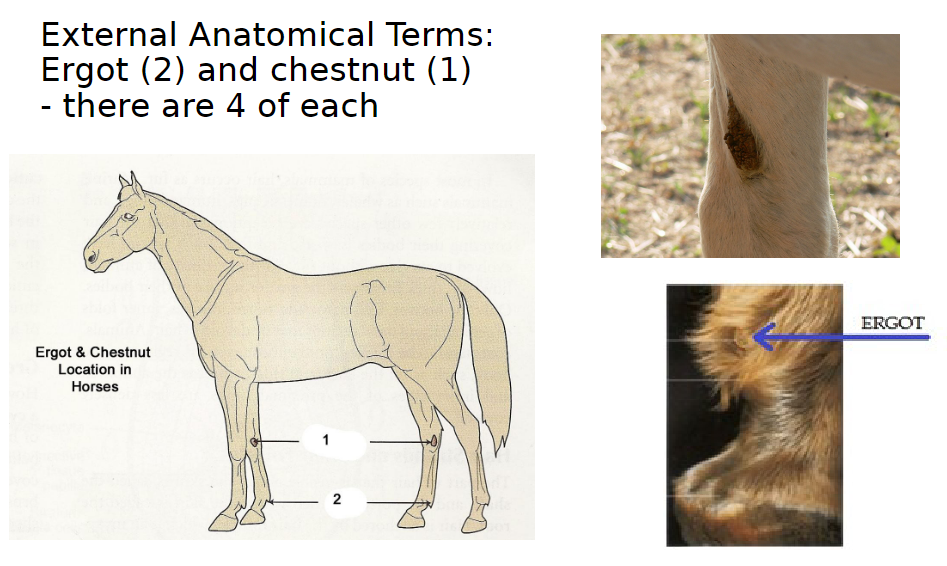
External Anatomical Terms – Horse *MEMORIZE

Chestnut (1)
ā€ƒHorn-like, roughened growth on the inner side of each leg
ā€ƒThere are 4 chestnuts in total (one per leg)

Ergot (2)
ā€ƒSmall, horn-like growth near the fetlock of each leg
ā€ƒThere are 4 ergots in total (one per leg)
<p><strong>Chestnut (1)</strong><br>ā€ƒHorn-like, roughened growth on the inner side of each leg<br>ā€ƒThere are <strong>4 chestnuts</strong> in total (one per leg)</p><p><strong>Ergot (2)</strong><br>ā€ƒSmall, horn-like growth near the fetlock of each leg<br>ā€ƒThere are <strong>4 ergots</strong> in total (one per leg)</p>
5
New cards

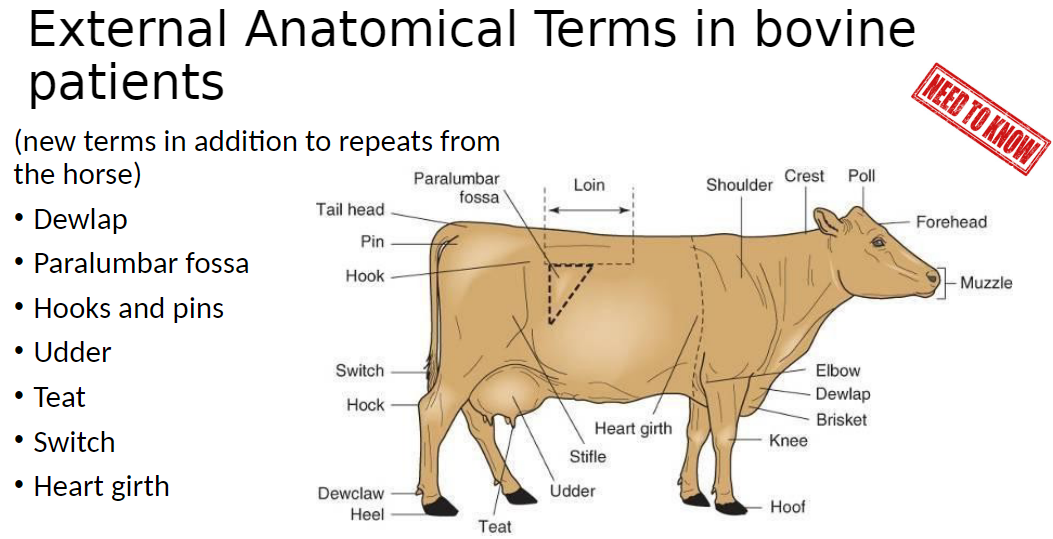
External Anatomical Terms – Bovine *MEMORIZE

(new terms in addition to repeats from the horse)

Dewlap
ā€ƒLoose skin hanging from the neck

Paralumbar Fossa
ā€ƒIndented area on the side behind the ribs

Hooks and Pins
ā€ƒProminent hip bones
ā€ƒHooks – cranial hip bones
ā€ƒPins – caudal hip bones

Udder
ā€ƒMammary gland of the cow

Teat
ā€ƒProjection from the udder through which milk is delivered

Switch
ā€ƒEnd of the tail with long hair

Heart Girth
ā€ƒCircumference of the chest behind the forelimbs
<p>(new terms in addition to repeats from the horse)</p><p><strong>Dewlap</strong><br>ā€ƒLoose skin hanging from the neck</p><p><strong>Paralumbar Fossa</strong><br>ā€ƒIndented area on the side behind the ribs</p><p><strong>Hooks and Pins</strong><br>ā€ƒProminent hip bones<br>ā€ƒHooks – cranial hip bones<br>ā€ƒPins – caudal hip bones</p><p><strong>Udder</strong><br>ā€ƒMammary gland of the cow</p><p><strong>Teat</strong><br>ā€ƒProjection from the udder through which milk is delivered</p><p><strong>Switch</strong><br>ā€ƒEnd of the tail with long hair</p><p><strong>Heart Girth</strong><br>ā€ƒCircumference of the chest behind the forelimbs</p>
6
New cards

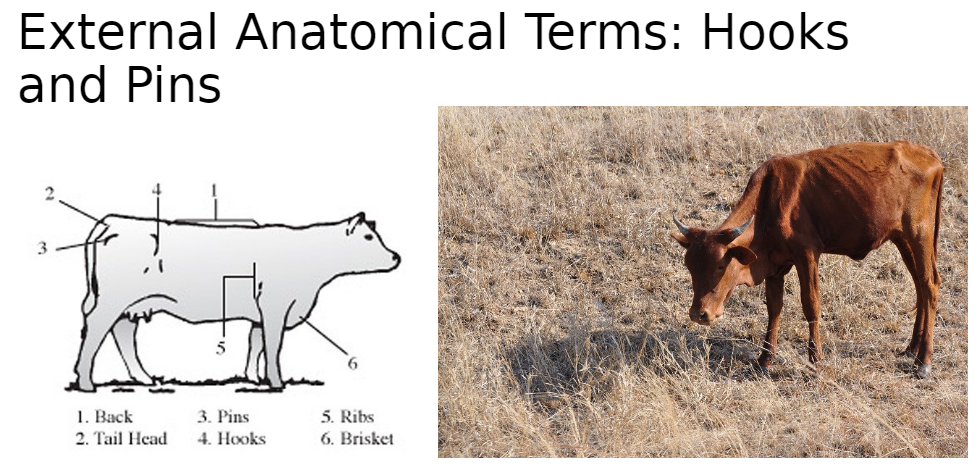
External Anatomical Terms: Hooks and Pins *MEMORIZE

Hooks
ā€ƒCranial (front) prominent hip bones

Pins
ā€ƒCaudal (rear) prominent hip bones

<p><strong>Hooks</strong><br>ā€ƒCranial (front) prominent hip bones</p><p><strong>Pins</strong><br>ā€ƒCaudal (rear) prominent hip bones</p>
7
New cards

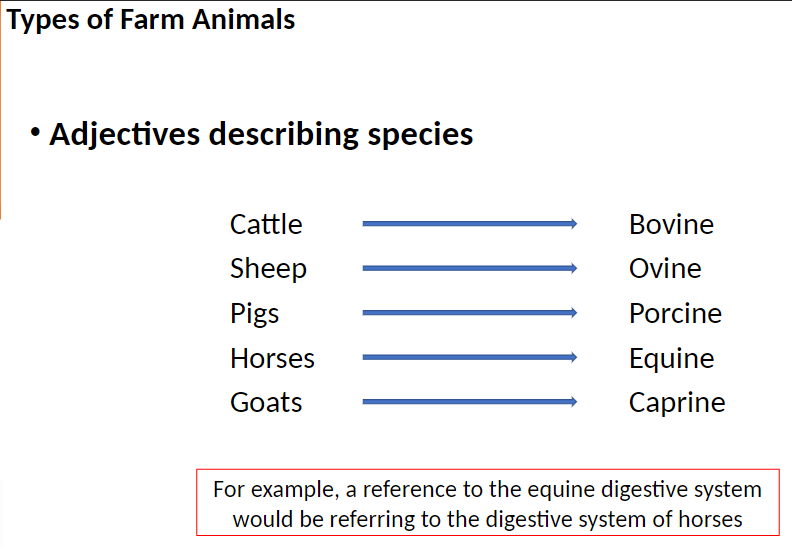
Adjectives Describing Species *DON’T MEMORIZE, JUST KNOW

Cattle – Bovine

Sheep – Ovine

Pigs – Porcine

Horses – Equine

Goats – Caprine

Example
ā€ƒA reference to the equine digestive system means the digestive system of horses
<p><strong>Cattle</strong> – Bovine</p><p><strong>Sheep</strong> – Ovine</p><p><strong>Pigs</strong> – Porcine</p><p><strong>Horses</strong> – Equine</p><p><strong>Goats</strong> – Caprine</p><p><strong>Example</strong><br>ā€ƒA reference to the <strong>equine digestive system</strong> means the digestive system of horses</p>
8
New cards

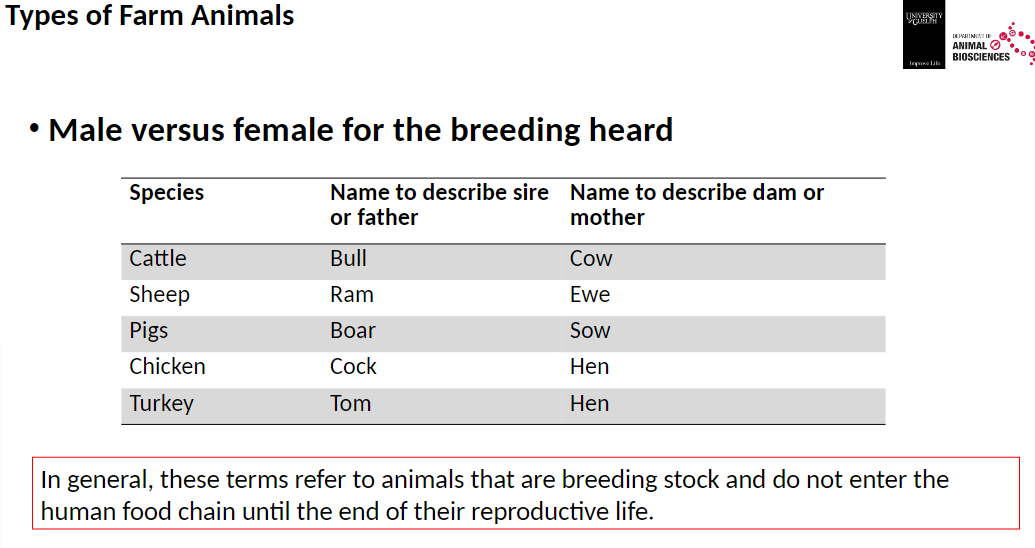
Types of Farm Animals (M/F) *DON’T MEMORIZE, JUST KNOW

Cattle
ā€ƒMale (sire) – Bull
ā€ƒFemale (dam) – Cow

Sheep
ā€ƒMale – Ram
ā€ƒFemale – Ewe

Pigs
ā€ƒMale – Boar
ā€ƒFemale – Sow

Chicken
ā€ƒMale – Cock
ā€ƒFemale – Hen

Turkey
ā€ƒMale – Tom
ā€ƒFemale – Hen

Note
ā€ƒMale versus female refers to the breeding herd
ā€ƒThese terms generally describe animals used for breeding
ā€ƒThey usually do not enter the human food chain until the end of their reproductive life
ā€ƒWhen they do enter the human food chain, they are often used in processed products (there are exceptions) as they may be less tender or have an unusual flavor – applies to Bull, Ram, Boar, Tom, Hen
<p><strong>Cattle</strong><br>ā€ƒMale (sire) – Bull<br>ā€ƒFemale (dam) – Cow</p><p><strong>Sheep</strong><br>ā€ƒMale – Ram<br>ā€ƒFemale – Ewe</p><p><strong>Pigs</strong><br>ā€ƒMale – Boar<br>ā€ƒFemale – Sow</p><p><strong>Chicken</strong><br>ā€ƒMale – Cock<br>ā€ƒFemale – Hen</p><p><strong>Turkey</strong><br>ā€ƒMale – Tom<br>ā€ƒFemale – Hen</p><p><strong>Note</strong><br>ā€ƒMale versus female refers to the breeding herd<br>ā€ƒThese terms generally describe animals used for breeding<br>ā€ƒThey usually do not enter the human food chain until the end of their reproductive life<br>ā€ƒWhen they do enter the human food chain, they are often used in processed products (there are exceptions) as they may be less tender or have an unusual flavor – applies to Bull, Ram, Boar, Tom, Hen</p>
9
New cards

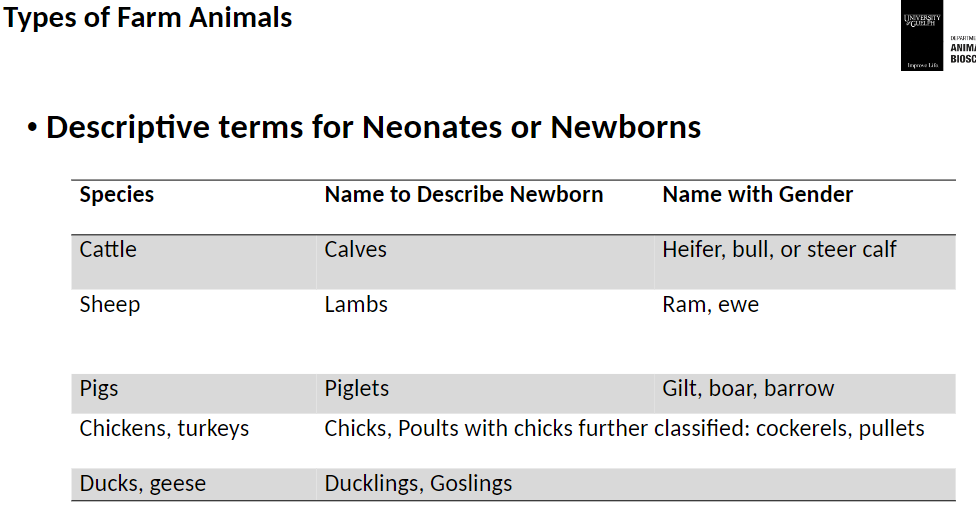
Types of Farm Animals (Neonates/Newborns)

Cattle
ā€ƒNewborn – Calves
ā€ƒGender-specific – Heifer (female), Bull (male), Steer (castrated male)

Sheep
ā€ƒNewborn – Lambs
ā€ƒGender-specific – Ewe (female), Ram (male)

Pigs
ā€ƒNewborn – Piglets
ā€ƒGender-specific – Gilt (female), Boar (male), Barrow (castrated male)

Chickens and Turkeys
ā€ƒNewborn – Chicks or Poults
ā€ƒChicks further classified – Cockerels (male), Pullets (female)

Ducks and Geese
ā€ƒNewborn – Ducklings, Goslings

<p><strong>Cattle</strong><br>ā€ƒNewborn – Calves<br>ā€ƒGender-specific – Heifer (female), Bull (male), Steer (castrated male)</p><p><strong>Sheep</strong><br>ā€ƒNewborn – Lambs<br>ā€ƒGender-specific – Ewe (female), Ram (male)</p><p><strong>Pigs</strong><br>ā€ƒNewborn – Piglets<br>ā€ƒGender-specific – Gilt (female), Boar (male), Barrow (castrated male)</p><p><strong>Chickens and Turkeys</strong><br>ā€ƒNewborn – Chicks or Poults<br>ā€ƒChicks further classified – Cockerels (male), Pullets (female)</p><p><strong>Ducks and Geese</strong><br>ā€ƒNewborn – Ducklings, Goslings</p>
10
New cards

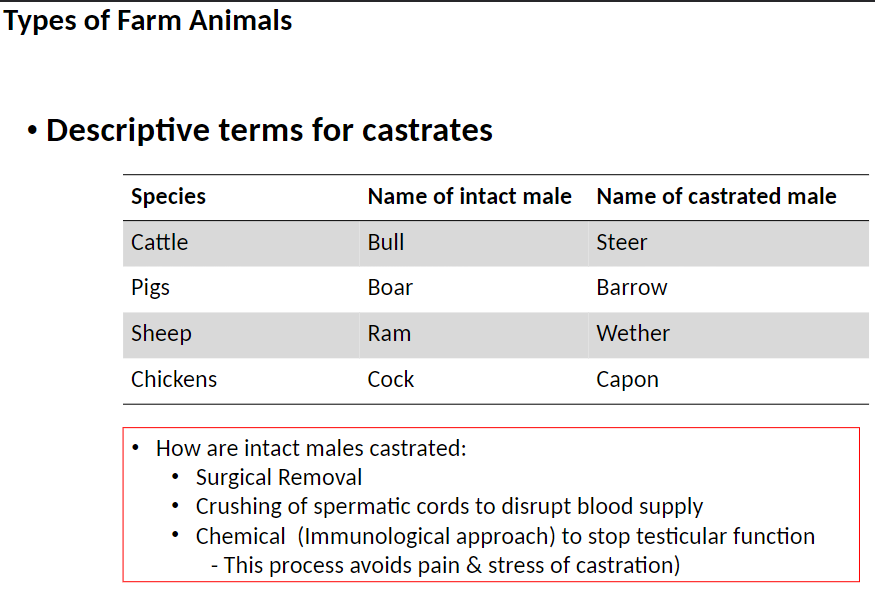
Types of Farm Animals (Castrates)

Cattle
ā€ƒIntact male – Bull
ā€ƒCastrated male – Steer

Pigs
ā€ƒIntact male – Boar
ā€ƒCastrated male – Barrow

Sheep
ā€ƒIntact male – Ram
ā€ƒCastrated male – Wether

Chickens
ā€ƒIntact male – Cock
ā€ƒCastrated male – Capon

Methods of Castration
ā€ƒSurgical removal of testes
ā€ƒCrushing of spermatic cords to stop blood supply
ā€ƒChemical or immunological approach to stop testicular function
ā€ƒā€ƒThis method avoids pain and stress associated with traditional castration
<p><strong>Cattle</strong><br>ā€ƒIntact male – Bull<br>ā€ƒCastrated male – Steer</p><p><strong>Pigs</strong><br>ā€ƒIntact male – Boar<br>ā€ƒCastrated male – Barrow</p><p><strong>Sheep</strong><br>ā€ƒIntact male – Ram<br>ā€ƒCastrated male – Wether</p><p><strong>Chickens</strong><br>ā€ƒIntact male – Cock<br>ā€ƒCastrated male – Capon</p><p><strong>Methods of Castration</strong><br>ā€ƒSurgical removal of testes<br>ā€ƒCrushing of spermatic cords to stop blood supply<br>ā€ƒChemical or immunological approach to stop testicular function<br>ā€ƒā€ƒThis method avoids pain and stress associated with traditional castration</p>
11
New cards

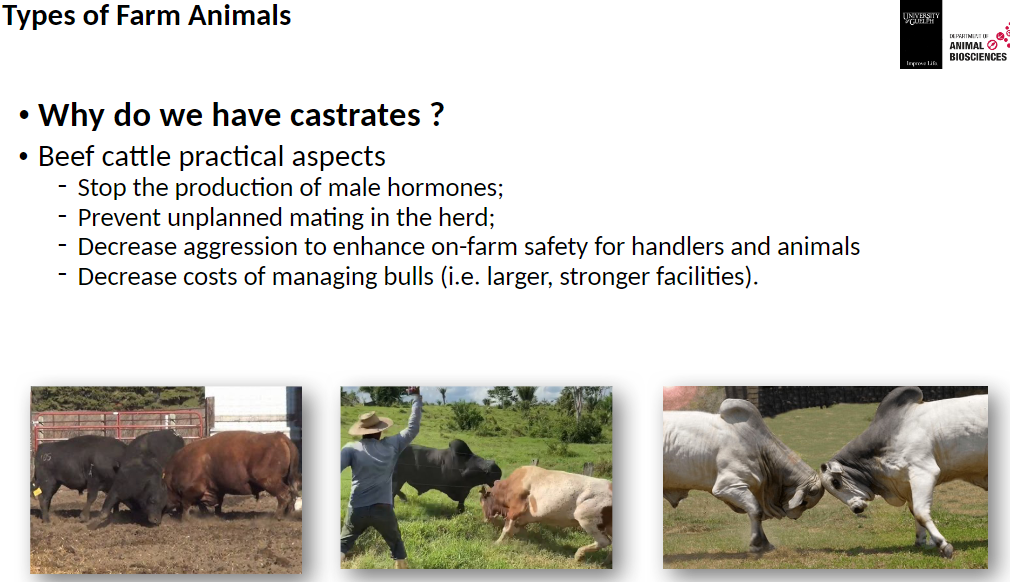
Why We Have Castrates (Practical Aspects)

Beef Cattle Practical Aspects
ā€ƒStop the production of male hormones
ā€ƒPrevent unplanned mating in the herd
ā€ƒDecrease aggression to improve safety for handlers and animals
ā€ƒReduce costs of managing bulls (larger, stronger facilities needed)
<p><strong>Beef Cattle Practical Aspects</strong><br>ā€ƒStop the production of male hormones<br>ā€ƒPrevent unplanned mating in the herd<br>ā€ƒDecrease aggression to improve safety for handlers and animals<br>ā€ƒReduce costs of managing bulls (larger, stronger facilities needed)</p>
12
New cards

Why We Have Castrates (Productivity Aspects)

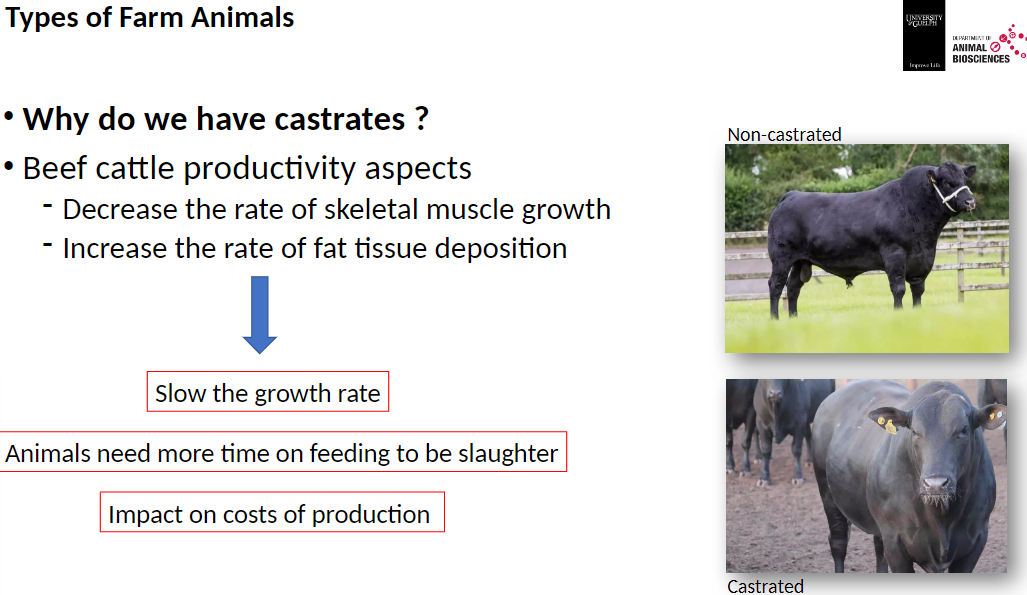
Beef Cattle Productivity Aspects
ā€ƒDecrease the rate of skeletal muscle growth
ā€ƒIncrease the rate of fat tissue deposition
ā€ƒSlow the overall growth rate
ā€ƒAnimals need more time on feed before slaughter
ā€ƒThis impacts the costs of production

Comparison
ā€ƒCastrated – slower growth, more fat deposition
ā€ƒNon-castrated – faster growth, leaner meat
<p><strong>Beef Cattle Productivity Aspects</strong><br>ā€ƒDecrease the rate of skeletal muscle growth<br>ā€ƒIncrease the rate of fat tissue deposition<br>ā€ƒSlow the overall growth rate<br>ā€ƒAnimals need more time on feed before slaughter<br>ā€ƒThis impacts the costs of production</p><p><strong>Comparison</strong><br>ā€ƒCastrated – slower growth, more fat deposition<br>ā€ƒNon-castrated – faster growth, leaner meat</p>
13
New cards

Why We Have Castrates (Meat Quality Aspects)

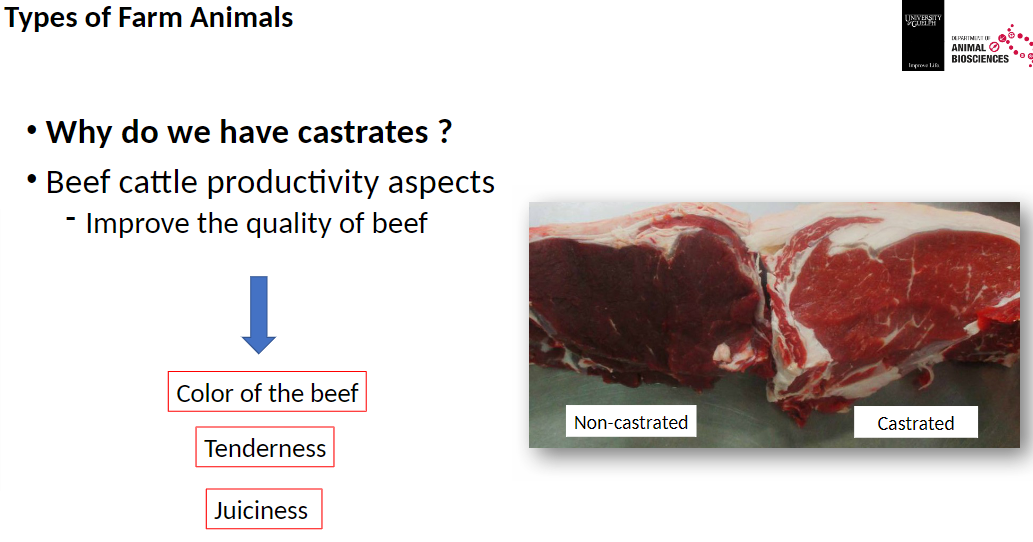
Beef Cattle Productivity Aspects
ā€ƒImprove the quality of beef

Factors Affected
ā€ƒColor of the beef
ā€ƒTenderness
ā€ƒJuiciness
ā€ƒMarbling

Comparison
ā€ƒNon-castrated – different quality
ā€ƒCastrated – improved quality (better marbling, color, etc.)
<p><strong>Beef Cattle Productivity Aspects</strong><br>ā€ƒImprove the quality of beef</p><p><strong>Factors Affected</strong><br>ā€ƒColor of the beef<br>ā€ƒTenderness<br>ā€ƒJuiciness<br>ā€ƒMarbling</p><p><strong>Comparison</strong><br>ā€ƒNon-castrated – different quality<br>ā€ƒCastrated – improved quality (better marbling, color, etc.)</p>
14
New cards

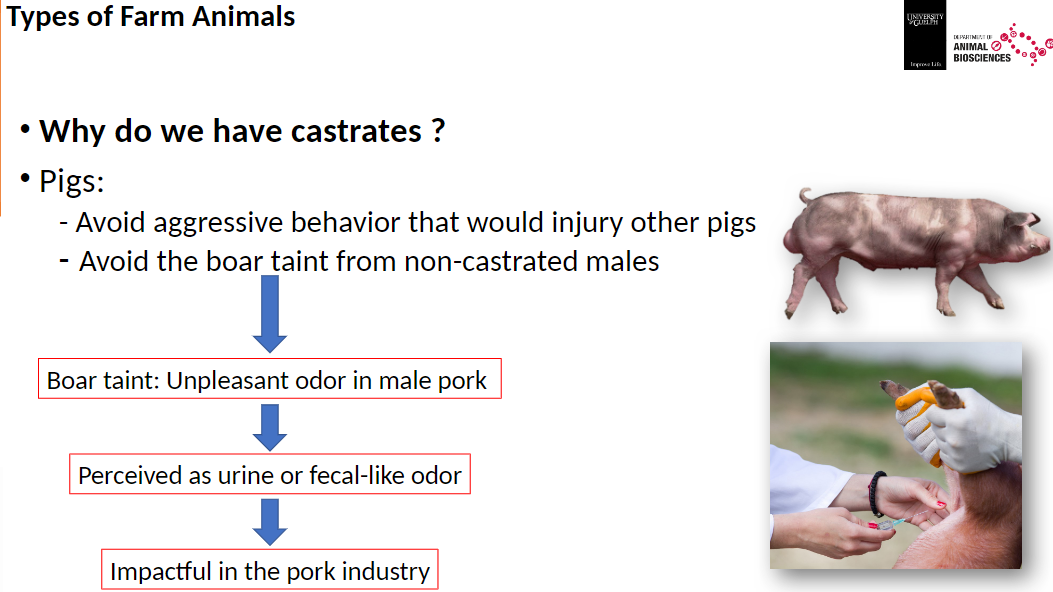
Why We Have Castrates (Pigs)

Pigs
ā€ƒAvoid aggressive behavior that could injure other pigs
ā€ƒPrevent boar taint in non-castrated males

Boar Taint
ā€ƒUnpleasant odor in male pork
ā€ƒImpactful in the pork industry
ā€ƒPerceived as urine- or fecal-like odor

<p><strong>Pigs</strong><br>ā€ƒAvoid aggressive behavior that could injure other pigs<br>ā€ƒPrevent boar taint in non-castrated males</p><p><strong>Boar Taint</strong><br>ā€ƒUnpleasant odor in male pork<br>ā€ƒImpactful in the pork industry<br>ā€ƒPerceived as urine- or fecal-like odor</p>
15
New cards

Why We Have Castrates (Sheep)

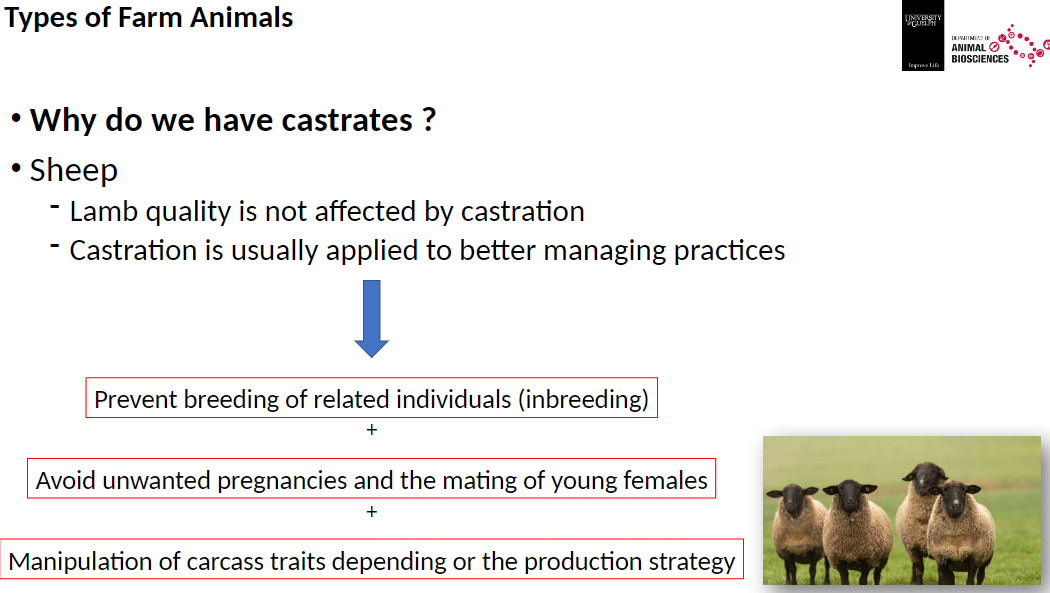
Sheep
ā€ƒLamb quality is not affected by castration
ā€ƒCastration is usually applied for better management practices

Reasons for Castration in Sheep
ā€ƒPrevent breeding of related individuals (inbreeding)
ā€ƒManipulate carcass traits depending on production strategy
ā€ƒAvoid unwanted pregnancies and mating of young females
<p><strong>Sheep</strong><br>ā€ƒLamb quality is not affected by castration<br>ā€ƒCastration is usually applied for better management practices</p><p><strong>Reasons for Castration in Sheep</strong><br>ā€ƒPrevent breeding of related individuals (inbreeding)<br>ā€ƒManipulate carcass traits depending on production strategy<br>ā€ƒAvoid unwanted pregnancies and mating of young females</p>
16
New cards

Why We Have Castrates (Chickens)

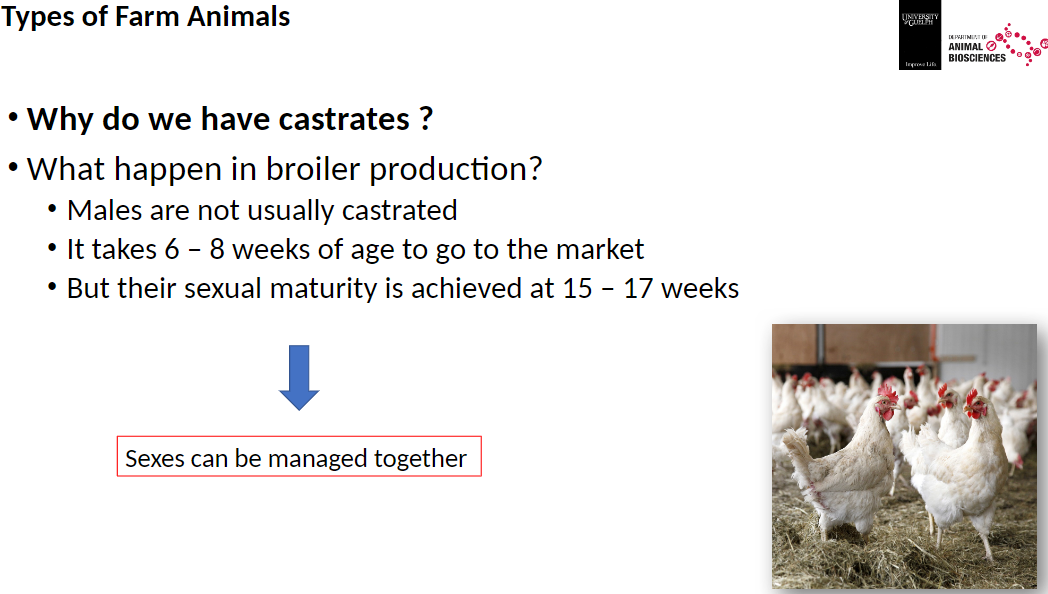
Broiler Production
ā€ƒMales are not usually castrated
ā€ƒBroilers go to market at 6–8 weeks of age
ā€ƒSexual maturity is reached at 15–17 weeks
ā€ƒSexes can be managed together during production
<p><strong>Broiler Production</strong><br>ā€ƒMales are not usually castrated<br>ā€ƒBroilers go to market at 6–8 weeks of age<br>ā€ƒSexual maturity is reached at 15–17 weeks<br>ā€ƒSexes can be managed together during production</p>
17
New cards

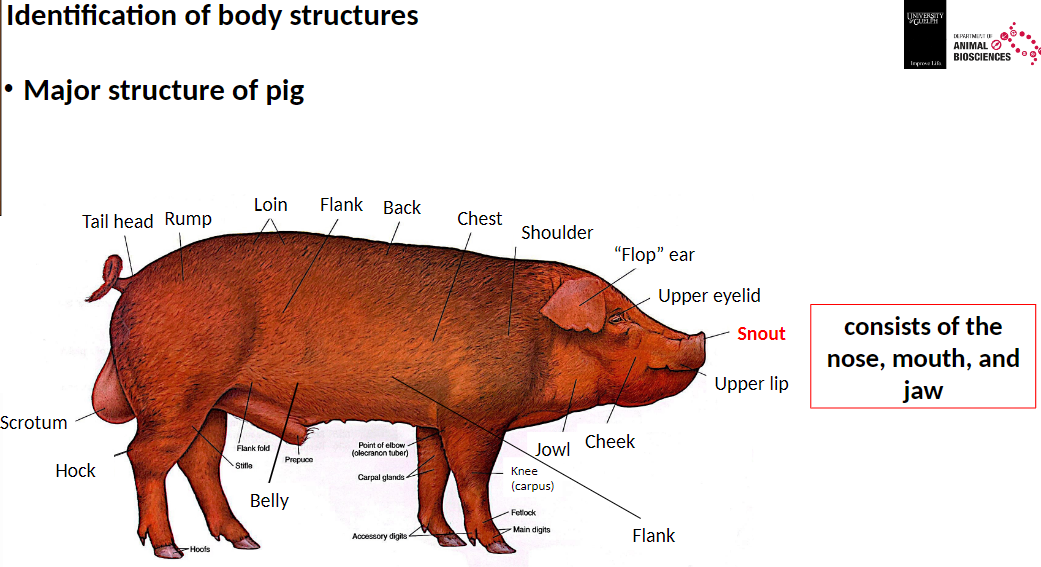
Major Pig Structures (Snout)

Snout
ā€ƒConsists of the nose, mouth, and jaws

<p><strong>Snout</strong><br>ā€ƒConsists of the nose, mouth, and jaws</p>
18
New cards

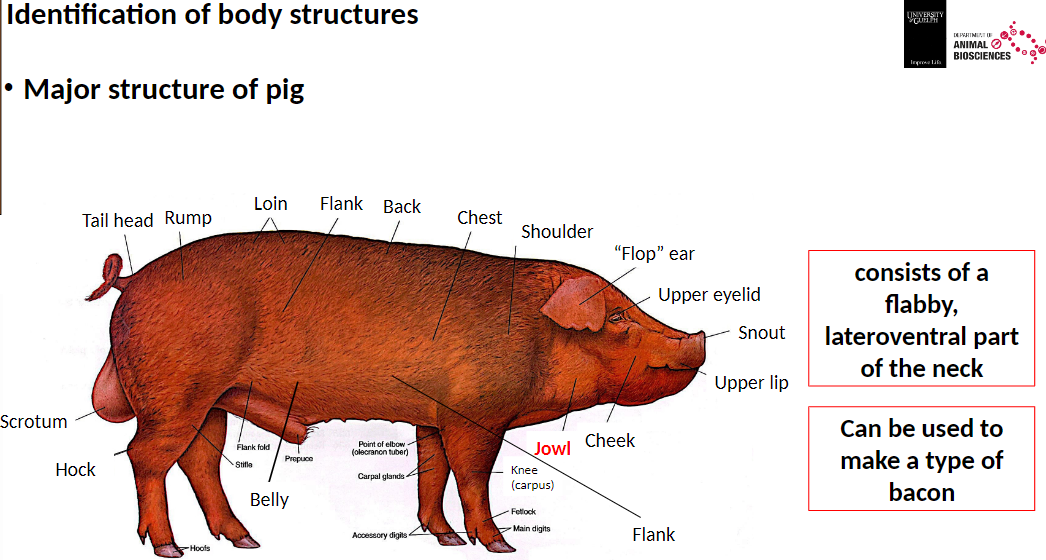
Major Pig Structures (Jowl)

Jowl
ā€ƒConsists of a flabby, lateroventral part of the neck
ā€ƒCan be used to make a type of bacon

<p><strong>Jowl</strong><br>ā€ƒConsists of a flabby, lateroventral part of the neck<br>ā€ƒCan be used to make a type of bacon</p>
19
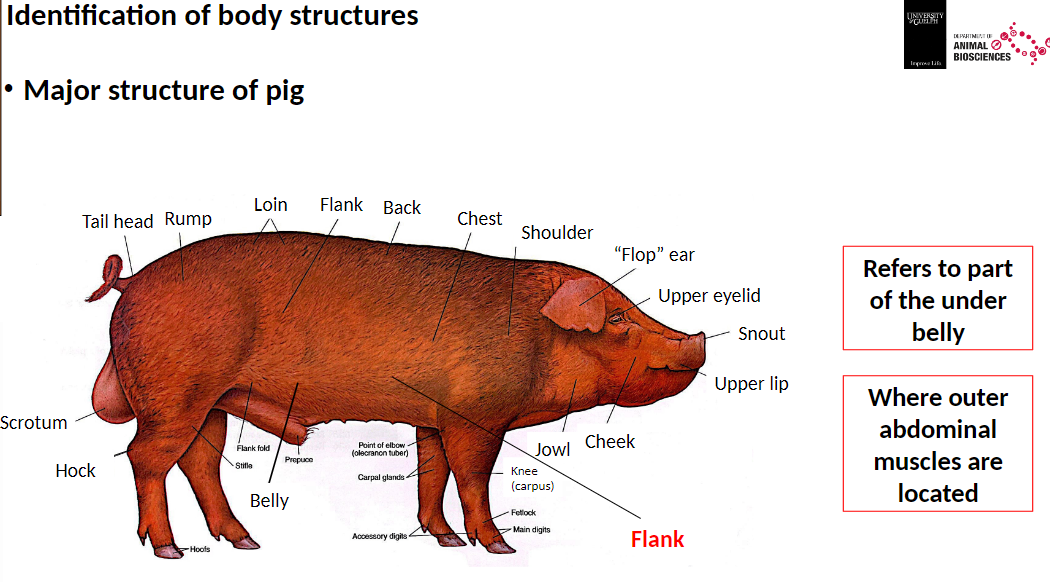
New cards

Major Pig Structures (Flank)

Flank
ā€ƒMajor structure of pig
ā€ƒRefers to part of the underbelly
ā€ƒLocation of outer abdominal muscles

<p><strong>Flank</strong><br>ā€ƒMajor structure of pig<br>ā€ƒRefers to part of the underbelly<br>ā€ƒLocation of outer abdominal muscles</p>
20
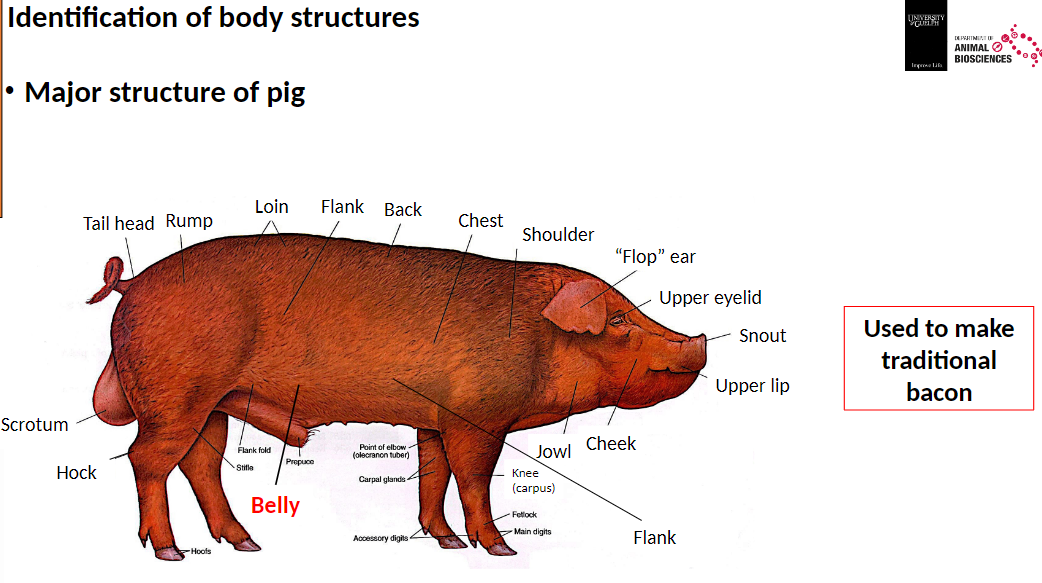
New cards

Major Pig Structures (Belly)

Belly
ā€ƒPart of the underbelly of the pig
ā€ƒUsed to make traditional bacon

<p><strong>Belly</strong><br>ā€ƒPart of the underbelly of the pig<br>ā€ƒUsed to make traditional bacon</p>
21
New cards

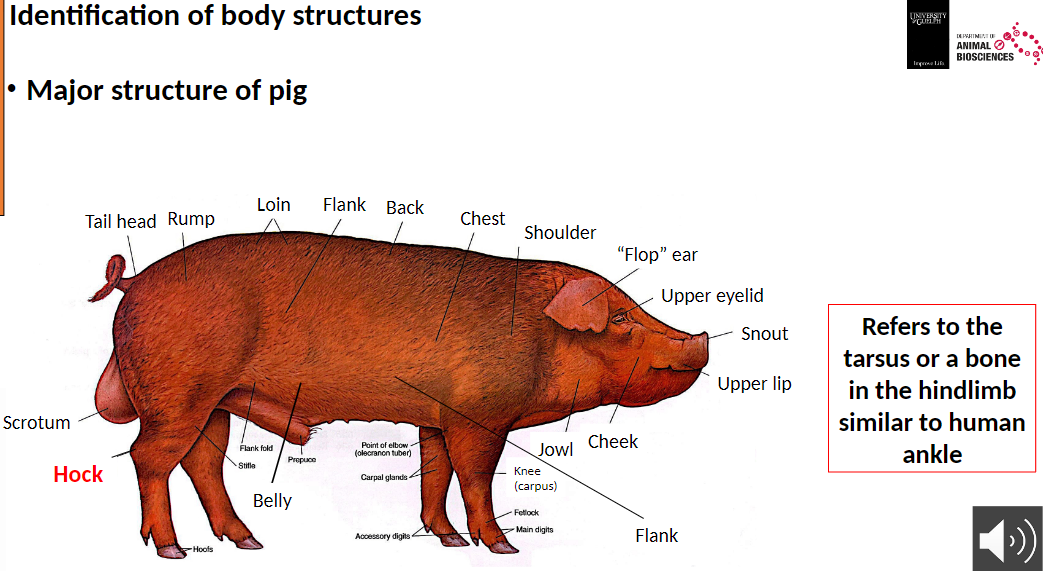
Major Pig Structures (Hock)

Hock
ā€ƒRefers to the tarsus or a bone in the hindlimb
ā€ƒEquivalent to the human ankle

<p><strong>Hock</strong><br>ā€ƒRefers to the tarsus or a bone in the hindlimb<br>ā€ƒEquivalent to the human ankle</p>
22
New cards

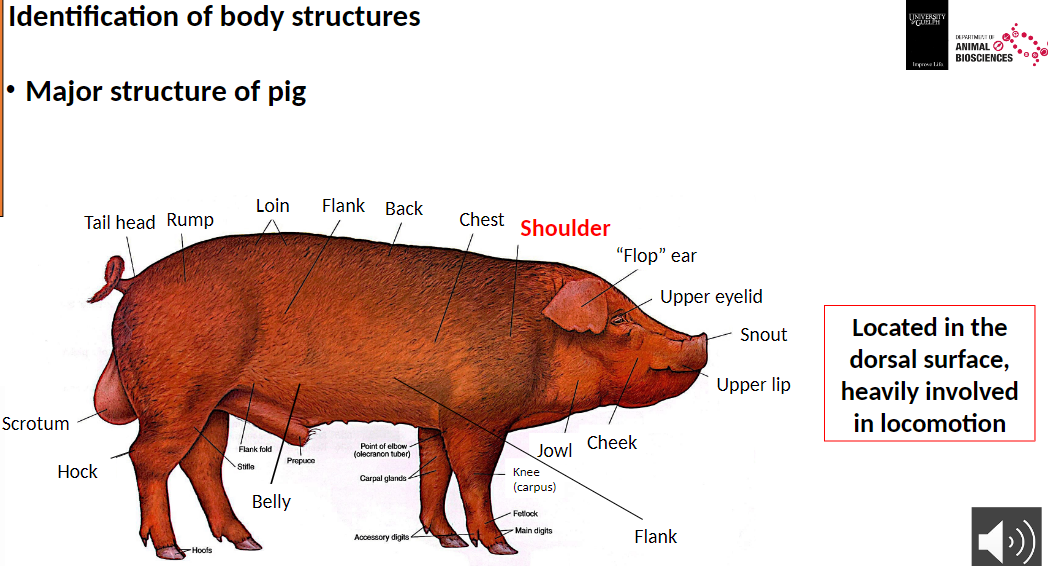
Major Pig Structures (Shoulder)

Shoulder
ā€ƒLocated on the dorsal surface
ā€ƒHeavily involved in locomotion

<p><strong>Shoulder</strong><br>ā€ƒLocated on the dorsal surface<br>ā€ƒHeavily involved in locomotion</p>
23
New cards

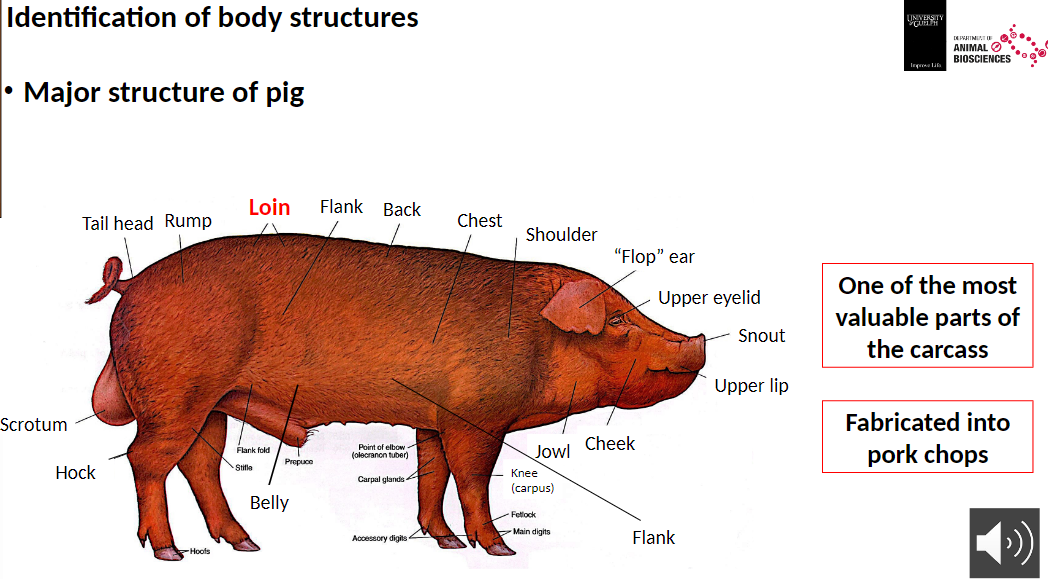
Major Pig Structures (Loin)

Loin
ā€ƒOne of the most valuable parts of the carcass
ā€ƒFabricated into pork chops

<p><strong>Loin</strong><br>ā€ƒOne of the most valuable parts of the carcass<br>ā€ƒFabricated into pork chops</p>
24
New cards

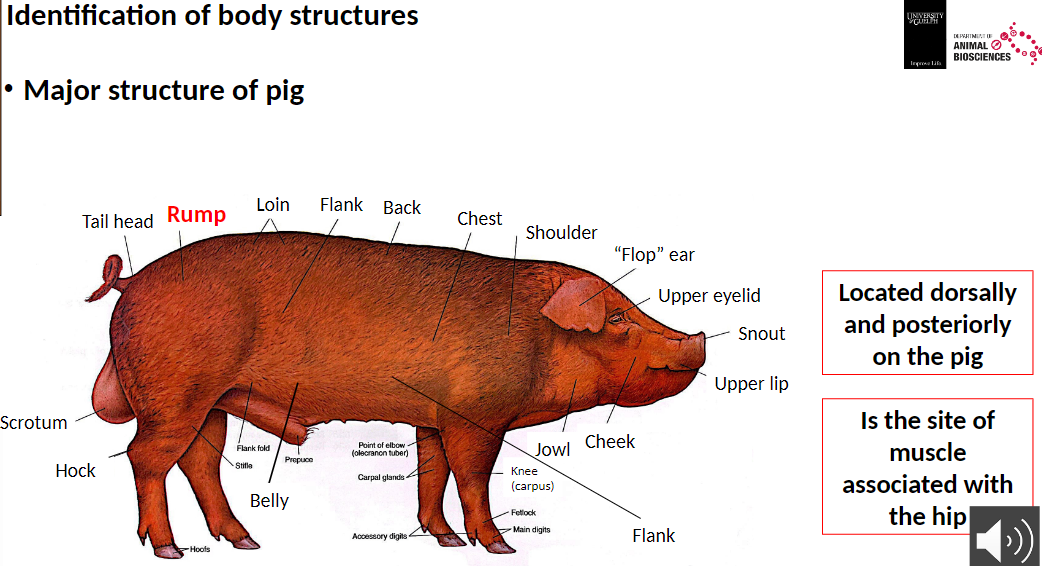
Major Pig Structures (Rump)

Rump
ā€ƒLocated dorsally and posteriorly on the pig
ā€ƒSite of muscle associated with the hip

<p><strong>Rump</strong><br>ā€ƒLocated dorsally and posteriorly on the pig<br>ā€ƒSite of muscle associated with the hip</p>
25
New cards

Identification of Body Structures – Pig

Major Structures & Carcass Cuts
ā€ƒBack fat
ā€ƒLoin (Clear plate)
ā€ƒPork shoulder / Boston butt
ā€ƒPork belly
ā€ƒHam hocks
ā€ƒHam

Note
ā€ƒThese represent several common carcass cuts of the hog
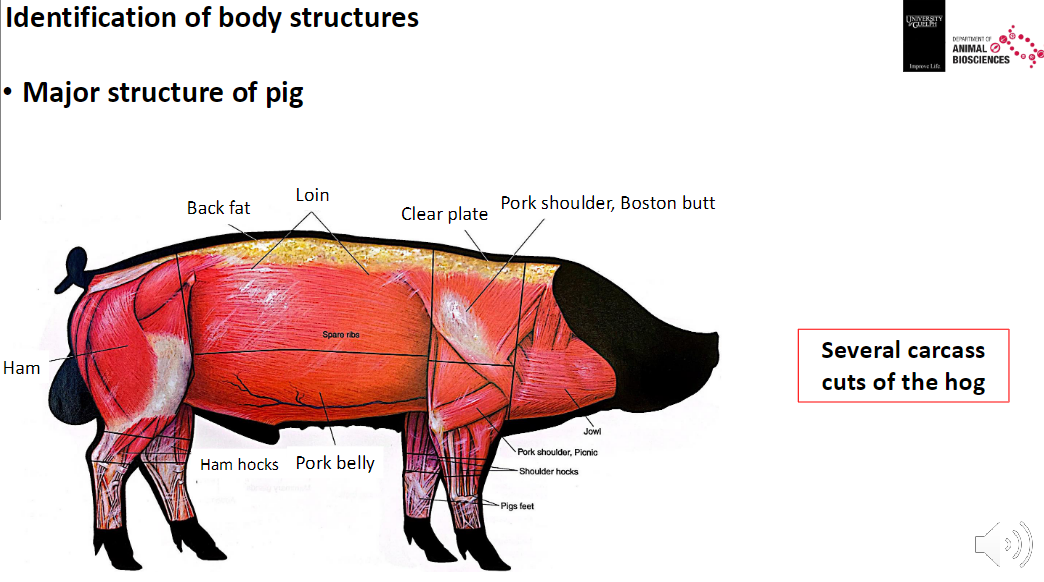
<p><strong>Major Structures &amp; Carcass Cuts</strong><br>ā€ƒBack fat<br>ā€ƒLoin (Clear plate)<br>ā€ƒPork shoulder / Boston butt<br>ā€ƒPork belly<br>ā€ƒHam hocks<br>ā€ƒHam</p><p><strong>Note</strong><br>ā€ƒThese represent <strong>several common carcass cuts</strong> of the hog</p>