tRNA ACtivation
 Call Kai
 Learn
Learn Practice Test
 Spaced Repetition
 Match
Match Flashcards
 Knowt Play
1/15

There's no tags or description
Looks like no tags are added yet.
Name | Mastery | Learn | Test | Matching | Spaced | Call with Kai |
|---|
No analytics yet
Send a link to your students to track their progress
16 Terms
What is the first major step of translation?
A.a activation
What is the end product of tRNA activation?
Formation of aminoacyl-tRNA
Formation of aminoacyl-tRNA
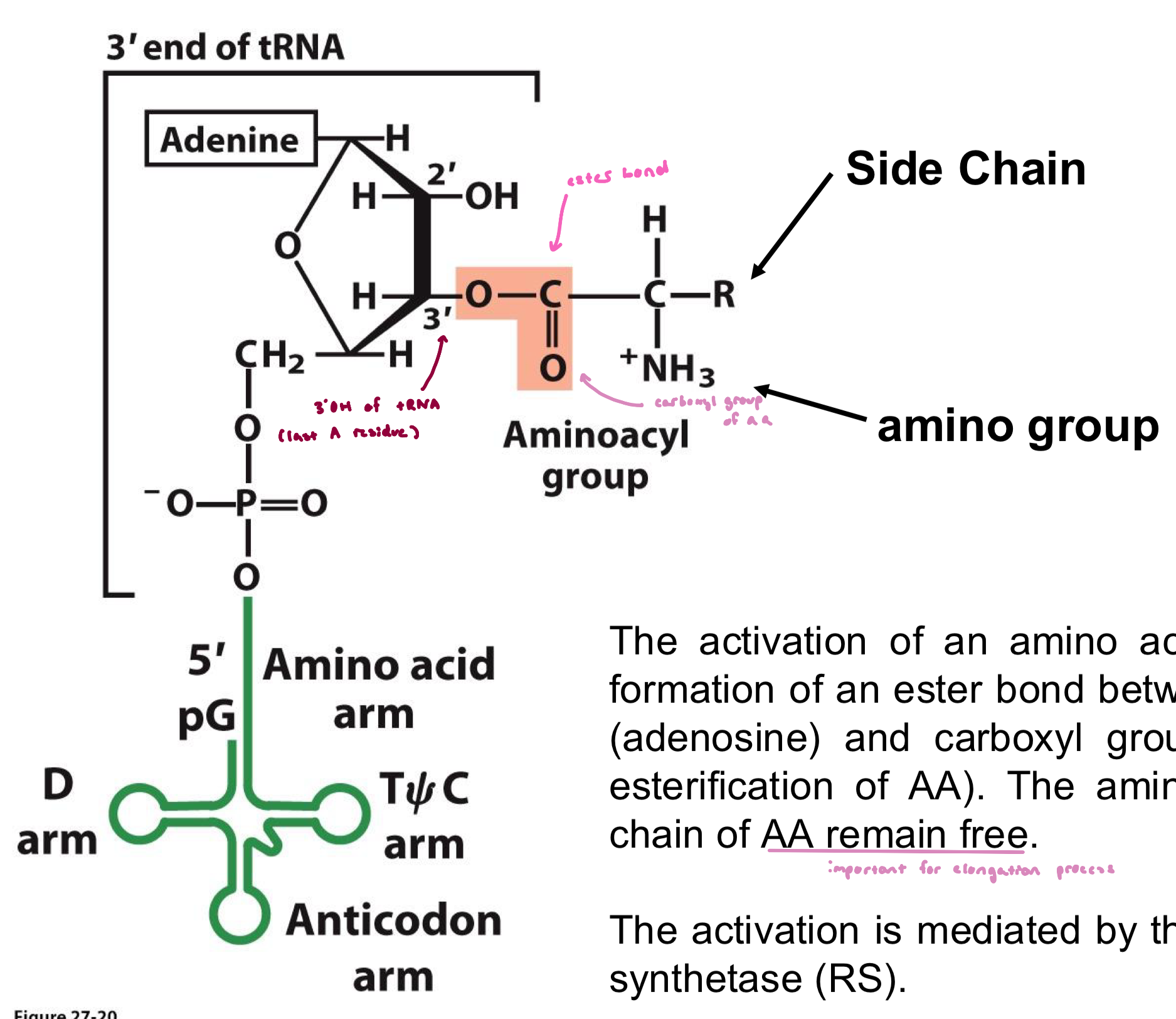
the activation of an a.a ocnsists of the formation of an ester bond b/w 3’OH of tRNA (adenosine) and carboxyl group of the AA
i.e esterificaiton of AA
the amino group and side chain remain free (important for elongation process)
the activation is mediated by the aminoacyl tRNA synthetase (RS)
Aminoacyl-tRNA Synthetase
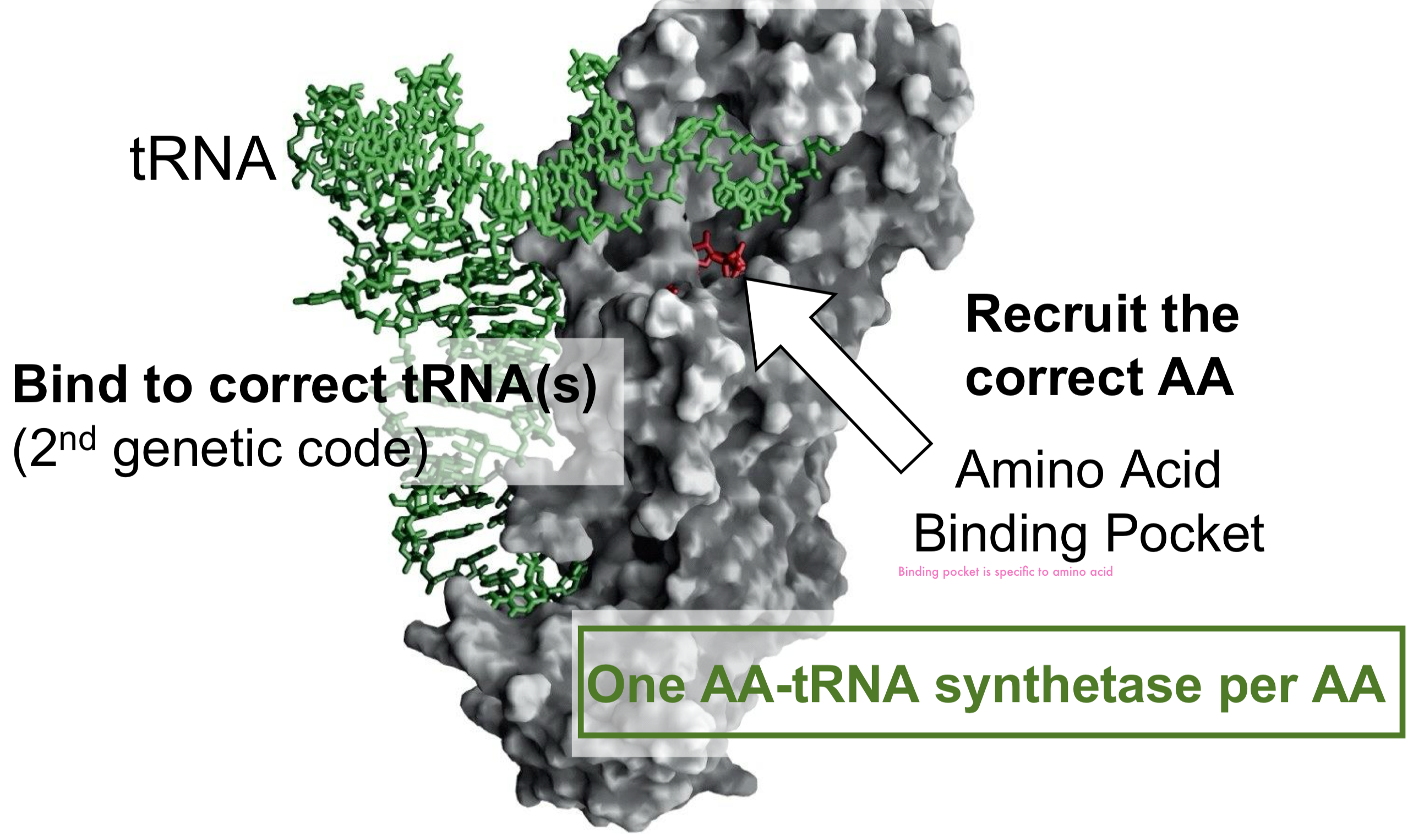
for a given AA, there will be one aminoacyl-tRNA synthetase (RS) that activates one or several isoacceptor tRNAs
20 RS
the synthetase recruits the AA in a binding pocket to bring it near the 3’OH of tRNA
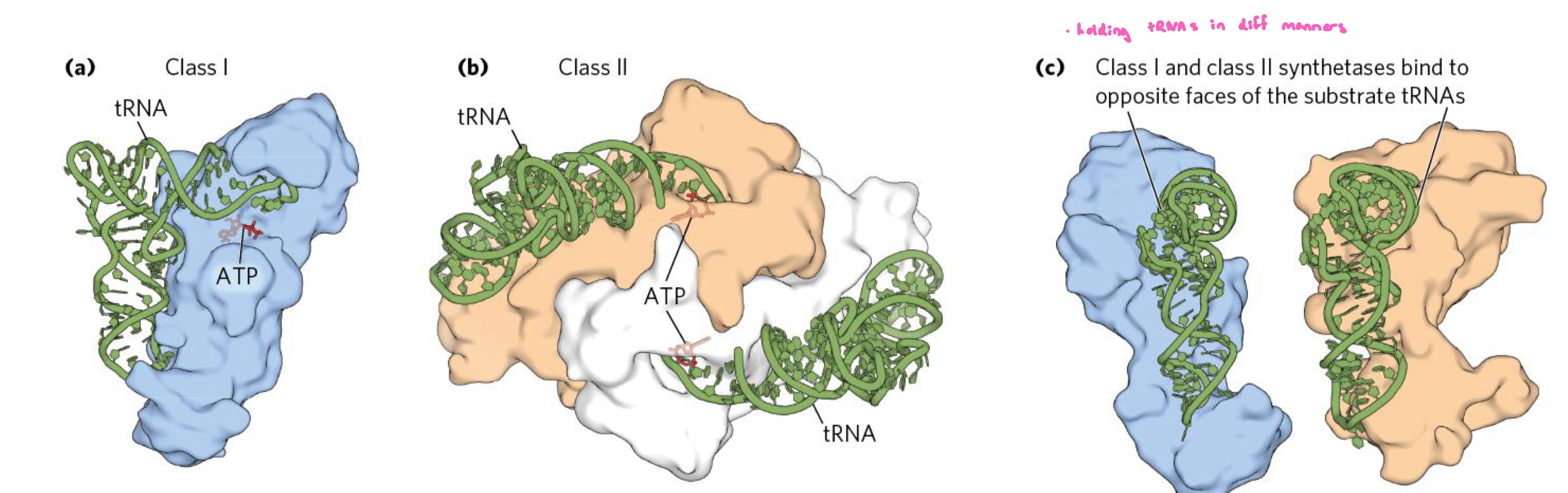
there are 2 stucturally unrelated classes of aminoacyl-tRNA synthetases
Class II enyzymes typically form homodimers
they hold tRNAs in diff manners
Aminoacyl-tRNA Synthetase Mech to Activate AA’s
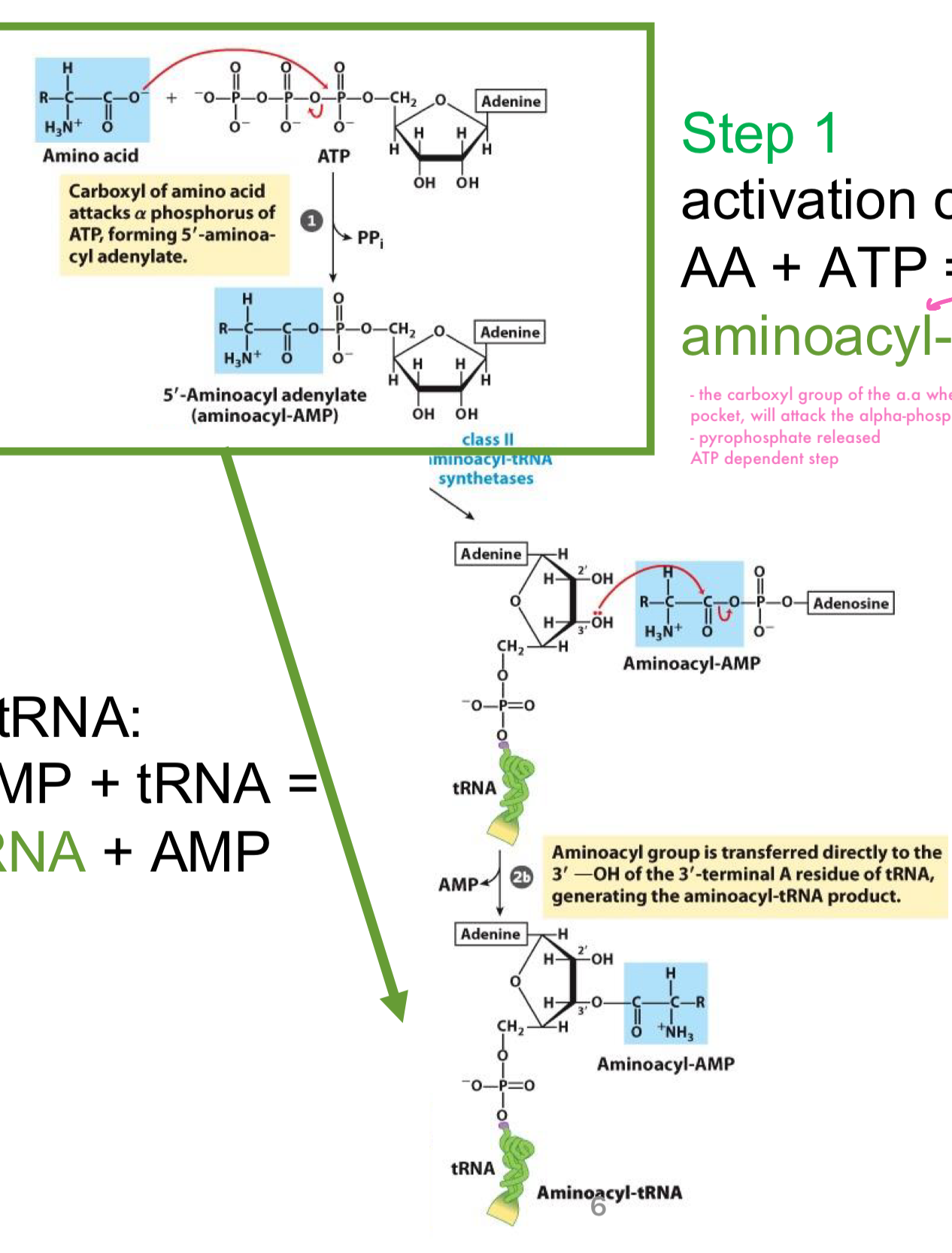
the aminoacyl tRNA synthetase mediates a 2-step ATP-dependent process
1) Activation of AA: AA + ATP = aminoacyl-AMP (not yet activated) + PPi
the carboxyl group of the AA, when position correctly in the binding pocket, will attack the ⍺-phosphorus of ATP → to create aminoacyl-AMP
2) activation of tRNA: aminoacyl-AMP + tRNA = aminoacyl-tRNA + AMP
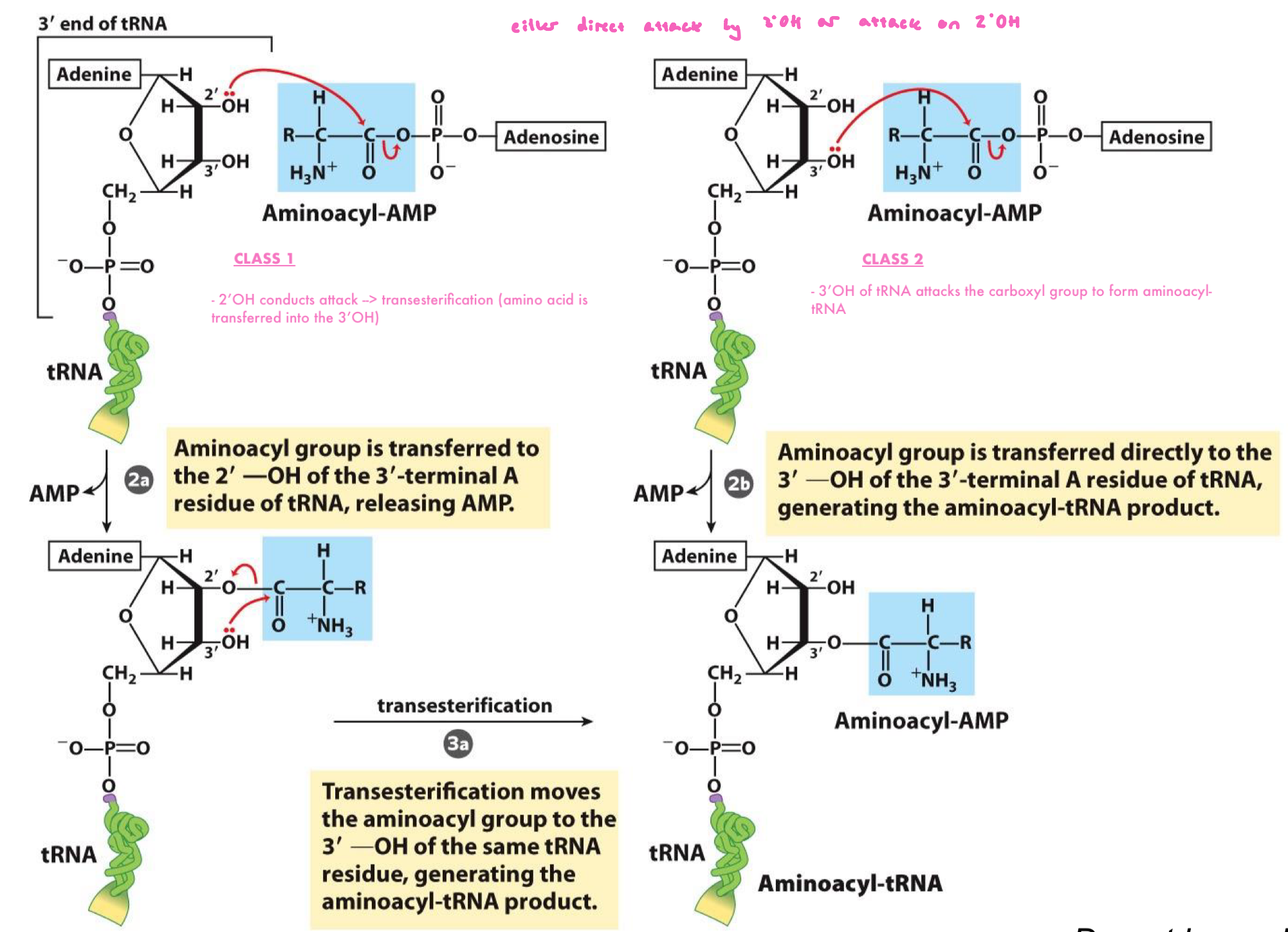
Aminoacyl-tRNA Synthetase Mech to Activate AA’s FIGURE
Differences in the mechs of aminoacyl tRNA synthetase classes
Class II directly transfers the AA on the 3’OH of the tRNA in step 2B
right of the figure
Class I relies on an additional transesterification (Steps 2a and 3a)
left of the figure
2’OH conducts attack → transesterification (AAA is transferred into the 3’OH)
Specificity Challenge of the Genetic Code
the genetic code defines which AA is added for each codon
b/c the code is degenerate, multiple codons encode the same AA
however, maintaining 61 distinct tRNAs and 61 aminoacyl-tRNA synthetases would be energetically costly for the cell
enzymes can recognize more than one codon and add the same AA to the tRNA molecule
one tRNA can recognize more than one codon
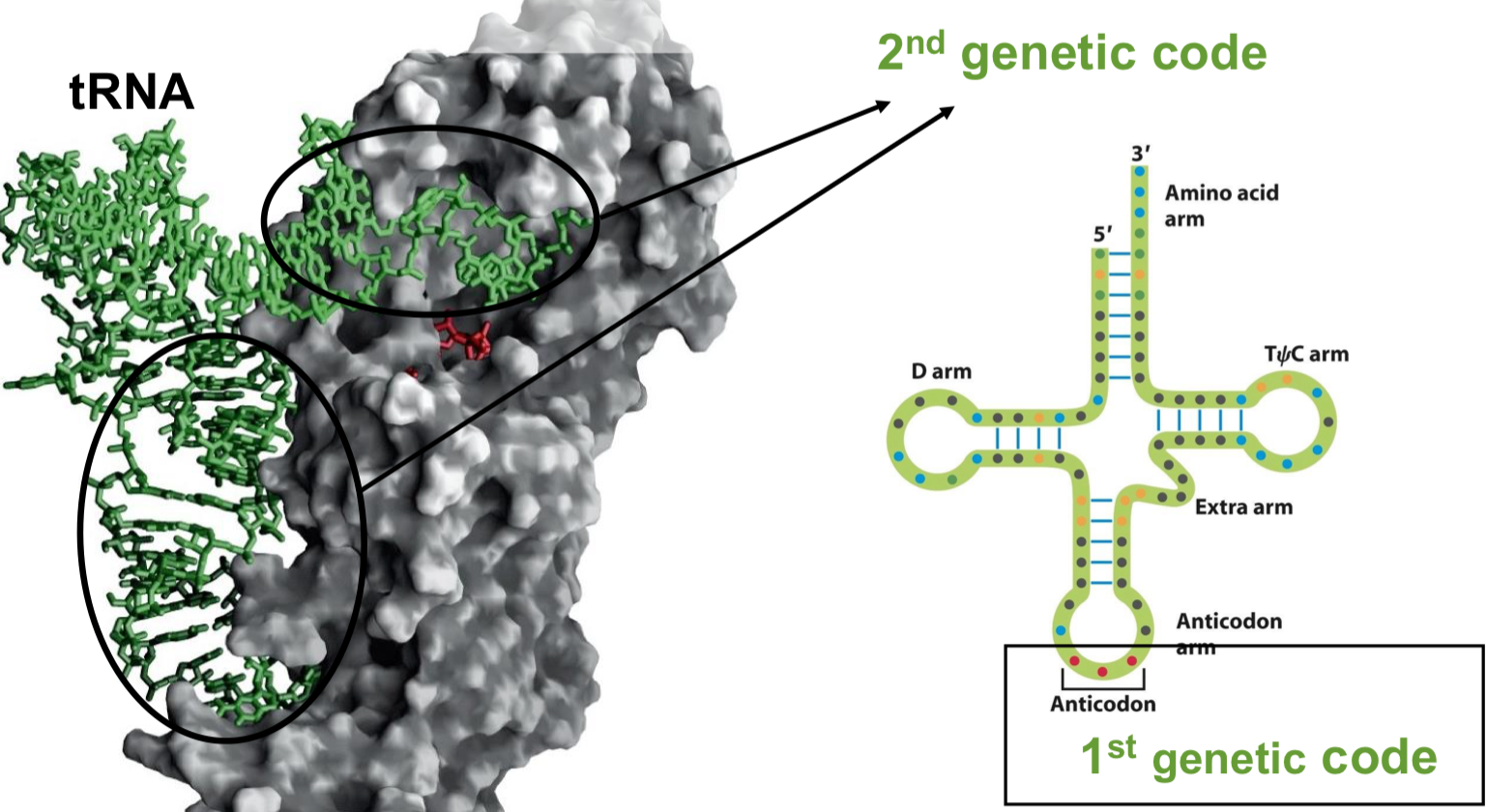
The Second Genetic Code
the synthetase binds to multiple nucleotides (1-10) on the tRNA but not necessarily via the tRNA anti-codon
i.e it recognizes multiple positions on the tRNA, which are scattered across the tRNA structure
the binding to these tRNA nucleotides is referred to as the 2nd genetic code
determines which tRNA will be recruited to a given synthetase, and thereby which AA will be added to that tRNA
“First” vs Second Genetic Code
First genetic code: codon matched with amino acid (during translation)
Second genetic code: tRNA matched with amino acid (during tRNA charging)
the 2nd code happens before translation begins
the 2nd genetic code isn’t defined by a simpel table and consists of several residues on the tRNA that mediates their recognition by the aminoacyl-tRNA synthetase
it is distinct from codon/anti-codon interaction
Specificity of aminoacyl-tRNA synthetase
the enzyme places the tRNA in a way so that the 3’OH is located near the AA binding pocket (this is where the AA need to be transferred to get activated tRNA)
Proofreading in tRNA activation: Challenge
for some AA, creating a specific binding pocket is relatively straightforward, such as for proline, which has a distinct and characteristic structure
more challenging for valine vs isoleucine
AA’s are relatively small molecules
if 2 AA are similar, we might activate the incorrect AA’s
must ensure high specificity so that the correct AA is added by the RSs
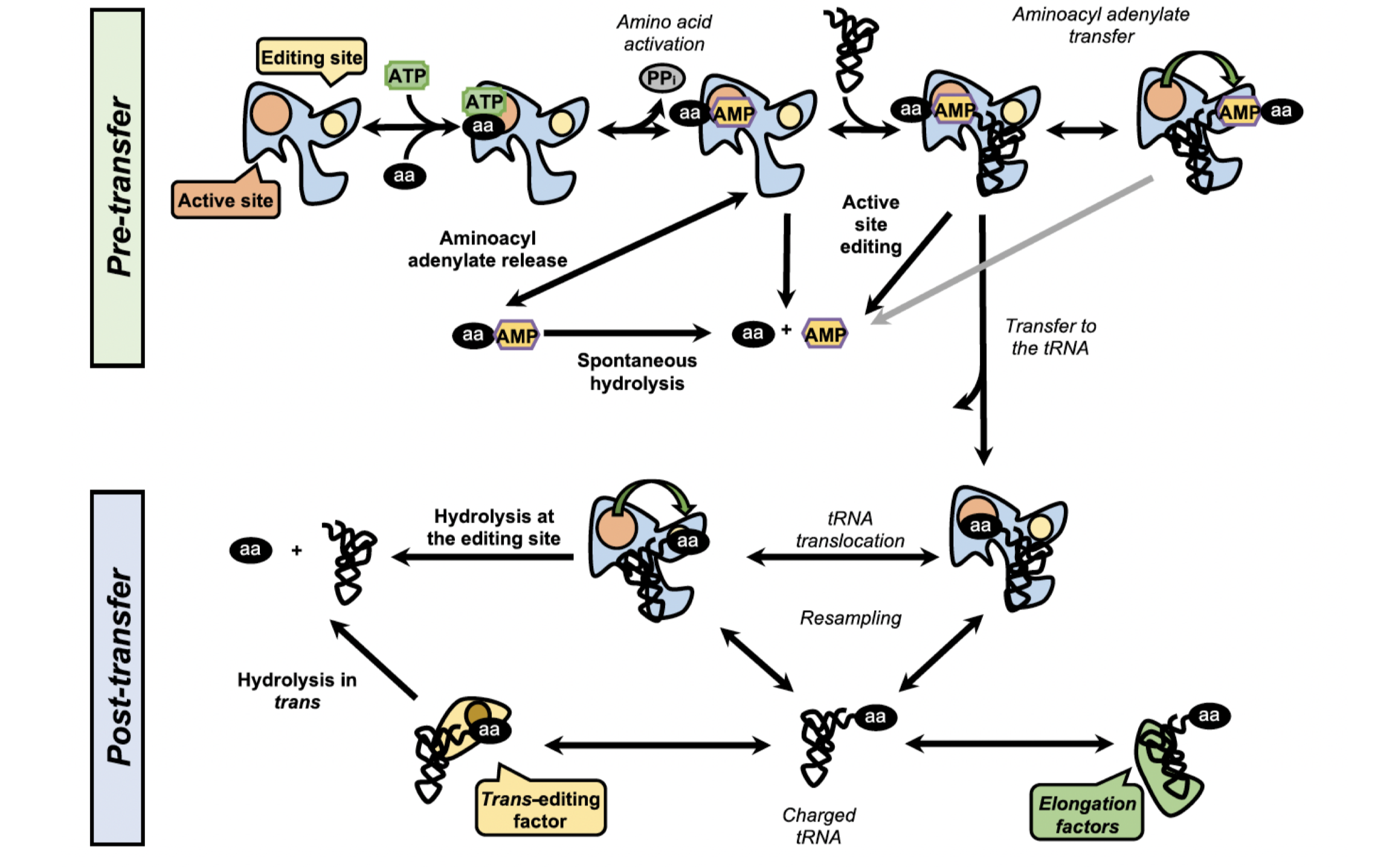
multiple proofreading mechanisms have evolved that occur at diff steps (pre tRNA transfer or post-tRNA transfer)
Proofreading in tRNA activation: Isoleucyl-tRNA synthetase Solution
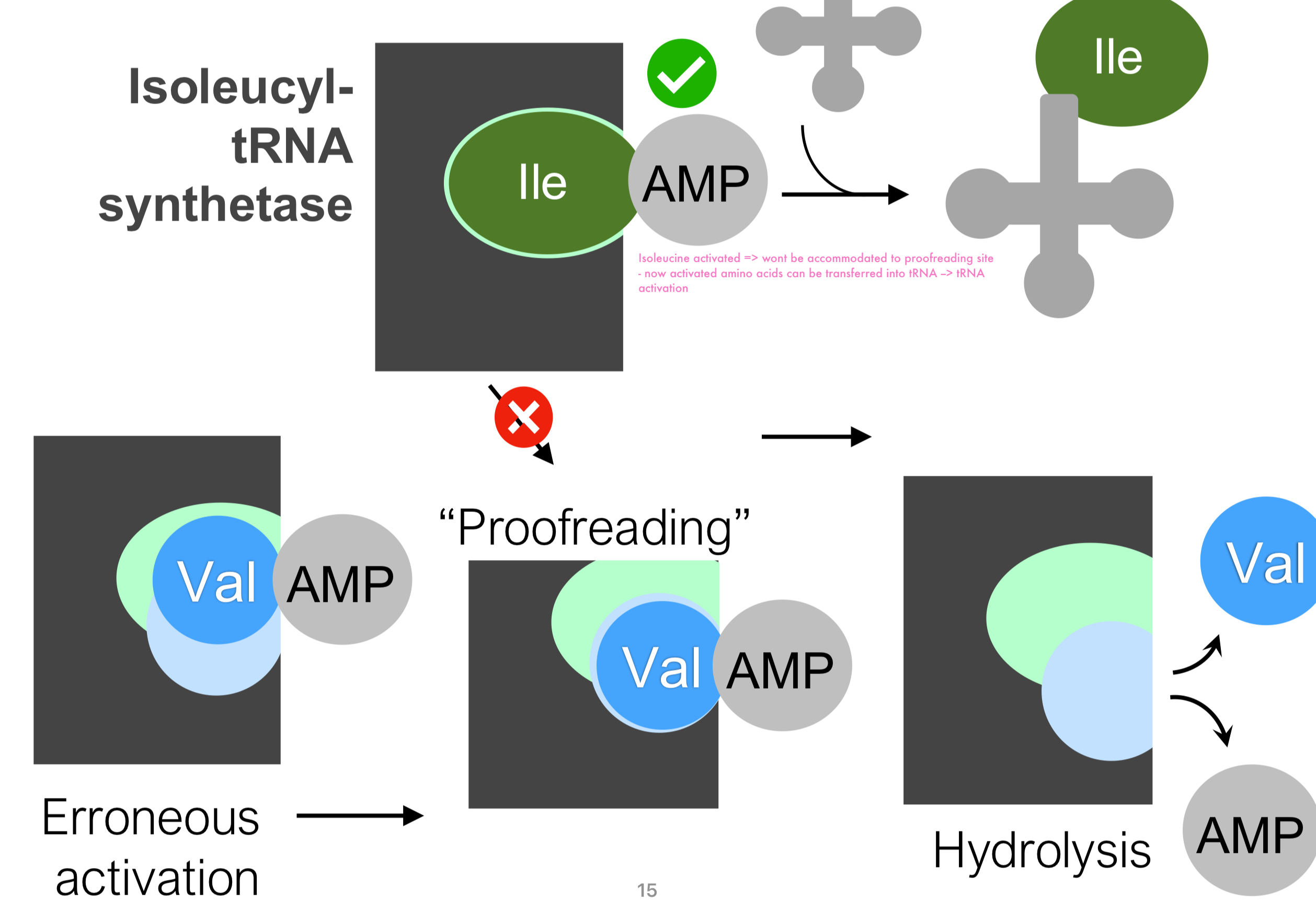
isoleucyl-tRNA synthetase possess two distinct activities
its active site has a high affinity for Ile and a weak affinity for Val, no affinity for Pro
the second activity, hydrolysis site exhibits a high affinity Val and low affinity for Ile
consequenctly, if Val is incorrectly activated, it will be rapidly hydrolyzed to prevent errors in tRNA charging
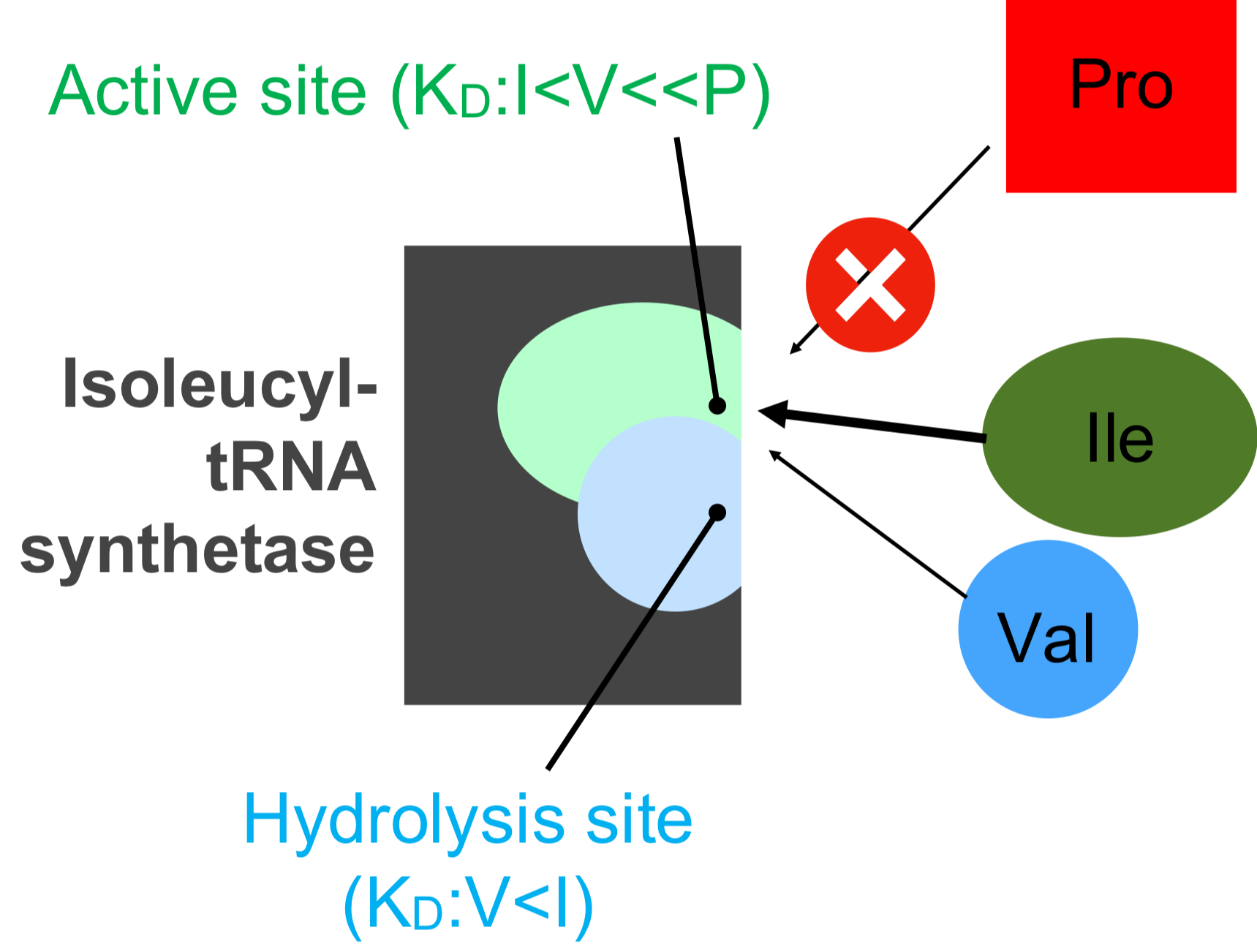
Proofreading in tRNA activation: Isoleucyl-tRNA synthetase Solution FIGURE