8.2 Transfer of Genetic information
 Call Kai
 Learn
Learn Practice Test
 Spaced Repetition
 Match
Match Flashcards
 Knowt Play
1/42

There's no tags or description
Looks like no tags are added yet.
Name | Mastery | Learn | Test | Matching | Spaced | Call with Kai |
|---|
No analytics yet
Send a link to your students to track their progress
43 Terms
What is the difference between parental and recombinant types in a dihybrid cross? (2)
- Parental types are the offspring that show the original combinations of characteristics seen in the pure-breeding parent generation.
- Recombinant types are the offspring that show new combinations of characteristics that were not present in the parent generation.
What is Mendel's Law of Independent Assortment? (3)
- The alleles of genes at different loci segregate independently of one another during the formation of gametes.
- Consequently, a double heterozygote will produce four different types of gametes in equal proportions.
- This law is only applicable to the alleles of genes that are located on non-homologous chromosomes.
What is epistasis? (2)
- Epistasis is a form of gene interaction where alleles at two different loci affect the same phenotypic character.
- It occurs when an allele of one gene suppresses or masks the action of the alleles of another gene.
How is coat colour in Labradors an example of recessive epistasis? (3)
- The dominant B allele produces a black coat, while the homozygous recessive bb genotype produces a brown coat.
- These genes for coat colour can only be expressed if the dominant E allele is present at a second locus.
- If a Labrador is homozygous for the recessive e allele (ee), it cannot develop either the black or brown coat colour and will be yellow.
What modified dihybrid ratio suggests recessive epistasis has occurred? (1)
A 9:3:4 phenotypic ratio suggests that recessive epistasis has occurred.
What is autosomal linkage? (2)
- Autosomal linkage occurs when two or more genes are located on the same chromosome.
- Due to their physical proximity, these genes have a tendency to be inherited together.
How does autosomal linkage affect the proportion of gametes produced? (2)
- While crossing over can produce recombinant gametes, they will represent a smaller proportion of the total.
- Consequently, gametes with the parental combinations of alleles will be produced in a much larger proportion.
What are the expected outcomes of a test cross for unlinked genes? (2)
- If the genes are unlinked, it is expected that there will be equal proportions of the four types of gametes produced by the heterozygote.
- This would result in approximately equal numbers of each of the four possible phenotypes in the offspring.
What are the expected outcomes of a test cross for linked genes? (2)
- If the genes are linked, the alleles are expected to remain in their parental arrangements.
- This results in a greater frequency of offspring with the parental genotypes and a lower frequency of offspring with recombinant genotypes.
What is the relationship between the distance separating two linked loci and the recombination frequency? (2)
- The frequency of recombinant gametes is a measure of the amount of crossing over that occurs between two genes.
- The greater the frequency of recombinant gametes, the further apart the particular loci are on the chromosome.
How does the gametic ratio differ for linked versus unlinked genes? (2)
- For two unlinked genes, the typical gametic ratio is 1:1:1:1, with all four gamete types produced in equal proportions.
- For two linked genes, this ratio is not obtained, as the parental gamete types will be produced more frequently than the recombinant types.
What is the difference between a dominant and a recessive character? (2)
- A dominant character is the characteristic that is expressed in the heterozygous F1 generation when two pure breeding lines are crossed.
- A recessive character is the characteristic that is obscured in the F1 generation and only reappears in the F2 generation.
What is a digenic cross? (3)
- A digenic, or dihybrid, cross considers the inheritance of the alleles of genes located at different loci.
- It involves the inheritance of two non-interacting, unlinked genes.
- This means the genes are located on different chromosomes and are responsible for expressing two particular characters.
What are the outcomes of a dihybrid cross in the first filial (F1) generation? (2)
- The first filial (F1) generation will consist entirely of double heterozygous offspring.
- The F1 generation will express a single phenotype, which is a combination of the two dominant traits.
What are the outcomes when the F1 generation of a dihybrid cross self-fertilises? (2)
- When the F1 generation self-fertilises, the gametes are produced in a 1:1:1:1 ratio of all possible combinations.
- This results in a characteristic 9:3:3:1 phenotypic ratio in the second filial (F2) generation.
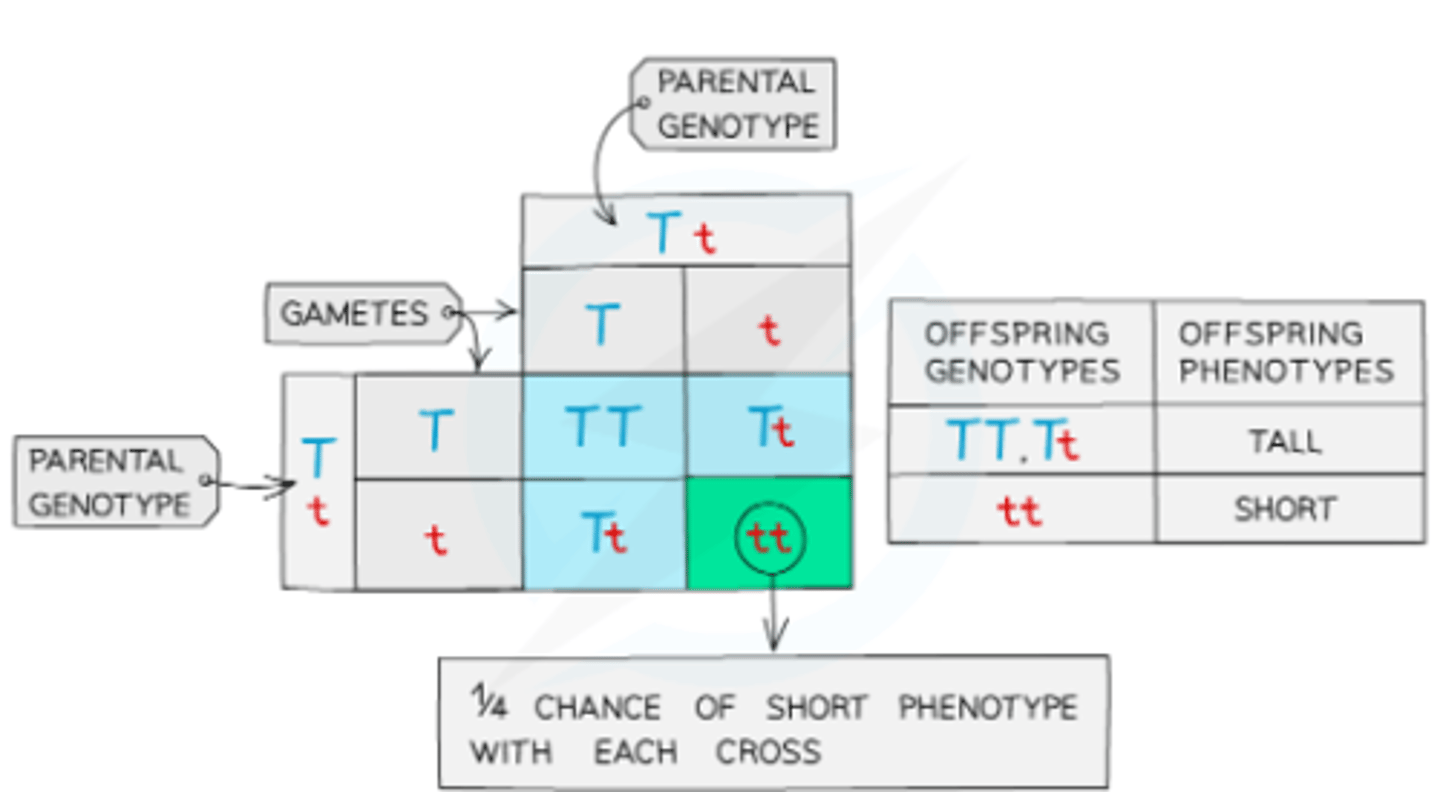
How would you draw a genetic diagram to show the results of crossing two heterozygous parents? (4)
- Parental genotypes: Tt x Tt.
- Parental phenotypes: Tall x Tall.
- Offspring genotypes: TT, Tt, and tt in a 1:2:1 ratio.
- Offspring phenotypes: Tall and Short in a 3:1 ratio.
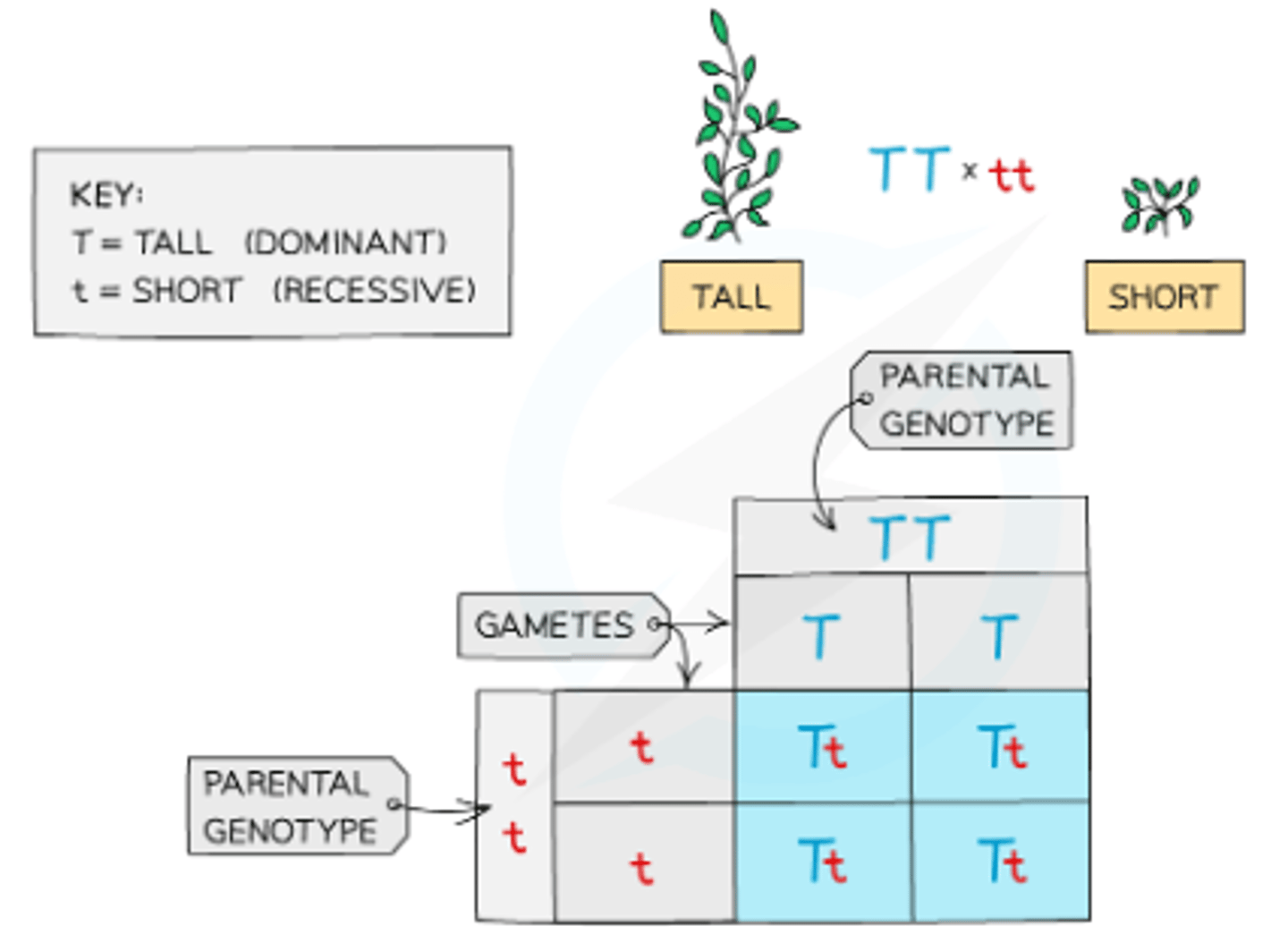
How would you draw a genetic diagram to show the results of crossing a pure-breeding tall plant with a pure-breeding short plant? (3)
- The parental genotypes are TT (homozygous dominant) and tt (homozygous recessive).
- The gametes from the tall parent all contain the T allele, and the gametes from the short parent all contain the t allele.
- All offspring will have the genotype Tt and will have the tall phenotype.
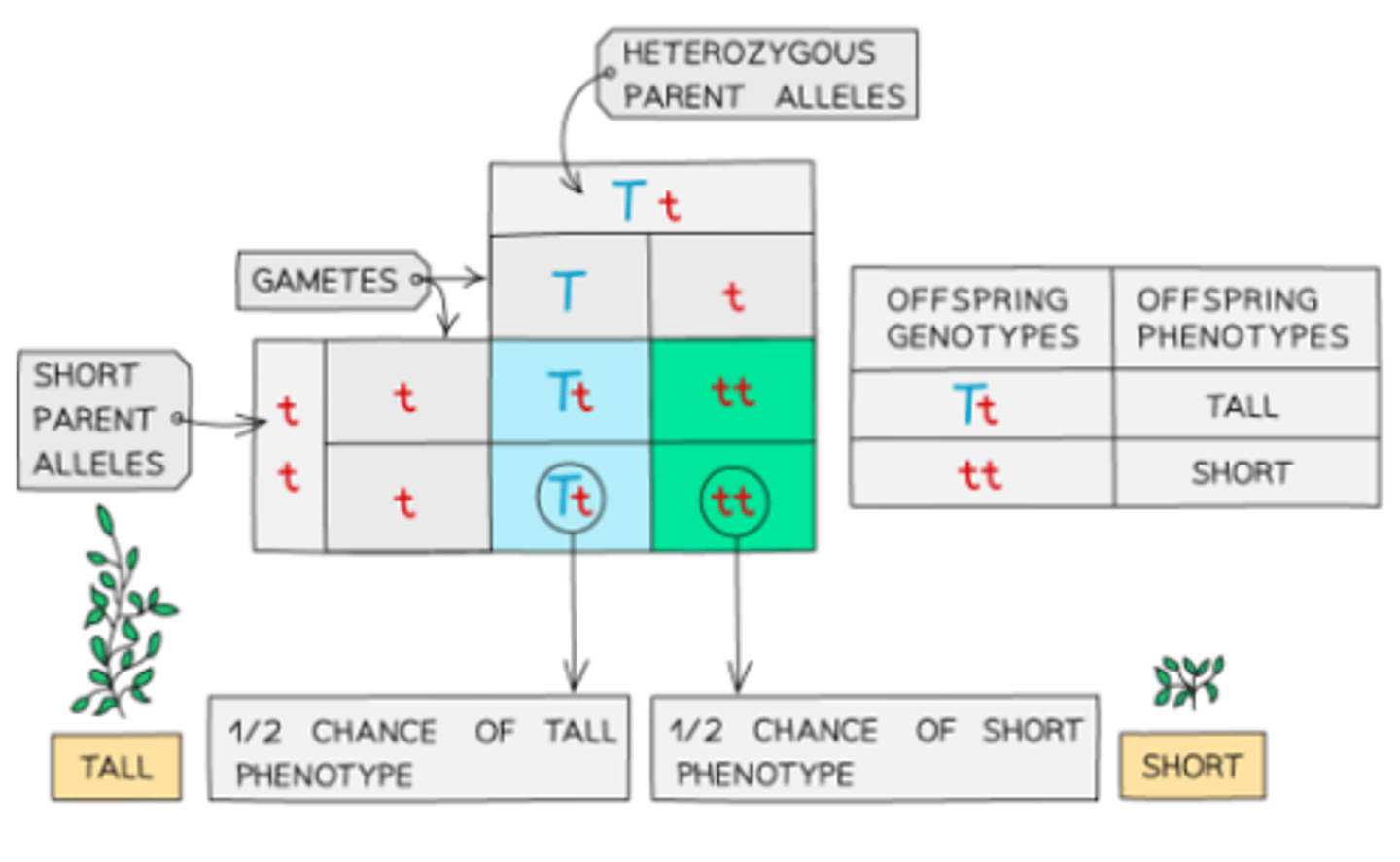
How would you draw a genetic diagram to show the results of crossing a heterozygous plant with a short plant? (4)
- The parental genotypes are Tt and tt.
- The possible offspring genotypes are Tt and tt.
- The ratio of phenotypes is 1 tall : 1 short.
- This means there is a 1 in 2 chance of producing a tall offspring.
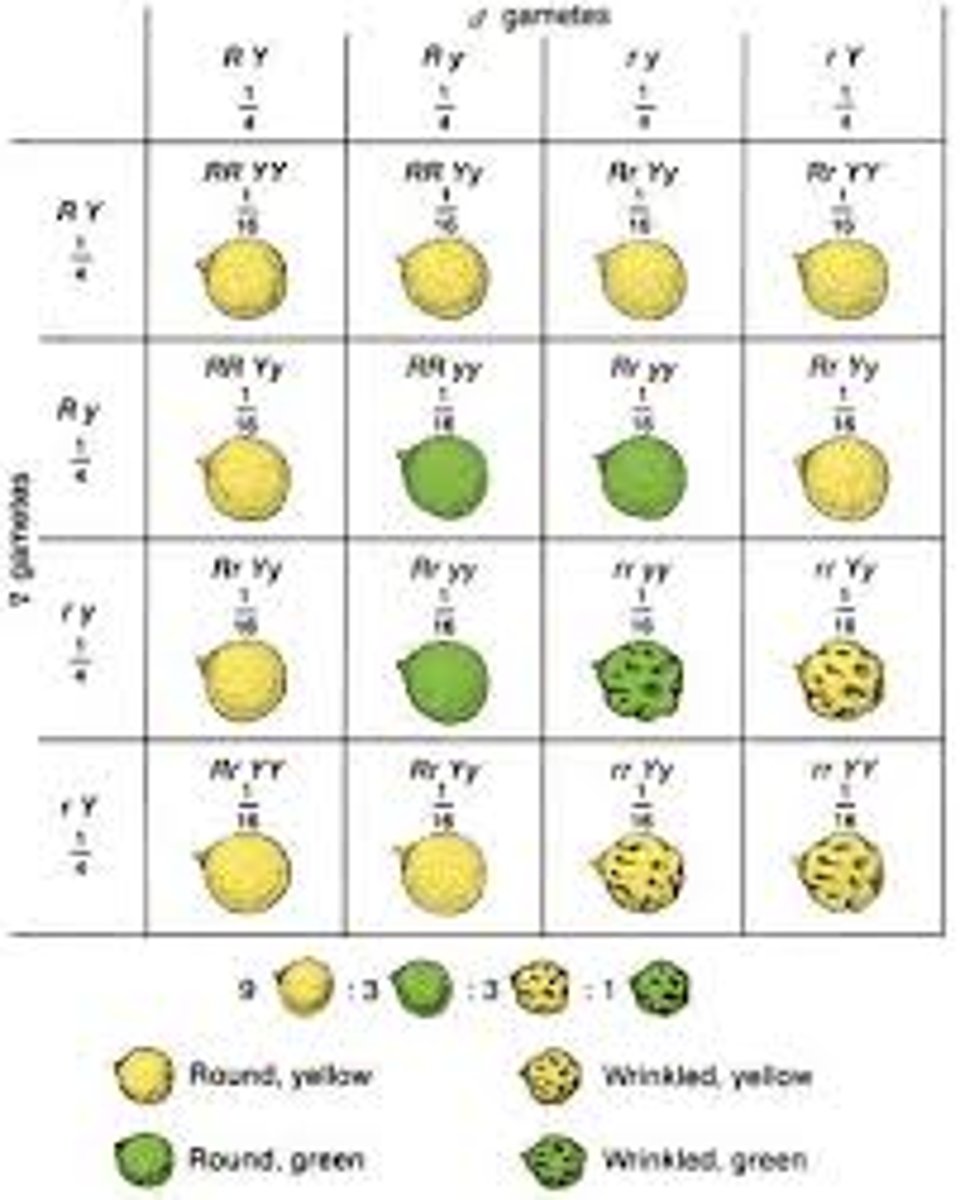
Why is the 9:3:3:1 phenotypic ratio the expected outcome in a dihybrid cross? (4 marks)
- 9 parts of the offspring exhibit both dominant traits.
- 3 parts exhibit one dominant and one recessive trait.
- 3 parts exhibit the other dominant and the other recessive trait.
- 1 part exhibits both recessive traits.
How would you describe the F1 generation produced when a homozygous long-winged, grey-bodied Drosophila is crossed with a vestigial-winged, black-bodied Drosophila? (3)
- The genes for body colour (grey/black) and wing length (long/vestigial) are located on the same chromosomes.
- The parental cross is between a homozygous dominant fly (b+ b+ vg+ vg+) and a homozygous recessive fly (b b vg vg).
- All the offspring in the first filial (F1) generation will be double heterozygotes with the genotype b+b vg+vg.
How would you explain the results observed in the F2 generation when the heterozygous F1 Drosophila are interbred? (4)
- The expected 9:3:3:1 phenotypic ratio for a dihybrid cross is not obtained.
- A greater proportion of offspring with the parental phenotypes (long grey and vestigial black) is observed than expected.
- A smaller proportion of offspring with the recombinant phenotypes (long black and vestigial grey) is observed than expected.
- This outcome occurs because the linked genes do not assort independently, leading to an unequal production of the four possible gamete types.
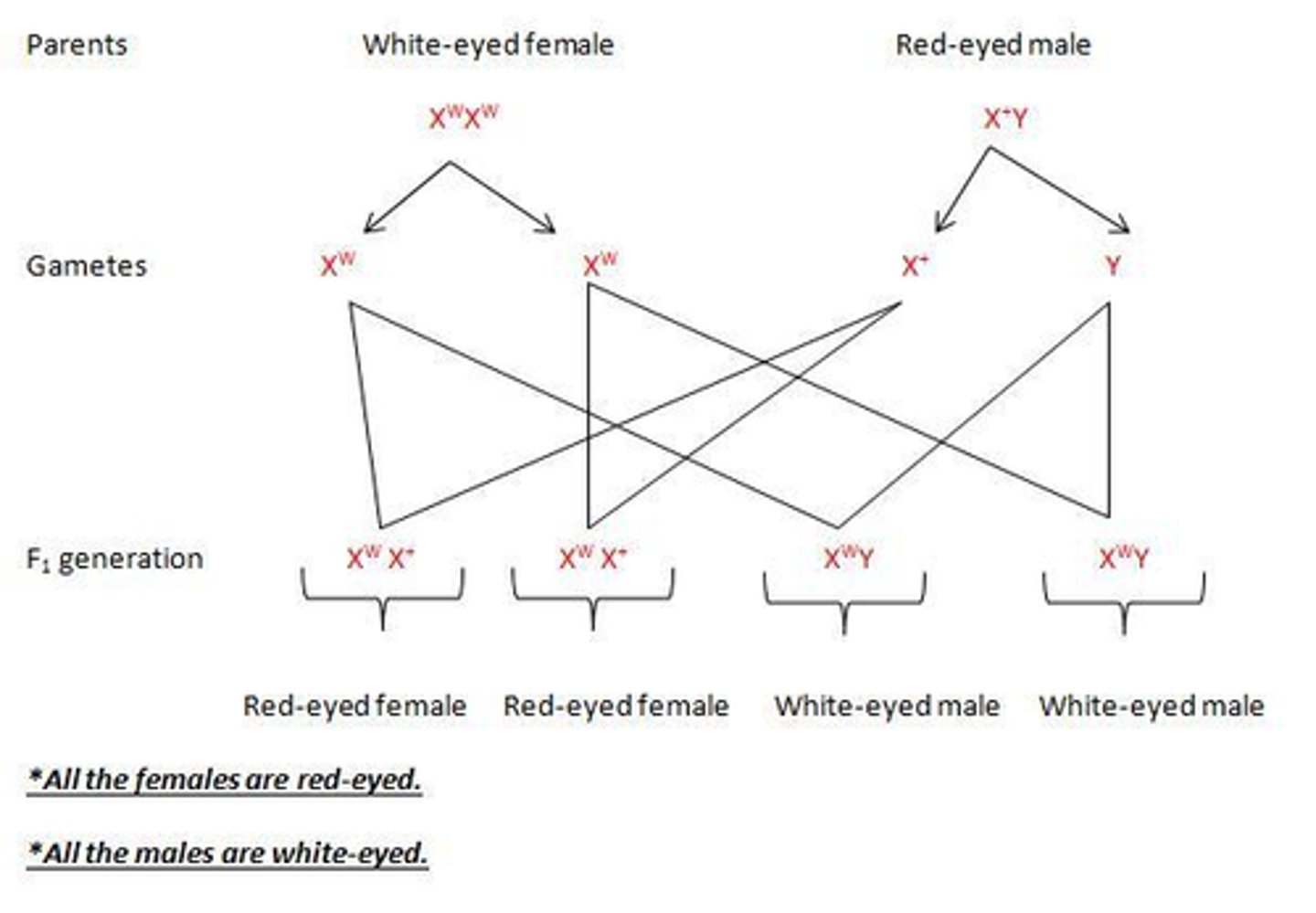
How would you describe the results of a reciprocal cross for eye colour in Drosophila that provides evidence for sex-linkage? (4)
- When a homozygous red-eyed female is crossed with a white-eyed male, all of the offspring have red eyes.
- However, in the reciprocal cross where a white-eyed female is crossed with a red-eyed male, a 1:1 phenotypic ratio is established.
- In this second cross, all female offspring have red eyes, while all male offspring have white eyes.
- The presence of these reciprocal differences in the results is a key indicator of a sex-linked trait.
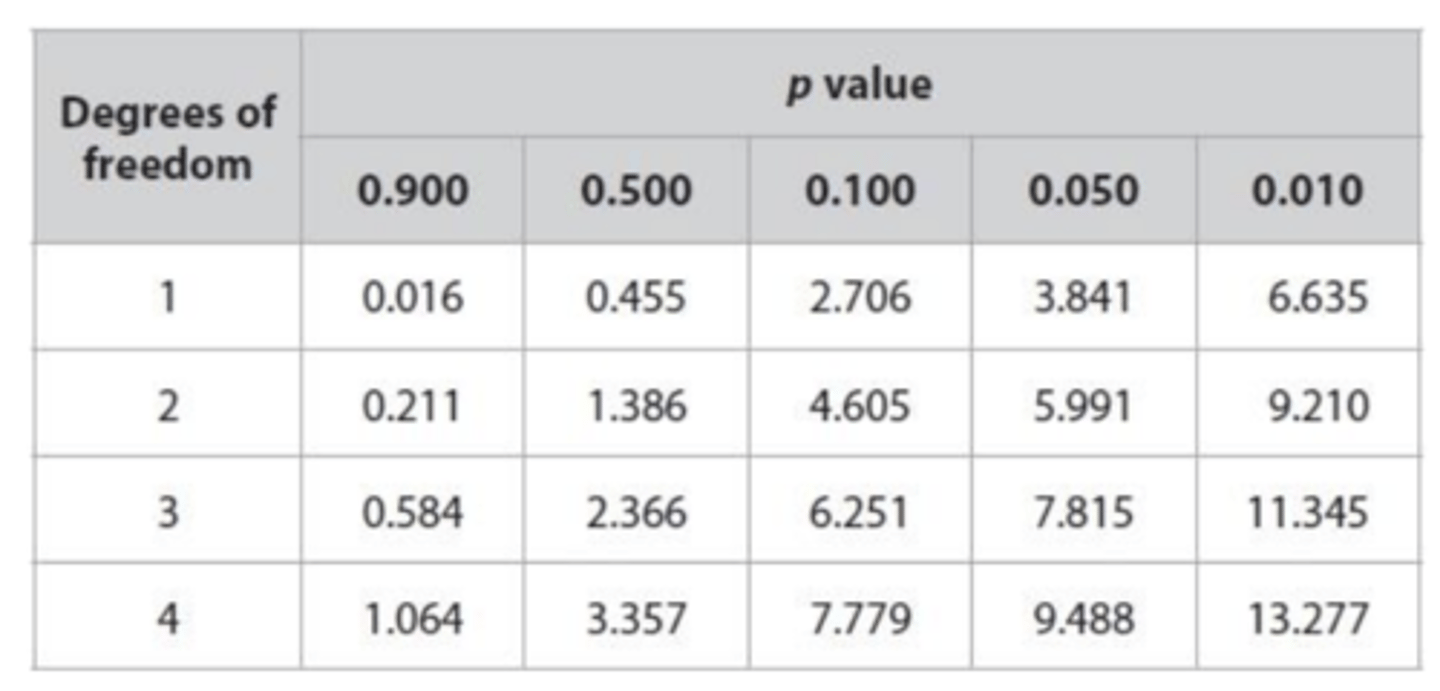
How is the chi-squared test used to analyse gene linkage? (3)
- A chi-squared test is conducted to determine if there is a significant difference between the expected and observed phenotypic frequencies.
- If the calculated chi-squared value is larger than the critical value, the difference is considered statistically significant.
- A significant result suggests the deviation from the expected ratio is not due to chance, implying another factor like gene linkage is involved.
What are sex-linked genes, and how do the X and Y chromosomes compare? (3)
- Genes that are associated with the sex chromosomes are considered to be sex-linked.
- The Y chromosome is often genetically inert and carries an insignificant number of functional genes.
- The X chromosome is significantly larger and carries a plethora of pertinent functional genes.
What is the difference between the homogametic and heterogametic sex in humans? (2)
- Females are the homogametic sex, as they are homozygous for the X chromosome (XX).
- Males are the heterogametic sex, as they carry one X chromosome and one Y chromosome (XY).
Why are recessive alleles on the X chromosome expressed differently in males and females? (2)
- A recessive allele on the X chromosome will only be expressed in the phenotype of a female if she is homozygous for that trait.
- However, the same allele will always be expressed in a male because there is no corresponding allele on the Y chromosome to mask its effect.
What is haemophilia? (3)
- Haemophilia is an example of a recessive, sex-linked genetic disorder.
- The allele responsible for the condition is present on the X chromosome.
- The condition's anticoagulation characteristics are due to an absence of clotting factor VIII.
How is haemophilia inherited in males and females? (3)
- For the phenotype to be expressed in a male, only one copy of the recessive allele is required on his X chromosome, whereas a female must be homozygous.
- Females who inherit only one recessive allele are phenotypically unaffected but are considered carriers.
- Males cannot inherit the disorder from their father, as they receive the Y chromosome from their paternal donor.
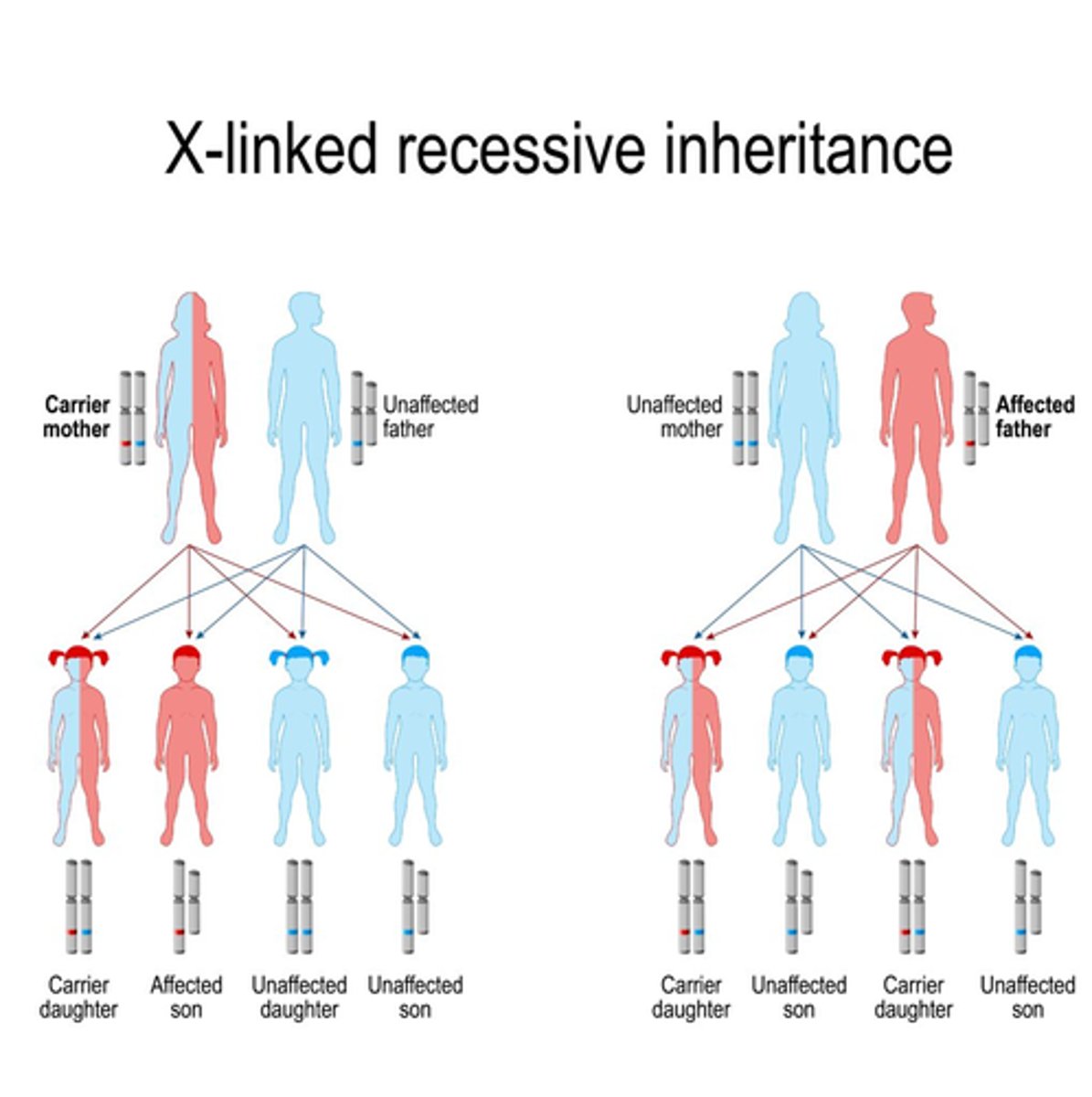
How would you describe the possible outcomes for the offspring of a carrier mother and a normal father for haemophilia? (4)
- There is a 50% chance that a daughter will be a carrier and a 50% chance she will be phenotypically normal and not a carrier.
- There is a 50% chance that a son will have haemophilia.
- There is a 50% chance that a son will be phenotypically normal.
- Overall, for any given pregnancy, there is a 25% chance of having a child with haemophilia.
What is incomplete dominance? (2)
- Incomplete dominance is a form of inheritance where the heterozygous genotype results in a phenotype that is intermediate between the two homozygous phenotypes.
- Neither allele is completely dominant over the other, leading to a blended appearance.
Why are males more commonly affected by X-linked recessive conditions than females? (2)
- Males have only one X chromosome (XY), so they only need to inherit one copy of the recessive allele for the trait to be expressed.
- Females have two X chromosomes (XX), so they must inherit two copies of the recessive allele to express the trait; if they have only one, they become a carrier.
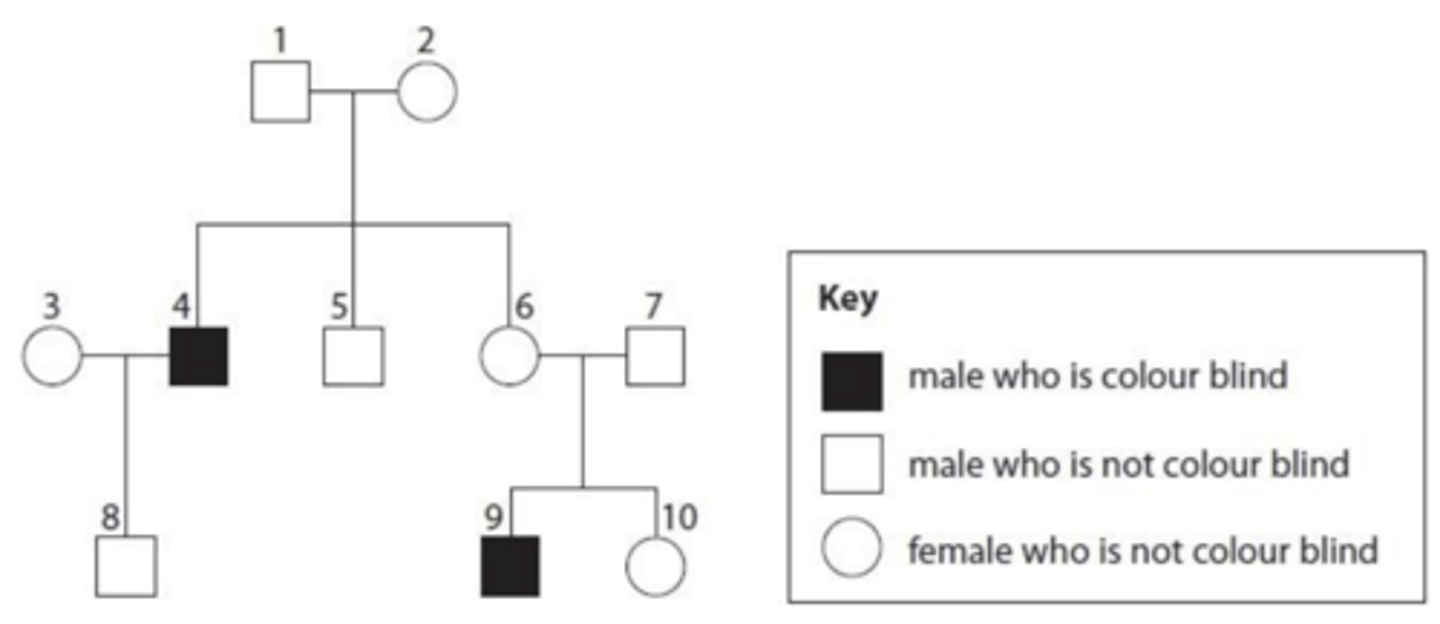
How does the diagram show that red-green colour blindness is caused by a recessive allele using the chart given below? (2)
- Individuals 6 and 7 are unaffected by colour blindness, but they have a son, individual 9, who is colour blind.
- Since the son inherits his X chromosome from his mother, the mother (individual 6) must be a heterozygous carrier of the recessive allele.
How would you draw a genetic diagram to determine the probability that the next child of individuals 6 and 7 is a male who is colour blind? (4)
- Parental Phenotypes: Unaffected male x Unaffected female (carrier)
- Parental Genotypes: XRY x XRXr
- Offspring Genotypes: XRXR, XRXr, XRY, XrY
- The probability of having a male child who is colour blind (XrY) is 1 in 4, or 25%.
How would you draw a genetic diagram to determine the probability that the next child of individuals 6 and 7 is a male who is colour blind? (4)
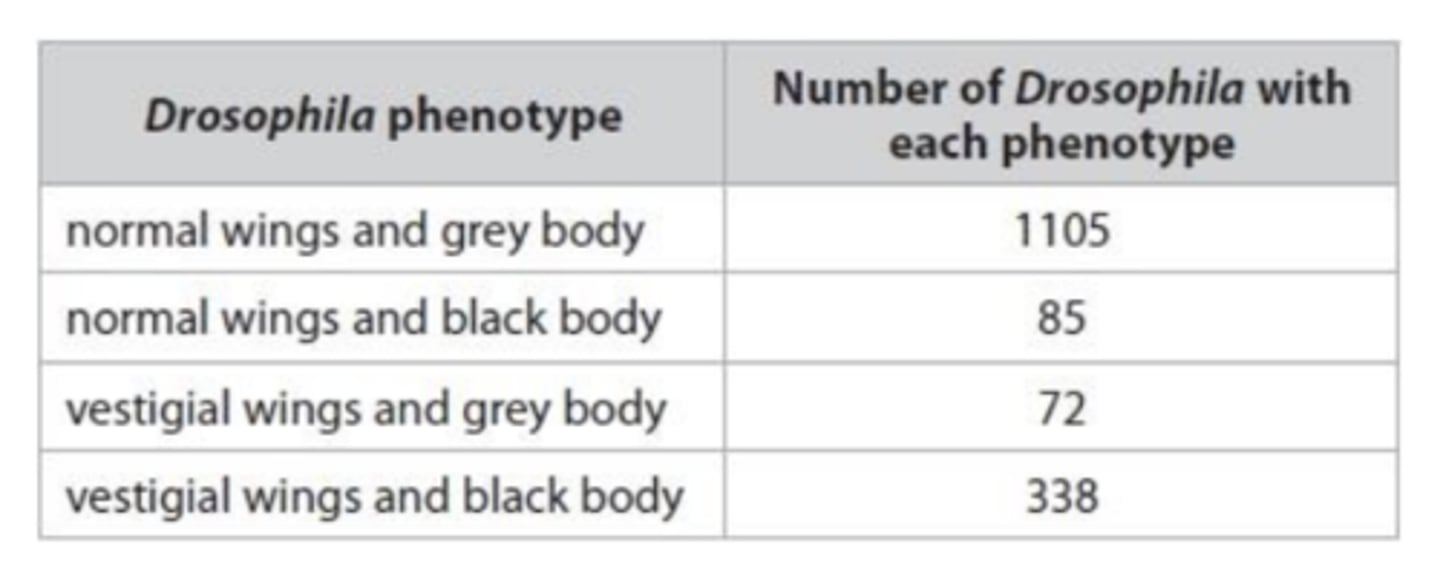
- The phenotypic ratio in the F2 generation deviates significantly from the expected 9:3:3:1 ratio.
- This is because the genes for wing length and body colour are linked; they are located on the same chromosome.
- Consequently, the parental alleles (NG and ng) are often inherited together, leading to a much higher number of offspring with the parental phenotypes (normal wings/grey body and vestigial wings/black body).
- The offspring with non-parental or recombinant phenotypes (normal wings/black body and vestigial wings/grey body) are less common.
- These recombinant phenotypes are formed as a result of crossing over occurring between the two gene loci during prophase I of meiosis.
Why are tortoiseshell cats, which have both black and orange fur, almost always female? (2)
- The gene for fur colour is located on the X chromosome, and males (XY) only have one X chromosome, so they can only express one allele (either black or orange).
- Females (XX) can be heterozygous for the fur colour gene (XBXO), and because the alleles are codominant, both colours are expressed simultaneously to create the tortoiseshell pattern.
How would you describe the genetic cross between a tortoiseshell cat with long fur and an orange male cat, heterozygous for fur length, and deduce the probability of producing a tortoiseshell cat with long fur? (4)
- Parental Genotypes: XᴮXᴼff (female) × XᴼYFf (male)
- Female Gametes: Xᴮf, Xᴼf
- Male Gametes: XᴼF, Xᴼf, YF, Yf
- Probability: The chance of producing a tortoiseshell cat with long fur (genotype XᴮXᴼff) is 1/8 (12.5%).
How can a pedigree chart be used to determine if an allele is dominant or recessive? (2)
- A key indicator is when two parents who both express the same phenotype have an offspring with a different phenotype.
- If the parents both have the dominant phenotype, they can be heterozygous and produce an offspring who expresses the recessive phenotype.
How does the pedigree diagram show that the allele for short fur (F) is dominant to the allele for long fur (f)? (2)
- Individuals 3 and 4 both have short fur, but they have produced an offspring, individual 9, who has long fur.
- For an offspring to express a recessive trait (long fur), both parents must carry the recessive allele. This means that parents 3 and 4 are both heterozygous (Ff) and express the dominant short fur phenotype.
How can the genotypes of individuals 1 and 2 can be determined? (3)
- Individual 1 is a male without haemophilia, so his genotype must be XᴴY.
- Individual 2 is a female without haemophilia, but they have a son (individual 4) with the condition.
- She must have passed the recessive allele to her son, meaning she is a heterozygous carrier with the genotype XᴴXʰ.
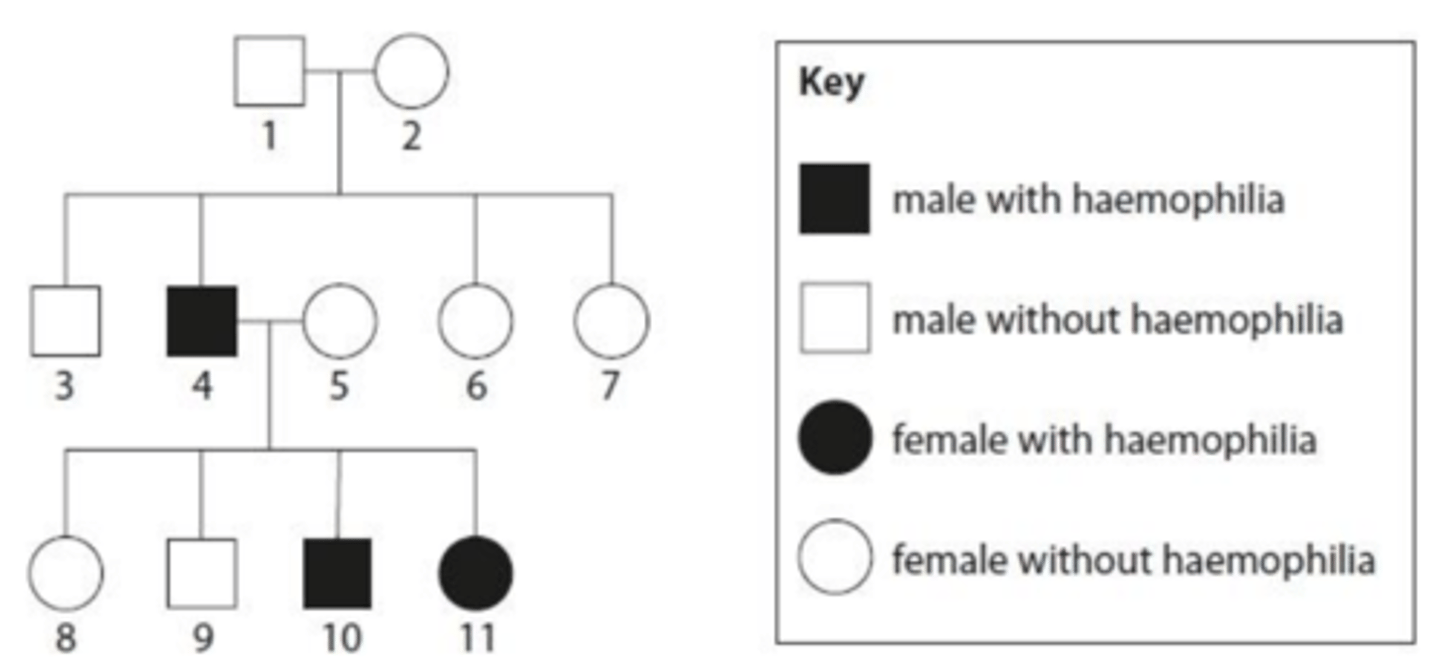
How can you determine the genotypes of individuals 4 and 5? (3)
- Individual 4 is a male with haemophilia, so his genotype is XʰY.
- Individual 5 is a female without haemophilia, but she has a daughter (individual 11) with the condition.
- To have a daughter with haemophilia (XʰXʰ), the daughter must inherit a recessive allele from both parents. Therefore, individual 5 must be a heterozygous carrier, XᴴXʰ.
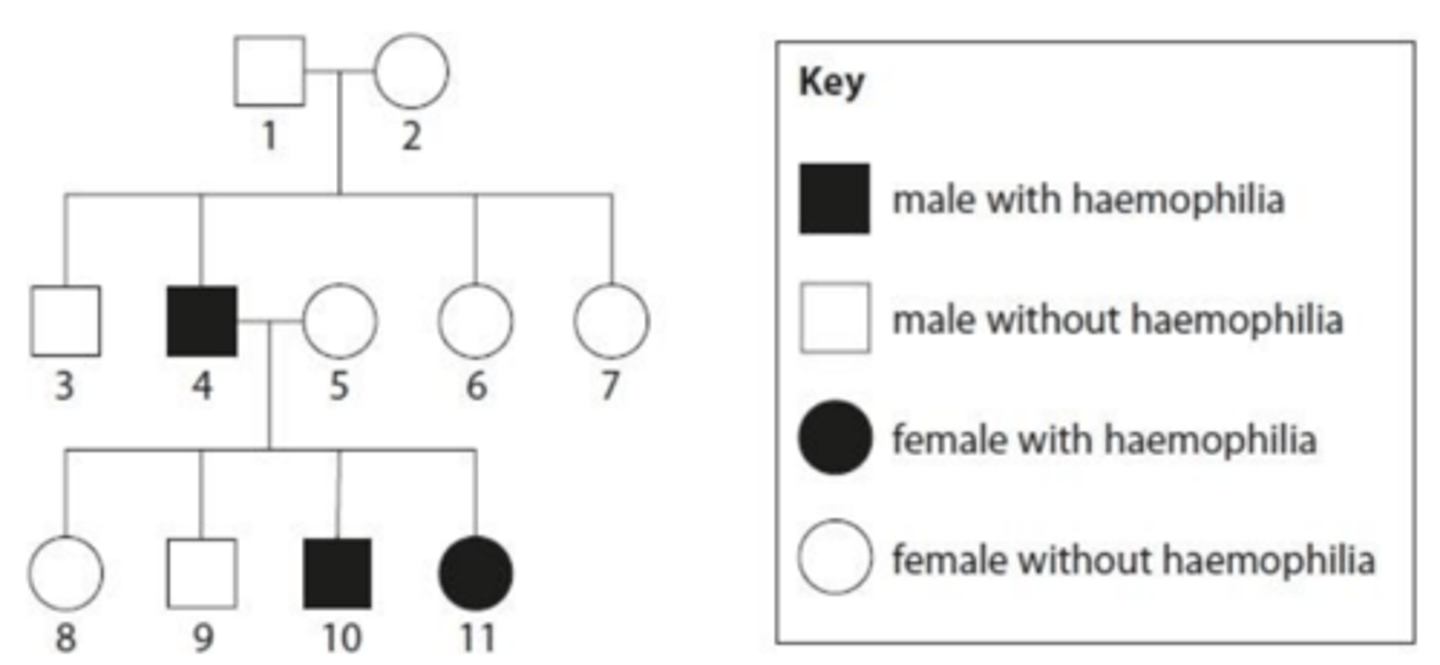
How would you draw a genetic diagram to determine the probability that the next child of individuals 4 and 5 will be a boy without haemophilia? (4)
- Parental Genotypes: XʰY × XᴴXʰ
- Gametes (Male): Xʰ, Y
- Gametes (Female): Xᴴ, Xʰ
- Probability: The chance of producing a boy without haemophilia (genotype XᴴY) is 1 in 4 (25%).
How are the genotype of the F1 generation and the expected phenotypic ratio of the F2 generation between a white cauliflower and a purple cauliflower showing incomplete dominance? (3)
- The F1 generation cauliflowers are all light purple, indicating they have the heterozygous genotype, Prpr.
- The expected phenotypic ratio in the F2 generation for a cross involving incomplete dominance is 1:2:1.
- This corresponds to 1 dark purple : 2 light purple : 1 white.
Why the conclusion that cauliflower colour is controlled by a single gene with two codominant alleles is likely to be valid using the data given in the table? (3)
- The calculated Chi-squared value for this data is 2.37, with 2 degrees of freedom (3 phenotypes - 1).
- The critical value from the table at a probability level of 0.05 is 5.991.
- Since the calculated value (2.37) is less than the critical value (5.991), the probability that the observed differences are due to chance is greater than 5% (p > 0.05), so the null hypothesis is accepted.