unit 4
 Call Kai
 Learn
Learn Practice Test
 Spaced Repetition
 Match
Match Flashcards
 Knowt Play
1/34

There's no tags or description
Looks like no tags are added yet.
Name | Mastery | Learn | Test | Matching | Spaced | Call with Kai |
|---|
No analytics yet
Send a link to your students to track their progress
35 Terms
contractionary monetary policy on the part of the fed results in:
A decrease in money supply, an increase in interest rates, and a decrease in GDP.
assume limited reserves, there is no leakage from the baking system and all commercial banks are loaned up. the required reserve ration is 10%. if the fed buys $10 million worth of government securities from the public, the change in the money supply will be
100 million
The money market model is concerned with ____ and the loanable funds market model is concerned with ______.
short-term nominal interest rate; long-term real interest rates
an increase in price level causes
the money demand curve to shift to the right
which of the following would most likely induce the federal reserve to conduct expansionary monetary policy? a significant decrease in:
investment spending
which of the following would cause the money demand curve to shift to the left?
decrease in real GDP
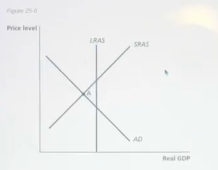
refer to 25-6. in the figure above, if economy is at point A, assuming limited reserves, the appropriate monetary policy by the federal reserve would be
lower interest rates
suppose the FED increases the money supply which of the following is true?
At the original interest rate, the quantity of the money demanded is less than the quality of the money supplied
an increase in the demand for Treasury bills will
decrease the interest rate on treasury bills.
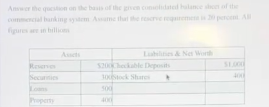
the commercial banking system has an excess reserve of
zero
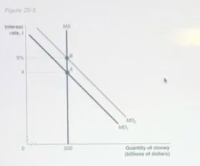
Refer to Figure 25-5. in the figure above. the movement from point A to point B in the money market would be caused by
an increase in the price level
Assuming limited reserves, if the fed buys treasury bills, this will shift the
money supply curve to the right.
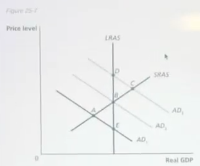
suppose the fed lowers it target for the federal funds rate. Using the basic AD-AS model in the figure above, this situation would be depicted as a movement from
A to B.
Expansionary monetary policy to prevent real GDP from falling below potential real GDP would cause the inflation rate to be relatively ____ and real GDP to be relatively ____
higher; higher
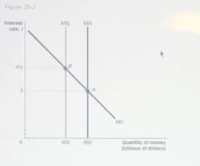
refer to Figure 25-2. in the figure above the movement from point A to point B in the money market would be caused by.
an open market sale of Treasury securities by the federal reserve
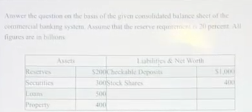
the monetary multiplier for the commercial banking system is
5
which of the following describes what the fed would do to pursue an expansionary monetary policy with limited resources
use open market operations to buy Treasury bills
an increase in real GDP can shift
money demanded to the right and increase the equilibrium interest rates
the discount rate is the rate of interest at which
Federal reserve banks lend to commercial banks
The discount rate is the rate of interest at which
Federal reserve banks lend to commercial banks
the interest rates will fall when the
quantity of money supplied exceeds the quantity of money demanded
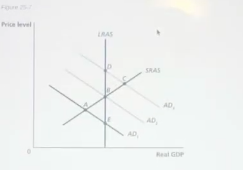
refer figure 25-7. suppose the Fed sells treasury bills in pursuit of contractionary monetary policy. using the basic AD-AS model in the figure above, this situation would be depicted as a movement from
C to B
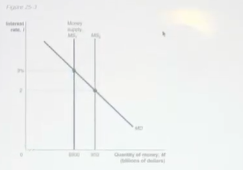
refer to figure 25-3. In the figure above. when the money supply shifts from MS1 to MS2,a t the interest rate of 3 percent households and firms will
buy Treasury bills
An increase in interest rates
decreases investment spending on machinery, equipment, and factories and consumption of spending on durable goods
To reduce inflation, the central bank would be most likely to
increase its administer interest rates
if a countries economy is operating below the full employment level of output at a very low inflation rate, the central bank of the country is most likely to
lower administer interest rates to generate an increase in output
if the federal funds rate declined as a result of policy action by a central bank. the central bank must have
decreased its administered interest rates
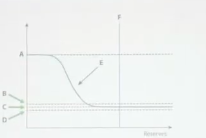
which of the following letters on the graph represents the discount rate?
A
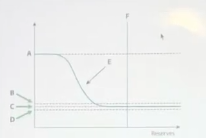
Which of the following letters on the graph represents the federal funds rate?
C
which of the following best describes how arbitrage makes interest on reserves an effective tool
if the federal funds rate falls far below the interest on reserve balances rate, banks will borrow at the federal funds rate and deposit the funds at the Fed to earn the interest on reserve balances rate and earn a profit. Many banks will seize on this opportunity, which will raise the federal funds rate.
with ample reserves, which monetary policy tool is the primary tool the fed uses to adjust the federal funds rate?
interest on reserves balances (IORB)
assume the economy starts to experience inflation, and the FOMC determines that employment is above the full employment level. which of the following would best describe an appropriate policy implementation
raise the interest on reserves balances rate. ON RRP offering rate, and discount rate
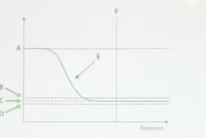
which of the following represents demand for bank reserves?
E
the chair of the federal reserves board of governors
is nominated by the president and confirmed by the senate
when the price of a financial asset ____ its interest rate will _____.
falls; rise

