exam 2 study guide
 Call Kai
 Learn
Learn Practice Test
 Spaced Repetition
 Match
Match Flashcards
 Knowt Play
1/49

There's no tags or description
Looks like no tags are added yet.
Name | Mastery | Learn | Test | Matching | Spaced | Call with Kai |
|---|
No analytics yet
Send a link to your students to track their progress
50 Terms
What does the limbic system do?
Controls arousal
What is the purpose of thalamus?
Relay center for sensory information
What is the purpose of hypothalamus?
Temperature and endocrine
If hot temperature is applied to cerebral cortex will the body temp change?
No
If hot temperature is applied to hypothalamus what happens?
There's thermal receptors
What is the purpose of pituitary gland?
Involved in hormone
What is the purpose of the pineal gland?
secretes melatonin
What is the purpose of cerebellar penducles?
Knows your body and creates motor motor plan from the frontal lobe
What is the one pathway for sensory information?
Medulla
What is the purpose of the midbrain?
Vision and auditory reflex
What is the purpose of pons?
Breathing and swallowing
What is the role of serotonergic projections?
Regulates mood, sleep cycle, motor behavior, and stress
What is the role of raphe nuclei?
Produces serotonin
What is the purpose of medulla oblongata?
Reflex center
What does the proprioceptors measure?
Body sensation, stretch of muscle, motor control
What does the proprioceptors do?
A sensory neuron wrapped around
Can change and make more sensitive to stretch
What is a sensory Cell?
Physical and chemical stimuli into neuronal signals
What makes the sensory cell positive?
Receptor proteins interacting with physical stimuli
What is a ionotropic receptor?
Ion channel; mechanoreceptor
What is metabotropic?
Affect ion channel through G protein
What is adaptation?
Diminishing response to repeated stimulation?
What is a mechanoreceptor?
responds to mechanical forces
What is a thermoreceptor?
responds to temperature changes
What is chemotaxis?
To move towards
What is the pinnae?
To catch the sound
What is the tempanic membrane?
eardrum; converts sound waves to vibrations to hear
What is the conduction of deafness?
loss of function of tympanic membrane or ossicles
What is the nerve deafness?
Damage to inner ear or hair cells; damage is also done to temporal lobe
fovea centralis
Where the cones are; detailed central vision and color perception
ciliary body
Wraps around the lens; helps lens move around different focal points
Cornea
For protection and so light can be transmitted
Iris
Absorbs or reflects light
Pupil
Controls the amount of light entering the eye
What is the macula lutea?
contains mostly cones
Ground Squirrel
A thermistor is placed into the hypothalamus
A thermistor can heat up or cool down an area, the thermistor cools down the hypothalamus
Metabolism increases, which burns more calories and and body temp increases
Hypothalamus starts to heat up, which decreases both body temp and metabolism
Bear Attack (sympathetic)
see a bear
brain goes, “oh no thats not good”
pre-ganglionic neurons in thoracic lumber region of spinal cord become active, firing AP, releasing PCH to post-ganglionic neuron
Post-ganglionic neuron receives neurotransmitters with a nicotinic receptor (ACH)
Post-ganglionic neuron fires and AP; releases norepinephrine, heart tissue will receive norepinephrine with adrengenic receptor (gs-coupled)
Norepinephrine is then released to the heart, increasing heart rate
Bear Attack (OR/AND)
pre-ganglionic neuron go around the post-ganglionic neuron; goes directly to adrenal medulla gland
Fires AP, releasing ACH into the cell
Adrenal Medulla cell receives ACH (nicontic receptor); releasing norepinephrine and epinephrine to blood stream (adrenaline rush)
Beer Attack (parasympathetic)
Interpret an event as a relaxation event
Brain will activate preganglionic neurons (located in brain stem)
Fires action potentials; goes to the ganglia (parasympathetic) close to the target organ
Releases ACH to the post-ganglionic neuron receives it with nicotinic ACH
Post-ganglionic neuron gets to threshold, fires AP; releases ACH
Heart tissues does NOT have nicotinic receptors; it will have muscarnuic ACH Receptors (Gi-coupled receptors)
This causes heart rate to go down
Olfactory Essay
ligand enters your nasal cavity; binds to the receptor proteins
GDP goes away
A shiny new GTP comes and binds to the alpha subunit of G protein effector (AC)
AC converts cAMP; cAMP binds to cynic gated ion channels
Both sodium and calcium enters; positively charge giving receptor potential
Calcium will bind to chloride ion channel; opens up
Chloride must be higher on the inside so chloride will leave; making receptor potential
Receptor potential if above threshold will cause an AP
Releases a neurotransmitter to the dendritic region of glomerulus mitral cell
Mitral cell fires action potential, then goes to the uncus
Chochea Essay
Basilar membrane stiff at the beginning but flexible at the end (moveable)
High frequency sound has higher energy; low frequency sound has low energy
Putting low frequency sound will not move the basal membrane
Vibrator energy takes a short cut from the upper to lower canal
basilar membrane through the middle canal causes the membrane to deflect up
The stern cilia deflect and move, opening ion channel, potassium enters
IF a positive enters, er get a positive receptor potential, releasing neurotransmitters
Neurotransmitters form action potential to the brain
Vision Essay
Light hits rhodopsin
Rhodopsin binds with g-protein
GDP goes away
GTP comes on goes to the alpha subunit
Alpha subunit goes to PDE
PDE converts cGMP to GMP
As cGMP levels decrease the ion channels will close and get more negative; detecting hyper polarization and decrease in neurotransmitters
Vision (DARK) (10)
no light hits photoreceptors
rhodopsin is inactive
g-protein (transduction) is inactive
PDE s inactive
cGMP lvls stay high
cGMP keeps Na+ channels open
Na+ and some Ca+ flow into the cell
Cell stays positive
Photoreceptors release a lot of glutamate
Signal continues to bipolar cells
In the dark, photoreceptors are depolarized and releases a lot of glutamate
Vision (LIGHT) (11)
light hits rhodopsin
retinal changes shape
rhodopsin becomes activated
activates g-protein (transduction)
transduction activates PDE
PDE breaks down cGMP to GMP
cGMP levels drop
CGMP gated Na+ channels close
Less Na+ enters and cell becomes more negative (hyper polarized)
Photoreceptors releases less glutamate
Bipolar cells detect this change and signal is sent to ganglion cells which is sent to the brain
Stroke Essay
Blood clot stops the flow of brain to region
No oxygen and glucose, neurons depolarized due to loss of sodium potassium pump
The neurons reach threshold and produce a barrage of AP
These firing neurons release excitatory neurotransmitter glutamate; lack of energy in the presynaptic neuron causes glutamate transporters
Removes the transmitter from the cleft, to stop working (no uptake)
Post-synaptic neurons are bombarded with glutamate, producing a barrage of AP, an excessive amount of calcium and zinc enters the cell
The excessive intercellular calcium and zinc trigger cll death and neuron succumbs to exotoxcity
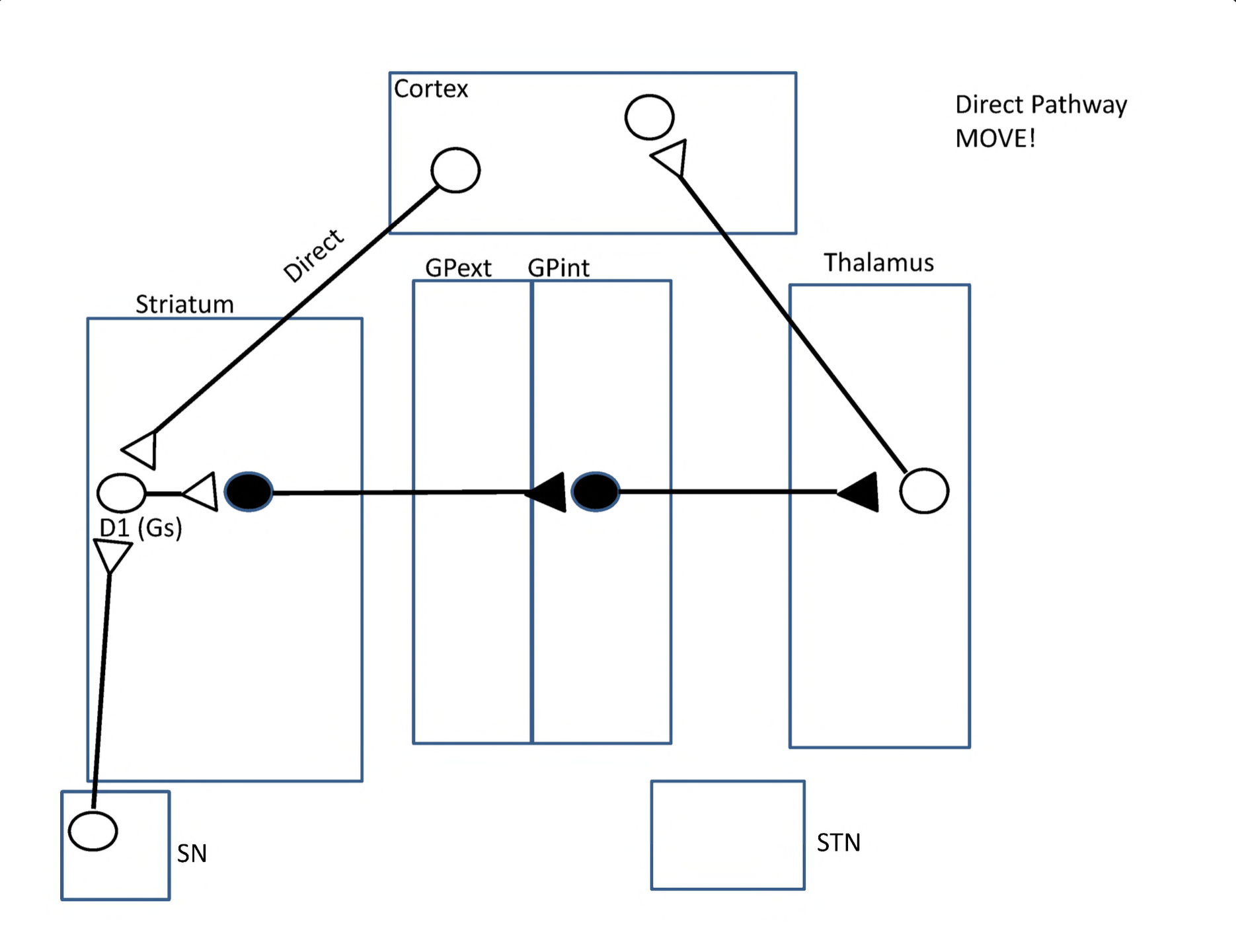
Basal Ganglia Direct Pathway: MOVE
Cortex neuron fires AP; release excitatory neurotransmitter
Stratum fires AP; releases excitatory neurotransmitter
Second striatal neuron fires; releases inhibitory neurotransmitter
Neuron in G int does not fire; does not release inhibitory neurotransmitter
Thalamic neuron is not inhibited by(relieve of IN); fires AP; releases excitatory neurotransmitter to the cortex
Signals brain to move
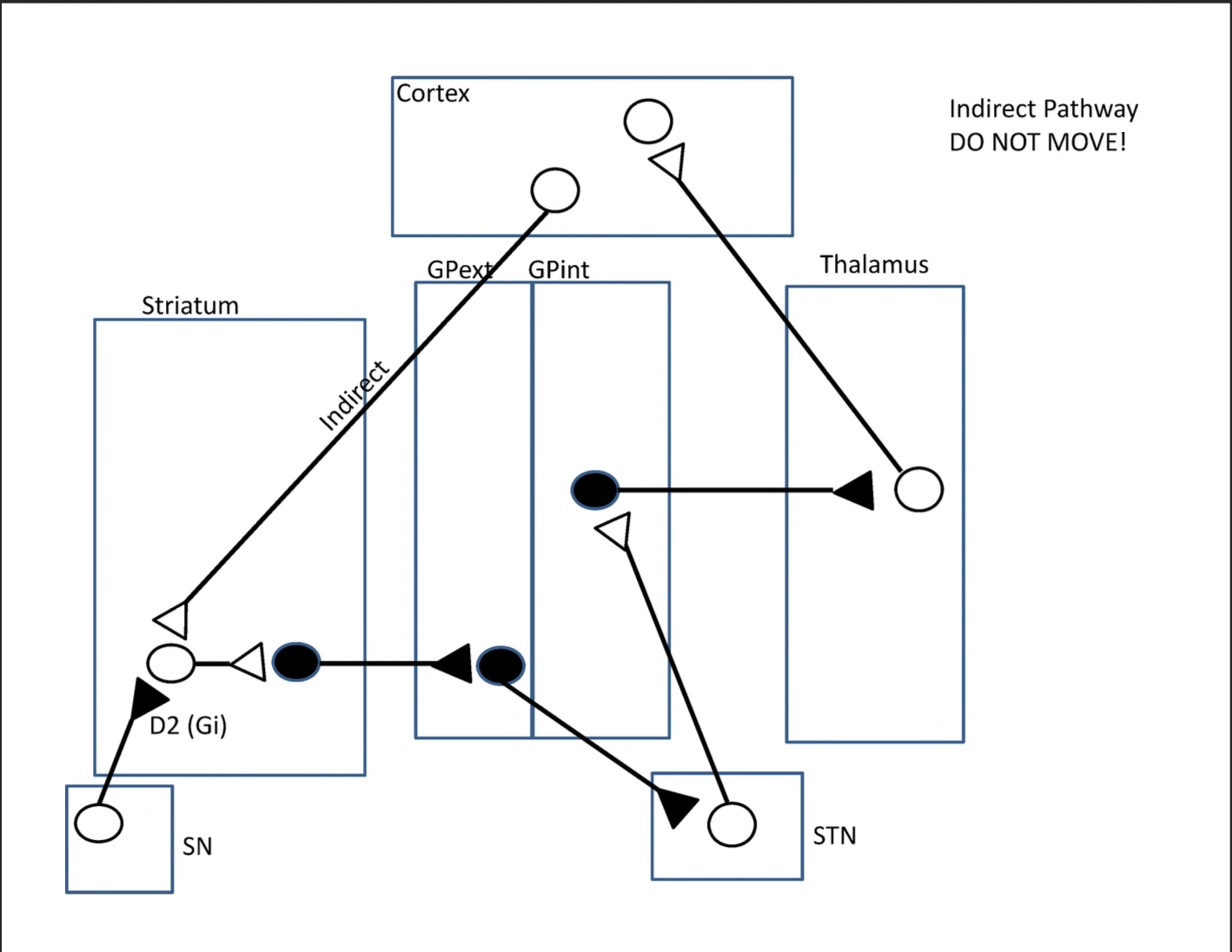
Basal Ganglia Indirect Pathway: DO NOT MOVE
Cortex fires AP; release ENY
Striatum gets excited, fires AP, release ENY
Second striatal neuron gets excited, fires releases INT
Guest gets inhibited; does NOT fire, does NOT release INT
Second GPext no longer inhibited to STN; STN fires and releases ENT
Gpint gets excited; fires; releases INT
Thalamus get inhibited; does not fire; does not release ENT
Direct Pathway with Parkisons’s
SN cells are dying with parkisons
Fires releases ENT
Gets more excited BUT dopamine is in a downstate
It fires but not as much ENT is released
Gets excited but not enough; fires less; releases INT but not enough
Get inhibited but not enough, fires too much; releases INT too much
Gets inhibited too much, does not fire enough, does not release enough ENT
eplipesy (essay)
Neurons have a dysfunctional chloride potassium pump; thus there is too much chloride
The extra chloride has no meaningful effect on resting membrane potential
Because the pump isn’t getting rid of the chloride, there would be a small ISPS
There would be too much fired out and thus epilepsy occurs

