12. Contaminants
 Call Kai
 Learn
Learn Practice Test
 Spaced Repetition
 Match
Match Flashcards
 Knowt Play
1/20

There's no tags or description
Looks like no tags are added yet.
Name | Mastery | Learn | Test | Matching | Spaced | Call with Kai |
|---|
No analytics yet
Send a link to your students to track their progress
21 Terms
What are the four steps of risk assesment?
Hazard identification
Hazard characterization (dose-response)
Exposure assessment
Risk characterization
Risk management
Risk communication
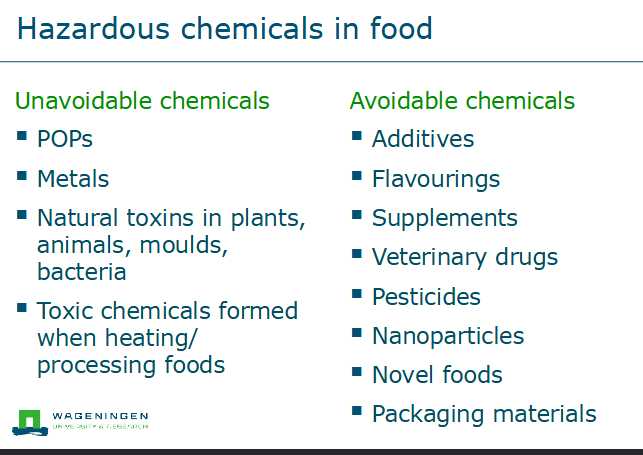
Unavoidable vs avoidable chemicals
Contaminants are the unavoidable chemicals
Persistent Organic POllutants (POPs)
Mostly anthropogenic, persistent carbon-based chemicals that bioaccumulate and are toxic → found everywhere in the environment
Includes:
Organochlorine pesticides
Polychlorinated biphenyls
Dioxins
Brominated flame retardants
Perfluoralkylated substances
Persistency, bioaccumulation and toxicity of POPs
Persistent: do not degrade easily in the environment, typically accumulate in fatty tissues and are only slowly metabolized
Bioaccumulative: concentrations in organisms accumulate over time
Toxic: exposure associated with chronic adverse health effects, including cancer and developmental and reproductive toxicity
They are PBTs (persistent, bioaccumulative, toxic)
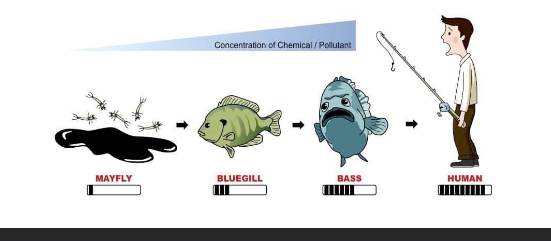
Biomagnification
Bioaccumulation up through trophic levels
Increasing concentration of chemical in tissues of organisms at higher levels in a food chain due to high lipophilicity and persistence (chemicals gather in fat)
Three types of POPs
Pesticides esp. organochlorine pesticides incl. DDT
considerd avoidable chemicals
Industrial and technical chemicals incl.
PCBs (polychlorinated biphenyls)
PBDEs (polybrominated diphenylethers)
PFAS
By-products of industrial processes incl
PCDDs: dibenzo-p-dioxins
PCDFs: polychlorinated dibenzofurans
POPs in our environment
Halogenation → resistant to degradation → persistent
Peak release of POPs in 1970s
Except PFAS, contaminant of emerging concern (CEC)
Now ±10% of peak concentrations in environment
Travel through air, water - even antartica
How POPs end up in our food
Over 90% of human exposure to POPs is through the consumption of contaminated food, esp. food of animal origin → fish
Depostion on crops
Drinking water
Soil ingestion by grazing animals
Bioaccumulation through trophic levels
Food preparation
Breastmilk
Agent orange
Agent orange is a herbicide and defoliant chemical contaminated with TCDD
Herbicidal warfare programme in vietnam war, 1961-1971
3 million people suffered illness
Developmental defects in children military personnel and inhabitants
Usage of dioxin-like chemicals, PCBs
polychlorinated biphenyls
Anthropogenic
Used as dielectric and coolant fluids in electrical apparatus, carbonless copy paper and in heat transfer fluids until 1979 in US, Stockholm Convention 2001
2 categories: non-coplanar (ortho-substituted) congeners vs coplanar congeners ← Dioxin-like
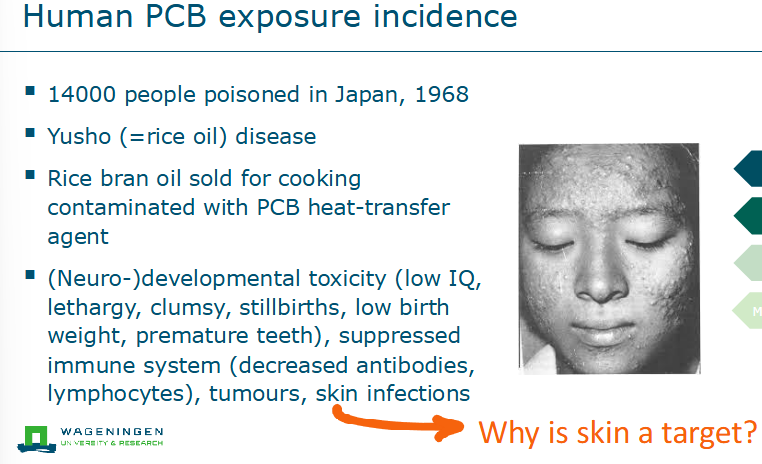
PCB exposure incidence
Skin because skin is fat
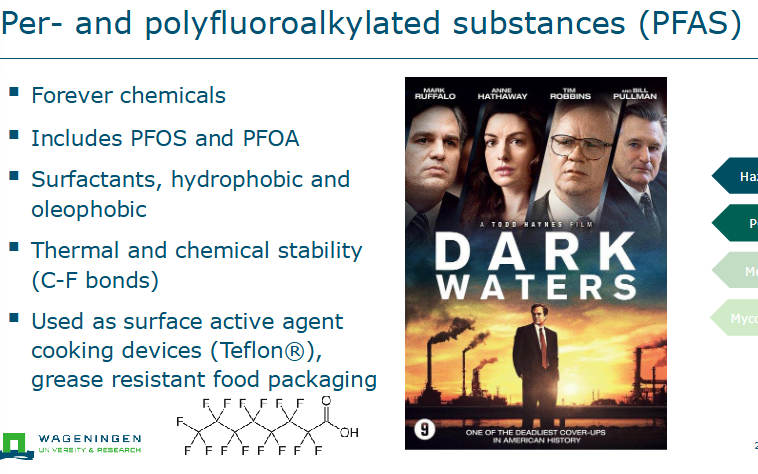
PFAS
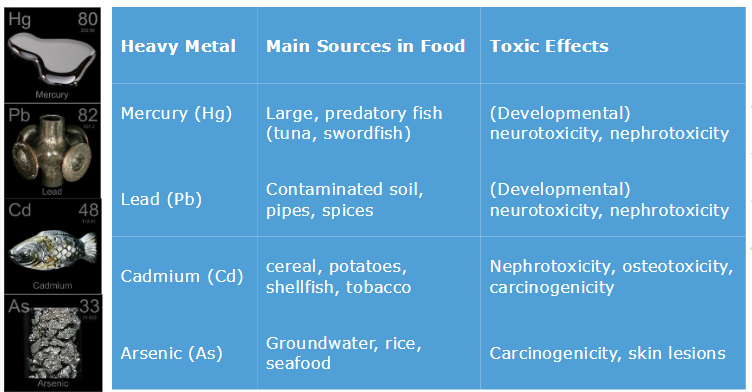
Heavy metals
Includes:
mercury (Hg)
Lead (Pb)
Cadmium (Cd)
Arsenic (As)
Current exposure levels raise concern for (developmental) neurotoxicity, nephrotoxicity, carcinogenicity
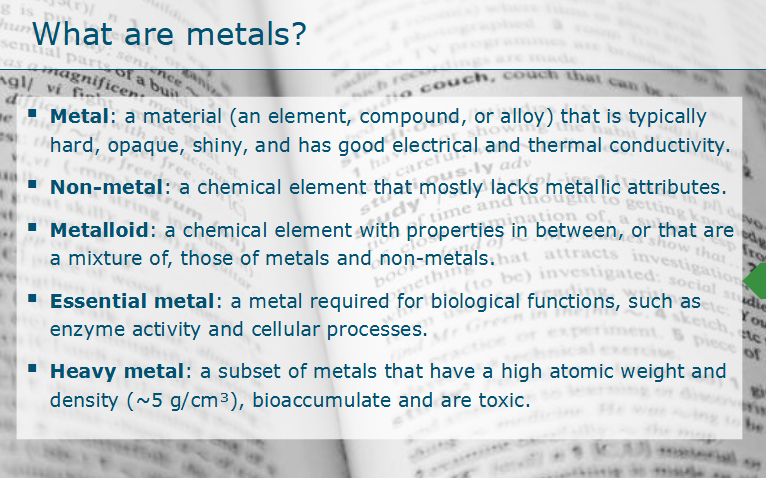
What are metals
Common non-essential metals in food
Why do fish contain mercury?
Hg2+ converted to MeHg by anaerobic microorganisms
Fish accumulate MeHg in fat tissue
Toxicokinetics of mercury
Long half-life ±50 days
Accumulates in liver, kidneys and brain
What is a mycotoxin?
A toxic chemical produced by fungi known to contaminate food and pose health risks to humans and animals
History of myoctoxins
A public health risk for a long time
Erogtism: the oldest recognized mycotoxicosis of humans
Produced by Claviceps purpurea (ergot) fungus on rye
After periodic outbreaks in central Europe, the disease became epidemic in the middle ages
Symptomology: gangrene (blackened limbs) due to vasoconstriction of blood vessels in extermities, neurotoxicity (madness)
Why are mycotoxins still a risk
Expected to increase due to climate change
They are hard to get rid of, very persistent and processing does not remove or kill them
Aflatoxin
Produced by Aspergillus flavus and A. parasiticus
Found on peanuts, soybeans, rice, pepper, corn

