Audiology Exam 2
 Call Kai
 Learn
Learn Practice Test
 Spaced Repetition
 Match
Match Flashcards
 Knowt Play
1/74

There's no tags or description
Looks like no tags are added yet.
Name | Mastery | Learn | Test | Matching | Spaced | Call with Kai |
|---|
No analytics yet
Send a link to your students to track their progress
75 Terms
Pure-Tone Threshold
The level at which tones are perceived as barely audible
Procedures for obtaining pure-tone threshold
Where is the testing taking place?
Sound-treated booths
Procedures for obtaining pure-tone threshold
How are sounds delivered to the patient?
Transducer, insert receivers, bone conduction vibrator, or sound field speaker
Procedures for obtaining pure-tone threshold
What should the patient do during testing?
Indicate when they hear a tone, even if it is very soft
Procedures for obtaining pure-tone threshold
How is the patient positioned during testing?
Turned so they can not see the person testing.
Frequencies for routine air conduction testing
250 Hz to 8000 Hz
Frequencies for routine bone conduction testing
500 Hz to 4000 Hz
Cutoff for normal hearing
>25 dB
Cutoff for mild hearing loss
26 - 40 dB
Cutoff for moderate hearing loss
41 - 55 dB
Cutoff for moderately-severe hearing loss
56 - 70 dB
Cutoff for severe hearing loss
71 - 90 dB
Cutoff for profound hearing loss
91+ dB
Flat Configuration
Within 20 dB across the audiogram
Sloping Configuration
>20 dB worsening toward high frequencies over some or all parts of the audiogram
Rising Configuration
>20 dB improvement from low toward high frequencies over some or all parts of the audiogram
Corner Configuration
Residual hearing ability only in the low frequencies
Notched Configuration
Worsening in a narrow frequency region (typically 3 to 6 kHz)
Cookie Bite Configuration
Worse in the mid frequencies; shallow concave appearance
Air-bone gap
AC - BC = air-bone gap
Pure Tone Average (PTA)
The average of 500, 1000, and 2000 Hz
Masking
The process of putting noise into the non-test ear (NTE) while measuring responses in the test ear (TE)
Why does the non-test ear (NTE) need to be masked in some cases in order to obtain true thresholds in the test ear (TE)
Masking is sometimes required so that the non-test ear cannot help out when evaluating the test ear
We deliver a noise to the non-test ear (always via AC) to raise its threshold. This removes it from the test
Cross Hearing
Reception of a sound signal by the non-test ear during a hearing test (when testing AC or BC)
Interaural attenuation (IA)
As sounds travel from one side of the head to the other, a certain amount of energy is lost in transmission
IA = the difference in the level of a signal delivered to TE (by AC or BC) compared to the level of the signal that occurs in the NTE (by BC)
Speech Recognition Test
Involves the presentation of speech stimuli at a fixed intensity level above threshold (suprathreshold); a measure of the ability to recognize speech at suprathreshold levels
Speech Threshold
The lowest level at which speech can be either detected or recognized
Speech Recognition Threshold (SRT)
The lowest hearing level at which speech can barely be understood at least 50% of the time
Describe the speech materials typically used for speech recognition threshold
Audiometer, transducers, test environments with controlled ambient noise levels, and no language barrier
Spondees
A word with 2 syllables, both pronounced with equal stress
What is the relationship between SRT and PTA
If the difference between SRT and PTA is more than 10 dB, it could indicate that the patient is exaggerating his pure-tone hearing loss
How do you estimate SRT from audiograms
Using the PTA
Word Recognition Score
An assessment of a patient's ability to identify and repeat single-syllable words presented at some suprathreshold level
What is meant by the speech banana and the general distribution of speech sounds as to frequency and intensity characteristics at a normal conversation level
The distribution of speech sounds at a normal conversational level ranges from 20 to 50 dB HL. Consonants are generally lower in intensity and higher in frequency. Vowels are generally higher in intensity and lower in frequency
SRT
Speech Recognition Threshold
SDT
Speech Detection Threshold
SRS
Speech Recognition Score
WRS
Word Recognition Score
Admittance
The ease at which energy will flow through the vibrating system
Immitance
A measure of how readily a mechanical vibratory system can be set into vibration by a driving force
Impedence
The extent to which the system resists the flow of energy through it
If the middle ear system is normal, energy will flow in a predictable way; if it is not, the energy will flow either too well (high admittance/low impedance) or not well enough (low admittance/high impedance)
More mass =
More impedance, which therefore reduces the flow of energy
example: Otitis Media
More stiffness =
More impedance
example: otosclerosis
How is the admittance of the middle ear is measured using tympanometry
Tympanometry measures middle ear admittance by using a probe to emit a constant tone (usually 226 Hz) while changing air pressure in the ear canal from positive to negative. This process assesses how efficiently the eardrum and ossicular chain move, with maximum mobility occurring when the air pressure in the canal equals the middle-ear pressure, creating a peak.
Tympanometry
Assess the status and function of the middle ear
What are the components of an immittance instrument for tympanometry
Probe tone generator 225 Hz at 85 dB SPL, measuring microphone, air pressure pump -400 to +200 daPa
Outer Ear Acoustical System: Probe tip, 85 dB SPL, Middle Ear Mechanical System
What are the procedures for generating a tympanogram?
A. Deliver a probe tone of a constant SPL (85 dB SPL) into the ear canal through a probe
B. Admittance is measured via the microphone (the amount of sound that is reflected/not transmitted)
C. The pressure in the ear canal is varied via the air pump from +200 to -400 daPa
High admittance =
A small amount of sound energy is reflected back
Low admittance =
A large amount of sound energy is reflected back
What is a tympanogram?
a graph produced during tympanometry that measures the flexibility (compliance) of the eardrum in response to air pressure changes
Tympanometric Peak Pressure (TPP)
The pressure at the peak of the tympanogram - reflects the middle ear pressure
Admittance of the middle ear (Ytm)
Peak admittance of the tympanogram; the ease with which energy will flow through the middle ear system
Vea
Acoustic equivalent volume of the ear canal - Size of ear canal
At +200 daPa, the middle ear system is immobilized, so the primary contributor to the admittance measure is the ear canal.
What are the types of tympanogram?
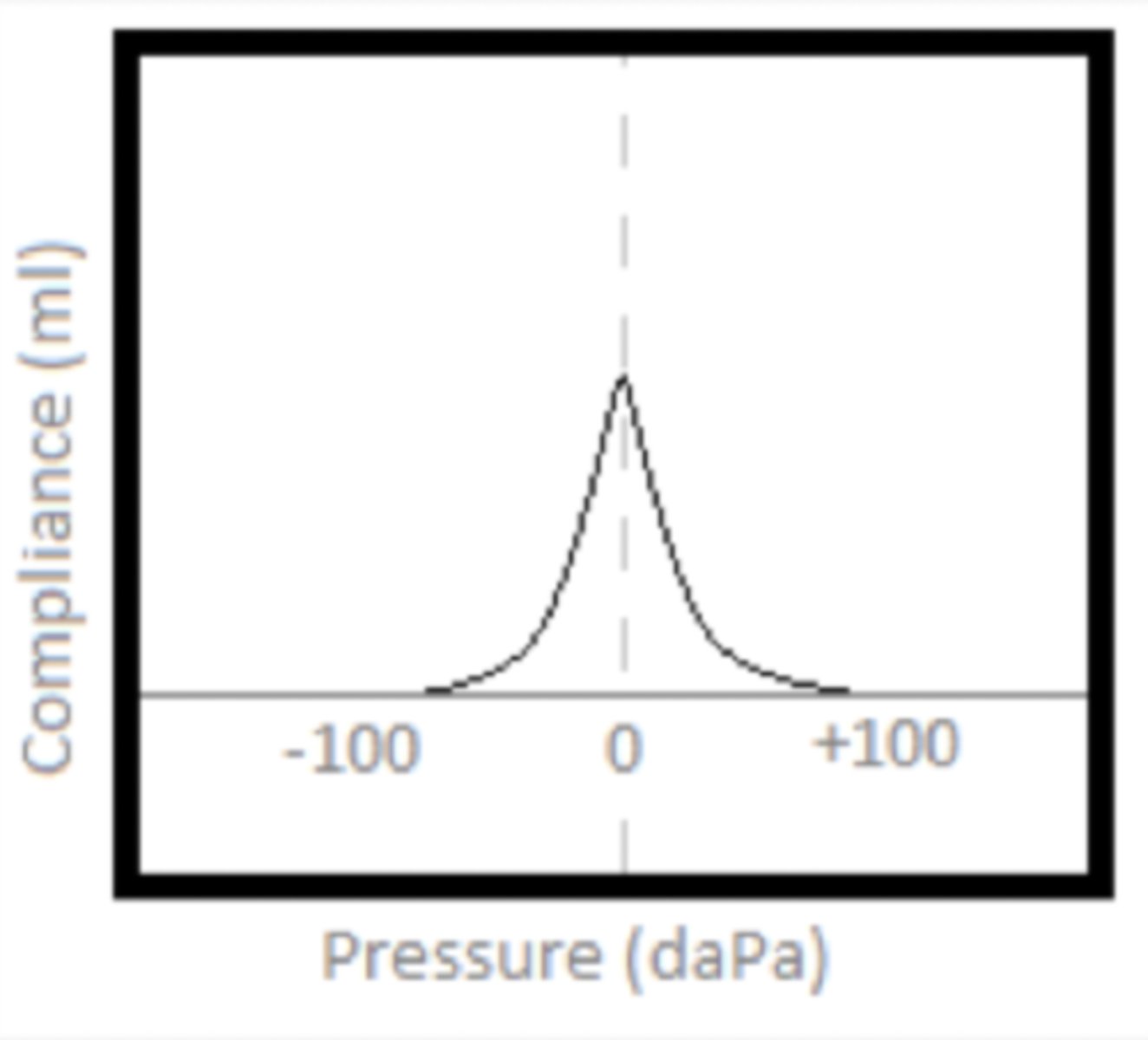
A, As, Ad, Add, B, C
Type A
Normal Hearing
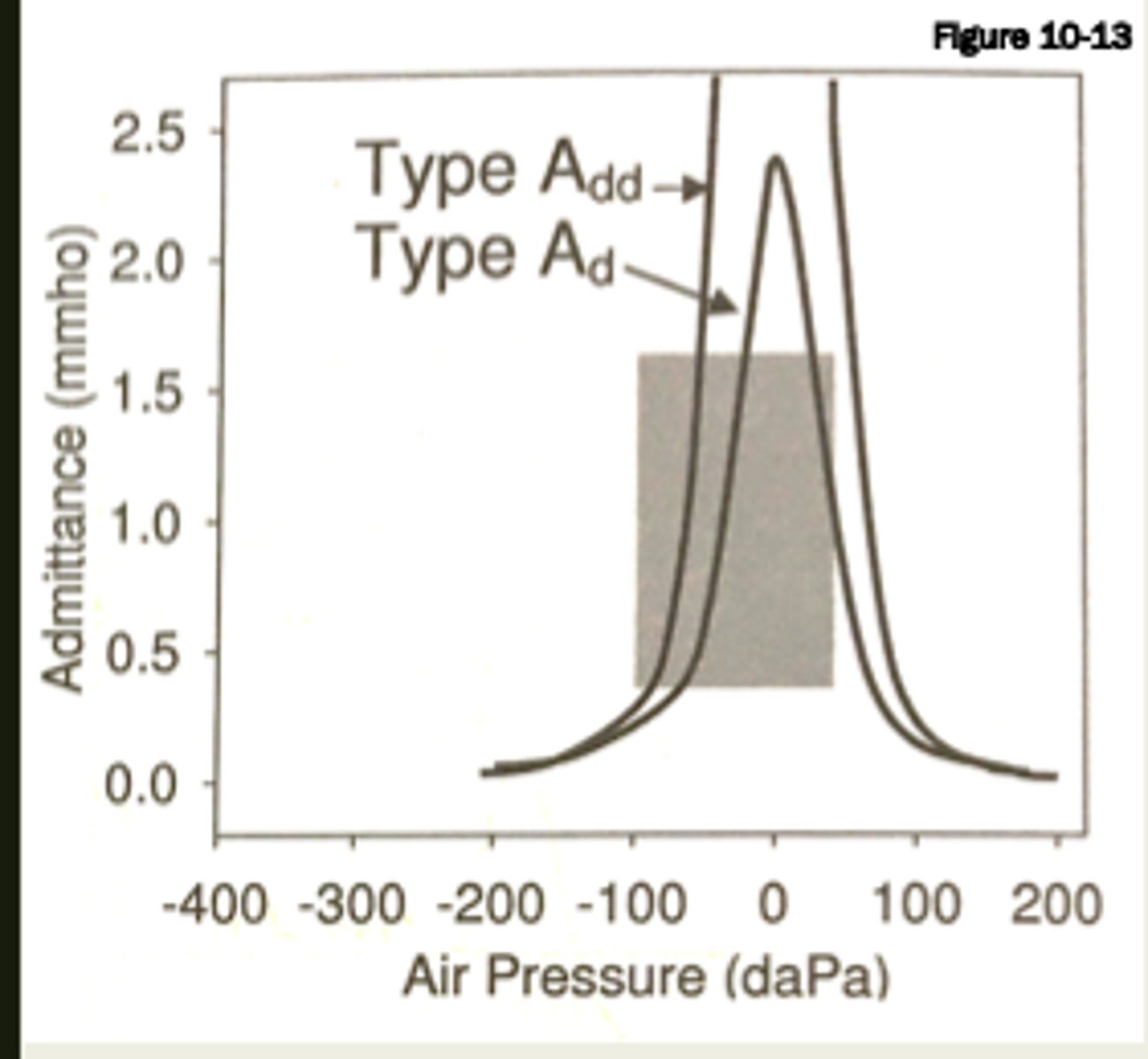
Type Ad/Add
Tymps similar to a typical ear, but the peak is extremely high. The middle ear system becomes too compliant, less stiff. Can be caused by ossicular chain discontinuity, an abnormal separation of the middle ear bones.
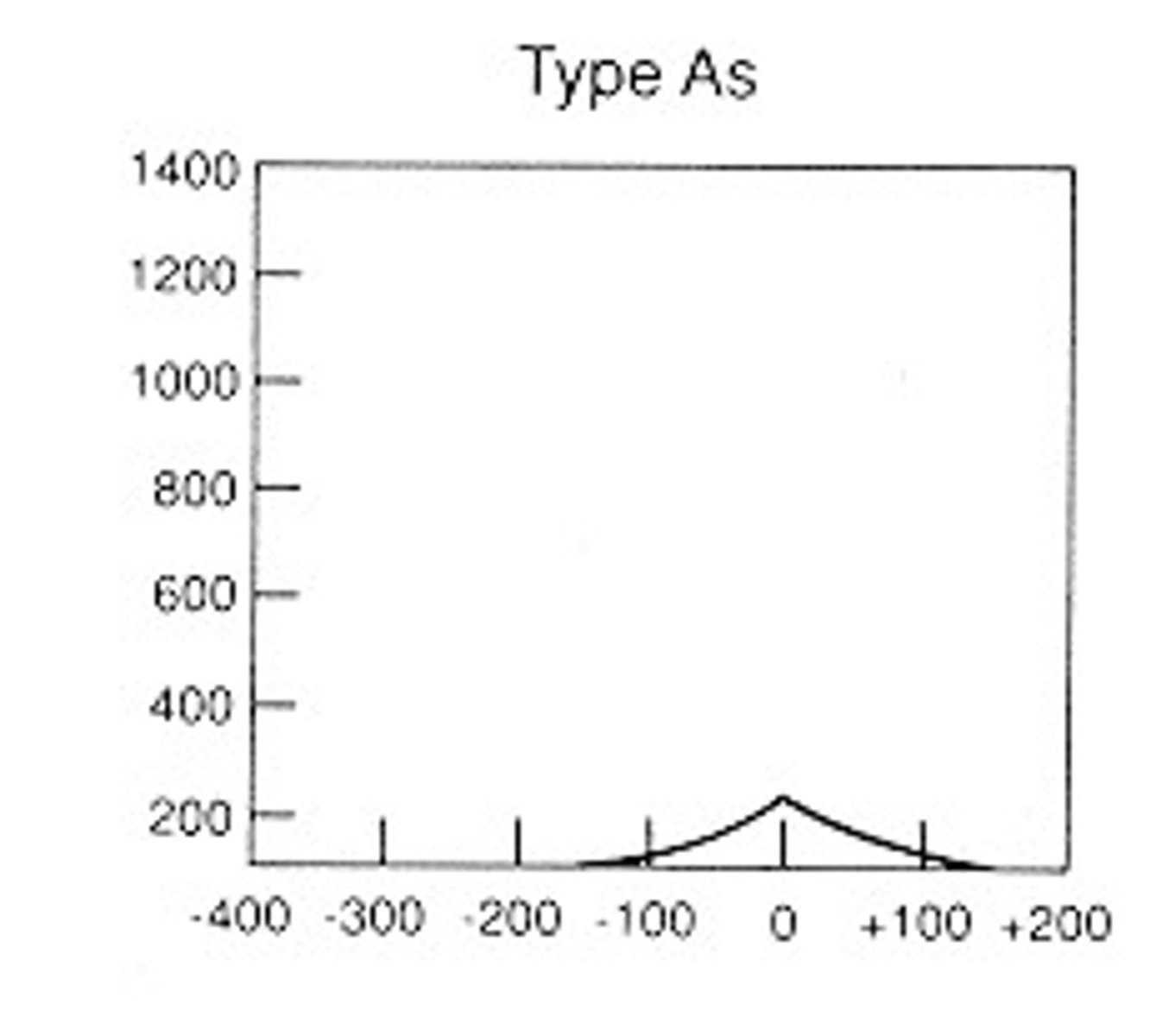
Type As
Tymps similar to a typical ear, but the peak is extremely low. The middle ear system becomes less compliant, more stiff.
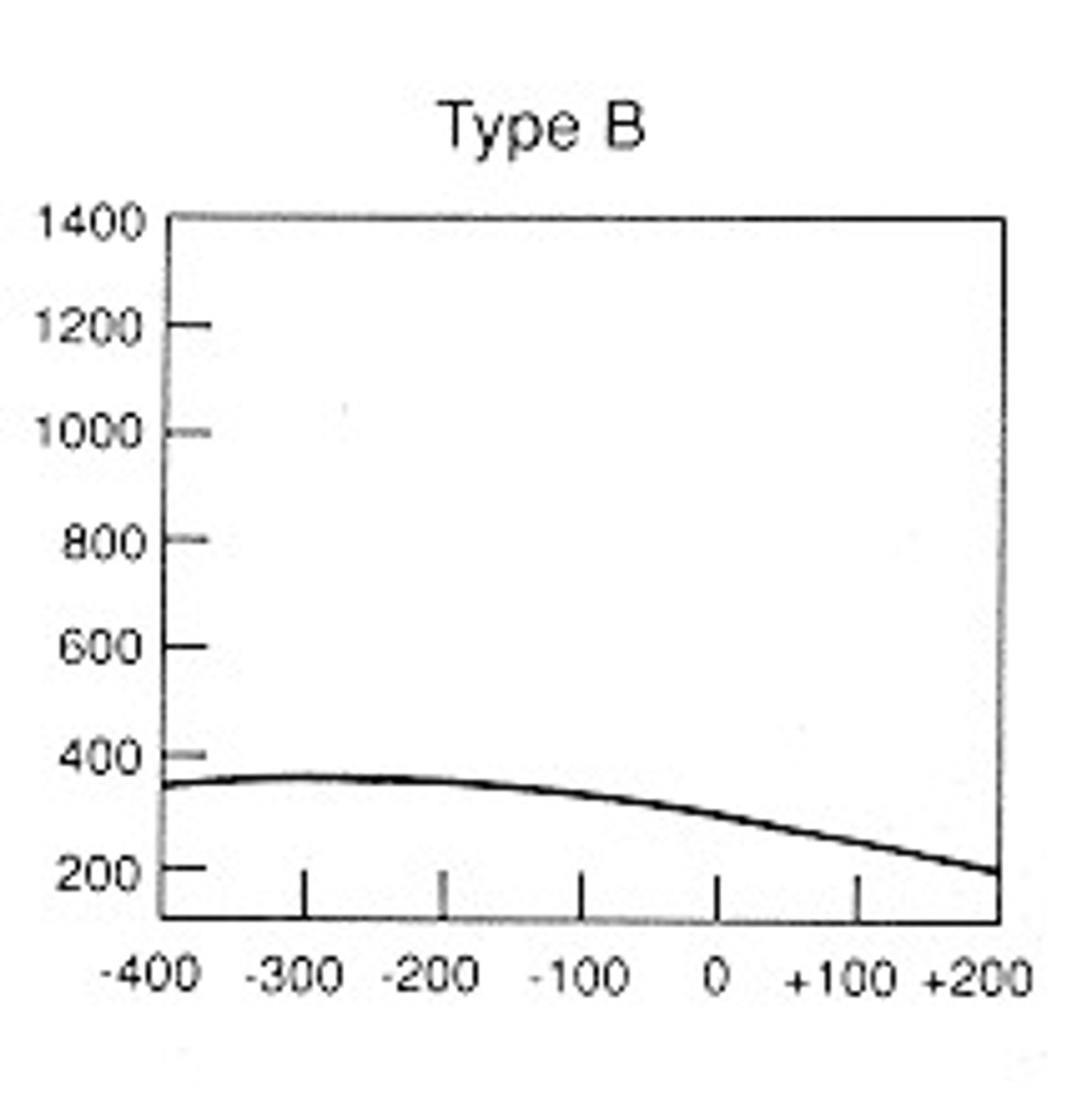
Type B
Flat, not able to match the air pressure between the ear canal and the middle ear, so no real peak. Can be caused by otitis media with effusion A condition characterized by inflammation and fluid accumulation behind the eardrum in the middle ear. Can be caused by a perforation in the tympanic membrane, since the change in the air pressure in the ear canal has not effect, so no real peak
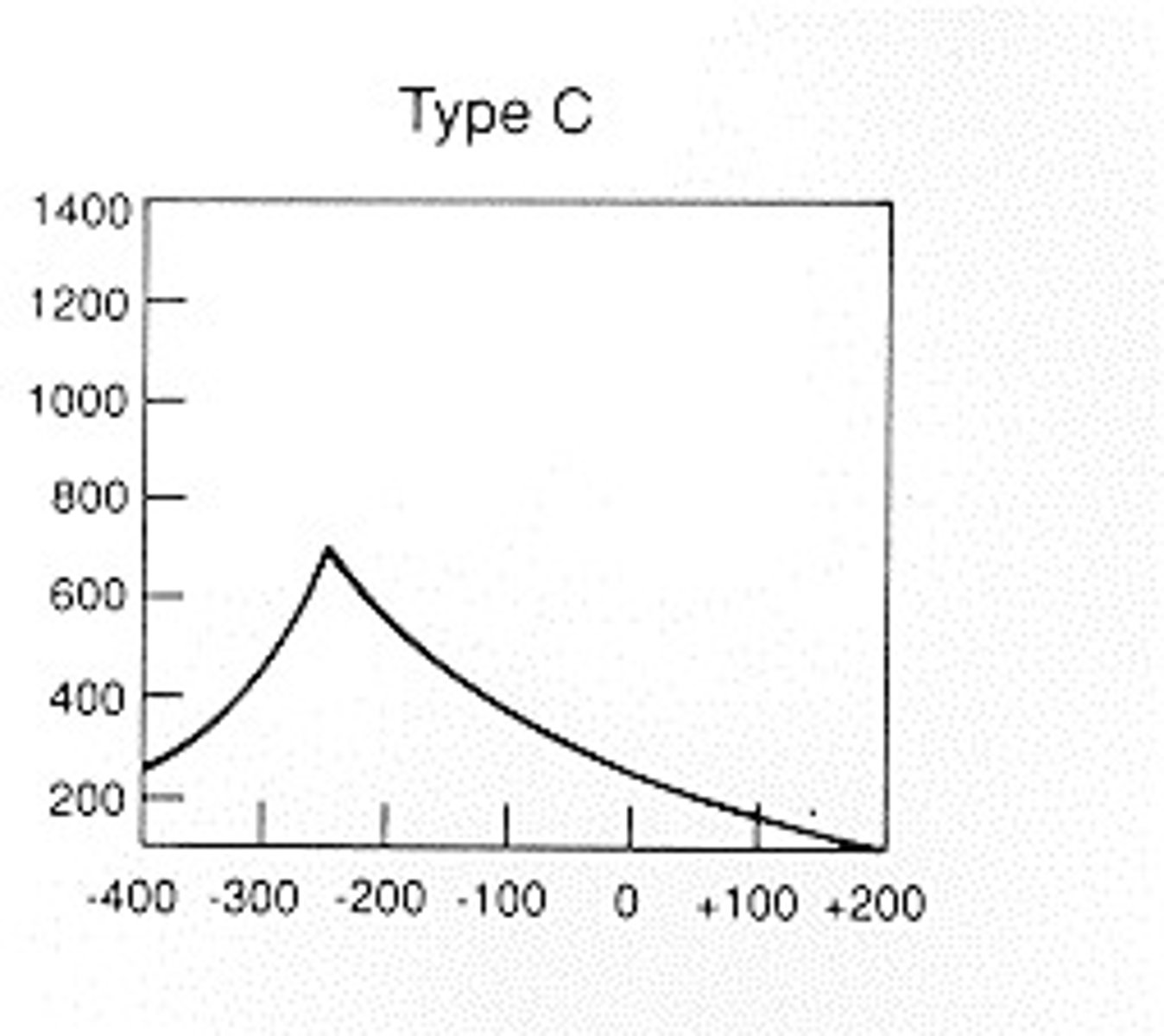
Type C
Still able to match the air pressure between the ear canal and the middle ear, but the peak is more negative. Can be caused by the eustachian tube malfunctioning by not opening properly resulting in a buildup of negative middle ear pressure
Acoustic Reflex
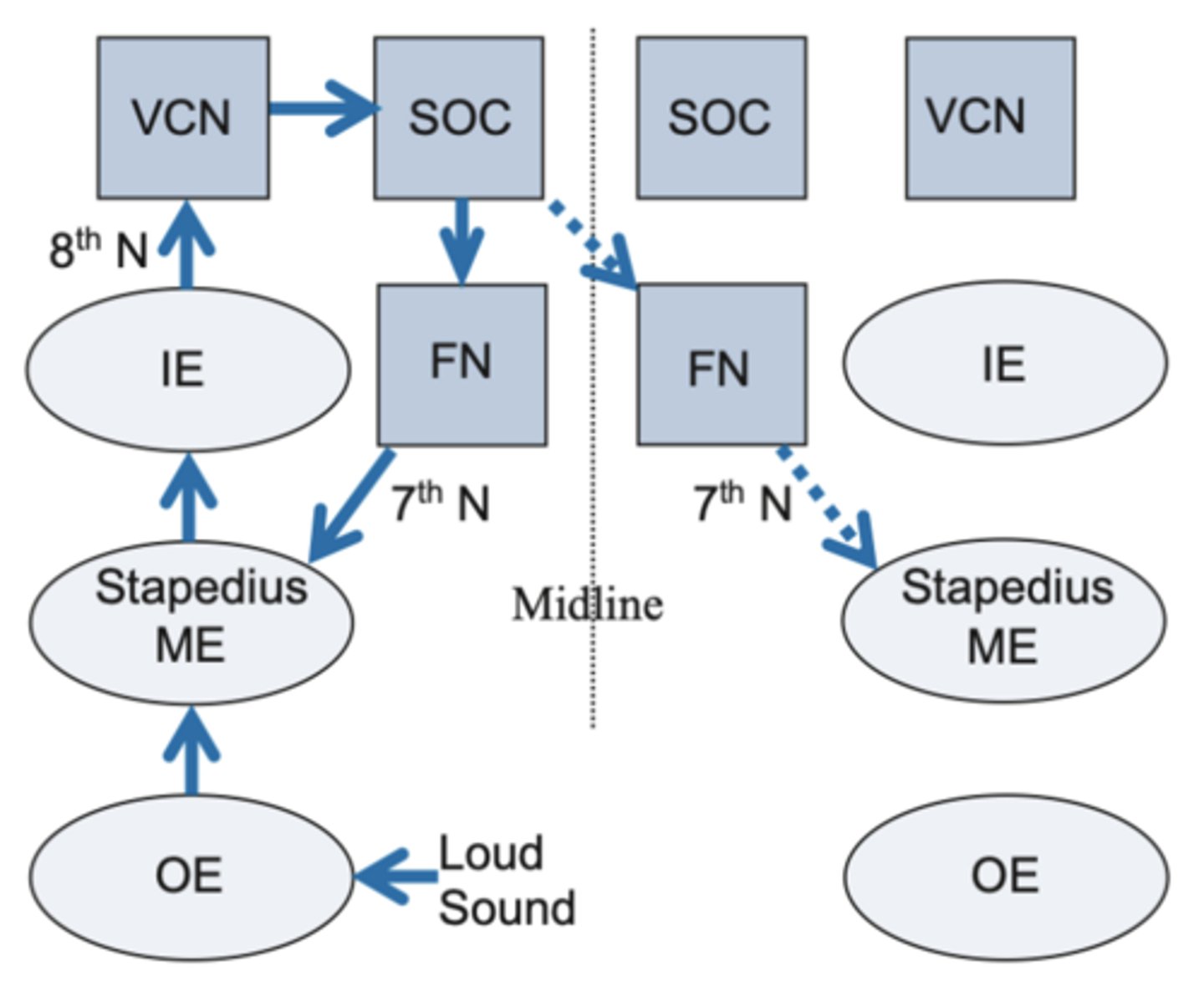
Stapedius muscle contracts reflexively and bilaterally in response to an intense sound presented to either ear. This causes the tympanic membrane to stiffen and decrease in admittance
Acoustic reflex reduces the admittance of the middle ear
What is the acoustic pathway?
See image
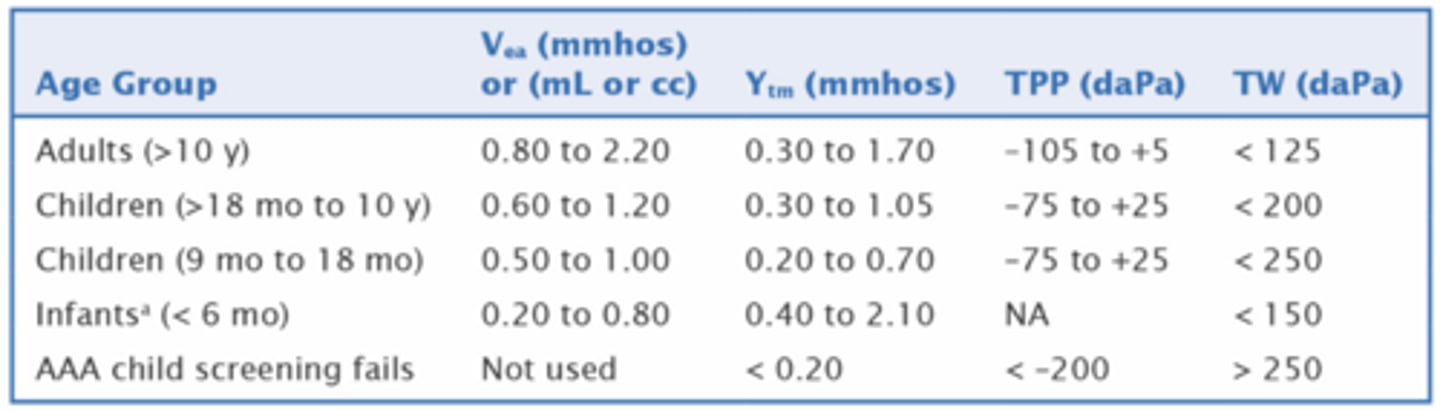
Normative Data
See image
Otoacoustic Emissions (OAEs)
Very low-level acoustic energy (-10 to 20 dB SPL) produced by the cochlea, with the primary sound coming from the active process of the outer hair cells
Auditory Brainstem Response (ABR)
Neuroelectric responses from the eighth cranial nerve and brainstem pathways in response to brief sounds, measured with electrodes on the surface of the head.
Describe the measurement of distortion product otoacoustic emissions (DPOAEs)
Requires at least 6 dB SNR (and at least -10 dB absolute amplitude) to be considered present/normal. 6 dB SNR means the OAE is present. The dB value should be at least -10; otherwise, it is not considered present. The -10 dB is only for the ear line, not the noise floor
What does the presence/absence of OAEs suggest about the ear condition/disorders?
The presence of OAEs suggests good OHC function, as well as normal middle and outer ear status
Absence of OAEs can occur with any degree of cochlear hearing loss, and (involving OHCs), a problem in the conductive parts of the ear
Describe the normal expected auditory brainstem response (ABR) waveform and neural generators
a series of 5-7 vertex-positive peaks (labeled I-VII) occurring within 10 ms of an auditory stimulus, reflecting synchronized neural activity along the auditory pathway.
What structures generate the ABR?
The Auditory Brainstem Response (ABR) is generated by synchronous neural activity within the auditory nerve and brainstem pathways, typically occurring within 10 ms of stimulation. Key generators include the auditory nerve (Wave I), cochlear nucleus (Wave II/III), superior olivary complex (Wave III/IV), and lateral lemniscus/inferior colliculus
How does the auditory brainstem response (ABR) changes with intensity?
When you make a sound louder, there is greater intensity, and more neurons are used
What does Pure Tone AC test?
The entire auditory structure
What does Pure Tone BC test?
Sensorinueral Mechanism
What do tymps test?
Outer ear, middle ear, NOT sensorineural
What do OAEs test?
Outer hair cells, cochlea, but also part of the conductive system
What does the ABR test?
Auditory nerve and the brainstem, if there is some conductive hearing loss that could affect the test
Determining the degree of hearing loss
Step 1: BC >25 dB HL = having sensorineural hearing loss, <25 dB HL = no sensorineural hearing loss
Step 2: ABG >10 dB HL = having conductive hearing loss, <10 dB HL = do not have conductive hearing loss
Explore top notes

