4.1.5.7 - Price Discrimination
 Call Kai
 Learn
Learn Practice Test
 Spaced Repetition
 Match
Match Flashcards
 Knowt Play
1/12

There's no tags or description
Looks like no tags are added yet.
Name | Mastery | Learn | Test | Matching | Spaced | Call with Kai |
|---|
No analytics yet
Send a link to your students to track their progress
13 Terms
Price Discrimination =
Charging different prices to different customers for the same product/service for reasons unrelated to the cost of production
1st Degree Price Discrimination
= Each consumer pays exactly the maximum price they are willing to pay
Eliminates consumer surplus
Conditions for 1st Degree Price Discrimination:
Perfect Knowledge of every customer’s maximum willingness to pay (reservation price)
Expensive & time-consuming
Examples of 1st Degree Price Discrimination
Auction house - letting people bid up the price - winning bidder pays at least the 2nd highest bidder’s reservation price
2nd Degree Price Discrimination
= Charging different prices based on the quantity of a good/service that the consumer buys, (for reasons unrelated to the cost of production)
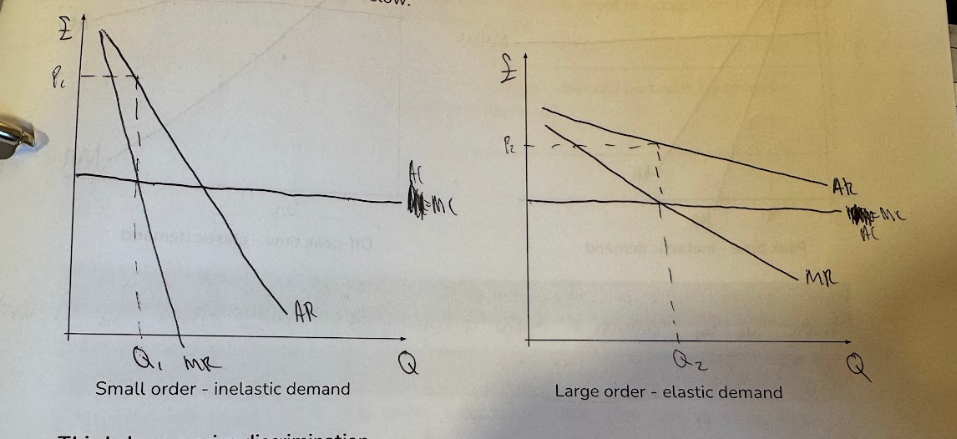
Example of 2nd Degree Price Discrimination with explanation & diagram
Bulk-buying discounts.
Consumers buying larger quantities have more price elastic demand.
This is because the expenditure is larger so consumer more sensitive to price changes, and have more incentive to look for savings as it would decrease amount spent more than for consumers only buying small quantity.
Therefore, at the profit-maxing point, price is lower at P2 for the larger order customer.
3rd Degree Price Discrimination
= Price discrimination based on splitting the market into different segments.
Examples of 3rd Degree Price Discrimination
Age - different ticket prices for age groups (children & pensioners discounts)
Time - peak vs off-peak train tickets, flights, taxis
Geographical - same good sold at higher price in richer area vs poorer area
Profession - discounts to military
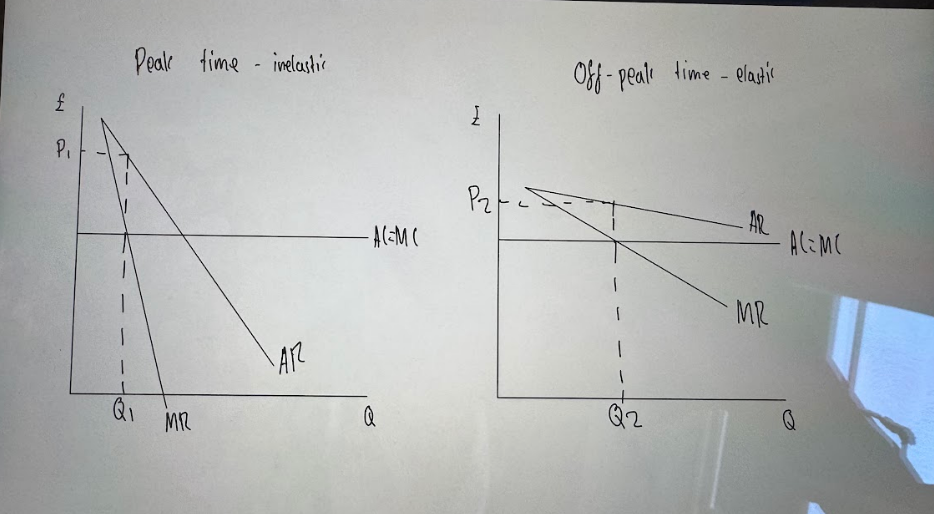
Diagram & Analysis of 3rd Degree Price Discrimination
Diagram the same as 2nd degree, but the reason for different elasticities is different.
For the example of Peak vs Off-peak train tickets:
At peak times, travelling home or to work is a necessity, so people are less sensitive to changes in price.
Therefore, demand is more inelastic so at profit-maxing point, price is higher at P1.
Conditions for 2nd & 3rd Degree Price Discrimination
Price-making power - Must be able to raise prices without losing all sales to competitors
Demand must have different elasticities in different segments - Otherwise profit-maxing price will be same in each segment
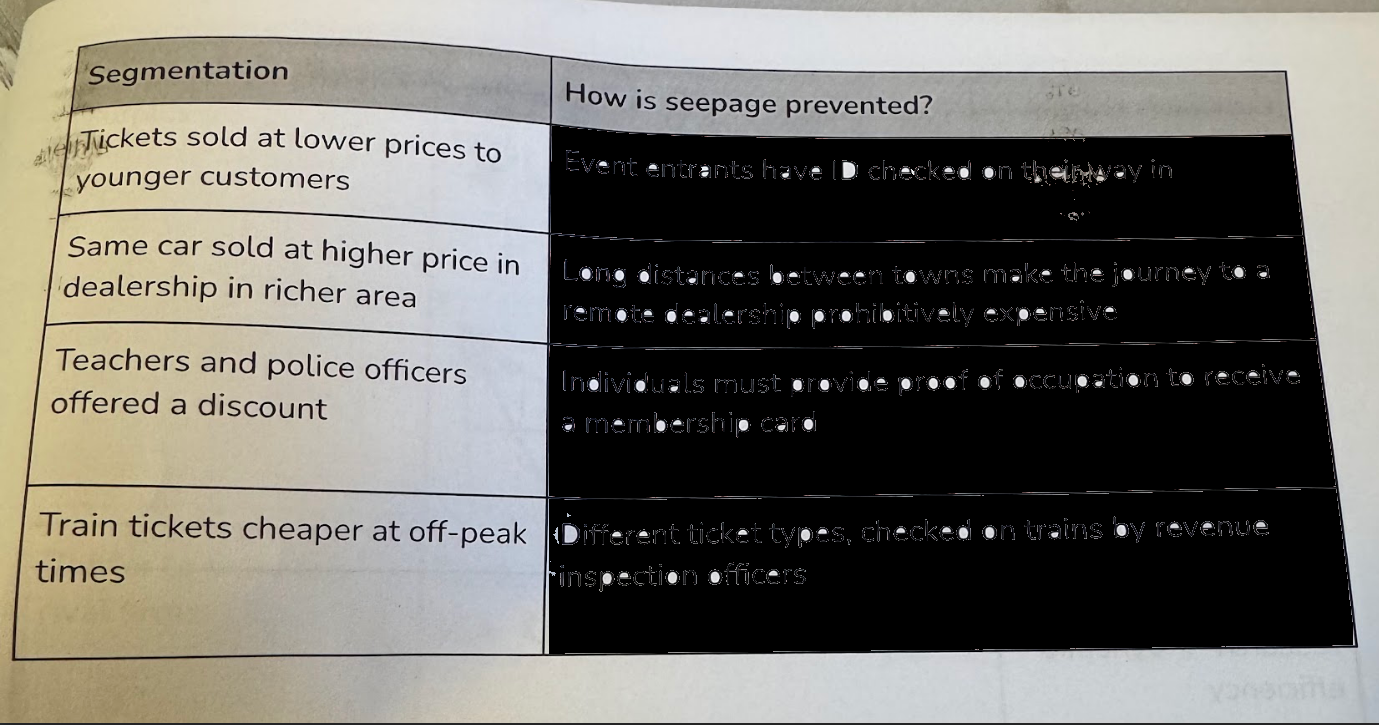
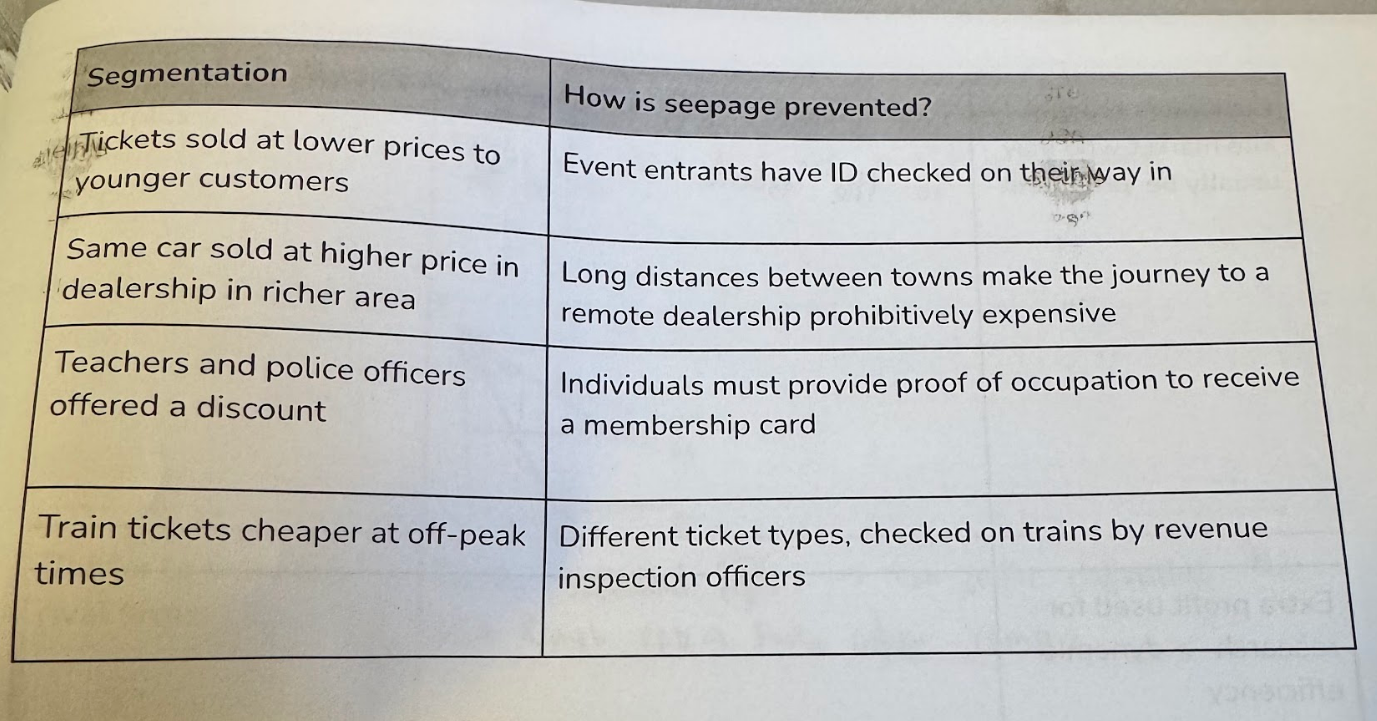
Prevent seepage - Must be able to prevent consumers from buying through other segments, otherwise all consumers will buy in the cheaper segment.
Advantages of Price Discrimination
Cross-subsidise - Profits from high-price segments can be used to subsidise activities that bring social benefits (e.g. free bus passes for pensioners)
Better use of spare capacitiy to prevent waste - Services like Flights & AirBnBs reduce prices over time so that all capacity is full.
New customers brought into market who would usually be ‘priced out’
Extra profit for firms - Can be reinvested for research → dynamic efficiency
Disadvantages of Price Discrimination
Exploitation of consumers - Consumers with more inelastic demand forced to buy in more expensive market segment → Firms can charge higher prices to more desparate / less well-informed customers, without losing sales in other segments.
Extraction of Consumer Surplus - Firms can raise prices in inelastic segment, reducing consumer surplus, without losing sales in other segments
Barrier to entry for rival firms - Making supernormal profits → Advantage for R&D & product differentiation → Reduces competition

