D1.1 DNA Replication

0.0(0)
studied byStudied by 0 people
0.0(0)
full-widthCall with Kai
learnLearn
examPractice Test
spaced repetitionSpaced Repetition
heart puzzleMatch
flashcardsFlashcards
GameKnowt Play
Card Sorting

1/24

encourage image

There's no tags or description

Looks like no tags are added yet.

Study Analytics
Name
Mastery
Learn
Test
Matching
Spaced
Call with Kai

No study sessions yet.

25 Terms

1
New cards

What is DNA replication?

The process of producing exact copies of DNA, which possess identical base sequences to original strand

2
New cards

Describe the functions of DNA replication (3)

Unicellular & multicellular organisms:

1) Reproduction - Allows transfer of genetic information to offspring → genetic continuity

Multicellular organisms: 

2) Growth - New cells require exact DNA copies for body growth 
3) Tissue repair - Damaged/old cells are replaced by new ones w/ same DNA

3
New cards

What is semi-conservative replication?

The process where a new DNA molecule is produced by one original and one newly synthesised strand

4
New cards

Describe the process of semi-conservative replication

  1. When DNA replicates, two strands of the double helix separates

  2. Each original strand serves as a template for a new complementary strand 

  3. This produces two identical DNA molecules containing: 

  • 1 original (parental) strand

  • 1 newly synthesised strand

5
New cards

Explain the role of complementary base pairing in replication (3)

  • DNA polymerase enzymes reads the template strand 

  • For each base on the template, DNA polymerase adds the complementary nucleotide to new strand 

    • This ensures genetic accuracy 

6
New cards

Define helicase

An enzyme separating the two strands of DNA double helix 

7
New cards

Explain how helicase works (3)

  1. Helicase breaks hydrogen bonds between complementary DNA bases 

  2. This action unwinds the double helix, separating the two strands

  3. Hence, creating the replication fork, where new strands can be synthesised

8
New cards

Define polymerase

An enzyme that synthesises new DNA strands by adding nucleotides to a growing chain

9
New cards

Explain how DNA polymerase works (4)

  1. DNA polymerase reads the original as a template strand 

  2. It adds complementary nucleotides by joining their 5’ phosphate to the 3’ hydroxyl (3’ end) of the growing strand → 5’ to 3’ direction

  3. Then, it catalyzes the formation of phosphodiester bonds between sugar of one nucleotide and phosphate of the next 

  4. This creates the sugar-phosphate backbone of the new DNA strand

10
New cards

Define PCR (Polymerase Chain Reaction)

A technique that amplifies DNA, creating millions of copies of a DNA sequence

11
New cards

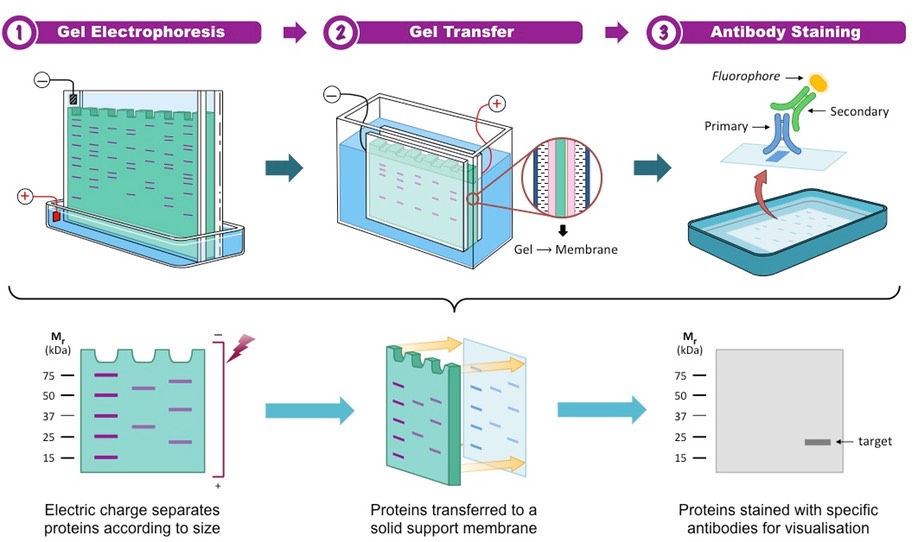
Define Gel Electrophoresis

A technique used to separate and analyse molecules based on size, charge, and shape (DNA, RNA, proteins)

12
New cards

What are they key components of PCR? (3)

  • Primers - Short DNA sequences that bind to the template

  • Taq Polymerase - A heat-resistant enzyme that synthesises new DNA strands

  • Thermal cycler - A machine that precisely controls temperature changes

13
New cards

Describe the process of PCR (8)

Stages

Explanation

1. Heating & seperating

  • DNA is heated to ~95°C → breaks hydrogen bonds between complementary base pairs 

  • This separates into 2 single strands

2. Cooling & annealing

  • The temperature is lowered to 50-65°C

  • Short DNA sequences (primers) bind to complementary sequences on each DNA template 

  • Primers mark starting point of DNA synthesis (where Taq polymerase binds) 

3. Reheating & extension 

  • Temperature is raised to 72°C, the optimum for Taq polymerase

  • Taq polymerase adds nucleotides to primers, synthesising new DNA strands from 5’ → 3’ 

  • After one cycle, DNA amount doubles

14
New cards

Describe the process of Gel Electrophoresis (8)

Stages

Explanation

1. Gel preparation 

A gel (usually agarose) is poured into a mold with wells at one end 

2. Loading DNA

DNA samples are mixed with a dye & loaded into wells 

3. Applying an electric field

The gel is placed in a buffer solution, & an electric current is applied:

  • Negative electrode near wells

  • Positive electrodes at opposite end 

4. DNA migration 

  • DNA is negatively charged due to phosphate backbone charge 

  • Repelled by negative attracted towards positive electrode → & moves toward positive 

  • Small fragments travel faster & farther, while larger move slower

<table style="min-width: 50px;"><colgroup><col style="min-width: 25px;"><col style="min-width: 25px;"></colgroup><tbody><tr><td colspan="1" rowspan="1" style="border-width: 1pt; border-style: solid; border-color: rgb(0, 0, 0); vertical-align: top; padding: 5pt; overflow: hidden; overflow-wrap: break-word;"><p><span style="background-color: transparent; font-family: &quot;Helvetica Neue&quot;, sans-serif;"><span>Stages</span></span></p></td><td colspan="1" rowspan="1" style="border-width: 1pt; border-style: solid; border-color: rgb(0, 0, 0); vertical-align: top; padding: 5pt; overflow: hidden; overflow-wrap: break-word;"><p><span style="background-color: transparent; font-family: &quot;Helvetica Neue&quot;, sans-serif;"><span>Explanation</span></span></p></td></tr><tr><td colspan="1" rowspan="1" style="border-width: 1pt; border-style: solid; border-color: rgb(0, 0, 0); vertical-align: top; padding: 5pt; overflow: hidden; overflow-wrap: break-word;"><p><span style="background-color: transparent; font-family: &quot;Helvetica Neue&quot;, sans-serif;"><strong><span>1. Gel preparation&nbsp;</span></strong></span></p></td><td colspan="1" rowspan="1" style="border-width: 1pt; border-style: solid; border-color: rgb(0, 0, 0); vertical-align: top; padding: 5pt; overflow: hidden; overflow-wrap: break-word;"><p><span style="background-color: transparent; font-family: &quot;Helvetica Neue&quot;, sans-serif;"><span>A gel (usually agarose) is poured into a mold with wells at one end&nbsp;</span></span></p></td></tr><tr><td colspan="1" rowspan="1" style="border-width: 1pt; border-style: solid; border-color: rgb(0, 0, 0); vertical-align: top; padding: 5pt; overflow: hidden; overflow-wrap: break-word;"><p><span style="background-color: transparent; font-family: &quot;Helvetica Neue&quot;, sans-serif;"><strong><span>2. Loading DNA</span></strong></span></p></td><td colspan="1" rowspan="1" style="border-width: 1pt; border-style: solid; border-color: rgb(0, 0, 0); vertical-align: top; padding: 5pt; overflow: hidden; overflow-wrap: break-word;"><p><span style="background-color: transparent; font-family: &quot;Helvetica Neue&quot;, sans-serif;"><span>DNA samples are mixed with a dye &amp; loaded into wells&nbsp;</span></span></p></td></tr><tr><td colspan="1" rowspan="1" style="border-width: 1pt; border-style: solid; border-color: rgb(0, 0, 0); vertical-align: top; padding: 5pt; overflow: hidden; overflow-wrap: break-word;"><p><span style="background-color: transparent; font-family: &quot;Helvetica Neue&quot;, sans-serif;"><strong><span>3. Applying an electric field</span></strong></span></p></td><td colspan="1" rowspan="1" style="border-width: 1pt; border-style: solid; border-color: rgb(0, 0, 0); vertical-align: top; padding: 5pt; overflow: hidden; overflow-wrap: break-word;"><p><span style="background-color: transparent; font-family: &quot;Helvetica Neue&quot;, sans-serif;"><span>The gel is placed in a buffer solution, &amp; an electric current is applied:</span></span></p><ul><li><p><span style="background-color: transparent; font-family: &quot;Helvetica Neue&quot;, sans-serif;"><span>Negative electrode near wells</span></span></p></li><li><p><span style="background-color: transparent; font-family: &quot;Helvetica Neue&quot;, sans-serif;"><span>Positive electrodes at opposite end&nbsp;</span></span></p></li></ul></td></tr><tr><td colspan="1" rowspan="1" style="border-width: 1pt; border-style: solid; border-color: rgb(0, 0, 0); vertical-align: top; padding: 5pt; overflow: hidden; overflow-wrap: break-word;"><p><span style="background-color: transparent; font-family: &quot;Helvetica Neue&quot;, sans-serif;"><strong><span>4. DNA migration&nbsp;</span></strong></span></p></td><td colspan="1" rowspan="1" style="border-width: 1pt; border-style: solid; border-color: rgb(0, 0, 0); vertical-align: top; padding: 5pt; overflow: hidden; overflow-wrap: break-word;"><ul><li><p><span style="background-color: transparent; font-family: &quot;Helvetica Neue&quot;, sans-serif;"><span>DNA is negatively charged due to phosphate backbone charge&nbsp;</span></span></p></li><li><p><span style="background-color: transparent; font-family: &quot;Helvetica Neue&quot;, sans-serif;"><span>Repelled by negative attracted towards positive electrode → &amp; moves toward positive&nbsp;</span></span></p></li><li><p><span style="background-color: transparent; font-family: &quot;Helvetica Neue&quot;, sans-serif;"><span>Small fragments travel faster &amp; farther, while larger move slower</span></span></p></li></ul></td></tr></tbody></table><p></p>
15
New cards

Describe the uses of PCR & Gel Electrophoresis (3)

1) DNA profiling - A technique used to identify individuals based on unique patterns in their DNA


Examples: 

  • In forensic investigations, crime scene DNA is matched to suspects

  • Paternity testing by comparing DNA 

2) Medical diagnostics - PCR identifies pathogens in infectious diseases by amplifying specific DNA sequences (e.g. viral DNA in COVID-19 testing) 

3) Evolutionary biology - Both enable study of genetic mutations & diversity in populations

16
New cards

Describe the terminals of DNA strands (3)

DNA strands have two distinct ends, giving 5’ to 3’ directionality:

  • 5’ end = where phosphate group is attached to 5’ carbon of pentose sugar 

  • 3’ end = where hydroxyl group (-OH) is attached to 3’ carbon of sugar

17
New cards

Describe how DNA strands are anti-parallel

  • DNA strands runs in opposite directions

    • One strand: 5' → 3' (leading strand direction)

    • Other strand: 3' → 5' (lagging strand direction)

18
New cards

Describe features of the leading strand (3)

  • DNA polymerase moves in the same direction as replication fork (5’ to 3’)

  • New DNA is made smoothly & continuously 

  • Only one RNA primer is needed at the start

19
New cards

Describe features of the lagging strand (4)

  • DNA polymerase moves opposite to the replication fork (3’ to 5’)

  • Synthesizes DNA discontinuously, in short Okazaki fragments

  • Requires multiple RNA primers, one for each fragment 

  • Fragments are later joined by DNA ligase 

20
New cards

What is the function of primase?

An enzyme that synthesises RNA primers on DNA template → initiate DNA synthesis by polymerase III

21
New cards

What are the functions of DNA polymerase III? (3)

1) Adds DNA nucleotides to 3’ end of a new strand

2) Synthesises DNA continuously on leading strand & discontinuous on lagging strand

3) Has proofreading function to ensure accuracy in DNA replication

22
New cards

What are the functions of DNA polymerase I? (3)

1) Removes RNA primers from new DNA strand

2) Replaces RNA primers w/ DNA nucleotides

3) Proofreading function to maintain accuracy in DNA replication

23
New cards

What are the functions of DNA ligase? (3)

1) Seals gaps between Okazaki fragments on lagging strand 

2) Forms phosphodiester bonds between adjacent nucleotides

→ Ensures continuous DNA strand forms 

24
New cards

Why is DNA proofreading neccessary? (2)

  • Although DNA replication is usually very accurate, sometimes mismatches can happen

  • Proofreading reduces errors → preventing mutations and maintaining genetic stability

25
New cards

Describe the process of DNA proofreading (5)

Stages

Explanation

1. Mismatch detection

  • DNA polymerase III checks the newly added nucleotide

  • If base pairing is incorrect (e.g., A + C), hydrogen bonds are unstable, signaling an error

2. Exonuclease activity

Built-in 3’ → 5’ exonuclease function enables enzymes to:

  • Pause, reverse direction, & remove incorrect nucleotide from 3' end 

3. Correct replacement 

DNA polymerase III adds correct nucleotide & resumes synthesis in 5’ to 3’ direction