102.4-102.6 practice quiz (anatomy)
0.0(0)
 Studied by 15 people
 Call Kai
 Learn
Learn Practice Test
 Spaced Repetition
 Match
Match Flashcards
 Knowt Play
Card Sorting
1/111

Earn XP
Description and Tags
anatomy
Last updated 10:20 PM on 4/2/23
Name | Mastery | Learn | Test | Matching | Spaced | Call with Kai |
|---|
No analytics yet
Send a link to your students to track their progress
112 Terms
1
New cards
A separate body structure composed of two or more different tissues is a(n)
organ
2
New cards
All of the following are bones of the cranium EXCEPT
metacarpal
3
New cards
Another name for the kneecap is
patella
4
New cards
Of the eight bones that compose the cranium, how many are affected by scalp massage?
frontal
5
New cards
Osteology is the study of:
bones
6
New cards
The 14 bones of the foot that form the digits are known as the:
phalanges
7
New cards
The 5 long, thin bones that form the palm of the hand are the
metacarpals
8
New cards
The 8 carpals held together with ligaments make up the
wrist
9
New cards
The bone located behind the eyes and nose that connects all the bones of the cranium is known as the:
sphenoid bone
10
New cards
The bone located on the little-finger side of the lower arm is the:
ulna
11
New cards
The bone that extends from the top of the eyes to the top of the head and forms the forehead is called the
frontal bone
12
New cards
The bone that forms the area from the throat to the shoulder is known as the:
clavicle
13
New cards
The bone that forms the back of the skull, indenting above the nape area, is the
occipital
14
New cards
The bone that makes up the lower jaw and is the largest bone of the facial skeleton is the:
mandible
15
New cards
The fourteen bones that form the digits or fingers of the hands are called the:
phalanges
16
New cards
The large, flat bone extending from the middle of the back upward to the joint where it attaches to the clavicle is called the:
scapula
17
New cards
The outer and narrower of the 2 lower leg bones, extending from the knee to the ankle, is known as the:
fibula
18
New cards
The parietal bones form the:
crown and upper sides of the head
19
New cards
The point at which two or more bones are joined together is called a:
joint
20
New cards
The seven bones that form the top part of the spinal column and are often manipulated in extended scalp massage are called the:
cervical vertebrae
21
New cards
The smallest two bones of the facial skeleton that form the front part of the inner, bottom wall of the eye socket are called the
lacrimal
22
New cards
The spongy bone found between the eyes that forms part of the nasal cavity is called the
ethmoid
23
New cards
The thumb has how many phalanges?
2
24
New cards
The two bones located on either side of the head, directly above the ears and below the parietal bones are the:
temporal bones
25
New cards
The two bones that form the upper jaw are the:
maxillae
26
New cards
The upper cheek and bottom of the eye socket are formed by the malar, also called:
zygomatic
27
New cards
The zygomatic bones are the two bones that form the:
upper cheek and the bottom of the eye socket
28
New cards
What is the technical term for bone?
os
29
New cards
Which body system has the function to give the body shape and strength?
skeletal system
30
New cards
Which of the following is NOT a function of the skeletal system?
sending and receiving body messages
31
New cards
Which of the following is the largest bone of the upper arm that extends from the elbow to the shoulder?
humerus
32
New cards
Which of the following is the thigh bone or the longest bone in the body?
femur
33
New cards
Which system has the function of surrounding and protecting internal organs?
skeletal system
34
New cards
Which system is the physical foundation of the body?
skeletal system
35
New cards
Which two bones join to form the bridge of the nose?
nasal
36
New cards
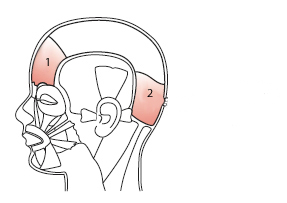
In the graphic below, what muscle does number 2 indicate?
occipitalis
37
New cards
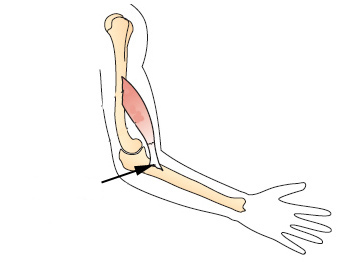
In the graphic below, what portion of the muscle is indicated by the arrow?
insertion
38
New cards
Located above the corners of the mouth, which muscle raises the angle of the mouth, as in snarling?
caninus
39
New cards
Muscle makes up approximately what percentage of the body's weight?
40% to 50%
40
New cards
Muscles affected by massage are generally manipulated from the:
insertion attachment to origin attachment
41
New cards
Muscles that draw the fingers together are called:
adductors
42
New cards
Muscles that separate the fingers are called:
abductors
43
New cards
Myology is the study of the structure, function and diseases of the:
muscles
44
New cards
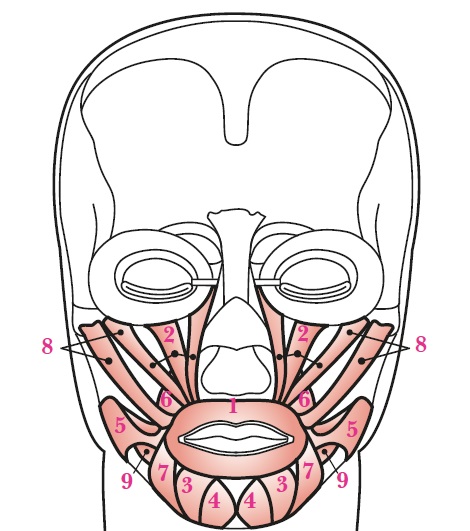
Number 1 in the diagram below illustrates the muscle that circles the mouth, contracts the lips and is known as:
orbicularis oris
45
New cards
One function of the muscular system includes supporting the
skeletal system
46
New cards
Raising the upper lip is accomplished by which of the following muscles?
quadratus labii superioris
47
New cards
The coordination of which two muscles enables the body to perform chewing (mastication)?
temporalis and masseter
48
New cards
The epicranius is formed by two muscles called the frontalis and the:
occipitalis
49
New cards
The frontalis and occipitalis muscles are joined by a tendon called the:
aponeurosis
50
New cards
The function of the masseter muscle is to
close the jaw
51
New cards
The midsection of the muscle is called the:
belly
52
New cards
The muscle located above and in front of the ear that performs both opening and closing the jaw, as in chewing, is called the
temporalis
53
New cards
The muscle located below the lower lip that pulls the lower lip down or to the side is known as the:
quadratus labii inferioris
54
New cards
The muscle located between the jaws and cheek that is responsible for compressing the cheek to release air outwardly, as in blowing is called the:
buccinator
55
New cards
The muscle located under the arm that helps in lifting the arm and in breathing is called:
serratus anterior
56
New cards
The muscle of the heart itself and the only muscle of its type in the human body is the:
cardiac muscle
57
New cards
The muscle that aids in drawing the head back and elevating the shoulder blades is known as the:
trapezius
58
New cards
The muscle that causes the foot to invert and turn outward is the:
peroneus longus
59
New cards
The muscle that circles the mouth and is responsible for contracting, puckering and wrinkling the lips, as in kissing or whistling, is known as:
orbicularis oris
60
New cards
The muscle that controls the eyebrows, drawing them in and downward is the:
corrugator
61
New cards
The muscle that runs across the front of the lower part of the radius and the ulna and turns the palm of the hand downward and inward is the:
pronator
62
New cards
The muscle that turns the palm of the hand up is the:
supinator
63
New cards
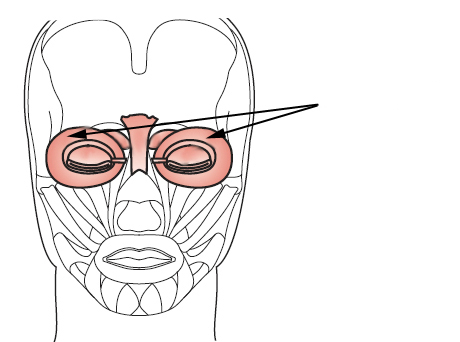
The muscles shown below control the closing of the eyelids and are known as:
orbicularis oculi
64
New cards
The muscles that assist in swinging the arms and extend across the front of the chest are called:
pectoralis major and pectoralis minor
65
New cards
The muscles that cause the thumb to move toward the fingers, giving the ability to grasp or make a fist are called:
opponens
66
New cards
The muscles that respond to commands regulated by will are referred to as:
striated
67
New cards
The nonmoving portion of the muscle attached to bone or another fixed muscle is the
origin
68
New cards
The occipitalis muscle is located at the nape of the neck and draws the scalp:
back
69
New cards
The portion of the muscle that is joined to the movable attachments: bones, movable muscle or skin, is known as the:
insertion
70
New cards
The risorius is located at the corner of the mouth and draws the mouth up and out, as in the expression of:
grinning
71
New cards
The salon professional is primarily concerned with which type of muscles found in the head, face, neck, hands and arms?
voluntary
72
New cards
The triangle-shaped muscle that lifts the arm or turns it is the:
deltoid
73
New cards
What term means "in front of"?
anterior
74
New cards
Which muscle bends the wrist and closes the fingers?
flexor
75
New cards
Which muscle is responsible for drawing down the brow and wrinkling the area across the bridge of the nose?
procerus
76
New cards
Which muscle is used when nodding yes or no?
sternocleido mastoideus
77
New cards
Which muscle straightens the fingers and wrist?
extensor
78
New cards
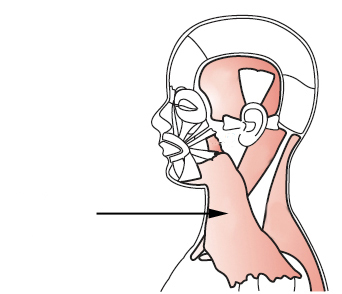
Which muscle, illustrated below, draws the lower lip and corner of the mouth sideways and down, partially opening the mouth, as in surprise or fright?
platysma
79
New cards
Which of the following is NOT a part of the muscle?
tibia
80
New cards
Which of the following muscles flexes the joint of the small toe?
flexor digiti minimi brevis
81
New cards
Which of the following muscles is located on the outside of the lower leg and bends the foot up and extends the toes?
extensor digitorum longus
82
New cards
Which of the following muscles moves the big toe away from the other toes?
abductor hallucis
83
New cards
Which type of muscle responds automatically to control various body functions?
non-striated
84
New cards
Groups of cells of the same kind make up:
tissues
85
New cards
Most of the activities of the cell take place in the:
cytoplasm
86
New cards
Organs that eliminate water and waste products are the:
kidneys
87
New cards
The chemical process in which cells receive nutrients for cell growth and reproduction is known as:
metabolism
88
New cards
The control center of cell activities is called the:
nucleus
89
New cards
The function of the lungs is to:
supply the blood with oxygen
90
New cards
The organ responsible for removing toxic byproducts of digestion is the
liver
91
New cards
The organ that controls all body functions is the
brain
92
New cards
The outer surface of the cell that encloses the protoplasm is known as the:
cell membrane
93
New cards
The primary function of the excretory system is to:
eliminate waste products from the body
94
New cards
The process of building up larger molecules from small ones is:
anabolism
95
New cards
The purpose of the heart is to:
circulate blood
96
New cards
The release of energy within a cell necessary for the performance of specific body functions is called:
catabolism
97
New cards
The stomach and which other organ are responsible for digesting food?
intestines
98
New cards
The study of structures that can be seen with the naked eye is called:
gross anatomy
99
New cards
The study of structures too small to be seen without using a microscope is called
microscopic anatomy
100
New cards
The study of the functions of the organs and systems of the body is known as
physiology
 Note
Note  Flashcards (40)