Chapter 10: Meiosis and Sexual Life Cycles
 Call Kai
 Learn
Learn Practice Test
 Spaced Repetition
 Match
Match Flashcards
 Knowt Play
1/62

Earn XP
Description and Tags
These flashcards cover key terms and concepts related to meiosis and sexual life cycles, as highlighted in the lecture notes.
Name | Mastery | Learn | Test | Matching | Spaced | Call with Kai |
|---|
No analytics yet
Send a link to your students to track their progress
63 Terms
Meiosis
A process that reduces the number of chromosome sets from diploid to haploid, resulting in four genetically distinct daughter cells.
Heredity
The transmission of traits from one generation to the next.
Chromosomes
Structures that package DNA, containing genes which are units of heredity.
Gametes
Reproductive cells (sperm and eggs) that carry genes to the next generation.
Karyotype
An ordered display of pairs of chromosomes from a cell, showing their number and structure.
Homologous Chromosomes
Chromosome pairs, one from each parent, that are similar in shape, length, and genetic information.
Tetrad
A group of four chromatids formed during meiosis, consisting of a pair of homologous chromosomes.
Crossing Over
The exchange of genetic material between nonsister chromatids during prophase I of meiosis.
Independent Assortment
The random orientation of homologous chromosome pairs during metaphase I of meiosis, contributing to genetic variation.
Zygote
The fertilized egg formed by the union of male and female gametes.
Diploid
A cell that contains two sets of chromosomes (2n); for humans, this is 46 chromosomes.
Haploid
A cell that contains a single set of chromosomes (n); for humans, this is 23 chromosomes.
Fertilization
The process of union between sperm and egg, resulting in the formation of a zygote.
Autosomes
Non-sex chromosomes that are not directly involved in determining the sex of an organism.
Alleles
Different versions of a gene that arise through mutation and contribute to genetic variation.
Mutations
Changes in the DNA sequence that can create new alleles and contribute to genetic diversity.
Recombinant Chromosomes
Chromosomes that result from the crossing over of homologous chromosomes, containing genes from both parents.
Synapsis
The pairing of homologous chromosomes during meiosis, allowing for crossing over to occur.
Cohesion
The mechanism that keeps sister chromatids together until they are separated during cell division.
Natural Selection
The process through which traits that enhance survival and reproduction become more common in a population.
How many parents are involved in asexual reproduction, and what is the genetic outcome?
A single individual passes all genes to offspring without gamete fusion, creating genetically identical clones.
What characterizes sexual reproduction?
Two parents give rise to offspring with unique combinations of genes.
What is the specific location of a gene on a chromosome called?
locus
What are the units of heredity made of DNA segments?
Genes
What is a Karyotype?
An ordered display of pairs of chromosomes from a cell
Define Homologous Chromosomes (Homologs).
A pair of chromosomes of the same length and shape that carry genes controlling the same inherited characters.
What is a Tetrad?
A homologous pair in sister chromatid form (four chromatids total)
Distinguish between Autosomes and Sex Chromosomes.
Humans have 22 pairs of autosomes and 1 pair of sex chromosomes (XX for females, XY for males).
What is the diploid (2n) and haploid (n) number for humans?
Diploid (2n) = 46; Haploid (n) = 23
What is a Zygote?
A fertilized egg containing one set of chromosomes from each parent (diploid).
Which life cycle stage is unique to plants and some algae?
Alternation of generations, which includes both diploid (sporophyte) and haploid (gametophyte) multicellular stages
What is the only diploid stage in most fungi?
The single-celled zygote (there is no multicellular diploid stage)
What occurs during Meiosis I?
Homologous chromosomes separate, resulting in two haploid daughter cells with duplicated chromosomes
What occurs during Meiosis II?
Sister chromatids separate, resulting in four genetically distinct haploid daughter cells.
Define Synapsis and Crossing Over.
During Prophase I, homologous chromosomes physically connect (synapsis) and exchange DNA segments (crossing over) at regions called chiasmata
When does DNA synthesis occur for Meiosis?
Only during Interphase before Meiosis I begins
What are the three mechanisms that contribute to genetic variation?
1. Independent assortment of chromosomes (Metaphase I) 2. Crossing over (Prophase I), random fertilization
How many possible chromosome combinations can result from independent assortment in humans?
8.4 million
What is the original source of all genetic diversity?
Mutations, which create different versions of genes called alleles
Homologous chromosomes align in the middle of the cell.
Metaphase I
Sister chromatids migrate to opposite poles
Anaphase II.
Synapsis occurs
Prophase I.
Four daughter cells are formed
Telophase II/Cytokinesis
What are the three events unique to Meiosis I?
Synapsis and crossing over (Prophase I), Homologous pairs at the metaphase plate (Metaphase I)., Separation of homologs (Anaphase I)
At what specific stage do homologous chromosomes (tetrads) align in the center of the cell?
Metaphase I.
At what stage do sister chromatids align in a single-file line at the center of the cell?
Metaphase II.
How does the genetic outcome of Mitosis differ from Meiosis?
Mitosis produces two genetically identical diploid (2n) cells; Meiosis produces four genetically unique haploid (n) cells.
Which process is used for growth and tissue repair, and which is used for gamete production?
Mitosis is for growth and repair; Meiosis is for producing gametes (sperm and eggs).
What is the specific role of Independent Assortment?
Each pair of chromosomes orients randomly at Metaphase I, meaning each daughter cell has a 50% chance of getting a specific maternal or paternal chromosome.
How does Crossing Over create "Recombinant Chromosomes"?
It combines DNA inherited from two parents into a single chromosome, creating brand-new genetic combinations.
Why is genetic variation important for Natural Selection?
It results in the accumulation of genetic variations favored by the environment, allowing a population to survive changing conditions.
At the end of this stage, there are 2 haploid cells with a set of duplicated chromosomes.
Telophase I / Cytokinesis.
Sister chromatids separate and go to opposite poles.
Anaphase II.
If homologs separate?
it is Anaphase I
When is DNA synthesized for Meiosis?
During the S phase of Interphase before Meiosis I only.
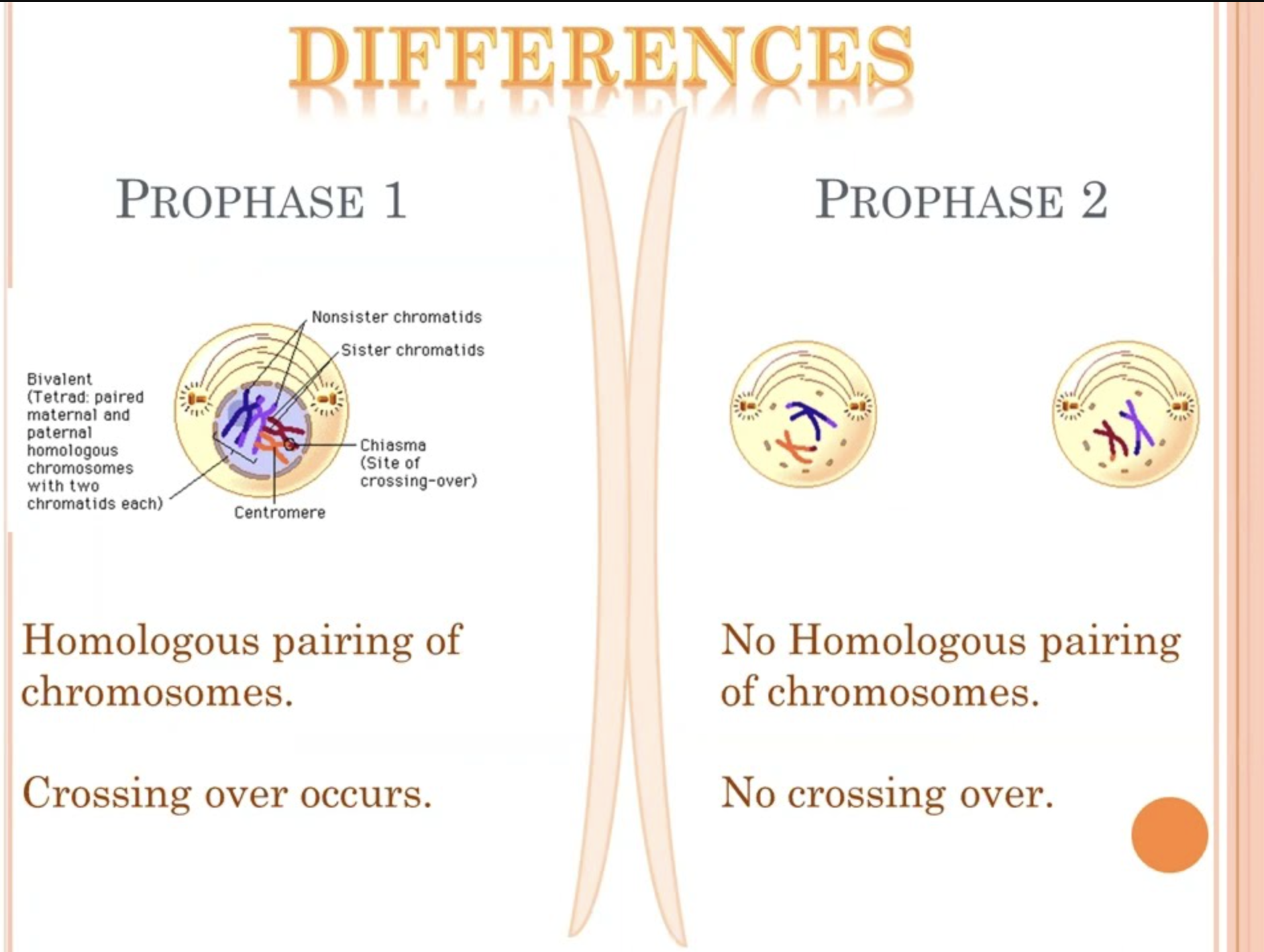
Prophase I vs Prophase II
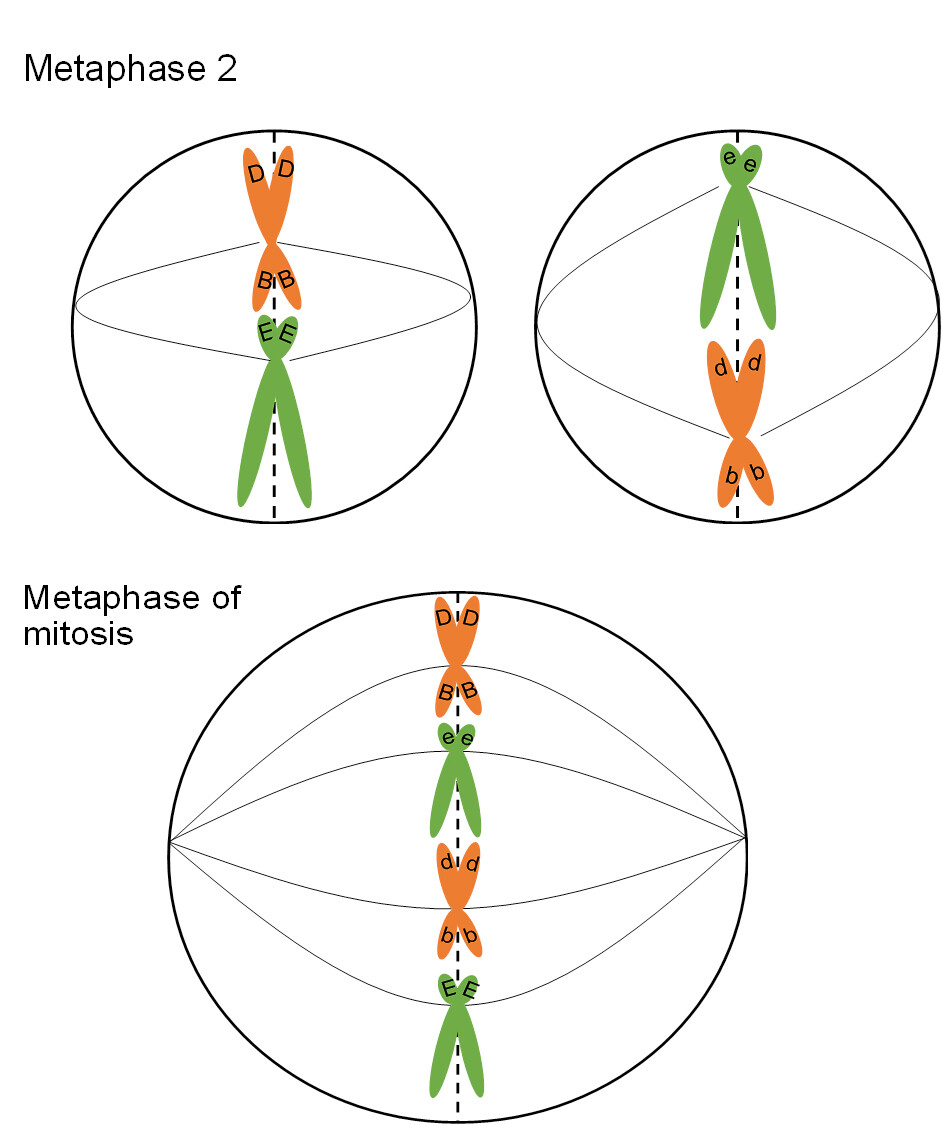
Metaphase I vs. Metaphase II:
Somatic Cell
46 chromosomes
Gamete (Sperm/Egg):
23 chromosomes (Haploid/n)
compare the life cycles of animals, plants, and fungi.
Animals: Only the gametes are haploid; the multicellular organism is diploid. Plants Have both a multicellular diploid stage (sporophyte) and (gametophyte).
The only diploid stage is the single-celled zygote; there is no multicellular diploid stage.
Fungi/Protists
A gene is the unit of DNA; an allele is the version of that gene (e.g., gene for eye color, allele for blue eyes).
True

