Models, Errors and the Normal Distribution

0.0(0)
studied byStudied by 0 people
0.0(0)
full-widthCall Kai
learnLearn
examPractice Test
spaced repetitionSpaced Repetition
heart puzzleMatch
flashcardsFlashcards
GameKnowt Play
Card Sorting

1/16

encourage image

There's no tags or description

Looks like no tags are added yet.

Study Analytics
Name
Mastery
Learn
Test
Matching
Spaced

No study sessions yet.

17 Terms

1
New cards

Formula

Error =

Error = Data - Model

𝑒𝑟𝑟𝑜𝑟𝑖 = 𝑦𝑖ŷ𝑖

2
New cards

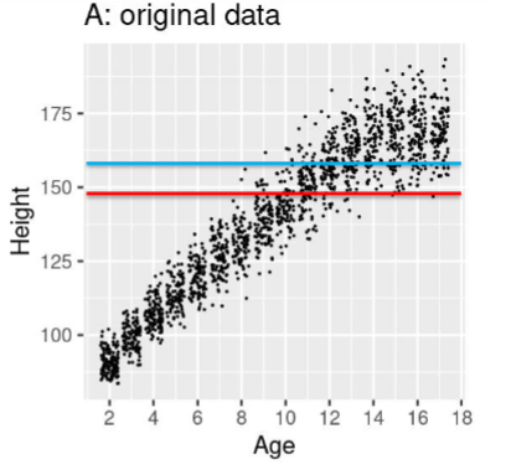
Mode as measuring error

ŷ𝑖

  • The most common value

  • A very simplified measure

3
New cards

Mean as measuring error

  • Summing all data points then dividing by number of data points - Ȳ represents the mean.

  • Looks at the average value.

  • Poor measure of error - allows values to cancel each other out.
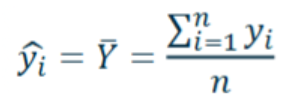
<ul><li><p>Summing all data points then dividing by number of data points - Ȳ represents the mean.</p></li><li><p>Looks at the average value.</p></li><li><p>Poor measure of error - allows values to cancel each other out.</p></li></ul><p></p>
4
New cards

Squared error as measuring error

𝑒𝑟𝑟𝑜𝑟𝑖 = (𝑦𝑖ŷ𝑖)2

Can only be positive because you're squaring it.

5
New cards

Sum Squared Error (SSE) as measuring error

Sums all of the data points
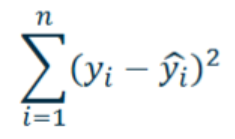
<p>Sums all of the data points</p>
6
New cards

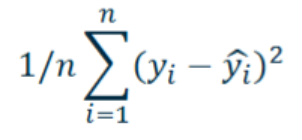
Mean Squared Error (MSE) as measuring error

  • Often seen being used in model fitting literature.

  • Sum of all the squares divided by number of data points.

  • Problem with units being squared.

<ul><li><p>Often seen being used in model fitting literature.</p></li><li><p>Sum of all the squares divided by number of data points.</p></li><li><p>Problem with units being squared.</p></li></ul><p></p>
7
New cards

Root Mean Squared Error (RMSE) as measuring error

Unit generated makes the most sense in measuring the model error.
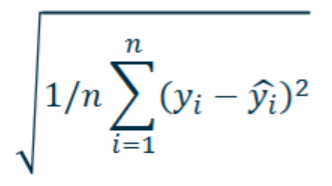
<p>Unit generated makes the most sense in measuring the model error.</p>
8
New cards
<p>Model A: Judge this model</p>

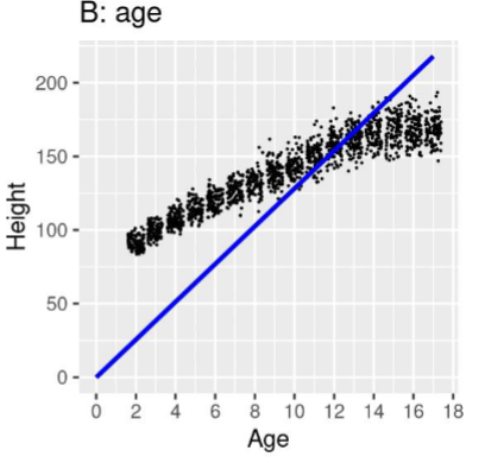
Model A: Judge this model

  • Equation: ŷ𝑖 = 𝑖 ∗ 𝑎𝑔𝑒𝑖

  • Takes into account that there actually are differences across age.

  • Model for each data point now depends on age of the specific child, multiplied by a parameter (the slope of the blue line).

  • Problem that this model goes through 0 - no child born at 0cm.
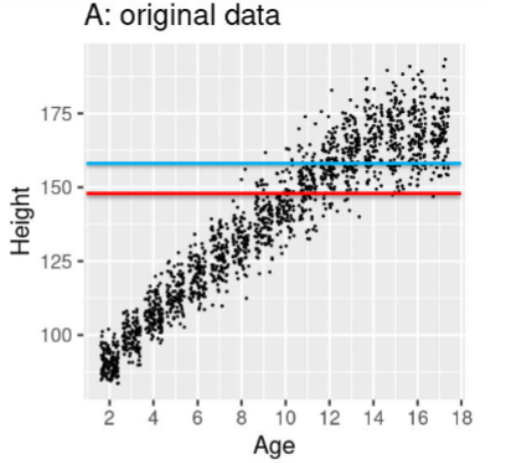
<ul><li><p><strong><span>Equation</span></strong><span>: ŷ</span><sub>𝑖</sub> = <span>B̂</span><sub>𝑖</sub> ∗ 𝑎𝑔𝑒<sub>𝑖  </sub></p></li><li><p>Takes into account that there actually are differences across age.</p></li><li><p>Model for each data point now depends on age of the specific child, multiplied by a parameter (the slope of the blue line).</p></li><li><p>Problem that this model goes through 0 - no child born at 0cm.</p></li></ul><p></p>
9
New cards
<p>Model B: Judge this model</p>

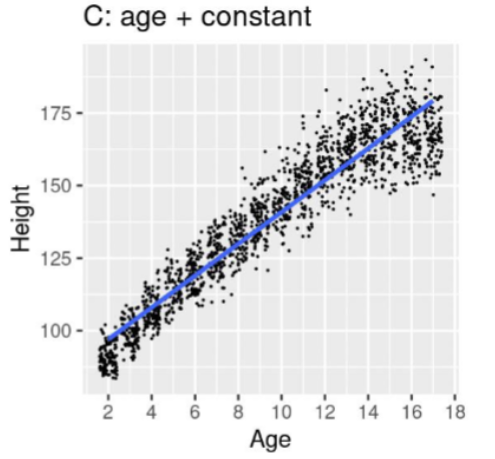
Model B: Judge this model

  • Equation: ŷ𝑖 = 0 + 1 ∗ 𝑎𝑔𝑒𝑖

  • Adds a constant - good job at explaining data, but could be split into other factors.
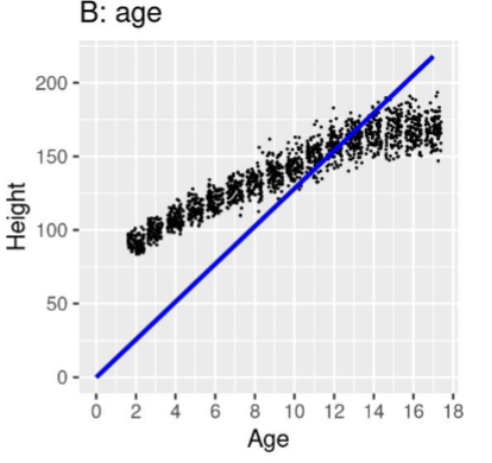
<ul><li><p><strong><span>Equation</span></strong><span>: ŷ</span><sub>𝑖</sub> = <span>B̂</span><sub>0 </sub>+ <span>B̂</span><sub>1</sub> ∗ 𝑎𝑔𝑒<sub>𝑖  </sub></p></li><li><p>Adds a constant - good job at explaining data, but could be split into other factors.</p></li></ul><p></p>
10
New cards
<p>Model C: Judge this model</p>

Model C: Judge this model

  • Equation: ŷ𝑖 = 0 + 1 ∗ 𝑎𝑔𝑒𝑖

  • Equation: ŷj = 2 + 3 ∗ 𝑎𝑔𝑒j

  • Two separate models.

  • Estimating slope and adding a constant for both male and female.
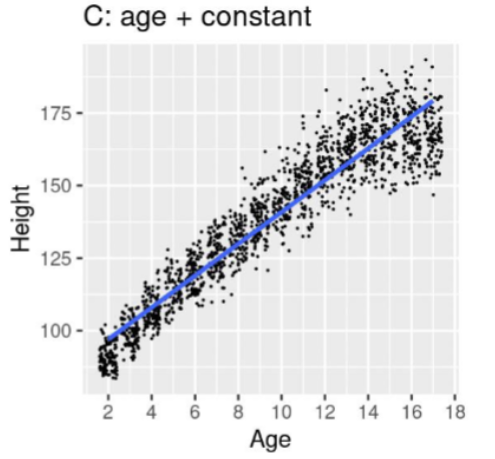
<ul><li><p><strong><span>Equation</span></strong><span>: ŷ</span><sub>𝑖</sub> = <span>B̂</span><sub>0 </sub>+ <span>B̂</span><sub>1</sub> ∗ 𝑎𝑔𝑒<sub>𝑖  </sub></p></li><li><p><strong><span>Equation</span></strong><span>: ŷ</span><sub>j</sub> = <span>B̂</span><sub>2 </sub>+ <span>B̂</span><sub>3</sub> ∗ 𝑎𝑔𝑒<sub>j</sub></p></li><li><p>Two separate models.</p></li><li><p>Estimating slope and adding a constant for both male and female.</p></li></ul><p></p>
11
New cards
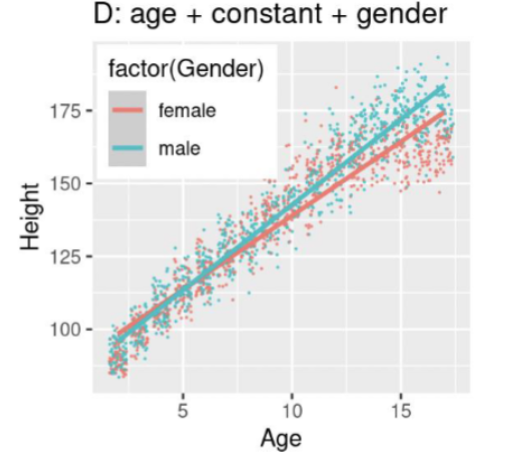
<p>Model D: Judge this model</p>

Model D: Judge this model

  • ŷ𝑖 = 0 + 1 ∗ 𝑎𝑔𝑒𝑖

  • ŷj = 2 + 3 ∗ 𝑎𝑔𝑒j

  • ŷ𝑖 = Ȳ

<ul><li><p><span>ŷ</span><sub>𝑖</sub> = <span>B̂</span><sub>0 </sub>+ <span>B̂</span><sub>1</sub> ∗ 𝑎𝑔𝑒<sub>𝑖  </sub></p></li><li><p><span>ŷ</span><sub>j</sub> = <span>B̂</span><sub>2 </sub>+ <span>B̂</span><sub>3</sub> ∗ 𝑎𝑔𝑒<sub>j</sub></p></li><li><p><span>ŷ</span><sub>𝑖</sub> = <span>Ȳ</span></p></li></ul><p></p>
12
New cards

Equation for a normal distribution

𝑁(𝜇, 𝜎2)

𝜇 - specifies where centre of the distribution is placed.

𝜎2 - how wide the distribution is.

13
New cards

Likelihood equation

  • 𝑃(𝑥|𝜇, 𝜎2)

    • Probability of obtaining a certain value - $x$ - given the two parameters in the model.

    • Circled point closer to the middle - highly likely, compared to lower circled point.

    • Can take all data points and multiply probabilities together to get likelihood of the data set - 𝑃(𝑥1|𝜇, 𝜎2) * 𝑃(𝑥2|𝜇, 𝜎2) * 𝑃(𝑥3|𝜇, 𝜎2)
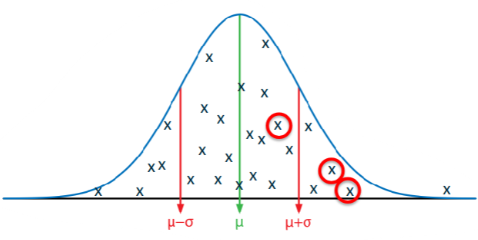
<ul><li><p>𝑃(𝑥|𝜇, 𝜎<sup>2</sup>)</p><ul><li><p>Probability of obtaining a certain value - $x$ - given the two parameters in the model.</p></li><li><p>Circled point closer to the middle - highly likely, compared to lower circled point.</p></li><li><p>Can take all data points and multiply probabilities together to get likelihood of the data set - 𝑃(𝑥<sub>1</sub>|𝜇, 𝜎<sup>2</sup>) * 𝑃(𝑥<sub>2</sub>|𝜇, 𝜎<sup>2</sup>) * 𝑃(𝑥<sub>3</sub>|𝜇, 𝜎<sup>2</sup>)</p></li></ul></li></ul><p></p>
14
New cards

Log likelihood equation

Uses logarithm to describe the likelihood equation
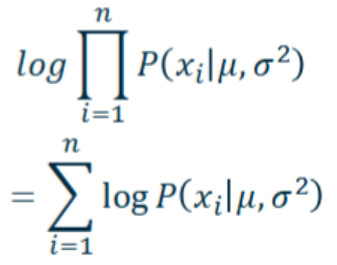
<p>Uses logarithm to describe the likelihood equation</p>
15
New cards

Maximising likelihood = …

Minimising MSE

16
New cards

Minimising MSE = …

Maximising likelihood

17
New cards

Explore top flashcards