class 9 : resisting the rules- vested interests and identities
 Studied by 0 people
 Call Kai
 Learn
Learn Practice Test
 Spaced Repetition
 Match
Match Flashcards
 Knowt Play
1/17

There's no tags or description
Looks like no tags are added yet.
Name | Mastery | Learn | Test | Matching | Spaced | Call with Kai |
|---|
No analytics yet
Send a link to your students to track their progress
18 Terms
Why are development projects still failing
. The rules are Ignored
'Good governance' is too demanding
Form prioritized over function: isomorphic mimicry
Not enforcing wins votes: Forbearance
2. The rules are Imported (Aid)
Coordination challenges and corruption
Dependency and a lack of political ownership/accountability
Donations skewed by self-interest, geopolitics and domestic politics
3. The rules are Broken
Distortions: Short-termism, electoral cycles, concrete bias
Clientelism
Corruption, though perhaps a symptom as much as a cause
those the resist development. What we are looking at today
1. Powerful losers resist
2. Powerful winners resist
3. Identities resist
1. Powerful losers resist
who loses from development?
Institutional reforms and development policies are designed to 'grow the pie'
But change creates losers, at least in the short-run:
Large landowners lose access to cheap labour under extractive institutions (serfdom)
they resist competitive labour, urbanization etc.
they like to rural elitist way of life
'Creative destruction' of old industries -textiles, coal mines, drivers
ex: those who use old technologies. example showed they actually destroyed the new technology as you need less ppl
ex: workers who provide diesel sabatoge and lobby that new industries fail
ex: pro fossil fuel companies vs climate change sustainable ones
Enforcement instead of Forbearance
Monopoly rents or corruption
ex: monopoly on phone companies
Losses can also be relative - eg. teachers, traditional village chiefs, men
ex: even in the most obvious gains some are unhappy
teachers are now seen as the last option job
1. Powerful losers resist
Losses may be political, not economic
Dictators may not care if the middle class get rich
But they may care if they start to demand democracy and threaten revolution
Definition: VestedInterests:
people who have a interest in preserving existing institutions
Resistance raises the economic/political cost of policy implementation
Protests
Sabotage
Lobbying
Bribery/corruption
Veto power
Easier to resist when the losses are concentrated on a specific group
when we have a small group of powerful people —> they can mobilize and stop development
1. Powerful losers resist
Losers are often powerful - they benefited from the 'old' system
Concentrated wealth allows them to organize against reform
Inequality can harm development when the rich oppose change and have the resources to block it
small group of people (rich) who are likely to oppose change
How do we stop losers resisting development?
Overcoming Resistance from Losers
Insulating the state from the political pressures of losers
Autonomy/discipline (the developmental state)
Authoritarian repression
Historical shocks, eg. Korean War, Rwandan genocide
Compensating losers
If development 'grows the pie' then the gains can be distributed to everyone
ex: we will pay you 100 euros every year
ex: social welfare systems and democracies to compensate unemployment
Why can't we always compensate losers for their losses?
1. Compensation may not be credible
The newly-rich=newly-powerful can just take everything in the future
Democracy and social welfare systems might help make compensation credible
2. Compensation may not be equivalent
Would you accept money to give up your career?
2. Powerful winners resist
Who are the winners from development?
the biggest blockage of development are the winners
Workers benefitting from investments in physical capital -> higher productivity ->higher salaries
Households benefitting from cheaper food (more productive agriculture)
ex: more productive in making food reduces the price = higher standards of living
Children benefitting from better teaching(human capital)
Consumers benefitting from smartphones(new technologies
= when alot ppl benefit it =
Definition: Policy Feedback
Policies and institutional reforms change future politics
new policies changes politics
Eg. Across Africa, women who possess a mobile phone are more supportive of women becoming politicians
(But phones don't change men's attitudes
Winners often support continued reform:
Motive to extend their gains
Means from the newly-acquired resource
But diffuse winners struggle to achieve collective action to push for more reform
Lots of citizens/consumers with a small stake
And difficulties in communicating and organizing2. Powerful winners resist
2. Powerful winners resist
But some winners are concentrated:
Capital Investors
Rent-seekers
And gain from partial reform
Opportunities created by the transition from old to new institutions
Eg. Privatization without an effective competition regulator
Eg. Liberalizing consumer prices but not exchange rates
So partial reform creates new rents
Monopolies, uneven subsidie
sLack of regulation, weak police/judicia
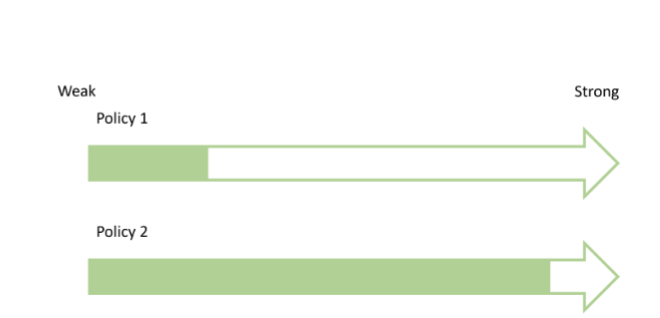
The winners from Policy 2 resist Policy 1
Using their winnings to resist further reform
2. Powerful winners resist
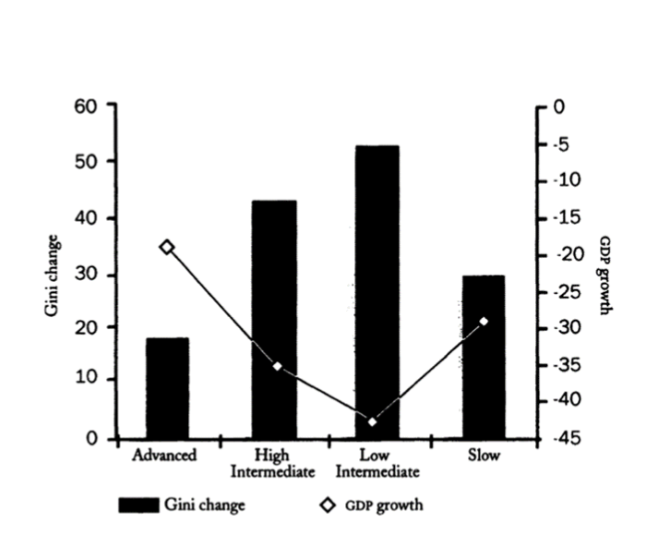
The countries in Eastern Europe that carried out' intermediate' reforms seem to have suffered the greatest increases in inequality, and opposition to further reformEg. Inequality doubled in Russia
2. Powerful winners resist
Overcoming Resistance from Partial ReformWinners
Insulating the state from the political pressures of winners
Autonomy/discipline (the developmental state)
Authoritarian repression
Strengthening losers!
More democracy/competition
Tax the winners!
= both the losers and winners can block development
they can create partial reforms where they benefit but no one else does
2. Powerful winners resist
Who are the winners and who are the losers?
Who are the winners and who are the losers?Subject to political debate/manipulation
Resistance to vaccination
Personal and community benefits
But strongly correlated with trust in government
Misinformation creates 'a seed of doubt'
About government intentions
About who is a winner
Misinformation is often Disinformation
circulated by elites opposed to reform
disinformation is intentional by telling you you are winning or losing
today its much harder to known if you are a winner or loser
3. Identities resist
So far, our analysis has focused purely on economic and political interests in the development process
But behaviour is also a question of identity:a sense of belonging to a group with shared beliefs and practice
Modernization theory: From traditional 'ethnic 'identities to modern secular 'post-materialist 'identities
Ethnic identities are strong at the start of development
And threatened by development
example: Triqui in Mexico protesting against displacement
As a group
example: Identities are diverse and multiple, eg. Papua New Guinea
>800 languages>1000 ethnic group
= they can resist policies , because they operate as groups
3. Identities resist
Ethnic diversity reduces investment in public goods (Easterly and Levine 1997). Why?
does the state homogenize groups?
Ethnic diversity reduces investment in public goods (Easterly and Levine 1997)
The challenge of cooperation across identities
Differences in preferences
Lack of information about others
lack of trust
Harder to use social sanctioning to enforce informal institution
within out identity groups we enforce informal institutions/norms
ex: theres ways you can punish ppl socially without the police
= hard to punish diff groups if you have different social norms
example:
Diverse parts of Western Kenya receive less
money per school pupil
Diverse parts of Indonesia suffer greater
deforestation
3. Identities resist
Ethnic diversity reduces investment in public goods(Easterly and Levine 1997)
BUT
Applies only to 'politically-relevant' ethnic groups
Ethnic groups are divided by politicians trying to form majorities
ex: The Chewa cooperate in Zambia but oppose eachother in Malawi
in zambia two groups are not in conflict= ethnic diversity isnt a problem vs in malawi they don’t get along
why the difference?
malawi is small, so these two groups are smaller. Harder to get a majority. Otherwise together they are too big vs zambia theres many groups so they can form alliances
ethnic diversity y is only a problem when its politicized by the political system
diversity doesn’t cause underdevelopment its discrimination
Ethnic discrimination reduces investment in public goods(Lee 2018)
Biased against the less powerful ethnic groups
Discrimination by dominant identities:
As pure discrimination
As political strategy to mobilize allies
As a side-effect of being more socially connected among themselves
the data makes it hard to distinguish between diversity and discrimination
Distinguishing the diversity and discrimination hypotheses (Lee 2018)
Hard in places like the USA: Diversity and discrimination are correlated (cities are more diverse and have fewer dominant whites)
We need a place where the powerful group is small and dispersed
Eg. Upper castes in India
you can’t escape your casts
Diversity: Villages with more diversity get just as many public goods
diverse villages in indias aren’t a problem
Discrimination: Villages with more upper castes DO get more public goods
the problem are with the lower casts where the elites don’t give enough resources to them for education and healthcare
4 more hours of electricity
From 77% to 97% chance of having a primary school
How can we twist 'identities' to help development
theres identities that are more positive and can help development
Can we twist identities to promote development?
If people of the same identity trust each other and are more willing to invest together, we need more inclusive identities
Overlaying ethnic identities with civic identities
they are often seen as fixed, but we know its not rlly true. Identities are socially constructed
Eg. Subnational identities in India (Singh 2015)
States with a stronger subnational identity are better at providing public goods
Eg. In Tanzania, 'nation-building' has promoted inter-ethnic cooperation (Miguel 2004)
A common language (Swahili)
National identity in the school curriculum
Village councils replace tribes
Tanzania provides more public goods than Kenya in diverse communities
in kenya diversity is a challange because less inclusive vs tanzania more diversity= more inclusive
Definition :Constructivism
Identities are not fixed but created by social interactions and political manipulation
when can create civic and higher level identities
ex: being dutch or being european
Conclusion
Powerful losers resist
Vested interests in the old economy
With the resources to resist change
Compensation for losers must be credible
Powerful winners resist
Diffuse winners have little power to sustain development
Concentrated winners try to preserve partial reform for rents
Identities resist
Ethnic diversity impedes cooperation over investments
If ethnic groups are politically mobilized
Or is it ethnic discrimination?
Constructing more inclusive civic identities can help
 Note
Note  Flashcards (342)