Biology MCAT
 Call Kai
 Learn
Learn Practice Test
 Spaced Repetition
 Match
Match Flashcards
 Knowt Play
1/164

There's no tags or description
Looks like no tags are added yet.
Name | Mastery | Learn | Test | Matching | Spaced | Call with Kai |
|---|
No analytics yet
Send a link to your students to track their progress
165 Terms
4 Tenets of Cell Theory
1. All Living things are composed of cells.
2. The cell is the basic functional unit of life.
3. Cells arise only from preexisting cells.
4. Cells carry genetic information in the form of DNA. This genetic material is passed on from parent to daughter cell.
prokaryotic cells
circular DNA, no nuclei or membrane bound organelles, lack histones
eukaryotic cells
have nucleus and membrane bound organelles
nucleus
The nucleus is the control center of the cell. The nucleus is a region of space within the cell that is surrounded by a double membrane envelope. This region houses all of our genetic information and machinery.
How does the environment in the nucleus compare to the environment of the rest of the cell?
Because the nuclear membrane is selectively permeable, the environment in the nucleus is separate and distinct from the environment in the rest of the cell.
nuclear pores
Nuclear pores allow selective two way exchange of material between the cytoplasm and the nucleus.
What is the nucleolus?
The nucleolus is a membrane-less structure in the nucleus that synthesizes ribosomal RNA (rRNA). It appears as a large dark spot in the nucleus.
mitochondrion
A mitochondrion is a double membraned organelle with structures in its inner membrane that allow it to generate ATP.
1. ATP production through the Citric Acid Cycle and the Electron Transport Chain
2. Apoptosis induction by releasing Electron Transport Chain enzymes.
mitochondrion is semi-autonomous
It means that mitochondrion can do some functions on their own independently from the cell. These functions are below.
1. Mitochondria contain some of their own genes (in the form of cicular DNA strands) and have their own ribosomes (That are similar in size to prokaryotic ribosomes!)
2. Mitochondria can divide independently of the cell as a whole (via binary fission).
purpose of mitochondria’s outer membrane
The mitochondrial outer membrane serves as a selective barrier between the cytosol and the inner environment of the mitochondrion.
cristae
Cristae are the infoldings of the inner mitochondrial membrane. These foldings increase the surface area available for electron transport chain enzymes.
Lysosomes
Lysosomes are membrane bound structures containing hydrolytic enzymes. They are found floating in the cell's cytoplasm
What occurs in the Follicular Phase of Menstruation?
The follicular phase begins when the uterine lining of the previous cycle begins to shed.
1. As Estrogen and Progesterone fall in response to the death of the corpus luteum, GnRH is secreted in response.
2. GnRH secretion leads to the rise of FSH and LH.
3. FSH and LH work together to cause the follicles in the ovary to grow (Mostly FSH though)
4. As the follicles grow, they release estrogen, which negatively inhibits the hypothalamus and causes a drop in GnRH, which slows the increase of FSH and LH.
5. The estrogen that has been released gets to work on re-thickening the endometrium (decidua).
What occurs in Ovulation?
1. Developing follicles release Estrogen. As the follicles grow they eventually get so big they are releasing a lot of Estrogen. Estrogen is interesting because it negatively inhibits the GnRH at low concentrations (⇒ inhibits FSH and LH), but after a certain concentration threshold, it will conduct positive feedback on those hormones.
2. This increase in GnRH by the hypothalamus leads to a spike in FSH and LH levels.
3. The spike in LH levels induces ovulation.
+ LH: Luteinizing hormone
+ GnRH: Gonadotropin-releasing hormone
+ FSH: Follicle-stimulating hormone
What happens in the Luteal Phase of Menstruation?
After ovulation, LH will cause the burst follicle to form into the corpeus luteum, which secretes progesterone and some estrogen. High progesterone and estrogen cause negative feedback on GnRH, FSH, and LH. This prevents the ovulation of multiple eggs.
What happens in the Menstruation stage of Menstruation?
If no implantation occurs, the levels of LH will fall. This causes the corpus luteum to cease production of progesterone, which weakens the integrity of the uterine lining and causes it to slough off. With the estrogen and progesterone levels low again, the block on GnRH is lifted and the cycle can begin again.
Stages of the Cell Cycle
G1. First growth for DNA replication and segregation machinery
S. Synthesis of new DNA
G2. Second growth to prepare for mitosis
M. Mitosis produces 2 daughter cells
Interphase
Interphase is just a way of referring to the non-reproductive stages (non-mitotic) of the cycle, i.e. G1, S, G2
quality control checkpoints
G1-S checkpoint (Restriction Point): check integrity of DNA prior to synthesis; mediated by p53.
G2-M: check integrity of post-S DNA. Check for sufficient organelles e.g. 2 centrosomes.
Metaphase-Anaphase: check all chromosomes attached to the spindle prior to separation of genetic material
does ploidy increase in the s stage?
No. DNA replication causes each chromosome to double in size, but even though there are now two sister chromatids, there is still only one chromosome.
If DNA is found to be too damaged to move past the G1/S restriction point, what happens?
The cell cycle will be stopped by a protein known as p53 and an attempt will be made to repair the DNA so it can pass the restriction point.
polarity of DNA
DNA as a long linear molecule that is considered by the enzymes that work on it to "start" with the 5' end and "end" with the 3' end. Because of the one way nature of DNA enzyme activity, DNA is said to have polarity. 5' end has OH or phoshphate and 3' end has free OH
draw the nitrogenous bases
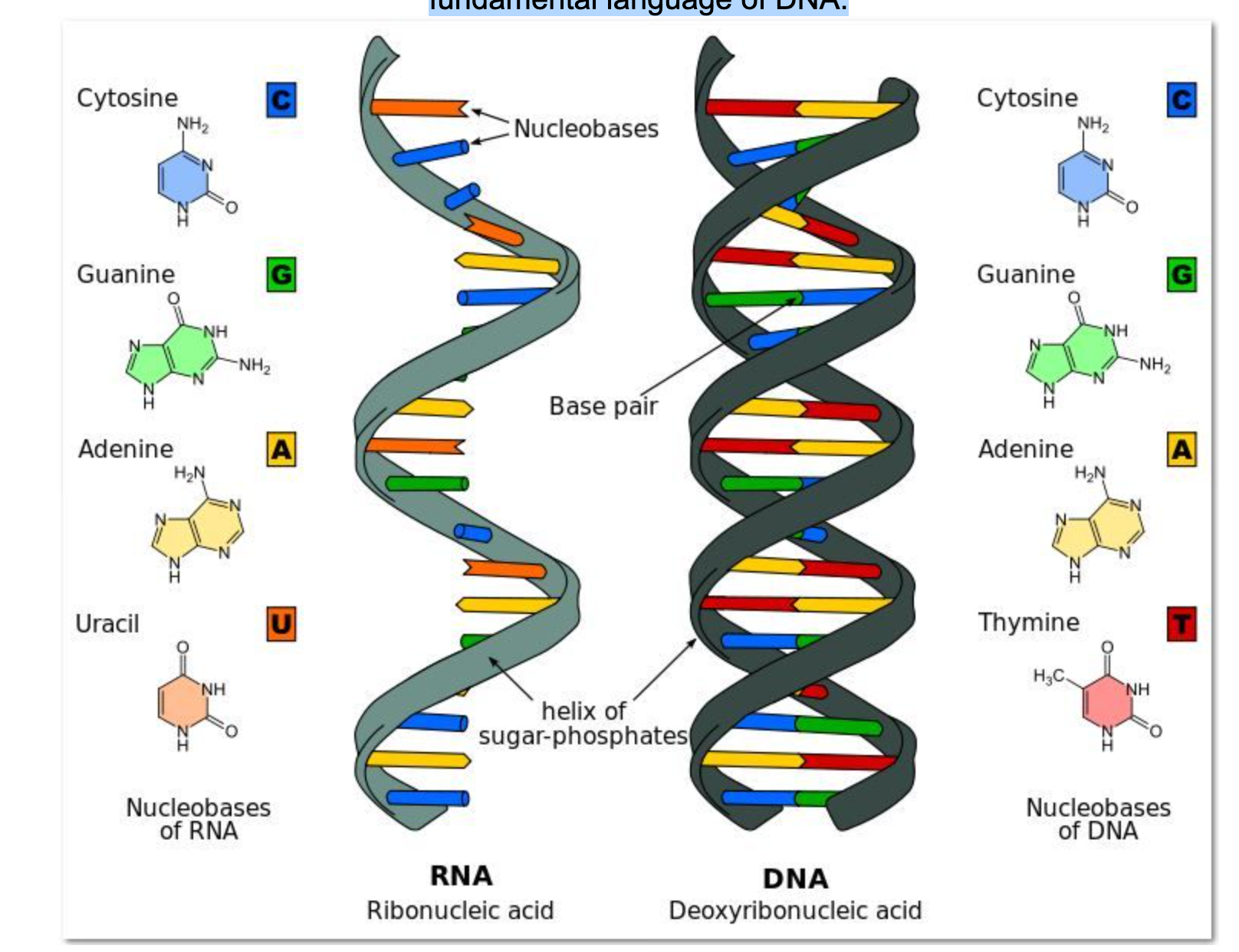
Watson and Crick DNA structure
1. The two strands of DNA are antiparallel. When one strand has polarity 5' to 3' down the page, the other has 5' to 3' up the page.
2. The sugar Phosphate backbone is on the outside of the helix and the nitrogenous bases are on the inside
3. The bases only pair with complementary bases via hydrogen bonds. A always goes with T and C always goes with G
4. Because of the specific pairing, the amount of A's is always equal to the amount of T's nad the amount of C's is always equal to the amount of G's
probe DNA
a strand of DNA with a known sequence. It is used in various testing and laboratory applications to learn about your mystery DNA.
lysosomes
Digests (hydrolyzes):
-Foreign endocytosed materials
-Damaged/unneeded organelles
-Misfolded proteins
fuses with vesicles to exert their effects!
When digesting food or unneeded organelles, the lysosome must interact with a membrane bound carrier of some sort (usually something ending in -some). The lysosome will fuse its membrane with the carrier, inject its hydrolytic enzymes into the new macro structure, and digest whatever the original carrier was carrying.
endosome
An endosome is an endocytic vesicle that pinches off from the membrane during endocytosis.
What are the three places an endosome can transport material to?
1. To and from the Plasma Membrane
2. To the lysosomes
3. To the trans-Golgi
autolysis
breaking the cell down from the inside out
What is the function of the mitochondria's outer membrane?
The mitochondrial outer membrane serves as a selective barrier between the cytosol and the inner environment of the mitochondrion.
ER
The Endoplasmic Reticulum (ER) is a series of interconnected membranes that are contiguous with the nuclear envelope.
Rough ER
RER studded with ribosomes that secrete proteins made from cytosolic ingredients into the ER lumen.
RER protein --> SER for packaging --> Golgi apparatus for further modification --> Ultimate destination
Smooth ER
Smooth ER is ER that takes on a tubular form and has no ribosomes in its membrane.

1. Lipid synthesis (phospholipids in bilayer and steroids)
2. Detoxification of some poisons and drugs
3. Proteins from RER packaged and directed to Golgi apparatus
golgi apparatus
a series of stacked membrane bound sacs inside of the cell, Receives material from ER; modifies it with functional groups that alter its function and that direct it to a specific location (intracellular, extracellular, or even back to ER)
Materials leave the Golgi apparatus in an appropriate vesicle
Mnemonic: The post office of the cell
what proteins are found in rough ER
Proteins that are destined for secretion or proteins that are destined for integration into a membrane.
incomplete dominance
Heterozygote. Dominant allele is unable to dictate the phenotype completely. Phenotype will appear as an intermediate between dominant and recessive phenotypes.
codominance
expresses both alleles simultaneously, resulting in a spotted or combined appearance
How do the concentration of organelles in different cell types vary?
The concentration of organelles is different from cell type to cell type. These differences are functional. For example, cells that need a lot of energy have a lot of mitochondria. Cells that secrete a lot have high RER and Golgi Apparatus.
peroxisome
A peroxisome is a bilayer membrane bound organelle containing Hydrogen Peroxide. This Hydrogen Peroxide is generated with the help of a crystalline core. Because of their hydrogen peroxide, peroxisomes are important in the breakdown of long chain fatty acids (Beta Oxidation). Peroxisomes also participate in the synthesis of phospholipids and contain some enzymes for the Pentose Phosphate Pathway.
cytoskeleton structural components
1. Microfilaments
2. Microtubules
3. Intermediate Filaments
nucleosome
histone with DNA wrapped around it.
two types of chromatin
Heterochromatin and euchromatin
heterochromatin
DNA that is wrapped tightly around histones, it is dark when viewed under microscope and is transcriptionally silent, meaning RNA polymerase cannot interact with Heterchromatin to make mRNA.
Euchromatin
Refers to DNA that is wrapped loosely around histones. Euchromatin is light when viewed under microscope and is transcriptionally active, meaning RNA polymerase can interact with euchromatin to make mRNA.
replisome
A replication complex that is a set of special proteins that assist DNA polymerases to copy DNA.
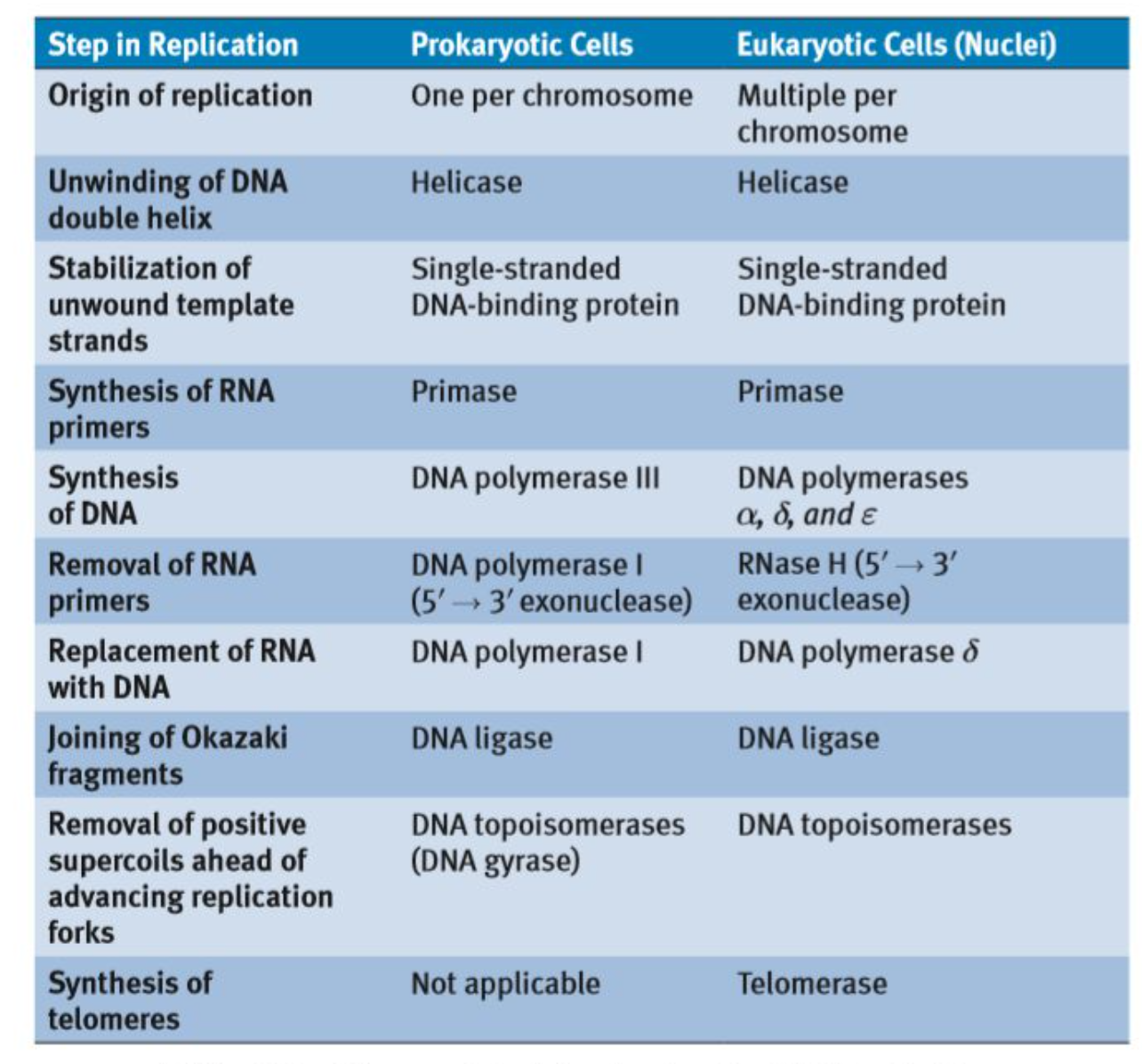
How does replication of DNA proceed differently in prokaryotes versus eukaryotes?
Eukaryotes will have multiple origins of replication and result in two attached sister chromatids.
Prokaryotes will only have one origin of replication and result in two unattached circular chromosomes.

What is the role of single stranded DNA binding proteins?
SSB's bind to unraveled DNA to prevent the reassoaciation of the DNA and to protect the base pairs from nucleases.
what is the role of the microfilaments
- Characteristics: Solid polymerized rods of Actin.
- Functions:
(1) Provide resistance to compression and fracture for the cell when organized into bundles and networks.
(2) Generate force for movement by interacting with Myosin.
(3) Formation of the cleavage furrow for cytokinesis in mitosis/meiosis. This is accomplished by an actin ring which forms at the site of division between cells. The ring contracts, and the cell gets pinched into two.
how does a lysosome digest things?
Lysosomes fuse with vesicles to exert their effects!
When digesting food or unneeded organelles, the lysosome must interact with a membrane bound carrier of some sort (usually something ending in -some). The lysosome will fuse its membrane with the carrier, inject its hydrolytic enzymes into the new macro structure, and digest whatever the original carrier was carrying.
characteristics and roles of microtubules
- Characteristics: Hollow polymers of tubulin proteins.
- Functions:
(1) provide pathways for motor proteins like kinesin and dynein to carry vesicles
(2) contribute to structures of cilia and flagella via 9 + 2 structure (a ring of 9 doublets w/ 2 central microtubules, pic below)
(3) mitotic spindle formation via centrioles
centrosome
the region of the cell where the centrioles are found.
centriole
the organizing center for the Microtubules within a cell, play an important role in the separation of chromosomes during mitosis
characteristics and functions of intermediate filaments
- Characteristics: diverse group of filament proteins (Keratin, Desmin, Vimentin, Lamin, etc.)
- Functions:
(1) cell-cell adhesion
(2) maintenance of the integrity of the cytoskeleton
(3) anchor organelles
4 tissue types
1. Epithelial Tissue
2. Connective Tissue
3. Muscle Tissue
4. Nervous Tissue
epithelial tissues
Epithelial tissues cover the body and line its cavities.
These tissues, being exterior tissues, provide protection against infection and dessication (drying out).
In some tissues, epithelial cells are also involved in absorption, secretion, and sensation.
Are polarized, because epithlelial cells cover the body and line its organs, one side of an epithelial cell will be attached to underlying structural cells and the other side will be exposed to the lumen of an organ or the outside world. Because of these dramatically different environments, the two sides of the epithelial cell are actually pretty different. We call this phenomenon polarization.
What is parenchyma and of which tissue type is it usually comprised?
Parenchyma are the functional parts of an organ. For example, nephrons in the kidney or acid producing cells in the stomach. The parenchyma is usually made up of epithelial cells.
lumen
the inside space of any hollow tubular structure.`
basement membrane
an underlying layer of connective tissue to which groups of epithelial cells will be attached. This is to help the epithelial cells stay close together and can remain a cohesive unit.
3 types of layering found in epithelial layers
1. Simple
2. Stratified
3. Pseudostratified
simple epithelium
epithelium that consists of a single layer
stratified epithel
pseudostratified epithelium
appear to be stratified, but are actually all attached to a basement membrane, like simple epithelium cells.
3 shapes of epithelium
1. Squamous
2. Cuboidal
3. Columnar
Squamous Epithelium
Squamous = scale-like: flat, scale like epithelial cells.
7 basic steps of DNA replication
1. Helicase unwinds the DNA
2. Single Stranded Binding Proteins protect the free DNA
3. Primase synthesizes RNA primers to attract DNA polymerase
4. DNA Polymerase binds and synthesizes DNA
5. RNA primers are removed
6. DNA Ligase joins Okazaki Fragments
7. Topoisomerase reduces tension in the advancing coil
How are RNA primers removed and replaced in Prokaryotes versus Eukaryotes?
In prokaryotes, RNA primers are removed and replaced by DNA polymerase I.
In Eukaryotes, RNA primers are removed by RNase H and replaced by DNA Polymerase delta
replisome
a set of special proteins that assist DNA polyemerases to copy DNA
How is the DNA polymerase in prokaryotes and eukaryotes different?
In prokaryotes, DNA is replicated by DNA polymerase III.
In Eukaryotes, DNA is replicated by DNA polymerase alpha, delta, and epsilon.
What are the 5 classic DNA polymerases in Eukaryotic cells?
Alpha, Beta, Gamma, Delta, and Epsilon.
which DNA polymerase fills gaps from RNA primers
delta
which DNA polymerase lays down the RNA primers
alpha
What is the role of DNA polymerase Gamma?
Replicates mitochondrial DNA
nucleosome
the name for a histone with DNA wrapped around it.
What eukaryotic DNA pols are involved in repair ?
beta and epsilon
What is the combined role of DNA pol delta and epsilon?
PCNA = Proliferating Cell Nuclear Antigen
PCNA present when cell is proliferating; makes sense that DNA pol is active
Just remember PCNA + DNA pol d*, e* = sliding clamp
What are the classic prokaryotic DNA enzymes?
DNA pol I (repair, primer, gap), II (DNA repair), and III (replication and proofreading)
In what ways are the enzymes for DNA Replication similar and different in Prokaryotes versus eukaryotes?
oncogenes
pieces of DNA that, if damaged (mutated) promote uncontrolled cell division and cancer.
What type of genetic info is more likely to be an oncogene?
Most of the oncogenes are genes that have to do with cell-cycle and division timing. Your eye color gene, on the other hand, probably wont give you cancer if it mutates.
What are antioncogenes/tumor supressor genes?
stop and slow tumor progression (Also called tumor suppressor genes, p53 and Rb). This can be because they prevent mutations to DNA in the first place, fix them after they happen, or kill cancer cells. When antioncogenes are mutated, they lose their anti-tumor properties.
Describe how DNA polymerase proof-reads bases.
Part of the DNA polymerase enzme is specifically designed to proofread. When complementary strands have incorrectly paired bases the hydrogen bonds are unstable. The proofreading section of DNA polymerase detects the unstable hydrogen bond and removes the incorrect base. All prokaryotic polymerases and eukaryotic DNA epsilon and delta have 3'-5' exonuclease activity
What is the role of DNA polymerase Gamma?
replicates mitochondrial DNA
mismatch repair
In the G2 phase of the cell cycle, special enzymes will check the DNA for errors missed by DNA pol during S phase and correct them. Uses genes MSH2 and MLH1
nucleotide excision repair
In nucleotide excision repair, a section of a damaged DNA strand is completely cut out, phosphodiester back bone included, by excision endonuclease. Next, DNA polymerase fills in the gap, using the undamaged strands as a template. The fixed strand is sealed back into place with DNA ligase. Used to repair Thymine dimers and other helix deforming lesions (chemical carcinogens or UV make bulky lesions)
base excision repair
In base excision repair, a damaged base is detected and removed by a glyosylase enzyme, leaving behind an empty backbone called an AP site (apurinic/apyramidic, or abasic site). AP endonuclease recognizes the empty backbone and cuts it out. DNA polymerase can then synthesize a complementary strand using the undamaged strand. DNA ligase seals the repaired strand back into place. Used to repair non deforming mismatches like cytosine deamination (cytosine loses amino group and becomes uracil) (oxidative damage, AP sites, and alkylation)
vector in biotech context
a bacterial or viral plasmid that can be transferred to a host bacterium.
Genomic Library
contains large fragments of DNA that are digested out of chromosomal DNA itself, which means these strands of DNA include both coding (exon) and noncoding (intron) regions. This method is preferred for sequencing the entirety of an organism's genome. Cloned genes may be split into multiple vectors, so you can't do anything with specifc genes. Uses restriction endonuclease and ligase
Complementary (expression) Library
constructed by reverse-transcribing processed mRNA, which means these strands only contain the exons of the DNA from which they came (no introns or promoter/enhancer sequences). Each clone containes the complete gene. This method is generally preferred for sequencing specific genes to identify their function. It is also the only way to make transgenic animals and express genes in animals from which the DNA did not originate (producing insulin). Uses reverse transcriptase and ligase
gel electrophoresis
DNA is negatively charged, and therefore will migrate towards the positive anode of the electrolytic cell. Larger DNA will migrate slower, just like in protein electrophoresis. Agarose is the preferred gel for DNA gel electrophoresis.
southern blot
A southern blot is used to detect the presence and quantity of various DNA strands in a sample. In this method, DNA is cut by restriction enzymes in specific ways and then separated by gel electrophoresis. The separated DNA fragments are then transferred to a membrane where they are exposed to a probe. The probe is radioactive single stranded DNA sequence that is visible under x-ray.
If the sequence in the DNA and the probe match up, they will hybridize, and that band of DNA on the membrane will be visible.

dna sequencing
DNA sequencing uses dideoxyribonucleotides (ddATP, ddGTP, etc.) to determine the sequence of a segment of DNA.
Dideoxyribonucleotides don't have a hydroxyl at Carbon 3, and will end DNA replication when they are incorporated into the DNA. Eventually the sample will be composed of a bunch of fragments that end in the ddnucleotide of interest. Then, using gel electrophoresis, you can see how long each fragment was when the ddnucleotide was incorporated. The ddnucleotide is easily read (fluorescent?), and so you can use this with the size seperation to determine nucleotide order

knockout mouse
A knockout mouse is a mouse that had one of its genes removed as a zygote, meaning it lacks the gene completely as an adult. Knockout mice are used to study the importance and effects of different genes.
stroma
The stroma is the support structure of an organ upon which the parenchyma depends. It is made of connective tissue.
examples of connective tissues
Bone, cartilage, tendons, ligaments, fat tissue, and blood.
What are the characteristics and 3 roles of Intermediate Filaments?
- Characteristics: diverse group of filament proteins (Keratin, Desmin, Vimentin, Lamin, etc.)
- Functions:
(1) cell-cell adhesion
(2) maintenance of the integrity of the cytoskeleton
(3) anchor organelles
What is the shared structure of flagella and cilia in eukaryotic cells?
The 9 + 2 structure, which is 9 doublets of microtubules surrounding 2 central microtubules.
three domains of life
Eukarya, Archaea, and Bacteria (prokarya)
archaea characteristics
Archaea are single-celled organisms that look like bacteria, but have genes and metabolic pathways that are more similar to Eukaryotes.
They were historically considered extremophiles and they are notable for their ability to employ chemosynthesis, an ability to generate energy from inorganic compounds like sulfur and nitrogen.
In what 3 ways are Archaea similar to Bacteria?
Circular chromosome, binary fission, lack of membrane bound organelles
In what 3 ways are Archaea similar to Eukarya?
1. Archaea start translation with Methionine like Eukarya
2. Archaea Contain similar RNA polymerases to Eukarya
3. Archaea associate their DNA with histones like Eukarya

