PSYC 382 LEC 3 LANGUAGE
 Studied by 1 person
 Call Kai
 Learn
Learn Practice Test
 Spaced Repetition
 Match
Match Flashcards
 Knowt Play
1/99

There's no tags or description
Looks like no tags are added yet.
Name | Mastery | Learn | Test | Matching | Spaced | Call with Kai |
|---|
No analytics yet
Send a link to your students to track their progress
100 Terms
who invented information theory
claude shannon
who invented theory of computation
alan turing
whos idea was computational (artificial) brain
alan turing
describe the mathematical theory of communication
information source → sent to a transmitter through a medium (has some noise) → picked up by a receiver → sent to destination
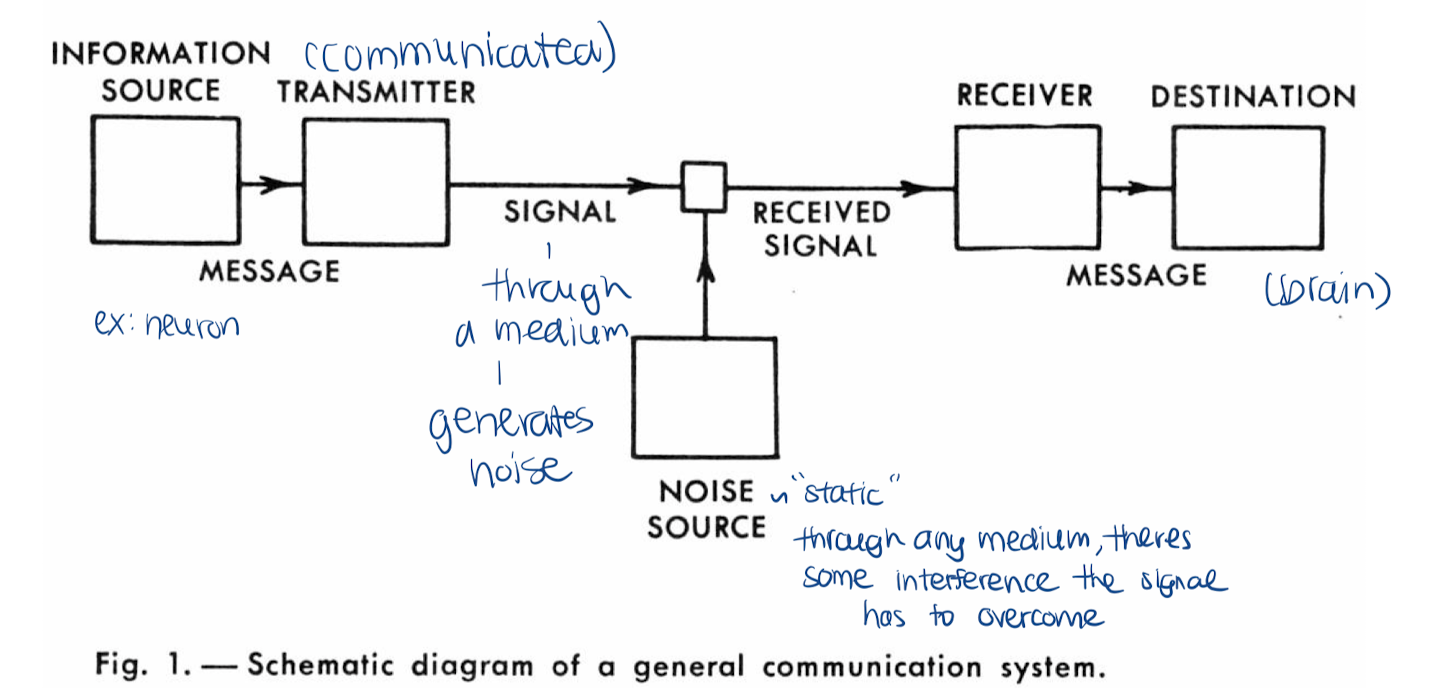
entropy (H)
average uncertainty of all possible messages or outcomes (more noise = higher entropy)
low vs high entropy
low = low range of options
high = high range of options
entropy measured in
bits (0,1)
T/F entropy models of human language capture the information transmitted between 2 people
F. entropy models consistently fail to fully capture info transmission in humans b/c:
context important to understanding
2 identical messages can have different meanings
message can be intentionally distinct based on audience member
shibboleth
a words that marks u as a member or nonmember of a group
Noam Chomsky’s hierarchy
hierarchy of the range of grammar complexity of human language compared to other communication systems
crucial component of noam chomsky’s hierarchy
syntactic recursion: can embed sentences/clauses within sentences/clauses
also called discrete infinity - infinity of sentences, words, but never 6.7 words.
computational capabilities depend on
transformation rules that require dedicated memory
human language is __ sensitive
context/grammar sensitive.
transformation rules use memory systems that can hold multiple clauses and modify grammar.
ex u know what the clause they and them refer to
2 reasons why human language stands out from behaviourism’s verbal behaviour
other species can learn human language fluently
children can learn any human language fluently without teaching or exposure
human language is __ based. why
rule-based.
it is generative (make new sentences) and transformational
humans must have __ to learn any human language
a deep neurocognitive architecture
language is instinct
how many human languages
7000
what part of language follows power law dist
number of speakers per language
language capacity
capacity to use language
language capacity evolved how many times
once
T/F languages dont change
F. languages change over time
how do linguists reconstruct unwritten languages
use comparative methods like genomics
ex: proto - indo europeans
what is known about the evolution of language capacity
none. could have emerged as result of cognitiev complexity or accident, or for general communication to organize thoughts
we start life with ___ connections
corticolaryngeal motor connections.
connections from prefrontal cortex to cranial nerve nuclei that control voice box.
describe the corticolaryngeal connections
indirect (medial PFC) - involuntary vocalizations (laugh, cry)
direct (lateral PFC) - voluntary vocalizations (babbling in animals)
T/F corticolaryngeal connections exist forever
pathway deminishes if not used
example of ancient observations of language deficits after brain injuries
galen’s gladiators
describe 2 modern observations of language deficits in the brain via paul broca
patients w aphasia had damage to left prefrontal cortex
deeper white matter damage (grey matter damage more common in temporary/transient language deficits)
list the 5 components of language
phonetics
phonology
morphology
syntax
semantics
phonetics
speech sounds
phonology
language specific rules for using speech sounds
morphology
combinatorial rules for putting meaning units together
syntax
recursive transformational rules for putting sentences together
recursive = adding setences within sentences
semantics
meaning of words and sentences
pragmatics
use of utterances (language, laugh, scoffs)
context based
near side pragmatic
background info needed to understand the utterance
far side pragmatic
other info communicated/accomplished besides the utterances’ meaning
conversational implicatures
meanings or intentions (from utterances) that can be inferred based on the context of the conversation
ex: its cold in here said towards person near heater.
relevance theory
assumes that speakers make more utterances when they believe its worth the audience’s effort to process it
linguistic relativity or sapir warf’s hypothesis
2 versions:
strong: thoughts determined by language structure
weak: content and structure of thoughts influenced by ones language structure
most evidence rules out and supports which aspect of linguistic relativity
rule out: strong - thoughts determined by language structure
support: content and structure of thoughts influenced by one’s language structure
frequency illusion / baader meinhof phenomenon
after you see a term for the first time, start to see it more often, making us believe it occurs more often than it actually does.
alexihmiya
lack of words to describe emotion
aphasia
language deficit (DAMAGE TO A BRain area)
describe the 4 main aphasia
broca’s aphasia
wernicke’s aphasia
conduction alphasia
global aphasia
broca’s aphasia
loss of speech production (nonfluent)
damage in left prefrontal lobe
wernicke’s alphasia
loss of speech comprehension (fluent)
damage in left temporoparietal lobe
conduction aphasia
fluent (good speech production) - conduction of axons to language areas affected
damage in left arcuate fasciculus
a type of disconnection syndrome
global aphasia
nonfluent (loss of speech production)
damage in multiple language regions
all 4 types of aphasia mentioned have poor __
poor repetition and naming
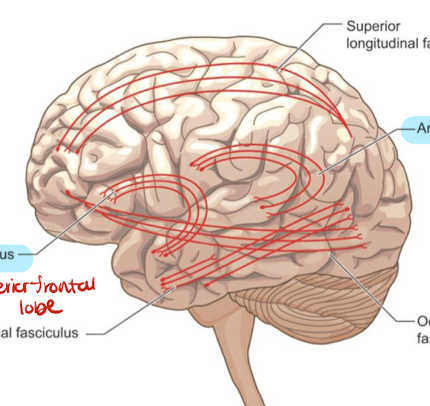
whats the 2 white matter tracts in blue called
most frontal - uncinate fasciculus
most posterior - arcuate fasciculus
where does the cortical pathway for understanding spoken language start
primary auditory cortex or superior temporal gyrus (STG)
describe the 2 paths of cortical pathway for understanding spoken language
dorsal streams (upward)
ventral streams (downward)
list the dorsal streams and what they do
auditory to premotor connection
→ sound perception-production loop
wernicke to broca connection
→ complex syntactic processing (recursive syntax)
list the ventral streams and what they do
STG + anterior temporal cortex to broca’s loop (uncinate fasciculus)
→ link sounds with meaning (comprehension)
anterior to inferior temporal cortex
→ simple syntactic concatenation (forming sentences) with meaning integration. (aka integrate sentences/phrases with meaning)
T/F language is modular
true. Language is a small part of the brain
within a signal brain area there are functional ___
functionals segregations or subregions
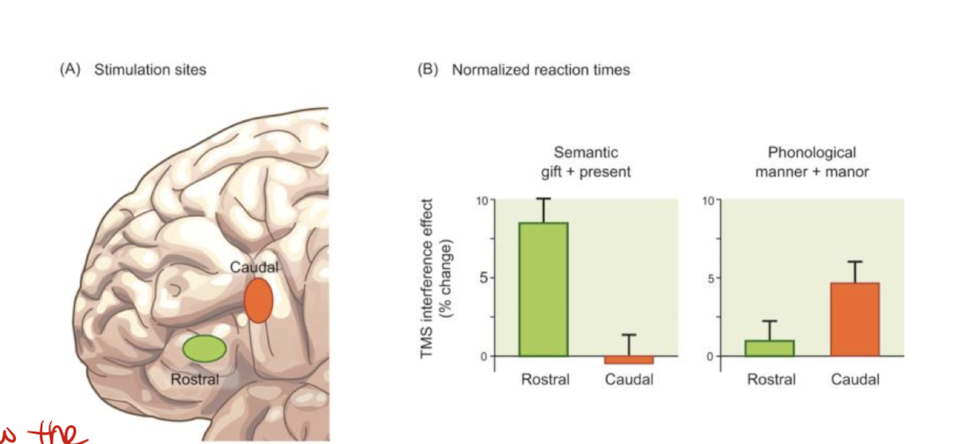
describe where and how a TMS applied to a specific subregion of brocas affects language
TMS applied to rostral (anterior) subregion - impair synonym/semantic judgements (ex: gift vs present)
TMS applied to caudal (posterior) subregion - impair homophony judgements (ex: manner vs manor)
ethical way to map brain function
EEGs, ERPs (event related potentials; measure changes in brain activity associated with an event)
anterior (brocas) and posterior (wernickes) language regions mapped with ERP
a P600 (positivity) difference to syntactic violations (grammar)
ex: child throw pig.
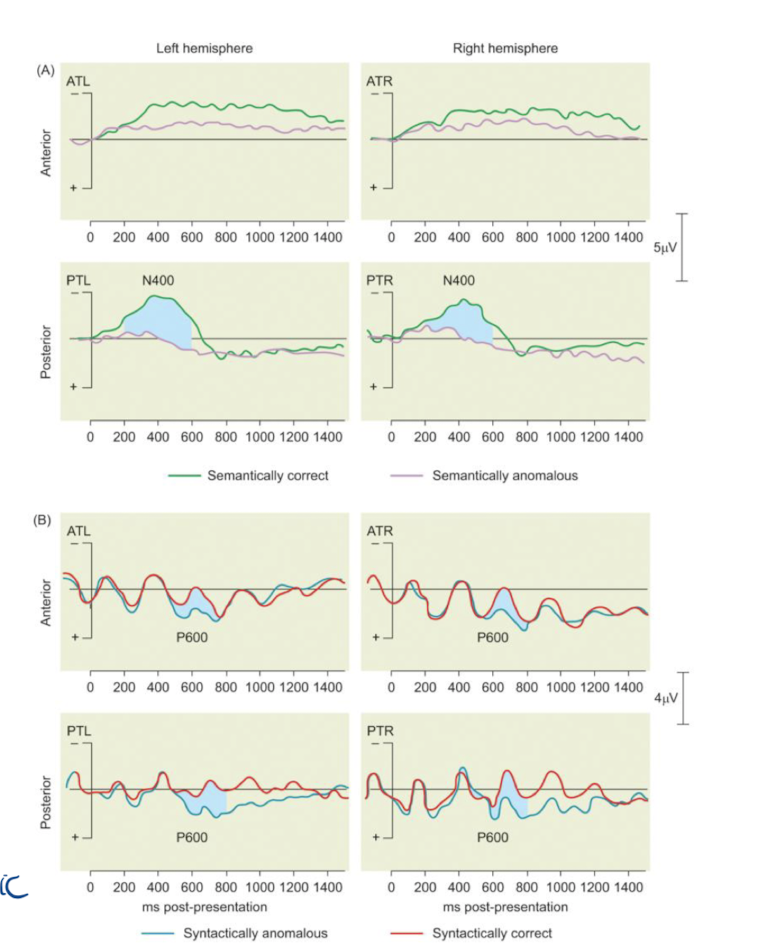
a posterior (wernickes) only language region mapped with ERP
a N400 (negativity) difference in semantic violations (meaning)
ex: girl dropped sky on table
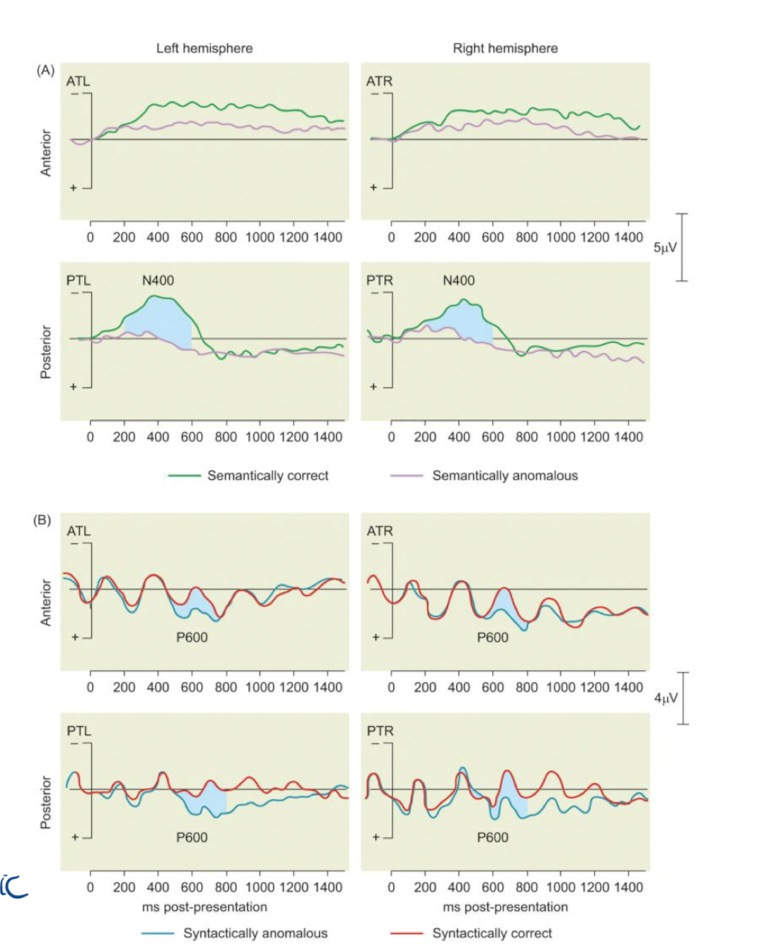
we detect _ violations faster than _ violations
semantic violations (meaning) faster than syntactic violations (grammar)
what 3 concepts frame the new view of language on the brain
language networks extend beyond the classical areas that are dedicated to just language (ex: inferior temporal cortex)
language subsystems not functionally distinct (all integrated), and semantics precedes syntax
language emerges through relational connections and coordination of multiple subsystems (ex: working memory)
can sign language (ASL) express same range of thought as spoken language
yes
how is context-sensitive grammars expressed in sign language compared to spoken
syntax and semantics expressed spatially instead of sequentially.
use of loci = an area of space in environment where something (noun) can be placed and accessed later for grammar retrieval
schizophrenia often accompanied by voice hallucinations. do people with this disorder who are born deaf still hear voices?
they can visually hallucinate hands signing at them
spoken and ASL lateralized to
left hemisphere
anterior damage leads to __ signing
nonfluent (loss of speech production)
aka broca
posterior damage leads to __ signing
fluent signing
often nonsense signing
are erp responses to semantic and syntactic violations also same to signing?
yes
p600 - syntactic violation
n400 - semantic violation
T/F no overlap in brain activity for spoken vs sign language
F. many but not complete overlaps.
what brain activations of signing occur thats different from spoken language
activity in parietal areas, perhaps reflecting proprioception (location of limbs) and symbolic gesturing.
larger activity in right hemisphere (increased cross-modal integration)
hearing “speakers” of ASL activates this area
right hemisphere
T/F brain activation areas vary depending on type of sign language learned
F. same brain activity regardless of which sign language learned (LSQ vs ASL)
what brain area activated for signing non words (words not in english language). what does it suggest
superior temporal cortex, suggests area activated for general sequencing
what percent of people monolingual
40% (speak only one language)
what 2 ways are nonprimary languages represented in brain
if language learned concurrently with primary language, neural overlap. → simultaneous bilinguals
if language learned later in life, more dissociation . → sequential bilinguals
multilinguals also called
polyglots
T/F second language L2 has less brain activations for sequential bilinguals
F. FMRI shows that L2 is more cognitively demanding because greater L2 fMRI activations, in addition to other brain areas activated.
T/F language learning and reading require explicit teaching
F. Language doesnt require explicit teaching, but reading does.
oldest writing is __ years old
5,000
language capacity is how old
over 50,00 years old
alexia/dyslexia
impaired reading
agraphia/dysgraphia
impaired writing
T/F dyslexia and agraphia are different and dont co-occur
F. dyslexia and agraphia often co-occur, but not always (double dissociation)
the 2 distinct pathways for reading and writing that can manifest dylexia and agraphia if impaired.
phonological route
orthographic route
describe phonological route
processes grapheme (words) to phonemes (speech sounds), then extract meaning
describe orthographic route
direct symbol (word) to meaning (no sound)
the 2 pathways both include what brain area
visual word form area
visual word form area adjacent to __
left fusiform face area (facial recognition)
name 3 writing systems
alphabet, abjad, pictorial
double dissociation
one route impaired, other intact
describe the japanese writing systems
Kana (syllabary)
→ uses the phonological route
→ activates left angular gyrus and TPJ
Kanji (logographic)
→ uses orthographic route
→ activates inferior posterior temporal cortex
music capacity is lateralized to what
lateralized to right hemisphere
amusia
impairments in music that doesnt affect language
does music have context-specific grammar
no; context free grammar
is music symbol system as complex as language
no
list 3 reasons why music reading different from language reading
activity in left occipitoparietal junction
lateral/posterior to word form area
experience w reading music can reorganize areas for reading words
what are the right hemisphere contributions to language
prosody: timing and sound when speaking words
→ can be syntactic, semantic, or pragmatic
ex: what do u see
semantics: retains multiple meanings of homophones
ex: ‘bank” - a river or a place to deposit money
also holds broader and context-free interpretations of words
aprosodic speech
a result of damage to the anterior regions of right hemisphere
 Note
Note  Flashcards (96)