Detecting motion part 2: Aperture problem, brain region, body and motion
 Studied by 0 people
 Call Kai
 Learn
Learn Practice Test
 Spaced Repetition
 Match
Match Flashcards
 Knowt Play
1/18

There's no tags or description
Looks like no tags are added yet.
Name | Mastery | Learn | Test | Matching | Spaced | Call with Kai |
|---|
No analytics yet
Send a link to your students to track their progress
19 Terms
The aperture problem
observation of a small portion of larger stimulus leads to misleading information about direction of movement
activity of a single complex cell does not provide accurate info about direction of movement.
Aperture problem examples

Blue is actual direction of motion
Red is perceived motion

The problem is with the red arrows here we don't perceive the person as going up

As long as u can see tip of the pencil you can see where it's moving
Whats the solution to the aperture problem?
Because some neurons (end stopped cells) in the striate cortex respond to movement of ends of objects, if we focus on the end of objects we will have a much easier time perceiving motion.
the brain combines signals from multiple of these striate neurons.
End stopped cells
End-stopped cells striate cells that are sensitive to tips and ends of objects.
They help detect true motion direction by focusing on the object’s edges.
Where does motion signal pooling occur in the brain?
Motion signals from multiple striate neurons are pooled in the medial temporal (MT) cortex, part of the where/action stream.
Newsome et al.
Experiment that proves that response pooling occurs in the medial temporal (MT) cortex.
Used a coherent motion paradigm where circles move
Some circles move together (100% coherence)
The task here is to say what is the coherent direction
by doing this, they are measuring activity in the MT cortex
the more coherence they saw, the more activity and the more MT firing and perceiving motion
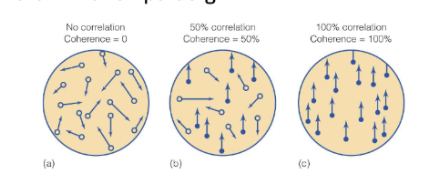
Newsome and Paré
Experiment that proves that response pooling occurs in the medial temporal (MT) cortex 2
They took monkeys and tested when they can detect motion at what coherence rate.
normal monkeys can detect motion with coherence of 1 or 2%
Monkeys with lesions in MT cortex cannot detect motion until the coherence is 10-20%
Beckers and Homberg
Experiment that proves that response pooling occurs in the medial temporal (MT) cortex 3
they used transcranial magnetic stimulation (TMS) to temporarily disrupt brain function
basically turning off a region of the brain
they turned off MT area with TMS and this resulting in temporary difficulty to determine motion direction
Britten et al
Experiment that proves that response pooling occurs in the medial temporal (MT) cortex 4
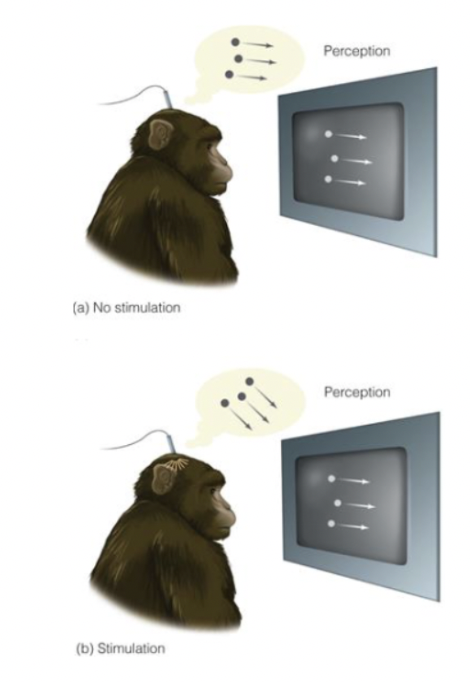
Used microstimulation to activate different direction sensitive neurons in the MT cortex, if they stimulated MT neuron with downward motion preference, the subject would be more likely to see motion in that direction.
What happens when pictures of a body alternate rapidly?
We perceive motion along the shortest path, even if it means seeing an impossible movement (e.g., a hand moving through the head).
Shortest Path Constraint
The brain tends to perceive motion along the shortest possible path between two positions, even if it results in an impossible movement.
so if we see a fast rate of alteration (pictures changing quickly, its more likely to have shortest path constraint
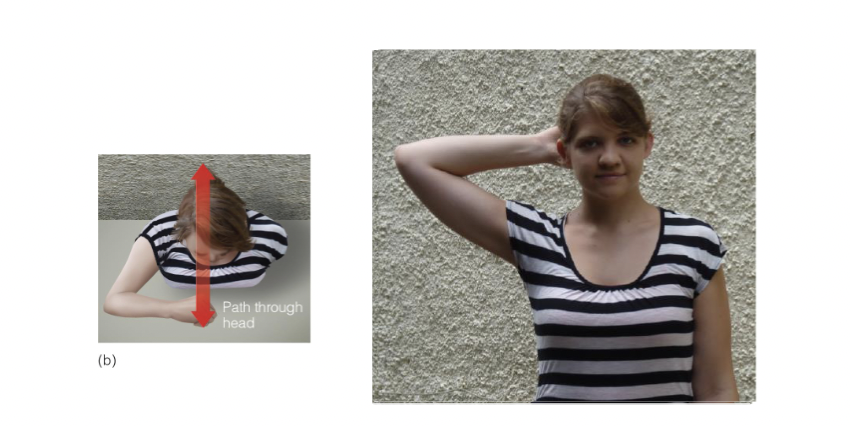
fast alternation→ shortest path constraint more likely
How does the brain detect motion in the human body?
Some neurons are specialized to detect biological motion, helping us perceive realistic body movements.
What if we showed 2 photos of a woman doing two different things (the fist example) but slower?
When pictures alternate more slowly, we perceive the hand moving around the head instead of through it.
Slower alternation → shortest path constraint less likely
What do we learn from apparent motion of the body?
The visual system needs time to process complex movements
The human body may have specilized processing for motion perception
Stevens et al
how the brain perceives human motion
Motor cortex is active only when motion is perceived as humanly possible (e.g., hand moving around head).
Parietal cortex is active in both possible and impossible movements.
Point-light walkers
Small lights placed on key joints (e.g., knees, elbows) to study movement perception.
When stationary, they appear as random dots, but when moving, they reveal human motion (e.g., walking, running).
Shows that the brain is highly sensitive to biological motion and can recognize movement patterns even with limited visual information.
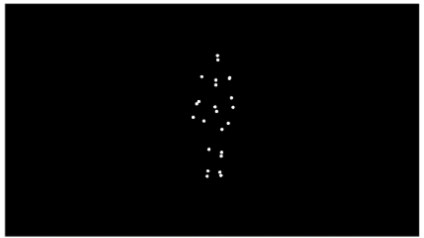
Is a point-light walker an example of biological motion or scrambled/random motion?
A point-light walker is an example of biological motion because it represents natural human movement using minimal visual cues. In contrast, scrambled motion occurs when the point lights are randomly repositioned, disrupting the recognizable motion pattern.
Brain area specialized for perceiving biological motion?
The Superior Temporal Sulcus (STS) is specialized for biological motion. TMS to the STS disrupts biological motion perception, while TMS to other motion-sensitive areas, like the MT cortex, does not.
Areas in our brain responsible for perceiving different kinds of motion

 Note
Note  Flashcards (42)