BIOL*1090
 Studied by 1 person
 Call Kai
 Learn
Learn Practice Test
 Spaced Repetition
 Match
Match Flashcards
 Knowt Play
1/266

There's no tags or description
Looks like no tags are added yet.
Name | Mastery | Learn | Test | Matching | Spaced | Call with Kai |
|---|
No analytics yet
Send a link to your students to track their progress
267 Terms
What is required to make a cell?
information
chemistry
compartments
What is unique about (mature) red blood cells?
No nuclei, organelles, contain no DNA and cannot synthesize RNA
What is enucleation? What are the consequences and why does it occur?
The process by which erythrocytes (maturing red blood cells) eject their nucleus.
Consequences: Mature blood cells cannot divide and have limited repair abilities.
This is to accommodate maximum hemoglobin carrying capacity
What is differentiation?
The process by which cells go from stem cells to specialised cells, ex stem cells to epithelial cells.
Most cells in multicellular organisms are generated this way.
What is the cell’s primary machinery?
Enzymes, kinases and receptors
What is the chemical origin of life?
Abiogenesis
What was the miller- urey experiment?
A chemical experiment that stimulated early conditions when life on earth began to test the chemical origin of life
What were the primary results of the miller- urey experiment?
took basic organic compounds, added energy and within a week simple compounds formed such as Hydrogen Cyanide, Formaldehyde
What were the secondary results of the Miller- Urey experiment?
Simple carbon compounds from round one had energy added, formed a second group of intermediate products comprised of urea, formic acids and amino acids
What were the basic organic compounds used in the Miller- Urey experiment?
N2, NH3, CH4, CO2, H2O, H2
What is Oparin and Haldene’s primordial soup hypothesis?
Putative conditions on early earth favored chemical reactions that synthesized more complex organic compounds from simpler organic precursors
What defines compartments of a cell?
Single/ double layered membranes
What are the fundamental roles of cell compartments?
physical boundary allowing separate metabolic activities to occur
micro environments physically and temporally regulate biological processes
Who discovered cells? How did he name them?
Robert Hooke- named them cells, after latin word Cella for rooms
What 2 rules did Schlieden and Schwann contribute to cell theory
all living organisms are made of 1 or more cells
the cell is the most basic unit of life
What rule did Rudolf Virchow contribute to cell theory?
cells only arise from pre- existing cells
What are the properties of cells?
Complex and organised
activity controlled by genetic program
can reproduce
assimilate and utilize energy
carry out many chemical reactions with enzymes
engage in mechanical activities
respond to stimuli
capable of self regulation
can evolve
What are the features of prokaryotic cells?
unicellular
1-10 Micrometers
no proper nucleus/ organelles
small ribosomes present
asexual reproduction
have a nucleoid containing genetic material (no proper chromosome, plasmid which is DNA arranged in a circular fashion)
What categories fall under eukaryotes?
Protozoa, fungi, plants, animals
What are the features of eukaryotic cells?
usually multicellular, can be unicellular (protozoa)
10-100 micrometers
contain nucleus and organelles
Have large ribosomes
genetic material is arranged as chromosomes, arranged in the nucleus
What organelles are unique to plant cells?
cell walls
vacuoles
chloroplasts
plasmodesmata
What organelles are unique to animal cells?
lysosomes
microvilli
Purpose of Plasma membrane
controls movement of molecules in and out of cell and functions in cell signaling and cell adhesion
Purpose of the mitochondria
Surrounded by double membrane, generates ATP by oxidation of glucose and fatty acids
Purpose of lysosomes
Have an acidic lumen, degrade material internalized by the cell and worn out organelles/ cellular membranes
Purpose of the nuclear envelope
double membrane enclosing contents of the nucleus, outer nuclear membrane is continuous with the rough ER
purpose of nucleolus
nuclear subcompartment where most rRNA is synthesized
What is the nucleus filled with?
Cromatin composed of DNA and proteins
What is the nucleus the site of?
mRNA and tRNA synthesis
What is the purpose of the smooth ER?
Contains enzymes that synthesize lipids and detoxify certain hydrophobic molecules
What is the purpose of the rough ER?
Synthesis, processing, and sorting of secreted proteins, lysosomal proteins and certain membrane proteins
What is the purpose of the Golgi complex?
Processes and secretes secreted proteins, lysosomal proteins and membrane proteins synthesized on the rough ER
What is the purpose of secretory vesicles?
Store secreted proteins and fuse with the membrane to release their contents
What is the purpose of peroxisomes?
Contain enzymes that break down fatty acids into smaller molecules used for biosynthesis and also detoxify certain molecules
What is the purpose of cytoskeletal fibers?
Form networks and bundles that support cellular membranes, help organize organelles and participate in cell movement
What is the purpose of microvilli?
Increase surface area for absorption of nutrients from surrounding medium
What is the purpose of the cell wall?
Composed largely of cellulose, helps maintain the cell’s shape and provides protection against mechanical stress
What is the purpose of the vacuole?
stores water, ions and nutrients, degrades macromolecules, and functions in cell elongation during growth
What is the purpose of the Chloroplasts?
They are surrounded by a double membrane and carry out photosynthesis, contain a network of internal membrane bound sacs
What is the purpose of the plasmodesmata?
Tubelike cell junctions that span the cell wall and connect the cytoplasms of adjacent plant cells
What are slime molds?
Eukaryotic single celled protists, use spores for sexual reproduction. Multinucleanated (have 1000s of nuclei)
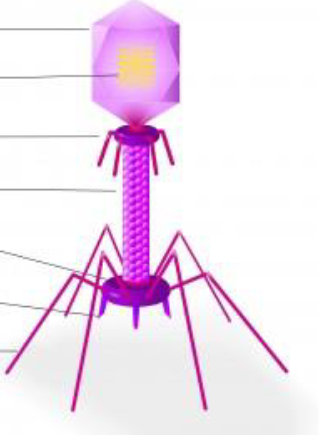
What is in this picture and what are the parts?
capsid head
DNA
Collar
Sheath
base plate
spikes
fibers
Bacteriophage
Are viruses cells?
No, they are macromolecular packages that only function and reproduce in living cells. Outside of cells, they exist as an intermediary particle called a virion.
What are virions composed of?
small amounts of DNA or RNA that encodes a few hundreds of genes
protein capsule called a capsid
What is the tobacco mosaic virus?
One of the first viruses to be categorised, gives leaves yellow spots
How does the Baltimore classification work?
categorises viruses based on their type pf genome and method of replication
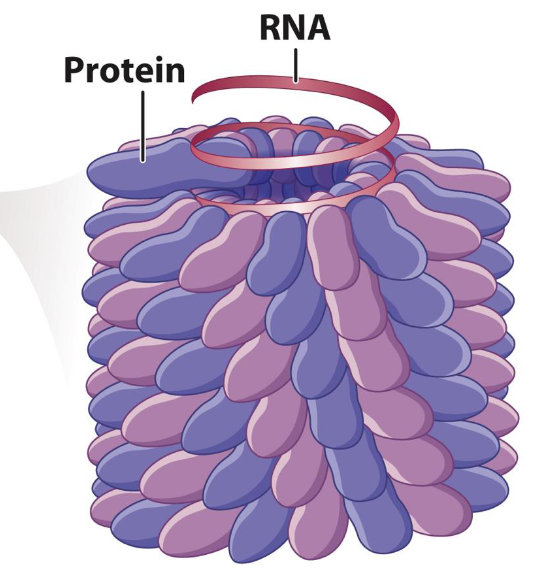
What is this?
The structure of the tobacco mosaic virus
What are Retroviruses?
RNA viruses that insert a copy of its genome into the DNA of the host cell. (non- lytic) Ex. HIV, which causes AIDS
What are hepadnaviruses?
DNA type viruses that affect the human liver, causing serious infections like Hep. B
What are filoviruses?
Negative sense RNA viruses that encode their genome, causing hemorrhagic fever, ex. ebola
What are adenoviruses?
Cause respiratory illnesses or eye infections
What are bactriophages?
DNA viruses that inject their genetic material into bacteria and archea
How many viruses have been formally described to date?
4958
What is Crispr- Cas?
The immune- like system that bacteria have evolved to battle the continuous attacks from bacteriophages.
What is host range?
Defines the cell types the virus can infect
Viruses bind to a specific protein and enter the cell
What is a virus with a narrow host range?
Influenza, only infects human epithelial cells
What is a virus with a wide host range?
rabies, can infect cells of a wide range of mammals
How does a virus infect a cell?
Once inside, it hijacks the cellular machinery to synthesize nucleic acids and proteins. these proteins are then assembled to make new virus particles and infect other cells
What are the 2 main modes of infection?
lytic: ruptures cell
non- lytic: Viral DNA is inserted into host cell and forms a provirus, infected cell survives with impaired function (aka lysogenic or integrative)
What is a monopartite genome?
A genome that occupies one nucleic acid molecule
What is a multipartite genome?
A genome that occupies several nuclein acid segments
What is the zika virus?
Positive sense RNA virus mainly spread by mosquitoes, also blood transfusions and sexual contact. Infected adults are often asymptomatic. Causes microcephaly in infants.
How do infants get microcephaly from zika virus from mother?
zika virus from mother can cross the placental barrier by targeting trophoblasts and macrophages.
if this infection occurs during neurogenesis (gestational weeks 10-25) , the survival of neuroprogenitor cells can be affected.
what is Microcephaly?
a disorder arising from defects in early brain development that can cause babies to have a smaller than normal head circumference along with other neurological problems
How do RNA vaccines work?
trick body’s cells into producing fragments of viruses (antigens) from an RNA template
How do RNA vaccines get made more effective at lower doses?
include instructions for assembling a replicase, which makes lots of copies of the RNA template for producing antigens
What role do membrane proteins play in signal transduction?
they convert an extracellular signal to intracellular signals
What does signal transduction allow cells to do?
respond to events in their environment
grow
divide
survive or self destruct
move
differentiate
what is a ligand?
A small molecule that binds to a receptor, changing the conformation of the protein and resulting in a change on the cytosolic side that causes other proteins to be activated
What are the stages of signal transduction?
binding of a ligand to a receptor (extracellular)
signal transduction via second messengers like cAMP, calcium, G- protein (intracellular)
cellular response (intracellular)
What is glycogenin?
An enzyme that behaves as a polymer to polymerize 1st glucose molecules forming branches before other molecules take over. End product is a glycogen molecule
What are the steps of glycogenolysis?
epinephrine binds to a hepatocyte (specifically the adregenic receptor)
the adregenic receptor recruits G- protein and allows binding of GTP to turn it on
a subunit of the G protein dissociates from the G complex and activates adenyl cyclase causing accumulation of cAMP in the cells.
cAMP triggers a molecular cascade that ends with Phosphporylase- P releasing glucose units from the glycogen molecule
What happens in the molecular cascade in glycogenolysis?
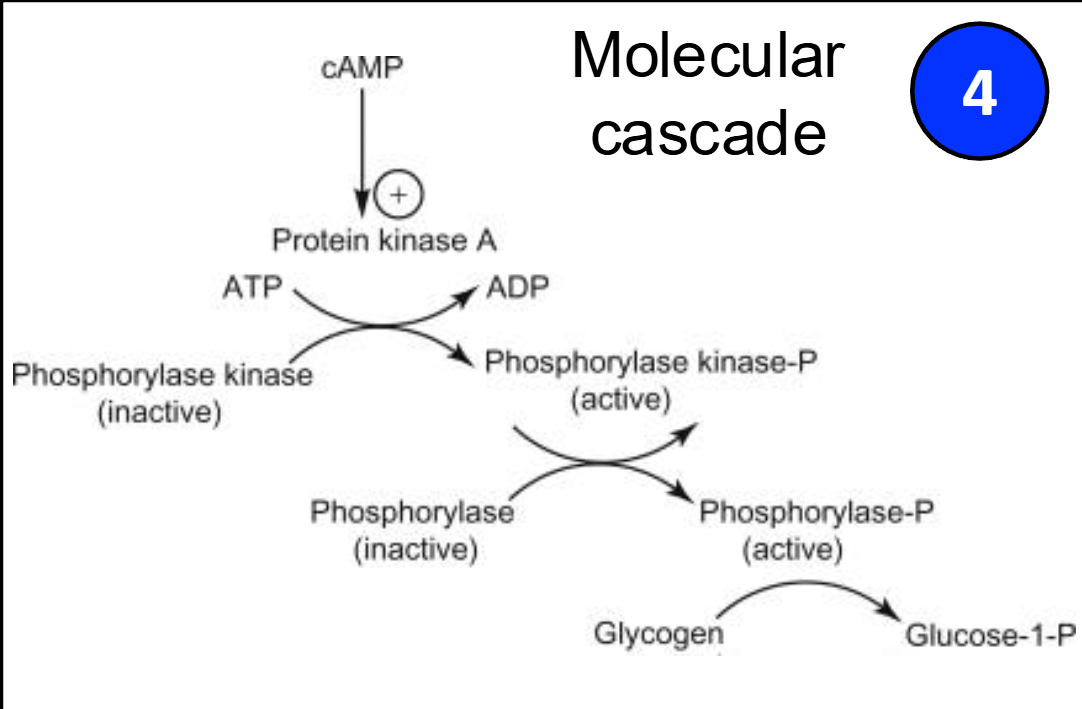
What is the function of anchor membrane proteins?
they play an important role by interacting with components of the extracellular matrix.
What makes up the extracellular matrix?
It is an organised network of material produced and secreted by cells
What are the functions of the ECM?
cell adherence
communication between cells
cell shape, mechanical support, structure and integrity
serves as a barrier, filters out some particles
Where is the ECM abundant?
In the skin and other connective tissues such as tendons, ligaments
What causes wrinkles?
fibrosis (thickening and scarring) of connective tissues of the skin
What is the misrepair- aging accumulation theory?
wrinkles develop from incorrect repairs of injured elastin and collagen fibers
some broken elastin/ collagen fibers are replaced by altered fibers, not replaced and restored
What are the components of the extracellular matrix?
Proteins , glycoproteins, proteoglycans
What is an example of a protein found in the ECM?
collagen
What is an example of a glycoprotein?
laminin fibronectin
what is a proteoglycan?
a protein with chains of polysaccharides
What organisms have ECM in their cell walls?
Bacteria, plants and fungi
What are cell walls composed of?
cellulose, hemicellulose, pectin, proteins
What are the purposes of cell walls?
provide structural support at both a cellular and organismal level (act as a skeleton for plants)
protect the cell from mechanical damage and pathogen attack
What are the 3 layers of the cell wall
primary cell wall, secondary cell wall, plasma membrane
What is the space between cell walls called?
the middle lamella
what is in the secondary cell wall?
cellulose, liginin
Who proposed the endosymbiotic theory?
Konstantin Mereschowski, later advancements were made by lynn margulis
What is the endosymbiotic theory?
Organelles in eukaryotic cells that have 2 membranes (e.g. chloroplasts, mitochondria) were originally free living prokaryotes that were engulfed in other prokaryotic cells, resulting in endosymbiosis.
What are 2 points proving the endosymbiotic theory?
binary fission of mitochondria and plastids
circular DNA inside these organelles similar to bacterial DNA
What is aerobic respiration?
In the presence of oxygen, energy from food (glucose molecules) is converted into ATP and CO2 (waste)
What does the outer mitochondrial membrane contain?
many enzymes with diverse metabolic functions
porins, large channels premeable (when opened) to many molecules through passive diffusion such as ATP, sucrose
What do monoamine oxidases do?
Break down monoamines ingested from food and monoamine transmitters such as dopamine, seretonin
What is the protein to lipid ratio in the inner mitochondrial membrane?
3:1
What are cristae and what is their function?
double layered folds in the inner mitochondrial membrane which increase the surface area and contain machinery for aerobic respiration and ATP fermentation
What is the inner mitochondrial membrane rich in?
Cardiolipin, which is characteristic of many bacterial membranes and needed for function of many enzymes
What are the 2 aqueous compartments of the mitochondria?
intermembrane space
matrix
What is in the matrix
gel like fluid high in proteins that contains mitochondrial ribosomes, DNA
 Note
Note  Flashcards (77)