liability in negligence for economic loss and psychiatic injury
 Call Kai
 Learn
Learn Practice Test
 Spaced Repetition
 Match
Match Flashcards
 Knowt Play
1/36

There's no tags or description
Looks like no tags are added yet.
Name | Mastery | Learn | Test | Matching | Spaced | Call with Kai | Chat |
|---|
No analytics yet
Send a link to your students to track their progress
37 Terms
If a claimant successfully,lay proves a negligent act or omission by another they will be able to claim damages for
Any physical injury suffered
Any damage to property
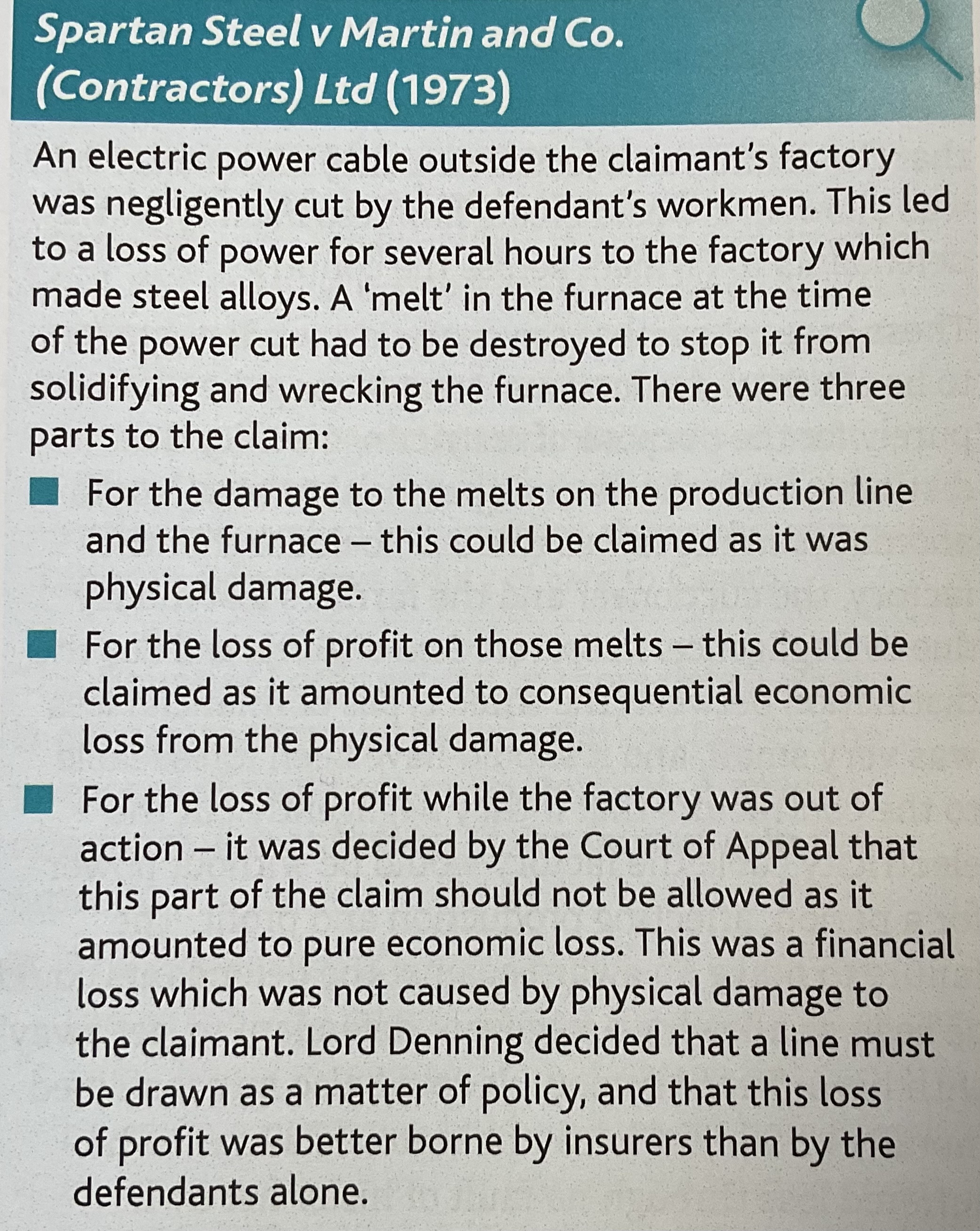
A claimant cannot claim for purely economic loss- economic or financial loss which is not caused by physical injury or damage. Exp if claimant who suffers a financial loss as a result of acting on a negligent misstatement-can claim for loss if they can establish special relationship with d
Loss caused by negligent acts
No liability for pure economic loss issue of contract rather than tort law
Spartan steel v Martin and co contractors ltd 1973
Weller v foot and mouth disease research institute 1966
The foot and mouth virus was negligently allowed to escape from the d’s premises. It infected cattle rendering them unsellabel and causing many to be destroyed. Restrictions were placed on the movement of all animals for some t8me to prevent the spread of the disease. The clamping was an auctioned and brought an action cla8ming the loss of profit he would have made had he been able to continue his normal sales. His claim failed as the court decided that pure economic loss issue not recoverable under tort law
Loss of income and profit was pure economic loss and not recoverable under tort law
Loss caused by negligent misstatements
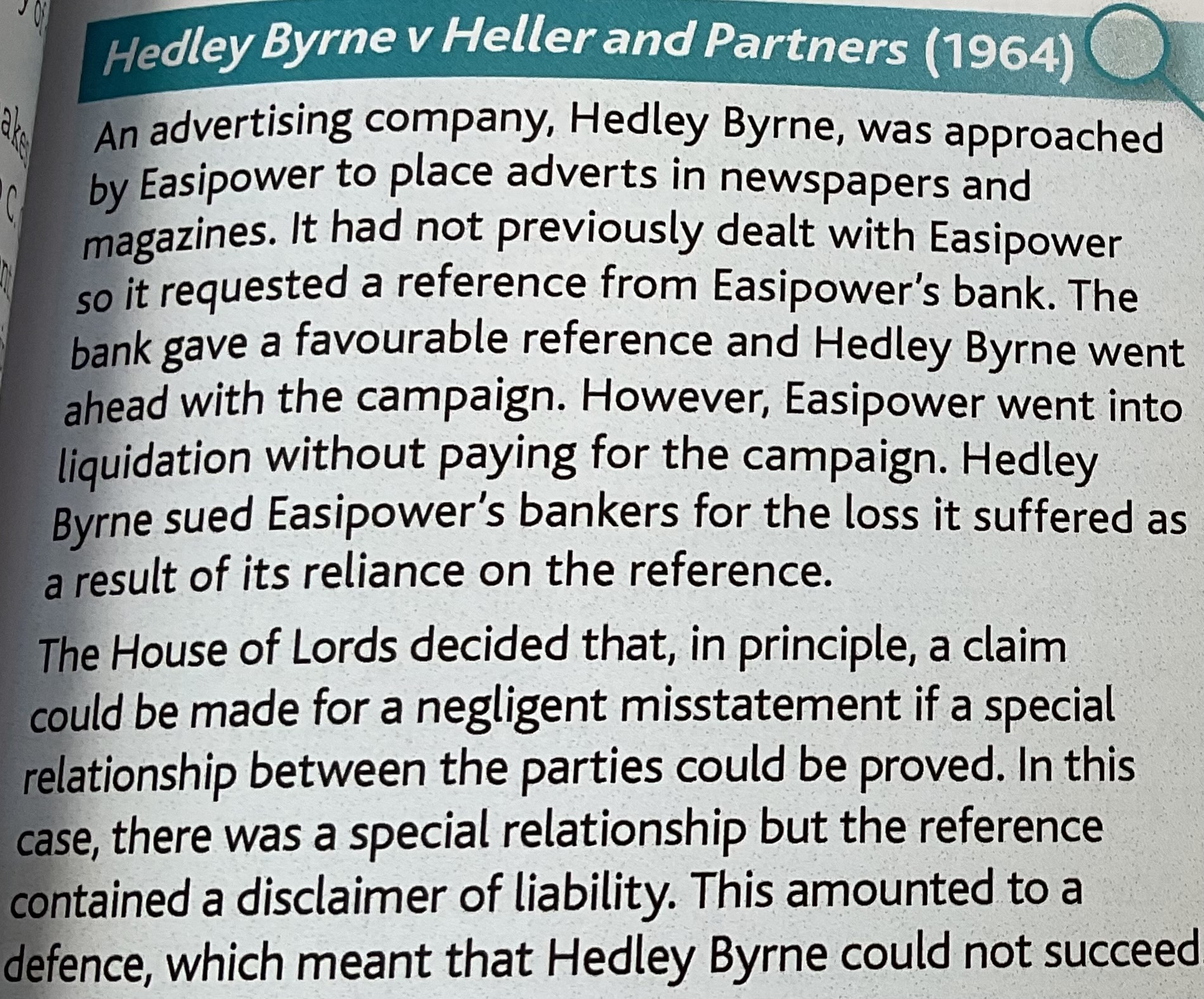
Two party liability-a gives advice to b and b suffers loss bc of it. Hasn’t paid a so no cont4act to sue under should the6 be able to claim 7ndee tort
Three party liability a makes statement to b b communicates it to c c then suffers loss in relying on the statement will an owe duty of care to c.
Before only available under tort of deceit but now in Candler v cane Christmas co. Lord denning when dissenting said that a duty of care should be owed to an investor who lost money relying on advice and to any third party.
From the Hedley case rule set that a ckamun may be made but must be established that the statement was made negligently and there is a special relationship between parties
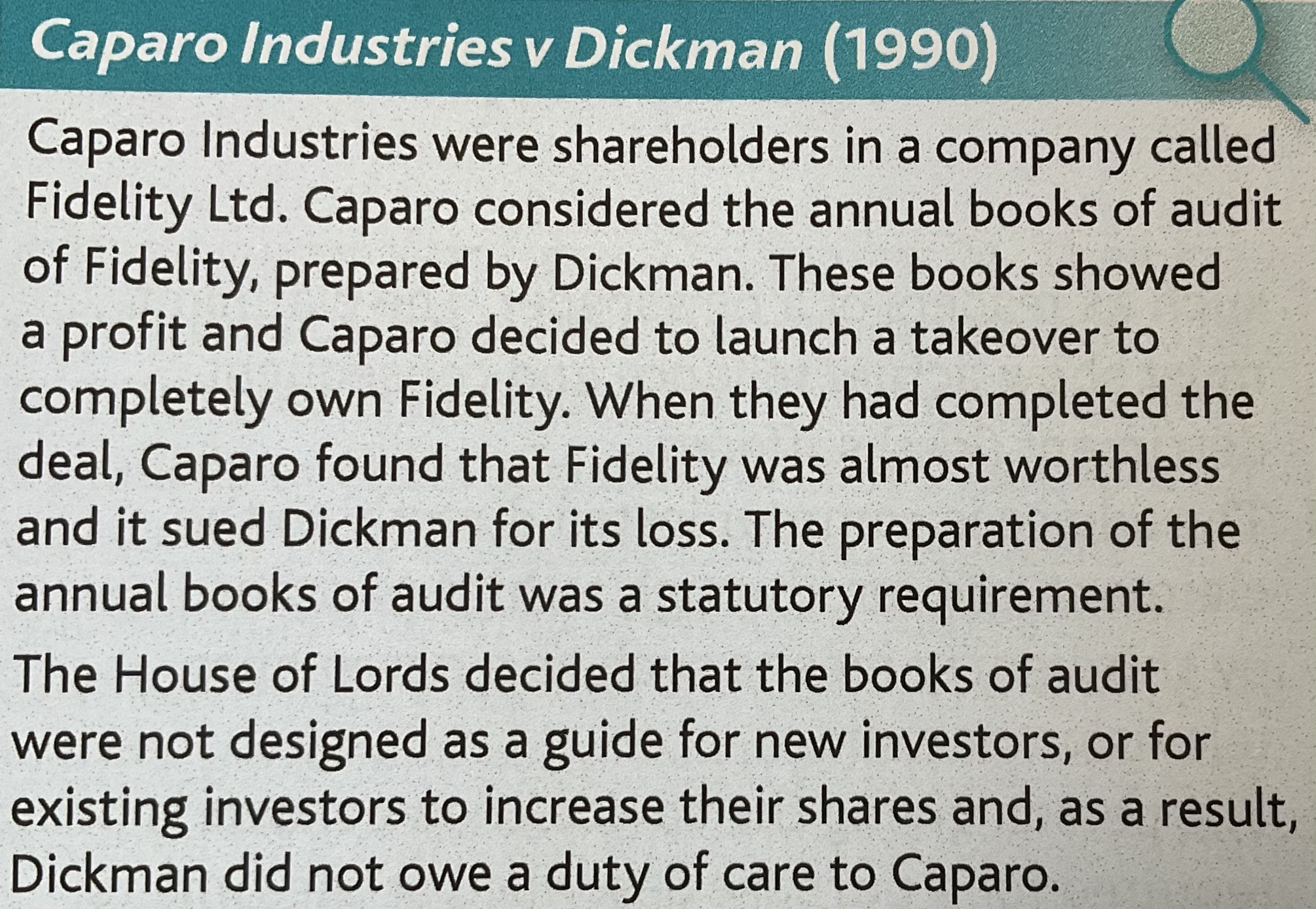
In caparo set up guidelines for special relationship
Special relationship for purposes of negligent misstament
Must prove all
Possession of a special skill on the part of the person giving the advice. Advisor doesn’t have to be professional advisor
A reliance by the claimant on the advice. Real test is wether there is proximity between parties for their to be reasonable reliance on advice
Raja v gray court of peal held that there was insufficient procximity between values appointed by recovers and parties with an interest in Margate’s property generally. Not be foreseeable reliance if the claimant belongs to a group of potential claimants that is too large
The advice is communicated directly to claimant not through third party
The person giving the advice knows that it is being used for a person described at the time by the defendant. He or she must know that the advice will be acted upon by the c without taking any further independent advice
There is no disclaimer to act as a defence
Disclaimer
A statement informing the claimant that the company does not accept responsibility for the advice being given
Hadley Byrne v heller nd partners 1964
Camaro industries v dickman 1990
Chauffeur v Prabhakar 1988
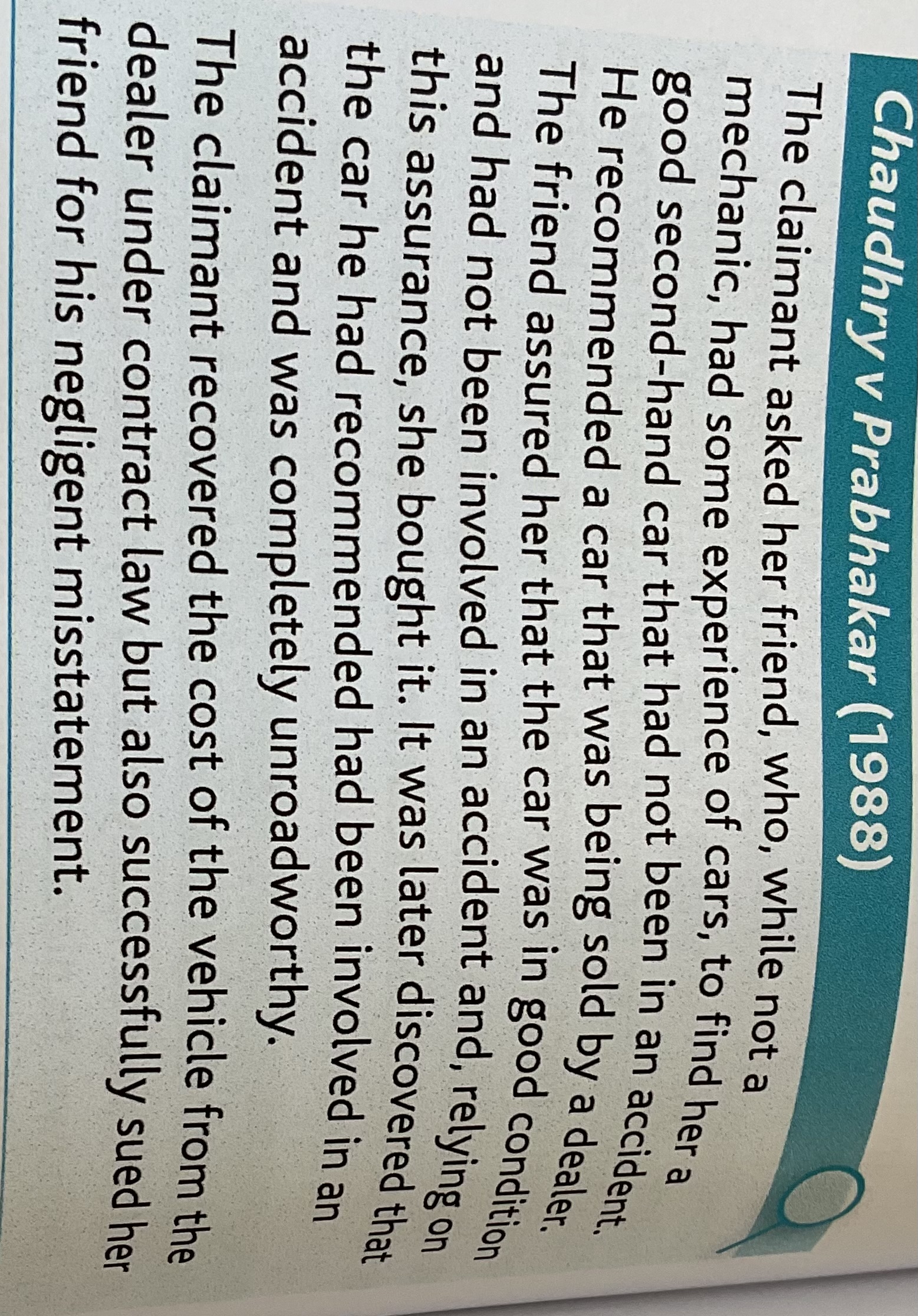
Chancery special relationship comments
Decided that a special relationship can exist even if and vice given in a social situation or in course of a special relationship not just quasi business.
But normally in social sitcoms judges don’t allow
Psychiatric injury
Nervous shock. A sever long term mental injury which is more than shock or grief
Liability for psychiatric injury sustained by primary and secondary victims
Primary -victim of accident
Secondary witnessed accident
Loss suffered is normally loss of earnings as the extent of medical injury so severe that claimant will be unable to do work.
Primary victims have to prove negligence on behalf of the defendant -no restrictions on these
Restrictions on secondary v’s must prove
There was an accident or sudden event where d was negligent which caused injury
Some form of mental injury
The claimant passes certain criteria (Alcock criteria) to allow them to claim
That a person of reasonable fortitude would have suffered the same injury in the circumstances
Liability for psychiatric injury sustained by primary and secondary victims
Negligence by d has initially to be proved
D owed c a duty of care the duty was breached and loss or damage caused
Liability for psychiatric injury sustained by primary and secondary victims
A mental injury
Must be medically proven, significant, long term affects. Must come from sudden event must show loss of past nd future earnings
Liability for psychiatric injury sustained by primary and secondary victims
Early development of the rules
Initially judges suspicious and claim could only be made if c suffered mental injury from fearing for his own safety (Dulieu)
Extended in hambrook then borehole who witnessed the immediate aftermath of accident -decision confirmed that in order to claim a mental injury must be suffered due to injury to oneself or member of family and persona able to claim must fall within a foreseeable range of people who could be affected by the negligence
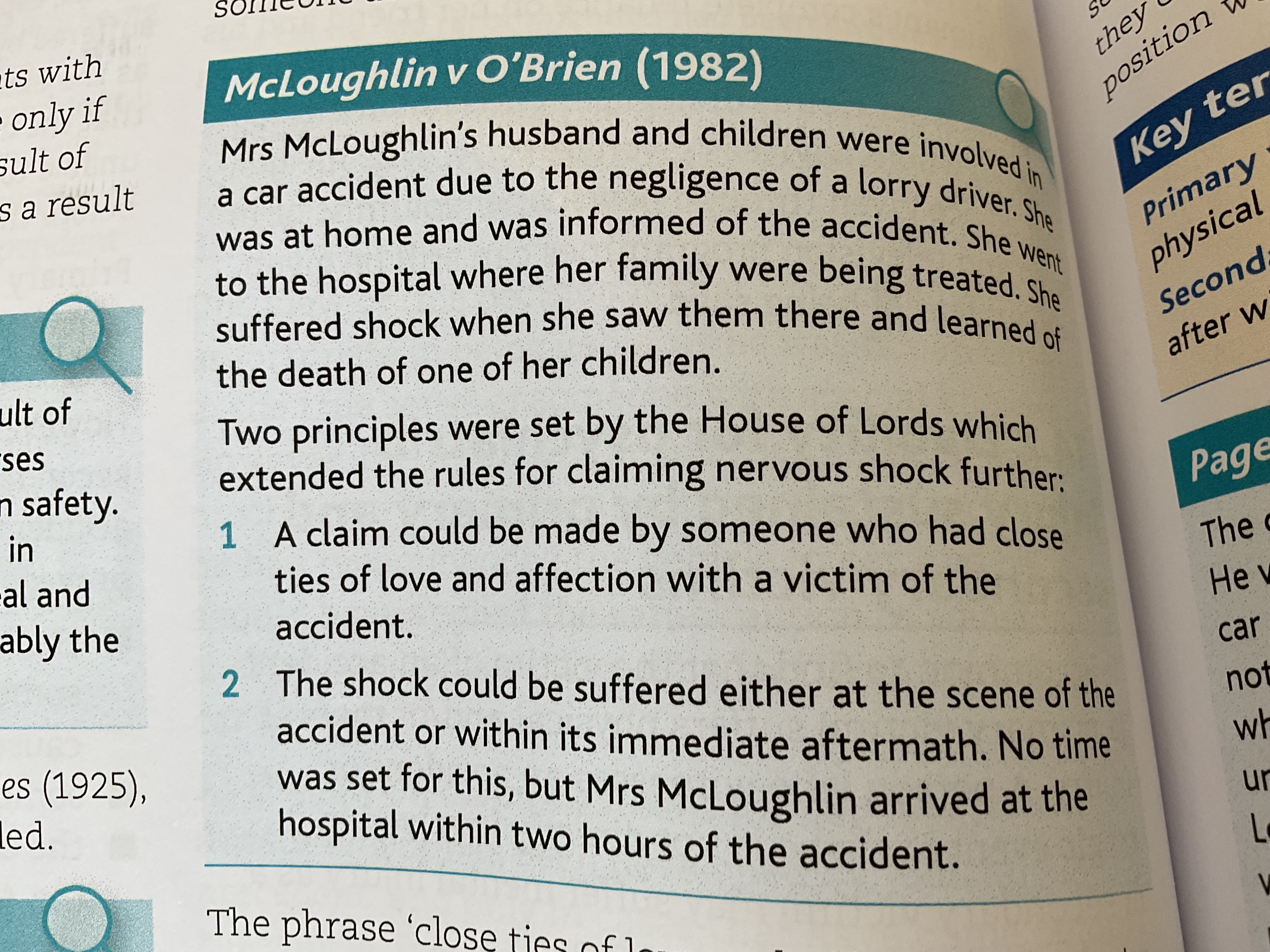
McLaughlin developed precedent with mental injury suffered short time after accident before only people at site could claim
Phrase close ties of love and affection-more distant relations and close friends or those in relationship with victim + decision extended period in which claimant could suffer shock up to two hours
Dulieu v White 1901
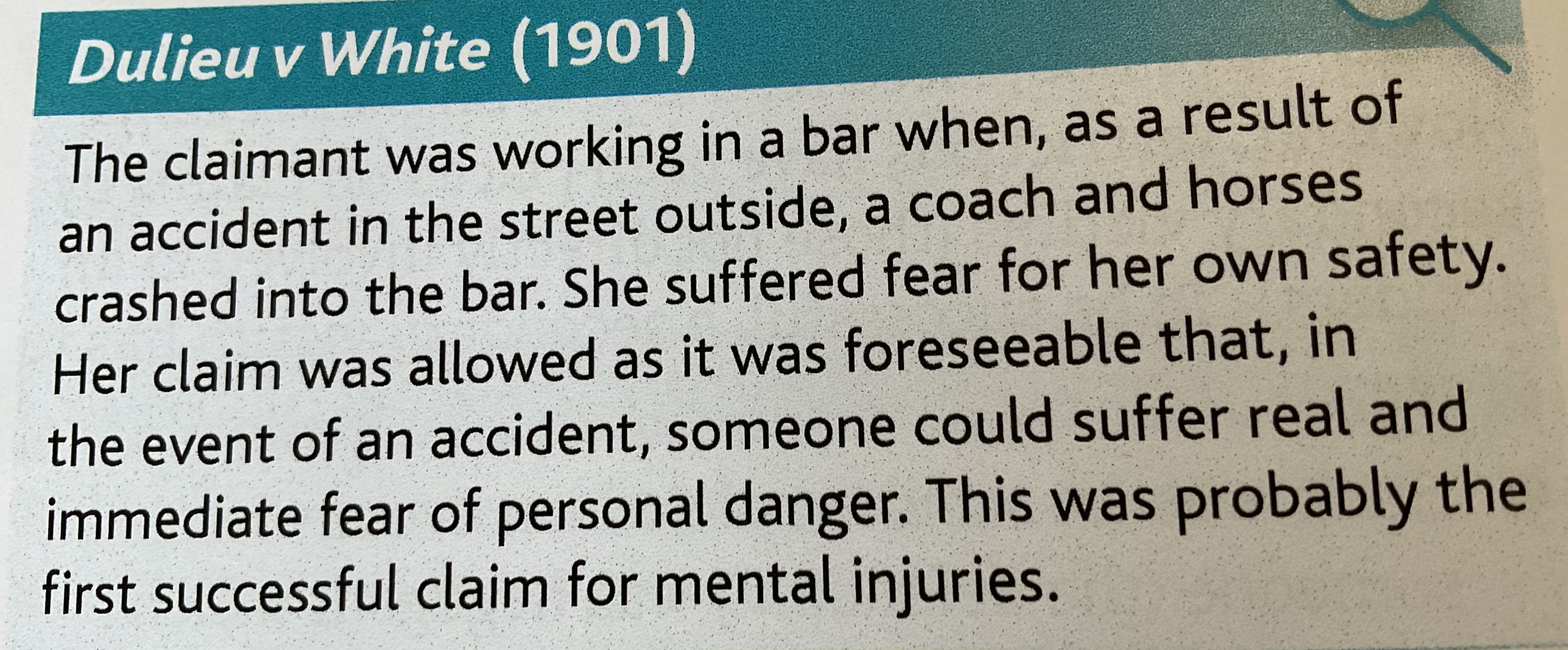
Hambrook v stokes 1925
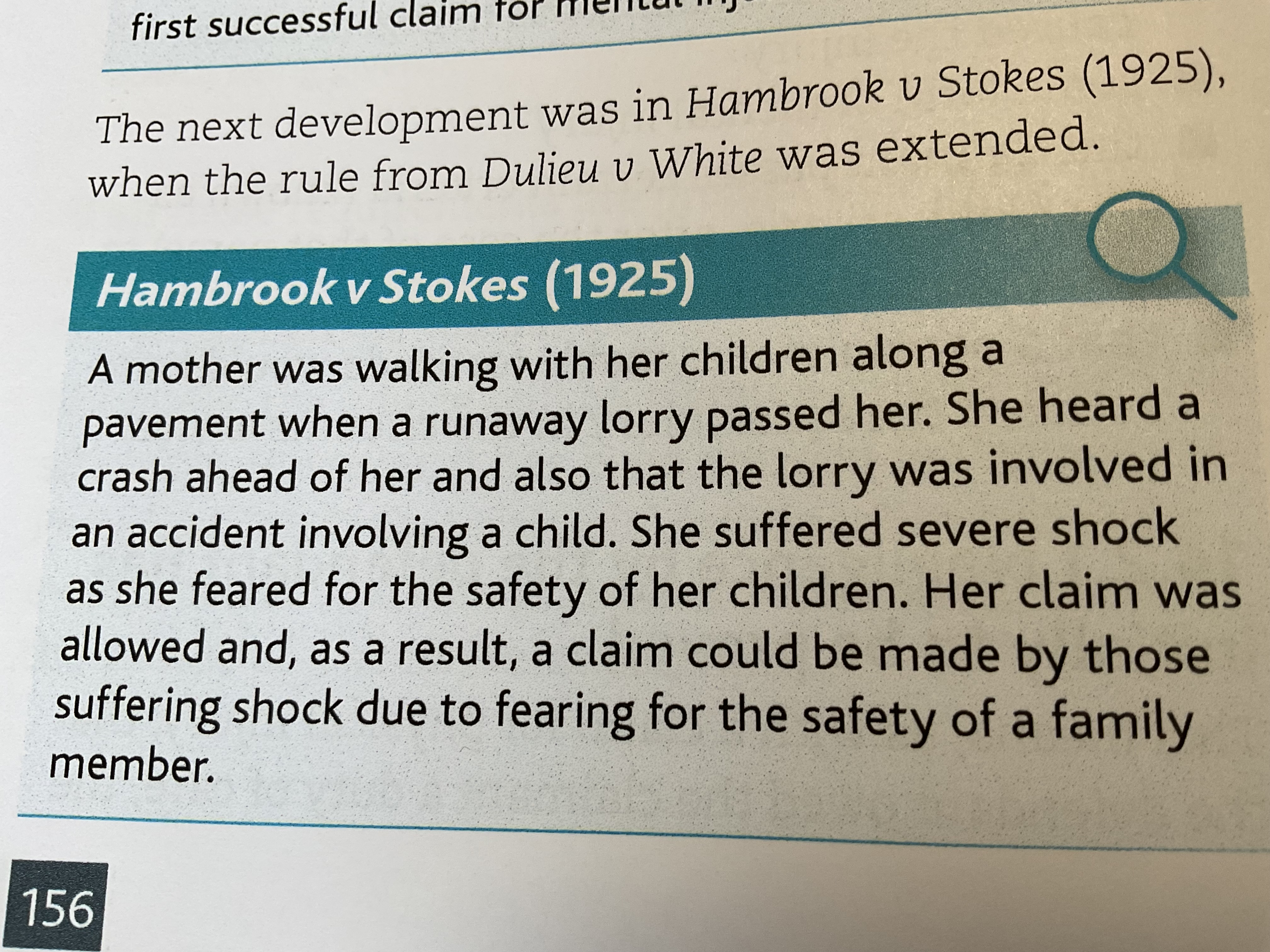
Bourhill v Young 1943
McLoughlin v O’Brien 1982
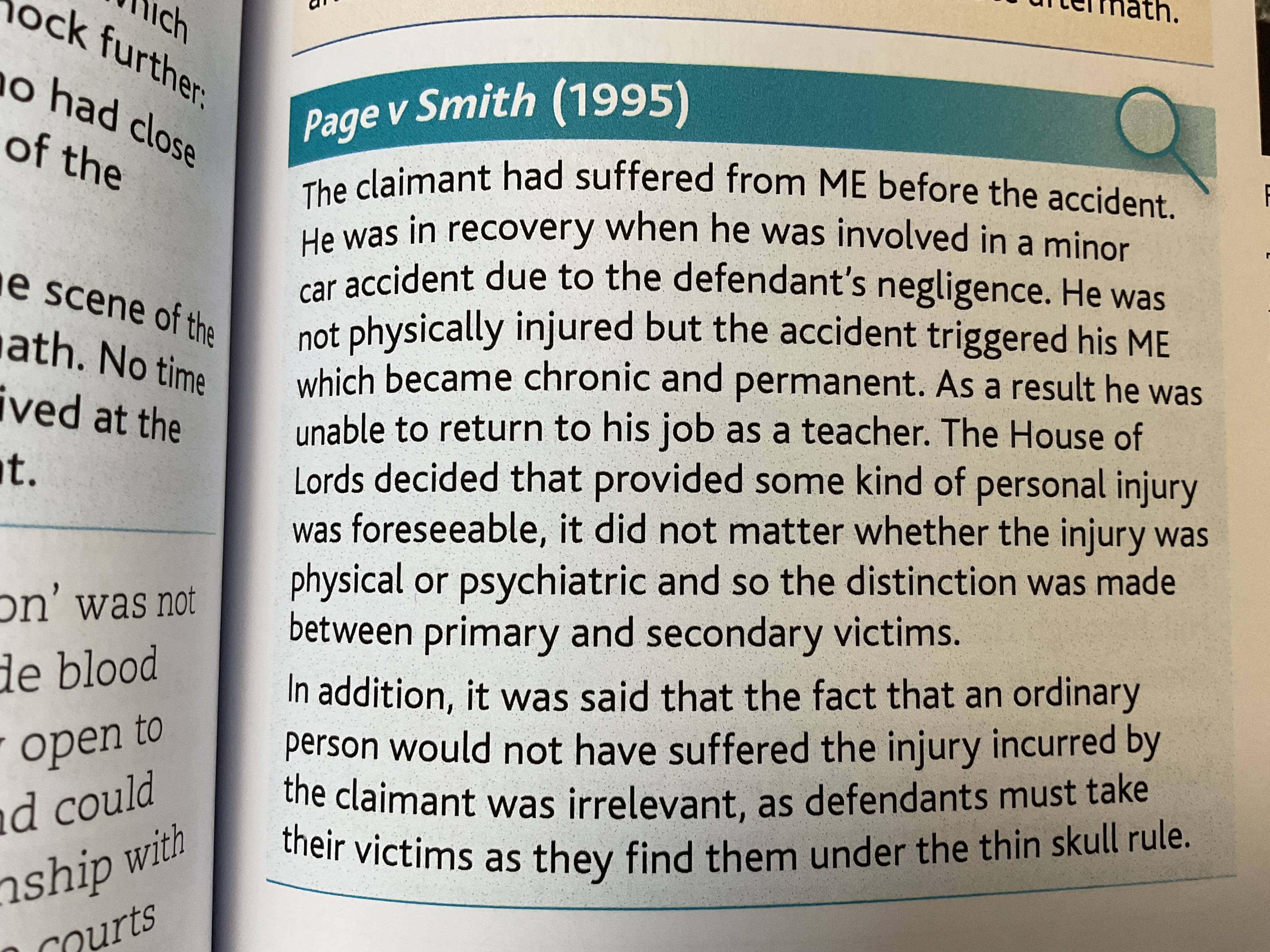
Page v smith 1995
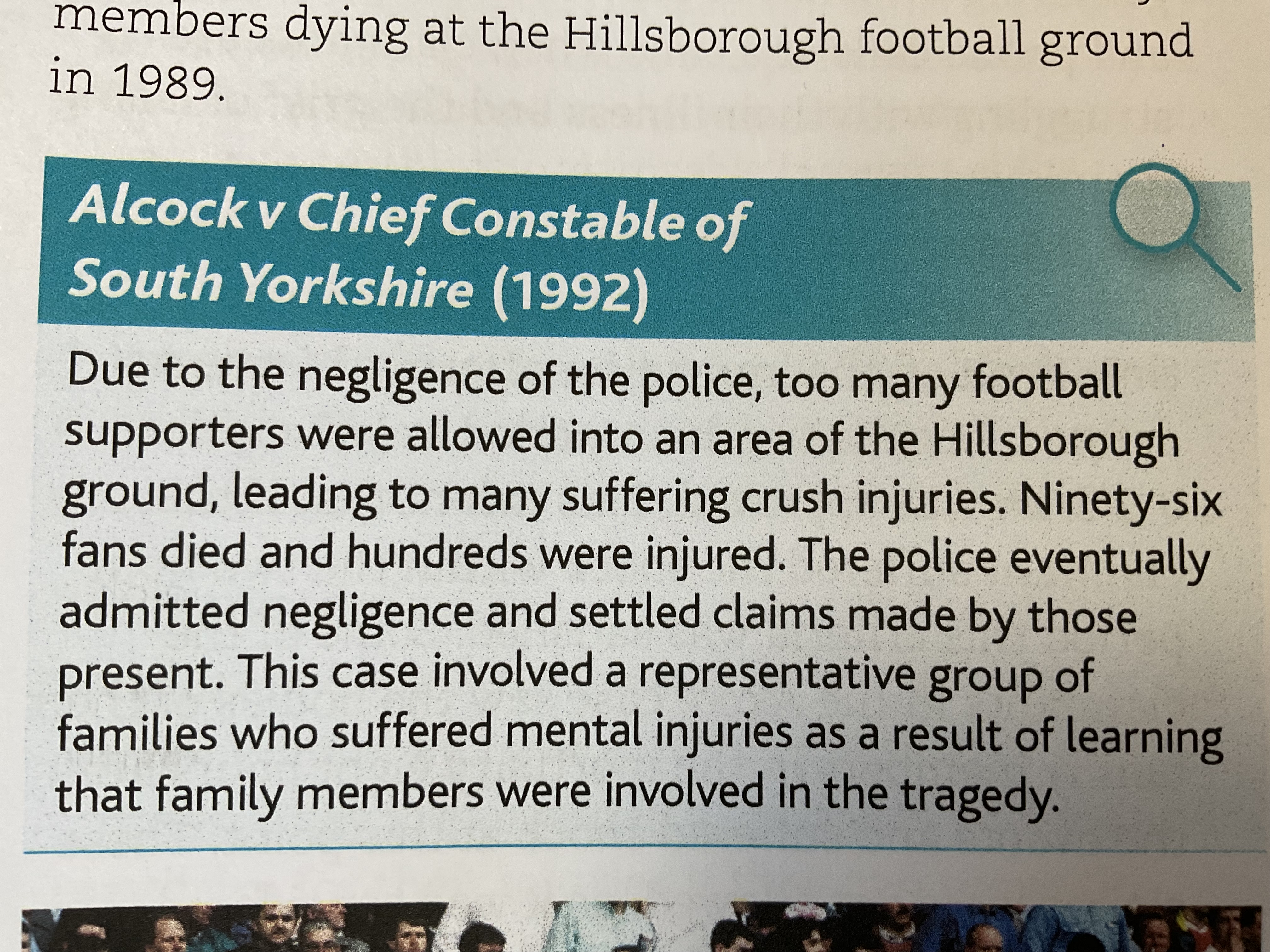
Alcock v chief constabulary of South Yorkshire 1992
Primary victim
A victim of an accident who suffers physical or mental, injuries or both
Secondary victims
A person who suffers mental injury after witnessing an accident or its immediate aftermath
Must prove negligence, Alcock criteria and a threshold test.
Alcock criteria
Came from people who witnessed seeing family members dying at hillsboruohj football ground
Criteria
C had to have close ties of love and affect with v.relayionship in close type of relationship(family or lover or friend ) and relationship is close in fact -wether or not family member
C suffered mental injuries at the scene of accident or its immediate aftermath not defined but O’Brien two hour period approved
Suffered shock through his or her own unaided senses-can’t be through to phone call radio etc.
All 3 criteria must be proved
Rescuers
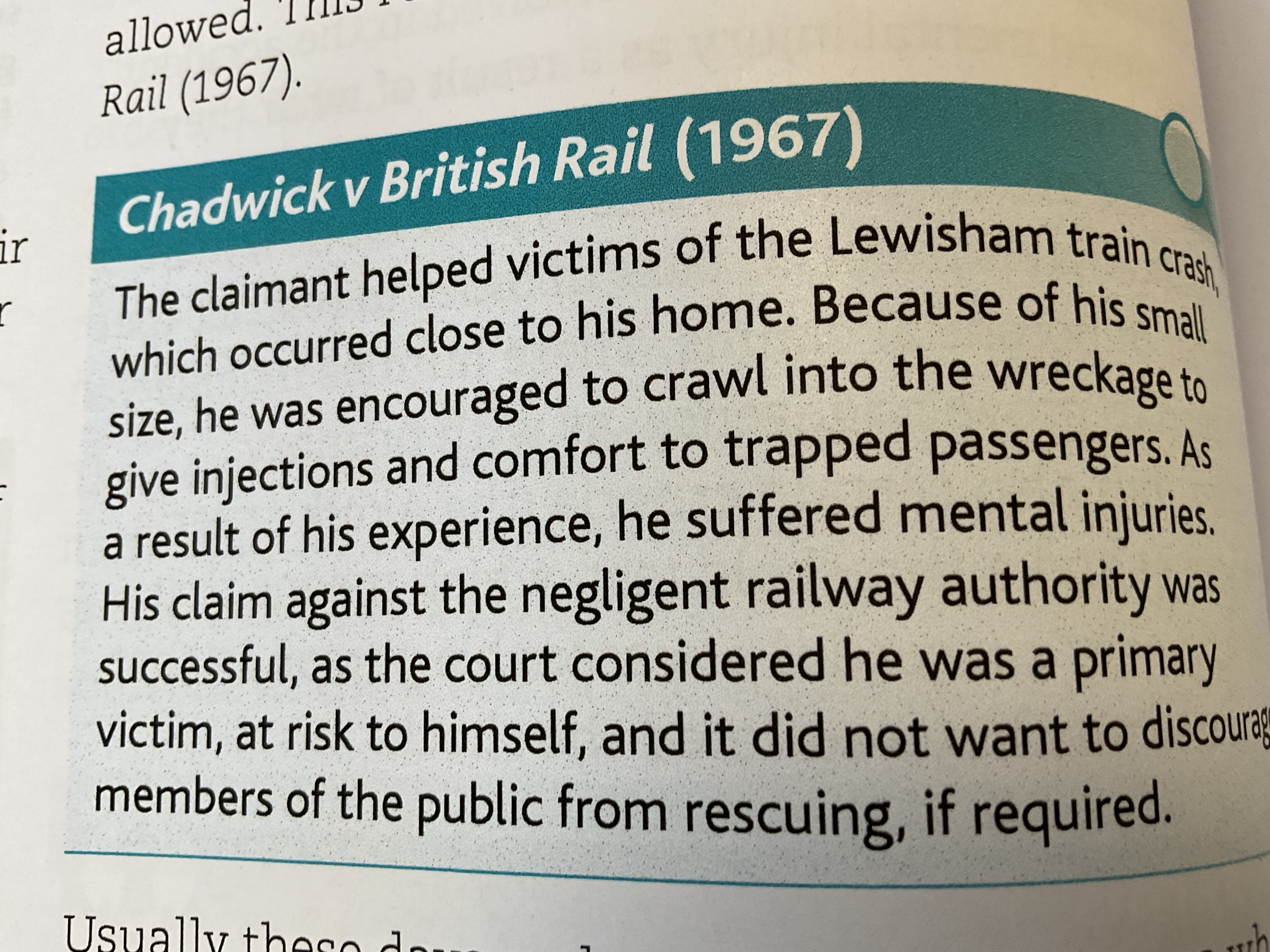
Don’t want to discourage rescuing so likely that claim for mental injuries suffered will be allowed
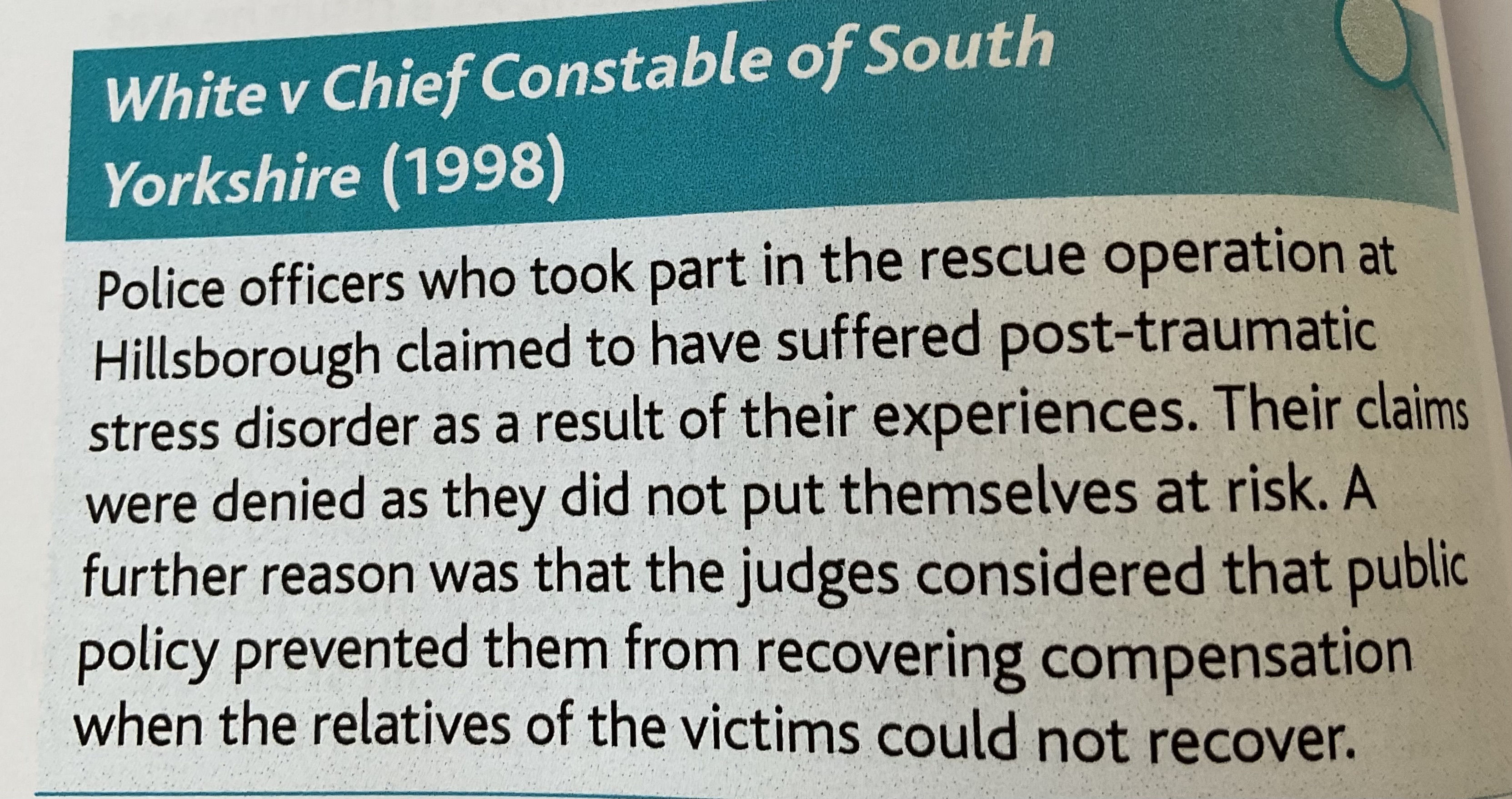
But these days mainly only professional rescuers who put themselves at risk will be able to claim
Hale v London Underground
fireman attending King’s Cross station fire successfully claimed for post traumatic stress disorder bc rescuers who put themselves directly in danger are primary victims
Chadwick v British rail
White v chief constable of South Yorkshire
Bystanders
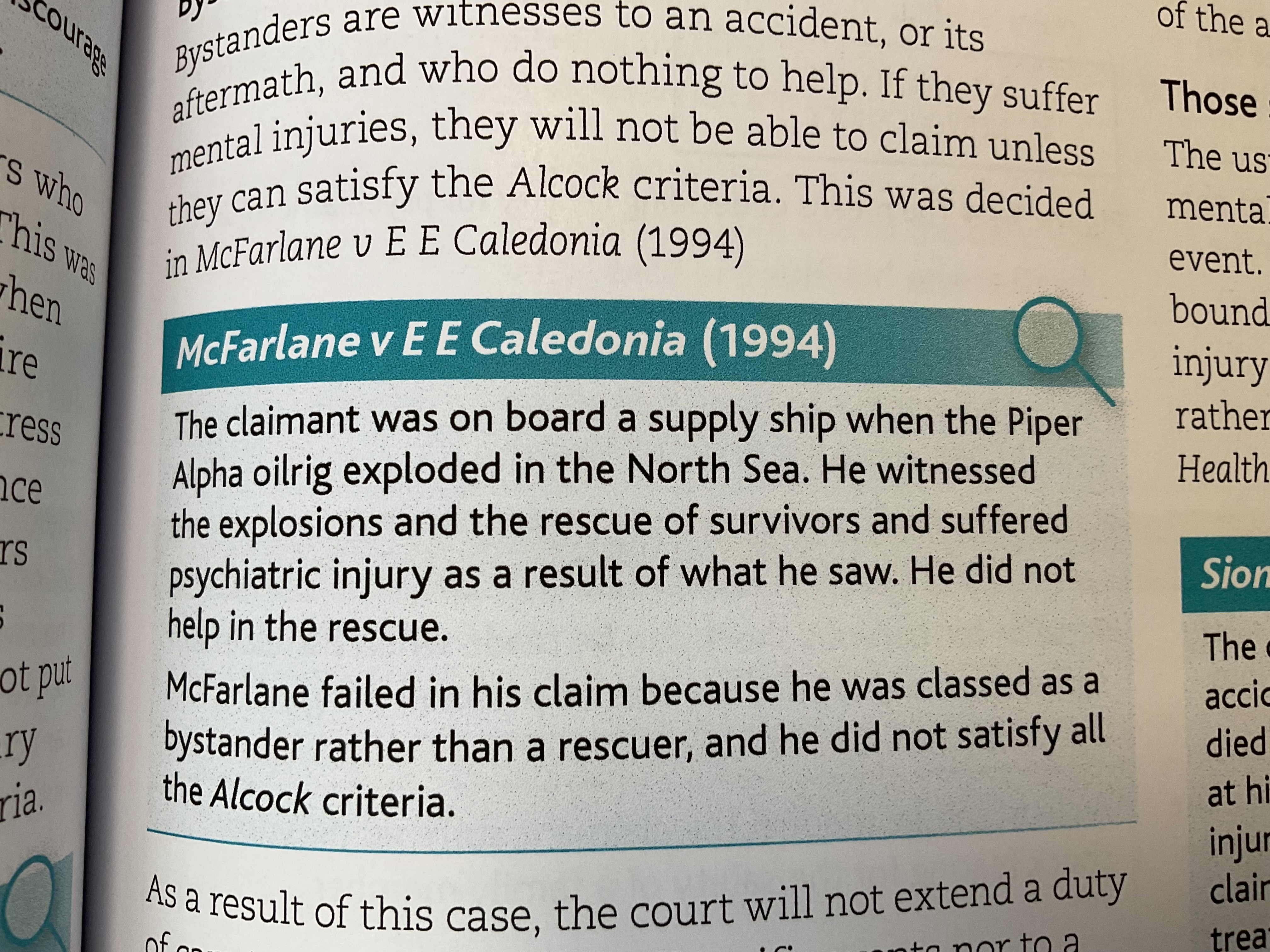
Cannot claim unless satisfy Alcock criteria
Cannot be claimed by rescuer of ordinary courage if trivial or peripheral assauitance given then usually not sufficient
McFarlane v E E Caledonia 1994
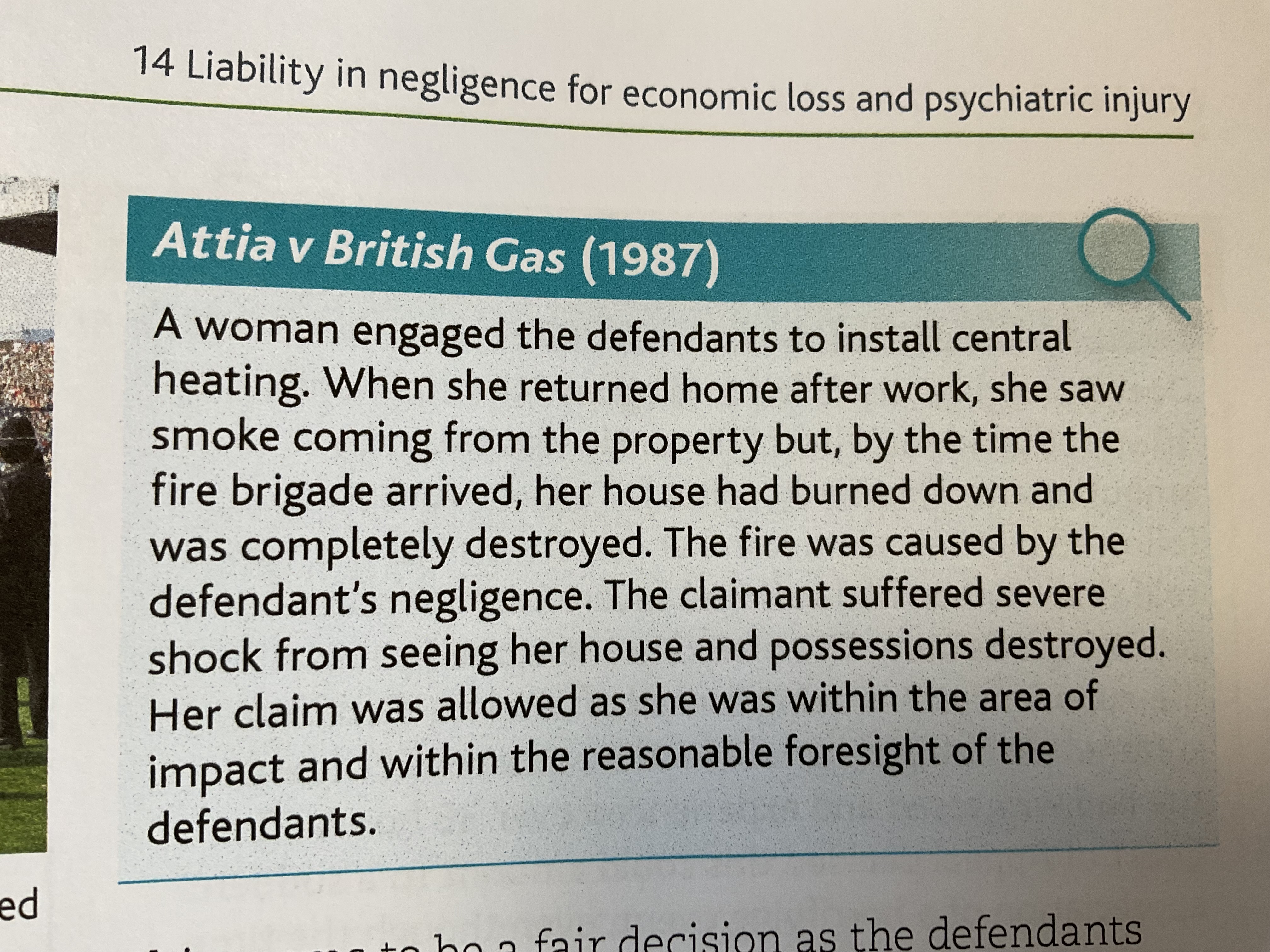
Attia v British Gas
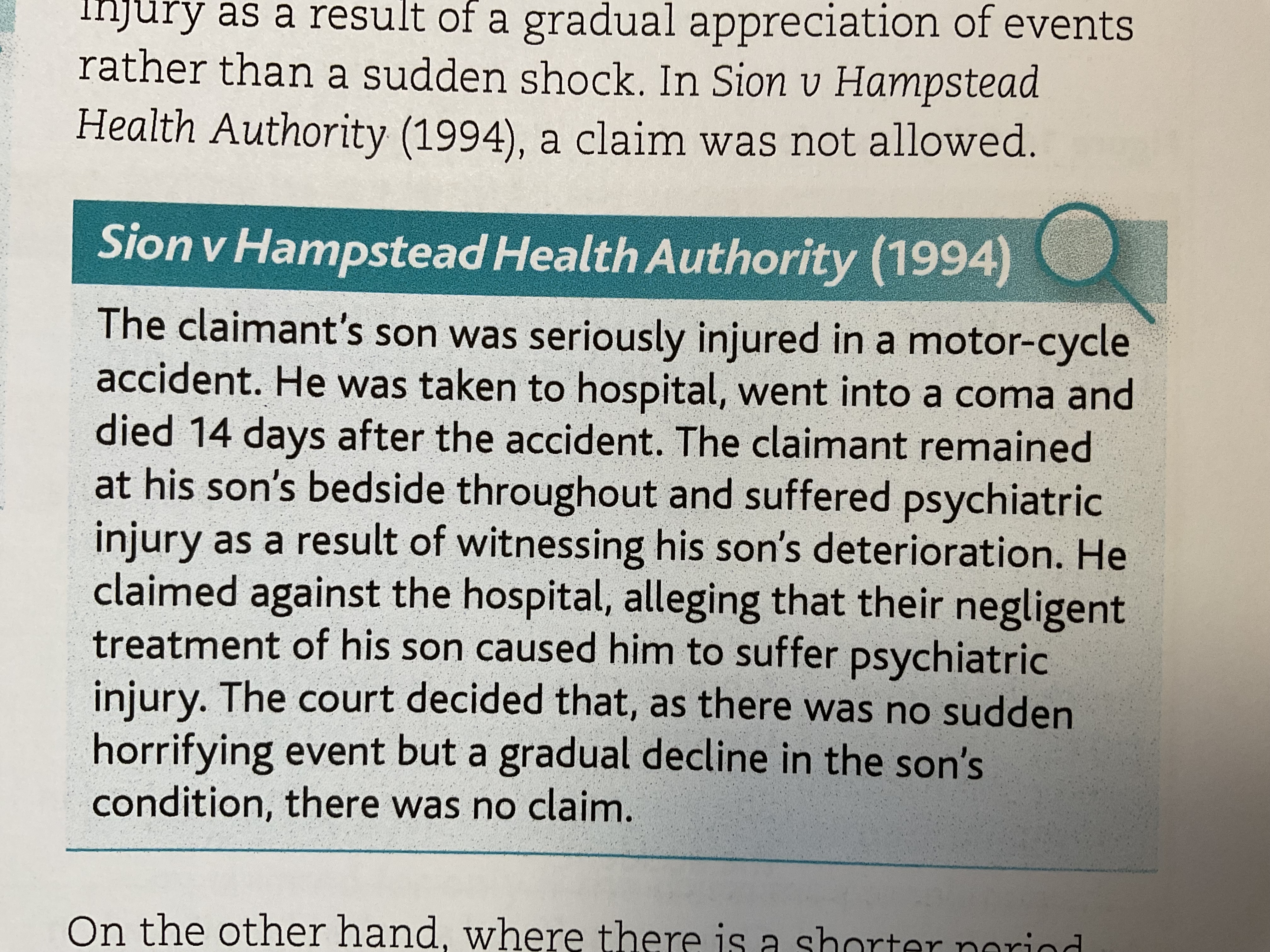
Simon v Hampstead health authority
Property owners
A women successfully claimed when suffered shock from witnessing her house burning down
Near missers
People who were close to the scene of accident and may have suffered physical or mental 8njuries regarded as primary victims ans can claim if prove d was negligent. Don’t have to be related to v
Those suffering gradual rather than sudden shock
In Simon v Hampstead claim not allowed
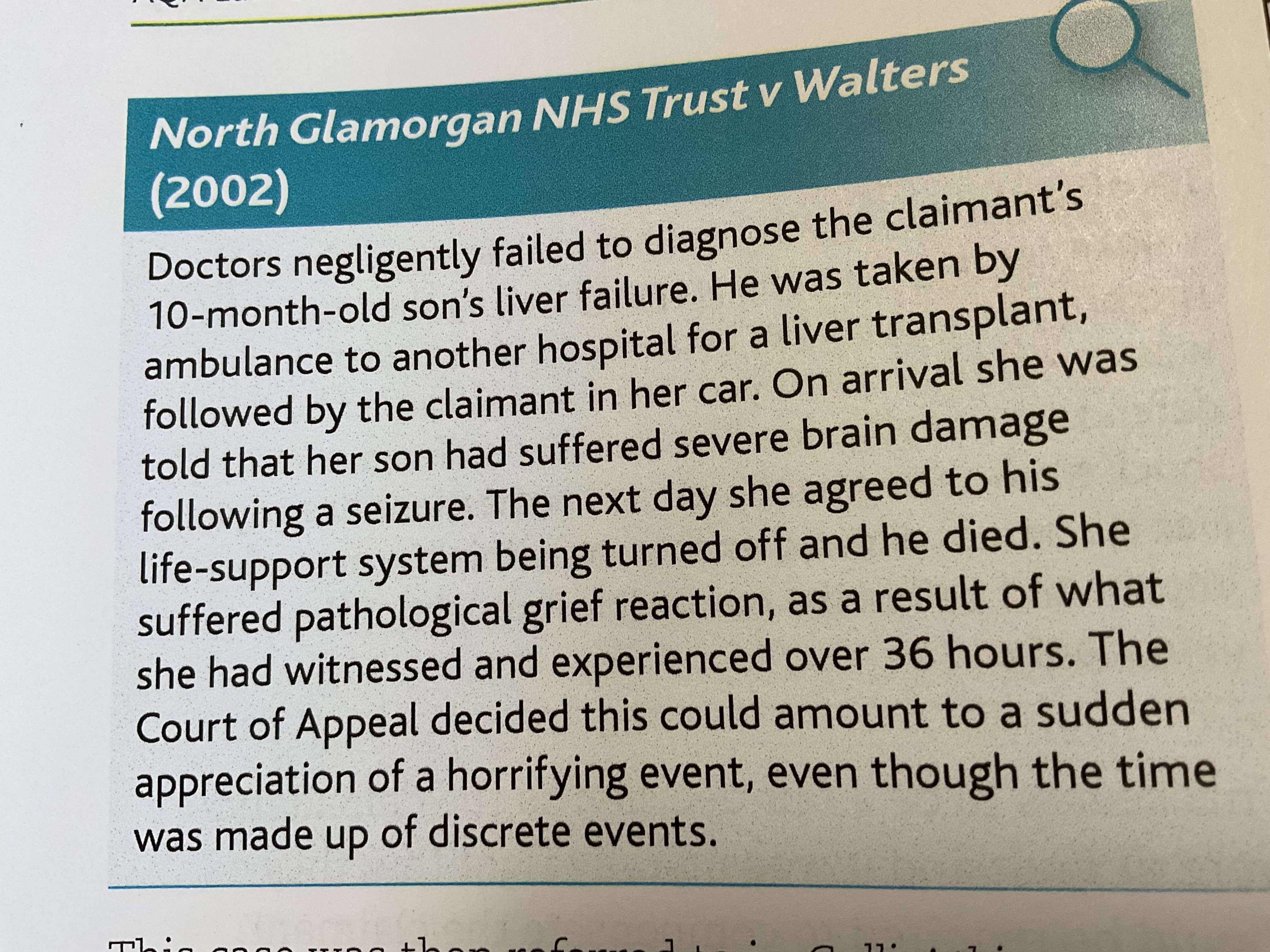
But when there is a shorter period of decline in patients condition a claim may be allowed north Glamorgan nhs trust v Walter’s
This case referred to in Galli-Atkinson v Seghal
C’s daughter killed in crash she arrived at scene of accident after her daughter had been removed hysterical she was taken to the mortuary and saw her duaghters body which was badly disfigured and suffered severe mental shock coa decided that in this case the immediate aftermath was an uninterrupted series of events from time of events to mortuary different to Alcock whose visits to mortuary eight hours after and knew what had taken place.
North Glamorgan NHS trust v Walter’s