Chemical Foundations i.e. - Water is Weird
 Studied by 0 people
 Call Kai
 Learn
Learn Practice Test
 Spaced Repetition
 Match
Match Flashcards
 Knowt Play
1/57

There's no tags or description
Looks like no tags are added yet.
Name | Mastery | Learn | Test | Matching | Spaced | Call with Kai |
|---|
No analytics yet
Send a link to your students to track their progress
58 Terms
Water homeostasis
◦Osmoregulation: Management of the body’s water content and solute concentration
Why do we manage water balance?
1. Nitrogenous waste disposal
2.Maintaining proper osmotic balance
1. Nitrogenous waste disposal
◦From ammonia to urea or uric acid, though some animal species can directly expel ammonia
◦Ammonia is far more toxic
Maintaining proper osmotic balance
◦Too much water: Dilutes serum concentration, decreases necessary ions in body (uncommon)
◦Too little water: Dehydrated: Dizziness, low blood pressure, can lead to organ failure
How do we regulate water?
◦Many adaptations, but our primary one as a land animal is the kidney
Diabetes insipidus
a disease where water homeostasis goes away.
why does Diabetes insipidus occur?
◦Either through a congenital defect (born with it) or through damage, typically to the brain, the body does not produce enough arginine vasopressin (AVP)
arginine vasopressin (AVP)
A hormone that helps blood vessels constrict and helps the kidneys control the amount of water and salt in the body
Central Diabetes Insipidus or Central DI
the body does not produce enough arginine vasopressin (AVP)
nephrogenic diabetes insipidus
kidney doesn’t respond to the hormone
Other types of Diabetes insipidus
◦Other types as well (gestational), but we’ll concentrate on the first two
Diabetes Insipidus
An extreme example of the inability of the kidneys to resorb water
Water does not get taken back up by select channels, aquaporins, in the nephron
A relatively rare disease (1:25,000), especially when compared to diabetes mellitus, estimated to be roughly 7.6% of the population of the USA, and roughly 9.3% of the population in Canada
How much urine do untreated patients with Diabetes Insipidus produce?
up to 20 litres a day
What is the pathway that causes ADH/ vasopressin to work in the first place?
Stimulus is detected by the hypothalamus, causing the posterior pituitary to release ADH into the bloodstream
ADH travels to the kidneys and binds to the Vasopressin-2-receptor, which is a G-protein coupled receptor.
Binding activates a G protein that increases cAmp levels.
Elevated cAMP levels activate protein kinase A (PKA)
Activate Pka phosphorylates Aquaporin 2 channels
AQP-2 channels get inserted into the membrane, making it permeable to water
Water then moves from the urine through the AQP-2 channels, and back into the blood, reducing the urine volume.
List of terms of the arginine vasopressin system
ADH: Antidiuretic hormone
◦This is another name for vasopressin
V2R: Vasopressin-2-receptor
cAMP: Cyclic adenosine monophosphate
Gs: G proteins
PKA: Protein kinase A
AQP-2: Aquaporin Proteins
Signs and Symptoms of Diabetes Insipidus
1. Increased volume of urine
◦Typically, the kidneys excrete 1-2 L of fluid per day
◦In DI, it’s considerably more – as high as 20 L
2. The biggest - extreme thirst!
Why is extreme thirst a Symptoms of Diabetes Insipidus?
◦Hypertonicity- Many ions and not enough water. Especially attributable to increases of Na+ in the blood plasma
◦Hypovolemia – low blood volume- Sensed by low pressure baroreceptors in large veins
◦Hypotention – decreased blood pressure - Sensed by high pressure baroreceptors in specific vessels
◦Decreased secretion of saliva à leads to dry mouth- Increased sensation of thirst
◦Increased signalling of angiotensin II secreted from the kidney- Activates specific receptors in the hypothalamus, leading to thirst
baroreceptors
a receptor sensitive to changes in pressure.
Etiology of diabetes Insipidus:
Typically (90% of time) it is aquired
How is diabetes Insipidus aquired?
◦Injury (traumatic brain injury, accident, etc.)
◦Cancer (especially cancers either resulting within the brain, or metastasizing there)
◦Stroke
◦Infection
◦Drug or toxin induced (lithium especially)
Congenital (present from birth) cases of diabetes Insipidus :
◦Inherited mutations in the AVP II gene
◦Idiopathic (i.e. unknown)
Treatments of diabetes Insipidus :
Our best, and most widely used drug to treat:
◦Desmopressin
Originally, the treatment of this disease (1910-1930) was accomplished by grinding up natural pituitary extracts which contained the hormone…
How does Desmopressin work as a treatment of diabetes insiptius?
◦Synthetic analogue of vasopressin, so works through very similar mechanisms
◦Has a prolonged anti-diuretic effect as compared to natural vasopressin, as it lasts longer in patients
covalent bond
◦A covalent bond is a bond that occurs when two atoms share electrons (usually, two).
Think:
◦Proteins and amino acids
◦Glycogen and other carbohydrates
Nucleic acids in the P-S-P-S backbone
Non-covalent bonds
bonds where no electrons are shared, and are typically the result of electrostatic or other forces.
These are especially useful for ongoing chemical reactions in the body
Energies of covalent vs noncovalent bonds
Energies of noncovalent bonds (0.5-20 kJ.mol) are about one to two orders of magnitude weaker than energies of the covalent bonds (150-400kJ/mol) commonly found in biochemical compounds
What are the types of non-covalent bonds?
Charge-charge
Charge-dipole
Dipole-dipole
Charge-induced dipole
Diple-induced dipole
Dipersion (van Der Waals)
Hydrogen bond
Charge-charge interactions
aka Ionic bonds
Strong electrostatic attractions between oppositely charged ions that form when electrons are completely transferred from one atom to another
eg Na-Cl
Charge – dipole interactions
◦Bonds between certain solutes and water
◦Ex. NaCl and Water, NaF and Water, etc.
Dipole-dipole interactions
electrostatic forces between polar molecules with permanent dipoles, where the positive end of one molecule attracts the negative end of another.
◦Example – HCl and HCl bonding
◦Relatively weak
Charged-induced dipole
An ion with a non polar molecule e.g cl- chloride with benzene
Dipole-induced dipole
weak intermolecular forces occurring when a polar molecule (permanent dipole) distorts the electron cloud of a nonpolar molecule (or atom), inducing a temporary dipole. Eg water and benzene
Dispersion effects (i.e. van der Waals interactions)
◦Two non-polar
◦Ex. Two benzene rings
◦Neither has a permanent dipole
What is coulomb’s law? And why is it important?
Describes the force between two charged particles to better explain their interactions
Energy of bond equation (similar to coulomb’s law, with a few more variables included):E=k q1q2/(∈r)
Where
◦E = Energy
◦k = constant (Coulomb’s constant)
◦q1 and q2 = Charge values of the ions (Na = +1, Ca = +2, Cl = -1, etc.)
◦r = radii of the two molecules
◦∈ = dielectric medium value (depends on the substance)
◦
Hydrogen bonding
great importance to water and to biochemistry
Very similar to dipole-dipole bonding, but since hydrogen is quite small, the distance between hydrogen and other molecule gets very close
In biochemistry, almost exclusive bonding to oxygen and nitrogen molecules to hydrogen, due to their tendency to have unbound electrons available for bonding
Hydrogen bond donor
Where the hydrogen is currently covalently bonded to
Hydrogen bond acceptor
Where the hydrogen is currently bonded via unbound electrons
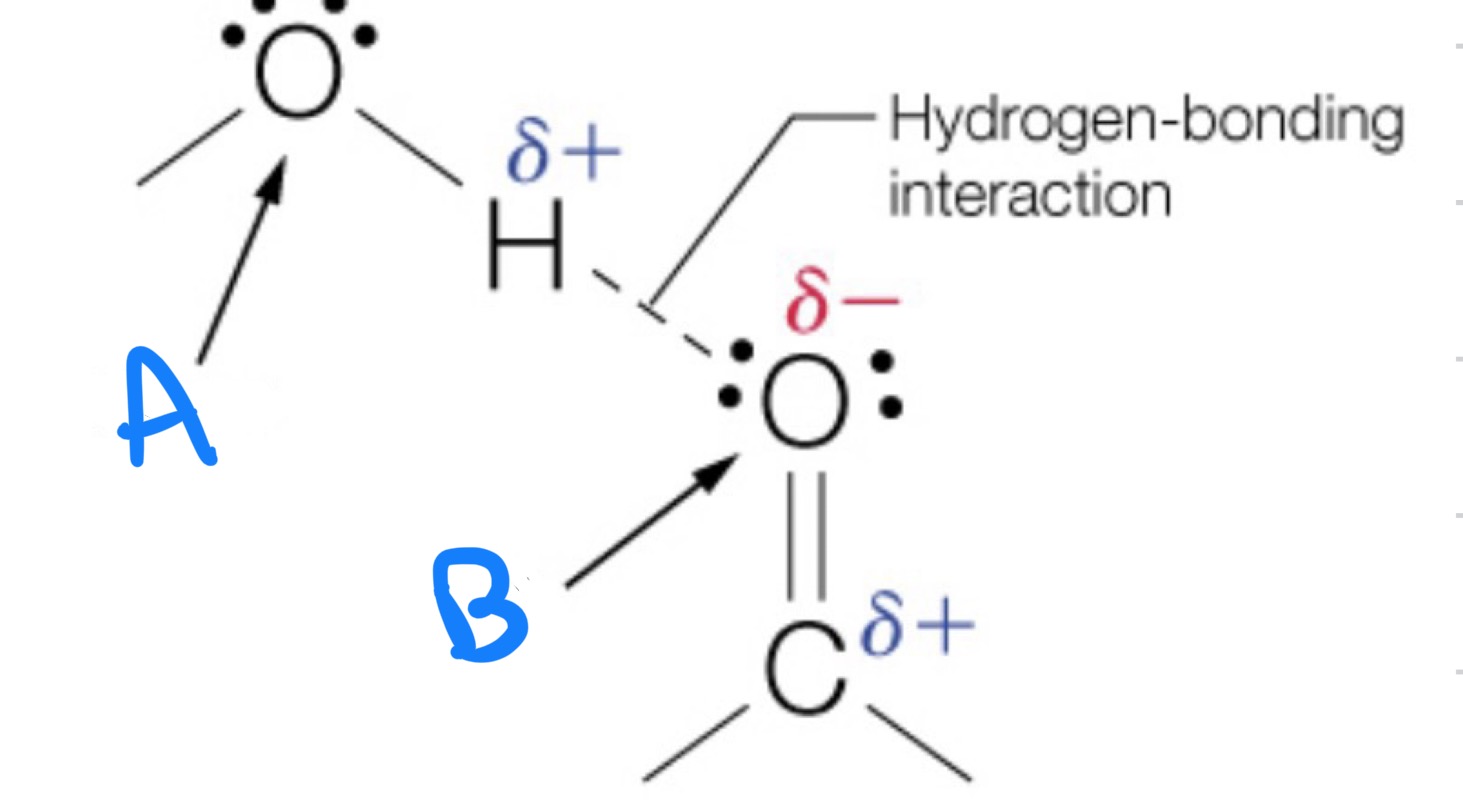
Of A and B, which is the hydrogen bond donor and which is the hydrogen bond accepter?
A) is the donor and B) is the acceptor
Think of the donor molecule as “loaning” its hydrogen atom to the acceptor.
The donor is covalently bonded to the hydrogen, the acceptor is not.
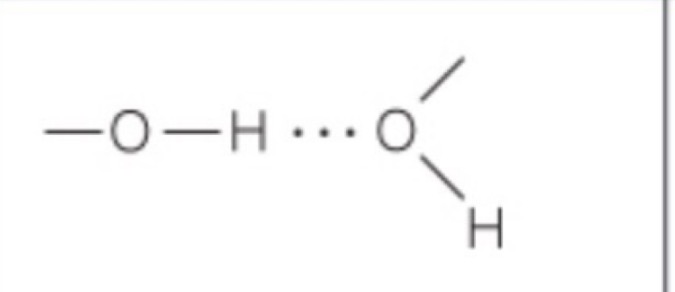
Distance between donor and accepter/ comment:
2.8 +- 0.1
H bond formed in water
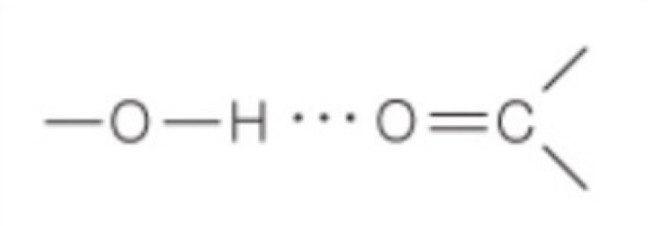
Distance between donor and accepter/ comment:
2.8+-0.1
Bonding of water molecules to other molecules often involves these
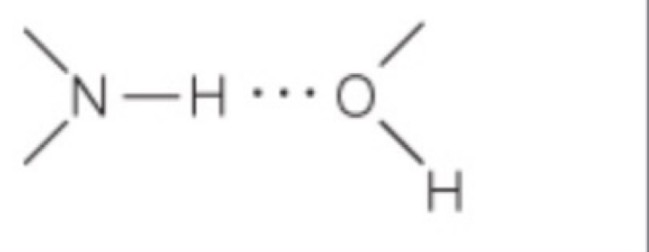
Distance between donor and accepter/ comment:
2.9+-0.1
Bonding of water molecules to other molecules often involves these
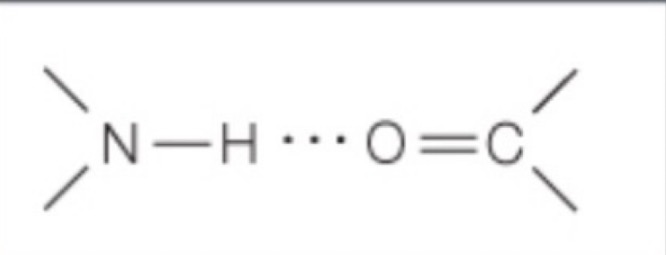
Distance between donor and accepter/ comment:
2.9+-0.1
Very important in protein and nucleic acid structures
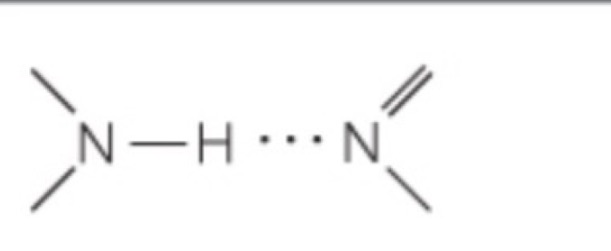
Distance between donor and accepter/ comment:
3.1+-0.2
Very important in protein and nucleic acid structures
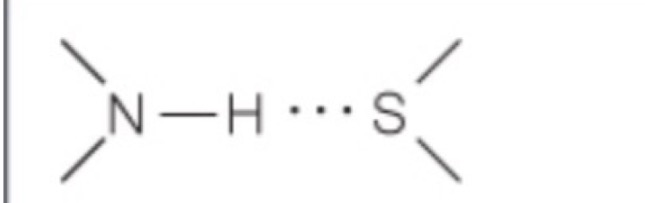
Distance between donor and accepter/ comment:
3.7
Relatively rare, weaker than above
An biological example of hydrogen bonding
The hydrogen bonding in an alpha helix
Formed due to h-bonds
One of the structures within proteins
What makes water fluid so essential and special for life?
t’s everywhere – Considerably more ubiquitous than any other liquid at room temperature / pressure on planet Earth
Forms a vast number of bonds – Ability to form numerous hydrogen bonds( Both with itself and with other molecules)
Acts as a vessel for transferring heat: It has a high heat capacity
Is an incredible solvent (Which means it can mix a lot of compounds together, and allow for many different interactions)
Boiling point of water
+100
way higher than ch4(-164), Nh3(-33), and H2s (-161)
high melting point due to Hydrogen bonds (3.4 bonds per molecule while in liquid form since it has bond angle of 104.5)
Water’s heat capacity
Water has a high heat capacity, meaning it takes a lot of energy to heat it up
Why is waters high heat capacity important?
1. Water acts a heat “buffer” in oceans, lakes, and the surrounding land communities
2. It allows for organismal thermoregulation
Water viscosity
Water also has a high viscosity because of its high proportion of hydrogen bonds. We can even “hear” them, or rather, hear a lack of them
Why do ionic substances dissolve so readily?
◦Remember those ionic bonds that are formed in the crystal lattice?
Turns out those aren’t as energetically favourable as being dissolved
◦The high dielectric constant of water
dielectric constant
a dimensionless measure of a material's ability to store electrical potential energy in an electric field
What happens to hydrophilic substances n an aqueous solution?
◦Even without a specific charge, molecules with significant dipoles that can be induced readily mix with water
What about hydrophobic molecules in a aqueous solution?
This can still “dissolve” but it is not energetically favourable for long
As well, they don’t truly dissolve, they become trapped in a “clathrate”
Over time, if enough of this clathrate is in solution and is left for long enough, they will separate from solution
◦Think oil and water
amphipathic
have both a hydrophobic and hydrophilic end
Amphipathic molecules examples
◦Detergents
◦Certain fatty acids
◦Phospholipids
◦Detergents
◦Why might having both hydrophilic and hydrophobic ends be useful here?
detergents are effective cleaning agents because they are amphipathic—meaning they possess both a hydrophilic ("water-loving") head and a hydrophobic ("water-fearing") tail. This unique structure is crucial because it allows them to bridge the gap between water and oily, nonpolar dirt that would otherwise not mix.
 Note
Note  Flashcards (133)