Nervous System— based on lec notes
 Studied by 0 people
 Call with Kai
 Learn
Learn Practice Test
 Spaced Repetition
 Match
Match Flashcards
 Knowt Play
1/62

There's no tags or description
Looks like no tags are added yet.
Name | Mastery | Learn | Test | Matching | Spaced | Call with Kai |
|---|
No study sessions yet.
63 Terms
the central nervous system consists of what?
brain, spinal cord, and retina
what are the 2 main nervous system subcategories of the peripheral nervous system?
somatic nervous system and autonomic nervous system
what is the somatic nervous system responsible for?
motor and non-visual
2 systems of the autonomic system
sympathetic (thoracic) and parasympathetic (cranial & sacral)
2 categories of nerves from the CNS— distinguish them
spinal and cranial. spinal nerves are responsible for motor and touch, cranial nerves are responsible for motor and other sensory
what is the correct terminology: side view
lateral view
what is the correct terminology: toward the back
dorsal view
what is the correct terminology: towards the stomach
ventral view
what is the correct terminology: towards the tailbone
caudal view
what is the correct terminology: towards the head
rostral view
ipsilateral vs contralateral
ipsilateral refers to the same side of the midline; contralateral refers to the opposite side of the midline
what type of cross-section: along x plane/ top & bottom
horizontal cross section
what type of cross-section: along z plane/ front & back
frontal/coronal cross section
what type of cross-section: along y plane/ left & right
saggital cross section
what is the brainstem not involved in?
the brainstem is not invovled in perception or thinking
what organs does the brainstem include and what is its function?
the brainstem includes the medulla, pons, and midbrain. it controls bodily functions and basic processes— homeostasis
what are the 4 main lobes?
frontal, temporal, parietal, and occipital
what is the main protection of the brain?
meninges and blood-brain barrier
frontal lobe association + areas
the frontal lobe consists of the primary motor cortex, Broca’s area, and Wernicke’s area. It allows for eye movement and speech production. It is associated with executive function and intellectual processes, such as concentration, planning, and problem solving.
prefrontal cortex/lobe function
the prefrontal cortex controls emotional behavior and produces awareness of possible consequences of behaviors
parietal lobe association + areas
the parietal lobe includes the somatosensory cortex (temperature, touch, pressure, and pain) and the complex spatial area (motion, attention). It is associated with interpreting sensory information and aiding in understanding speech and choosing words to express.
temporal lobe association + areas
the temporal lobe contains the auditory cortex, gustatory cortex (taste), and olfactory cortex (smell). It is associated in interpreting complex sensory experiences, visual senses, music, and patterns. It is also involved in complex feature processing, which includes faces, places, and memories
occipital lobe association + areas
the occipital lobe includes the primary visual cortex and parts of the complex spatial processing (motion, attention). it is associated with interpreting visual patterns, visual images, and facial recognition.
the nervous system is made of 2 main types of cells: neurons and glia. what are their responsibilities and what are they involved in?
neurons are responsible for communicating with other neurons and are involved in long processes. glia cells are responsible for supporting neuron shape, maintaining an ionic environment, and myelin formation.
plasma membrane function in nervous system
the plasma membrane provides channels and carriers to transport molecules and ions, receptors to signal responses, and are responsible for adhesions and junctions.
microtubules function in nervous system
microtubules provide axonal transport, aiding in the movement of molecules and vesicles along the axon.
anterograde vs retrograde
anterograde refers to away from the cell body, while retrograde refers to toward the the cell body
define membrane potential and resting potential
membrane potential refers to the differences in voltage between the inside and outside of the cell. it is dependent on open/closed channels
resting potential refers to when the membrane potential is negative, and is the result of different permeabilities of different ions
electrical force vs chemical force (in terms of concept)
electrical force refers to opposites attract, likes repel. chemical force refers to how ions go from high to low concentration.
what is the normal ion concentration and charge?
at a cell’s normal state the inside of a cell is negative (K+, Cl-), and the outside of a cell is positive (Na+, Cl-)
depolarization vs polarization
when a cell is depolarized, the inside of the cell becomes positive as na+ ions enter. when a cell is polarized, the outside of the cell becomes negative as K+ ions exit.
what is the importance of sodium-potassium pump in the nervous system?
the sodium-potassium pump helps create the electrochemical imbalance needed for neurons to fire and communicate effectively
what are the steps of producing an action potential (step-by-step)
voltage-gated Na+ channels start to open to initiate the depolarization phase, making the interior positive and triggering an action potential. Towards this event, voltage gated K+ channels open. After an action potential, voltage gated Na+ channels start to inactivate and close, and repolarization begins. Once the inside of the cell starts to become negative again, voltage gated K+ channels start closing, going from inactive to closed. During hyperpoarization, the cell is back to resting potential, with K+ pores being open and leak Na+ channels.
what are the 2 factors that affect the speed of an action potential propagation?
axon diameter and myeline— greater, the faster
if voltage gated sodium channels are blocked, what will (probably) happen?
action potentials are crucial for muscle contraction throughout the body. if voltage gated sodium channels are blocked, the body cannot trigger action potentials, resulting in paralysis (internal and external).
if a neurotransmitter were to bind to voltage-gated potassium channels for a prolonged time, what will (probably) happen?
it will result in a prolonged action potential, which can manifest in the form of convulsions.
action potential in pre-synaptic neuron vs action potential in post-synaptic neuron
an action potential in a presynaptic neuron is a self-propagating electrical spike that triggers neurotransmitter release, while a postsynaptic neuron receives the inhibitory or excitatory signal, and may summate to trigger a new action potential
chemical vs electrical synapse characteristics
a chemical synapse allows integration, is excitatory or inhibitory, and its effectiveness can be modified quickly. an electrical synapse is fast and reliable
temporal summation vs spatial summation
temporal summation is when many action potentials are triggered in one pre-synaptic neuron.
spatial summation is when many different pre-synaptic neurons have to have action potentials that release neurotransmitter to the same post-synaptic neuron at the same time.
ionotropic receptors vs metabotropic receptors
ionotropic receptors are fast, direct-acting channels that open immediately when a neurotransmitter binds.
metabotropic receptors require second messengers and G-protein coupled receptors. They last longer and may open or close channels elsewhere.
while ionotropic receptors directly open ion channels, metabotropic receptors do not.
in general, what do these neurotransmitter act as? glutamate, GABA, acetylcholine
glutamate always acts as an ionotropic excitatory neurotransmitter, GABA always acts an ionotropic inhibitory neurotransmitter, and acetylcholine can either be ionotropic or metabotropic and act on channels that allow more than 1 ion to pass through
interoceptors vs exteroceptors
interoceptors are also known as visual afferents and provide input to the brainstem, which sends output through the autonomic nervous system for homeostasis. exteroceptors are also known as sensory afferents and are responsible for external stimuli that is perceived— environment to perception (e.g. touch pain, hearing balance, vision, temperature, olfaction, taste, pain)
what are the outputs of these receptors: mechanoreceptors, photoreceptors, chemoreceptors, thermoreceptors, nociceptors
mechanoreceptors: touch, auditory— an example of a primary afferent, which generates action potentials
photoreceptors: vision— an example of a receptor that does not generate action potentials
chemoreceptors: taste, smell
thermoreceptors: cool, warmth
nociceptors: pain
sensory receptive field for receptors vs sensory receptive field for afferents/neurons
for receptors: sensory receptive field is the environmental energy that is necessary to change the membrane potential of the receptor
for afferents/neurons: sensory receptive field is the environmental energy that is necessary to change the activity of the neuron
what do stretch-activated channels not use nor do?
stretch-activated channels do not use second messenger system and does not allow just any ion to cross the membrane
what type of nerves are responsible for pain + temperature?
free nerve endings
divergence vs convergence
in divergence, a single neuron will branch its axon to make synapses onto hundreds of other post-synaptic neurons
in convergence, multiple neurons make synapses onto a single post-synaptic cell
lateral inhibition vs recurrent inhibition
in lateral inhibition, an excited neuron reduces the activity of its neighbors, enhancing sensory contrast and sharpening perception (smaller receptive fields result in great acuity.
in recurrent inhibition, an excited motor neuron sends a branch to an inhibitory interneuron, which then sends a signal back to inhibit the original motor neuron, creating a negative feedback loop. This prevents over-excitation and allows for precise force control.
what does somatotopy refer to?
somatotopy refers to how neurons with similar receptive fields are located next to each other.
the receptive field of a given neuron is dependent on what?
the receptive field of a given neuron is dependent on the input from the area projecting tot it, as well as the input from other neurons in the same area and nearby. It is also based on inhibition and excitation
ascending pathway of nociception
localization of where the nociceptive stimuli is coming from.
1) cell bodies reside in the dorsal root ganglion, detecting noxious stimuli and transmitting signals to the spinal cord.
2) located in the spinal cord gray matter, the neurons here receive input and ascend in the white matter
3) situated in the thalamus, these project the signal to the cerebral cortex for processing
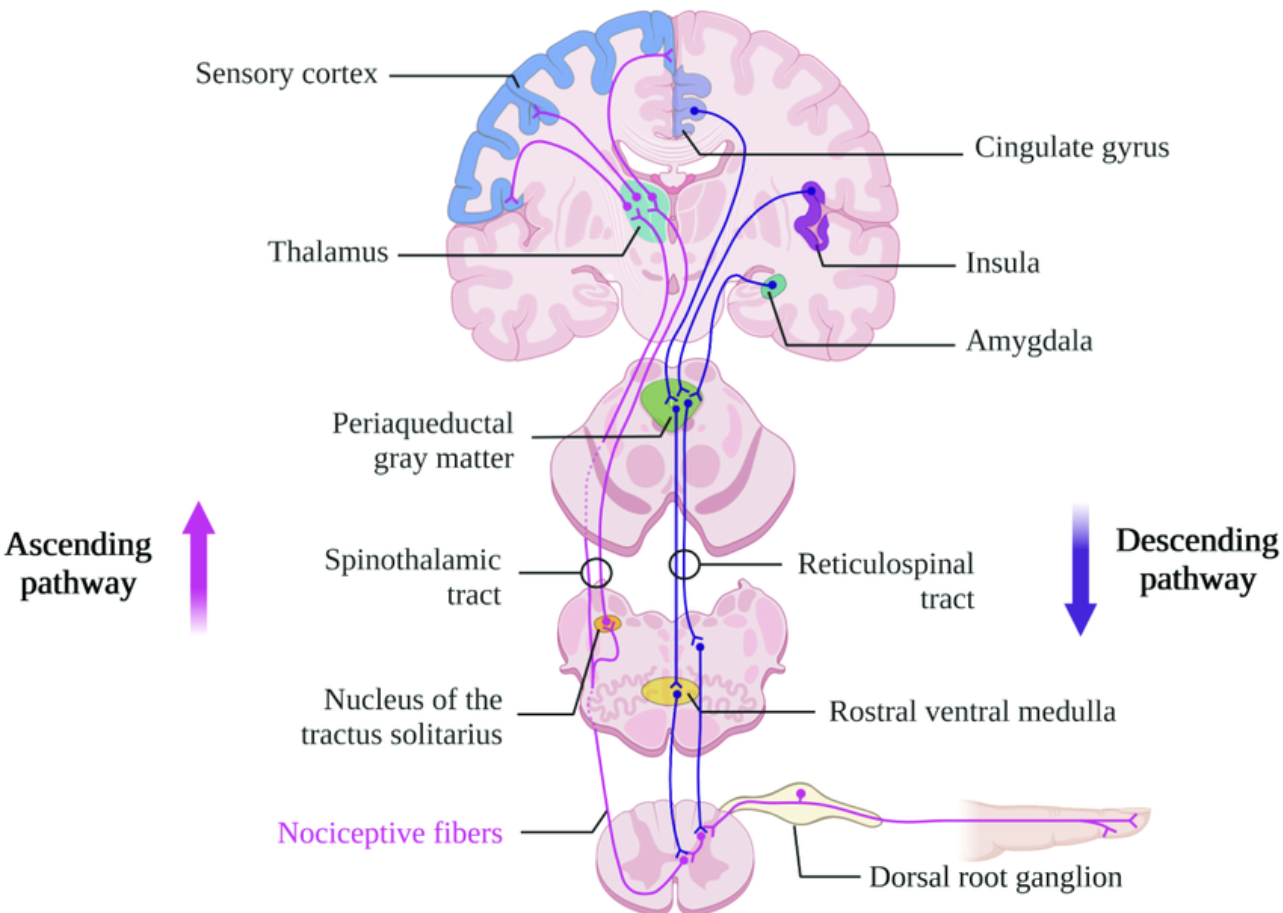
descending pathway of nociception
placebo effect, accupuncture— use of glutamate, serotonin, and endogenous opiates
the descending pathway modulates (inhibits/excites) incoming pain signals at the spinal cord’s dorsal horn
in afferent inhibition, a type of lateral inhibition, what is suppressed?
in afferent inhibition, sensory input traveling to the brain temporarily suppresses the motor cortex’s output
The PNS works via a two-neuron chain: preganglionic fiber + postganglionic fiber. What are the differences in these when comparing the sympathetic pathway and parasympathetic pathway of the autonomic system? where do the fibers stem from?
the preganglionic neuron in the sympathetic pathway is short and releases acetylcholine, which the postganglionic neuron is long and releases NE. the fibers in this pathway originate from the spinal cord.
the preganglionic neuron in the parasympathetic pathway is long while the postganglionic neuron is short. both release acetylcholine. the fibers in this pathway originate from the CNS.
if we notice widening of an action potential, which causes muscles to contract much more strongly, what can we assume?
We can assume more acetylcholine is released at the neuromuscular junction
reversal vs equilibrium potential
reversal potential opens a channel permeable to multiple ions, while equilibrium potential only opens a channel to one ion type
how can we tell a synapse is inhibitory?
we can tell a synapse is inhibitory if we know the equilibrium and reversal potential for the ion(s) that the post-synaptic receptor opens OR the activation threshold for voltage-gated K+ channels
what are the 5 sections of the spinal cord?
cervical, thoracic, lumbar, sacral, and coccyx
more caudal an injury, the less/more extent of symptoms?
the less extent of symptoms
label ascending/descending: motor signals, sensory signals
motor signals are descending. sensory signals are ascending
what does neuromuscular junction refer to?
neuromuscular junction refers to the synapse between the motor neuron and muscle fiber.
interpretation of touch fibers vs pain fibers
touch fibers stay on the ipsilateral side to the dorsal column. pain fibers pass spinal cord, up to the ipsilateral side.
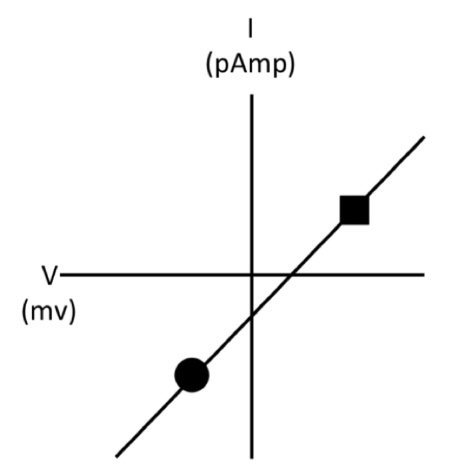
I-V plot for a positive ion:
1) What is the concentration gradient?
2) Does the ion flow with the concentration gradient or against it at the membrane potential designated by the square?
3) does the ion flow with or against the concentration gradient at the membrane potential designated by the circle?
1) the positive ions will enter the cell (at y = 0, the current is negative. recall, opposites attract)
2) the ion flows against the concentration gradient. (at the square, the current is positive. Therefore, the positive ion will be repelled and exit (instead of enter) the cell)
3) the ion flows with the concentration gradient. (at the circle, the current is negative. the positive ion will be attracted to the negative current and will enter the cell).
 Note
Note  Flashcards (50)