Gas Exchange
 Call Kai
 Learn
Learn Practice Test
 Spaced Repetition
 Match
Match Flashcards
 Knowt Play
1/17

There's no tags or description
Looks like no tags are added yet.
Name | Mastery | Learn | Test | Matching | Spaced | Call with Kai |
|---|
No analytics yet
Send a link to your students to track their progress
18 Terms
Ventilation
Ventilation refers to the mechanical process by which air moves into and out of the lungs
Driven by pressure changes within the thoracic cavity
Boyle’s Law
At constant temperature, the process of a gas is inversely propotional to its volume
Gas pressure is produce by collisions of gas molecules with the walls of a container
Volume increase, less pressure is exerted
Volume decrease, more pressure is exerted
Pressure and air movement ( Ventilation )
Air flows down a pressure gradient
Air moves from a areas of higher pressure to areas of lower pressure
To ventulate the lungs, the body alters thoracic volume which changes pressure and drives airflow
Changing thoracic volume ( Ventilation )
Change by the action of repiratory muscles: Diaphragm and intercostal muscle
Inhalation/ Inspiration ( Ventilation )
External intercostal muscles contract ( Internal intercostal muscle relax) → Ribcage moves upwards and outwards → Diaphragm contracts anf flattens → Volume of the thoracic cavity increases → pressure in alveoli decreases → air move into the lungs
Exhalation / expiration (Ventilation )
External intercostal muscles relax → Ribcage moves downwards and inwards → Diaphragm relaxes and bulges up → Volume of the thoracic cavity decreases → Pressure in alveoli increases → air move out of the lungs
External respiration
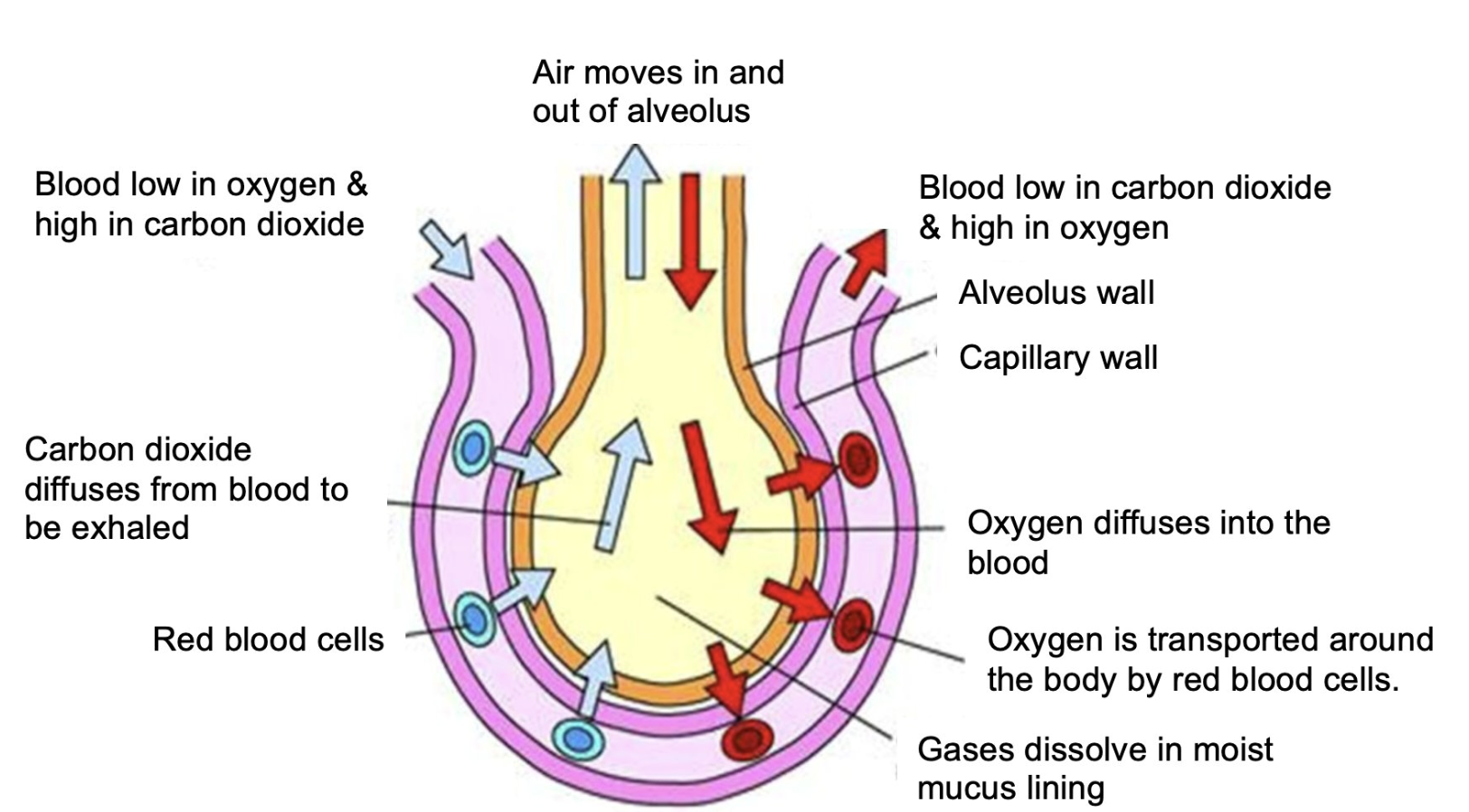
Exchange of gases between the alveoli and the blood in pulmonary capillaries
Occurs by diffusion down partial pressure gradients ( partical pressure is the pressure exerted by an individual gas in a mixture which determines the direction off diffusion across a membrane )
External respiration in the lungs
O2 partical pressure is higher in alveoli than in blood → O2 diffuses into the blood
CO2 partial pressure is higher in blood than in alveoli → CO2 diffuses into the alveoli
Internal respiration
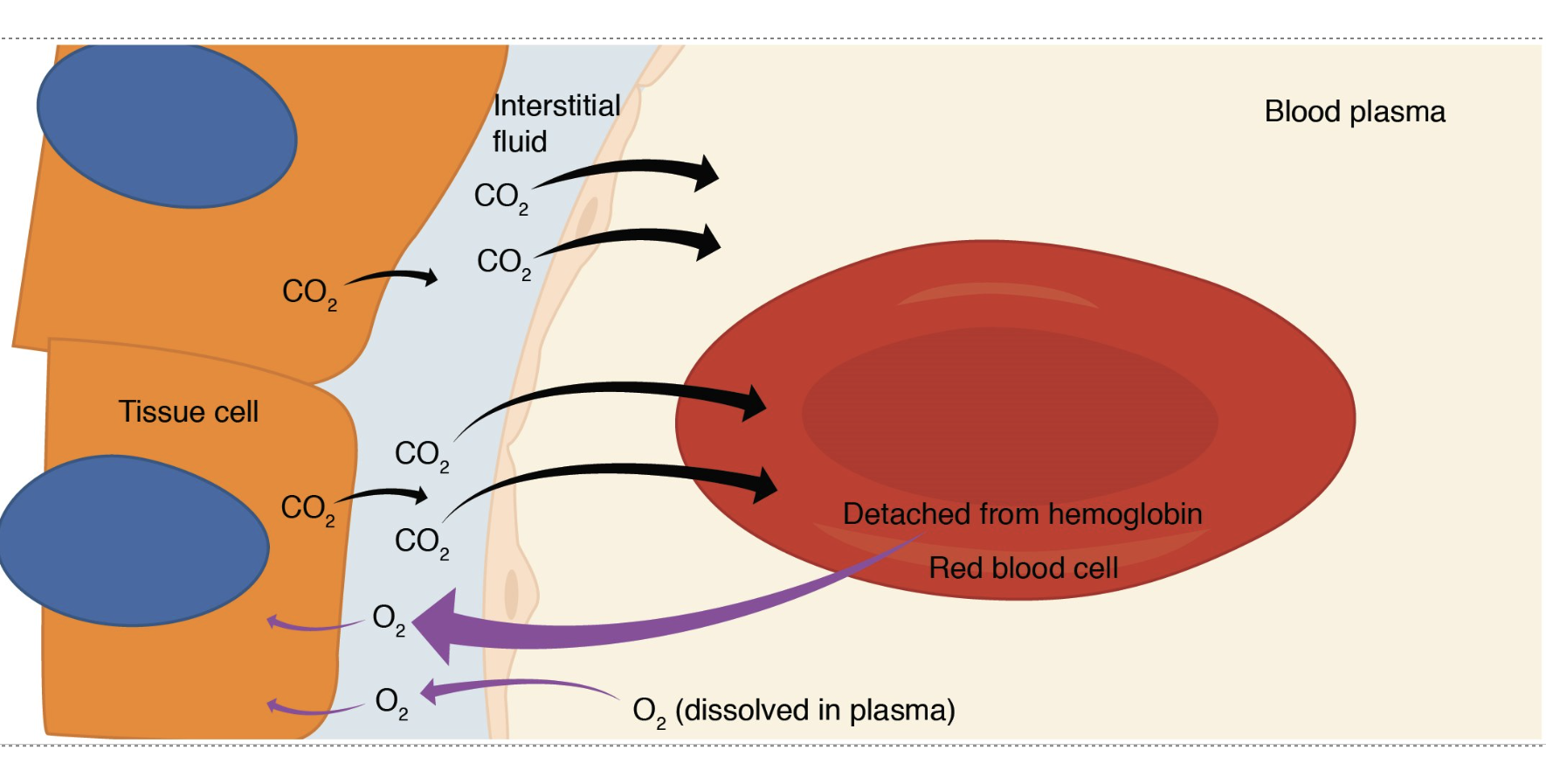
-exchange of gases between the blood and body tissues
support cellular respiration by supplying O2 to cells and removing CO2
Internal respiration in body tissues
O2 partial pressure is higher in blood in the cells → O2 diffuses into the cells
CO2 partial pressure is higher in cells than in blood → Co2 diffuses into the blood
N2 inspired air and expired air
79% ( not use/ produced by body process )
O2 inspired air
21% ( Used up in respiration )
O2 expired air
16% ( Used up in respiration )
Adaptations for efficient gas exchange - Large surface area
Milions of aveoli provide a surface area approximately to a tennis court
Adaptations for efficient gas exchange - Short diffusion pathway
alveolar anf cappilary walls are each one cells thick
Adaptations for efficient gas exchange - High concentration gradient: maontained by continous ventilation and blood flow
Adaptations for efficient gas exchange - Moist surface
The moist surface of the alveoli allow gases to dissolve and then diffuse through the cells
Adaptations for efficient gas exchange - The lungs are positioned deep within the body
prevent excessive evaporation of fluid

