BIOL 206 Exam 3 - Donna Janes
 Call Kai
 Learn
Learn Practice Test
 Spaced Repetition
 Match
Match Flashcards
 Knowt Play
1/452

There's no tags or description
Looks like no tags are added yet.
Name | Mastery | Learn | Test | Matching | Spaced | Call with Kai |
|---|
No analytics yet
Send a link to your students to track their progress
453 Terms
Bacterial cells are ________% water
70%
T/F: a bacterial cell is 85% composed of macroelements
False: it's 96% composed of macroelements
List the 6 macronutrients needed in gram quantities by bacterial cells
carbon, hydrogen, oxygen, nitrogen, phosphorous, sulfur (CHONPS)
List the 4 macronutrients needed in mg quantities by bacterial cells
calcium, iron, magnesium, potassium (CIMP)
What are the 2 functions of potassium in microbial cell processes?
essential to protein synthesis and membrane function
What is the function of calcium in microbial cell processes?
cell wall and endospore stabilizer
There are ___ (number) elements that compose 96% of a bacterial cell called _______________
10 elements, macroelements
What is the function of magnesium in microbial cells?
membrane and ribosome stabilizer
What is the function of iron in microbial cells? Why is this significant?
Iron is part of the ETC; important for ATP production
Iron need is _______________ (higher/lower) for organisms with high aerobic respiration
higher; use up more oxygen
Trace elements make up ________ % of the cell and include what 6 things?
4% of the cell, make up manganese, zinc, cobalt, molybdenum, nickel, copper
Trace elements are normally part of what two things in regards to microbial cell function?
part of enzymes and cofactors
What is the purpose of cofactors?
Help enzymes catalyse reactions; maintains 3D structure of enzymes
Cofactors increase enzyme activity by as much as __________%
1000%
Trace elements aid in what two things
aid in catalysis of reactions and in the maintenance of protein structure
Trace elements are needed in __________ quantities
microgram, ug
How are trace elements usually obtained?
From air and water
T/F: cofactors are lipids
false
The number of nutrients a microorganism must obtain to live is determined by the _____________ and ______________ of its _________________
Determined by the kind and number of its enzymes
Why do enzymes affect how many nutrients a microorganism needs?
Enzymes drive metabolic reactions
If an enzyme is not present, what happens?
The organism is incapable of using a metabolic reaction to produce a certain substance thus is must obtain from its environment
Nutrients that cannot be made and must be obtained from the environment are termed what?
Essential nutrients
If a microorganism has zero enzymes it obtains _________% of its nutrients from the environment
100%
E. coli contains ___________ (number) different compounds
over 5,000
E. coli needs to obtain ____________ (most/few) of its compounds from the environment
few
Name three compounds E. coli must obtain from its environment
glucose, trace elements, H2O
E. coli has __________ (lots/few) enzymes and uses ____________ (lots/few) compounds to metabolize ______________ (number) compounds
E coli has lots of enzymes and uses just a few compounds to metabolize over 5,000 compounds
The fewer nutrients needed the ______________ (more/less) enzymes a microorg has
more
Define an inorganic nutrient
a molecule that does not contain both carbon and hydrogen
T/F: an inorganic compound can contain carbon
true; just cannot contain both carbon and hydrogen
Determine which of the following are inorganic or are organic compounds:
- H2O
- O2
- CH4
- CHO
- CO2
inorganic: H2O, O2, CO2;
organic: CH4, CHO
T/F: most organic compounds have a carbon backbone
False: ALL organic compounds have a carbon backbone
Define an organic nutrient
contains both carbon and hydrogen
________________(organic/inorganic) nutrients are usually the products of living things
Organic nutrients
Molecules serving as carbon sources usually also contribute ___________ and _______________
hydrogen and oxygen
T/F: environmental factors occasionally harm the production of metabolic enzymes
False: environmental factors FUNDAMENTALLY AFFECT the FUNCTION of metabolic enzymes
If enzymes drive metabolic reactions, and an organism doesn't have any active enzymes, how does this affect the organism?
cell death - apoptosis
List the 7 environmental factors that can affect enzymes
Temperature, pH, gas requirements, osmotic pressure, radiation, barometric pressure, ecological associations (ie: low vs high salinity)
T/F: if enzymes are messed up, it can harm or kill the patient
true
How do environmental factors affect enzymes on a physiological level?
They denature (change the shape of) the protein and active site thus preventing it from fitting the substrate
Why is understanding microbial ecological niches significant?
it allows for the ability to control microbial growth by altering the environment to prevent enzymes from working properly
______ (number) cardinal temperatures define _____________________-
3 cardinal temperatures define the microorganism growth curve
Most single cell organisms are __________________ meaning they like what kind of temperatures?
poikilothermic; they like ambient/room temperature
List and define the three cardinal temperatures
1) minimum temperature: lowest temperature that permits microbe's growth and metabolism;
2) maximum temperature: highest temperature that permits a microbe's growth and metabolism;
3) optimum temperature: promotes the fastest rate of growth and metabolism
To determine the optimum temperature for a specific microorg to be able to grow, what would one do?
Observe at which temperature there is the most growth in the same amount of time
T/F: cardinal temperatures are rigidly fixed preventing them from adapting to their environment
False: cardinal temperatures are NOT rigidly fixed BECAUSE they are INFLUENCED BY OTHER ENVIRONMENTAL FACTORS
Why are hospitals kept cold?
To limit microbial growth
Define psychrophiles and list their optimum temperature range
Cold loving: rapid growth in cold environments; 10-13C temp
Where can psychrophiles be found? Why is this okay?
Found in the refrigerator and in cold oceans; okay because they are not human pathogens
Describe the cell membrane of a psychrophile
Contains many lipids; highly unsaturated (lots of double bonds)
Define psychrotolerant microbes and give their optimum temperature range
Cold tolerant: grow slowly in cold, do not like the cold; Opt temp is 15-30C
The majority of microbes are __________________ meaning that they love what kind of temperatures
mesophiles: prefer room temperature/body temperature
Define the optimum temperature range for mesophiles
20-40 C
The majority of human pathogens are _____________ (temperature group)
mesophiles
What temperature group are the normal flora a part of?
Mesophiles
Thermophiles ( ________________ loving) have an optimum temperature range of what?
heat loving; 45 - 80 C
Thermophiles can be found in what two common environments?
Compost piles and hot water heater
Extreme thermophiles like a temperature range of ___________ and consist mostly of _____________ (type of microbe)
70C or greater; archaea
Extreme thermophiles can be found in what two common environments?
Hot springs and deep ocean vents
List the five reasons that allow archaea to be more resistant to heat
1) unique enzymes
2) unique lipids
3) increased C+G % in DNA
4) no peptidoglycan
5) lipids in the cell membrane or highly saturated -- double bonds
List the temperature classifications of microorganisms from coolest conditions to warmest conditions
Psychrophile, psychrotolerant, mesophile, thermophile, extreme thermophile
List and describe the six temperature ranges related to microbial growth in food preservation
1) high temperatures which destroy most microbes
2) warm temperatures which slow bacterial growth
3) optimum temperature for rapid bacterial growth
4) cool temperatures which most bacteria survive and some grow
5) refrigerated temperature which may slow bacterial growth and allows for very few pathogens to survive
6) below freezing with no significant growth
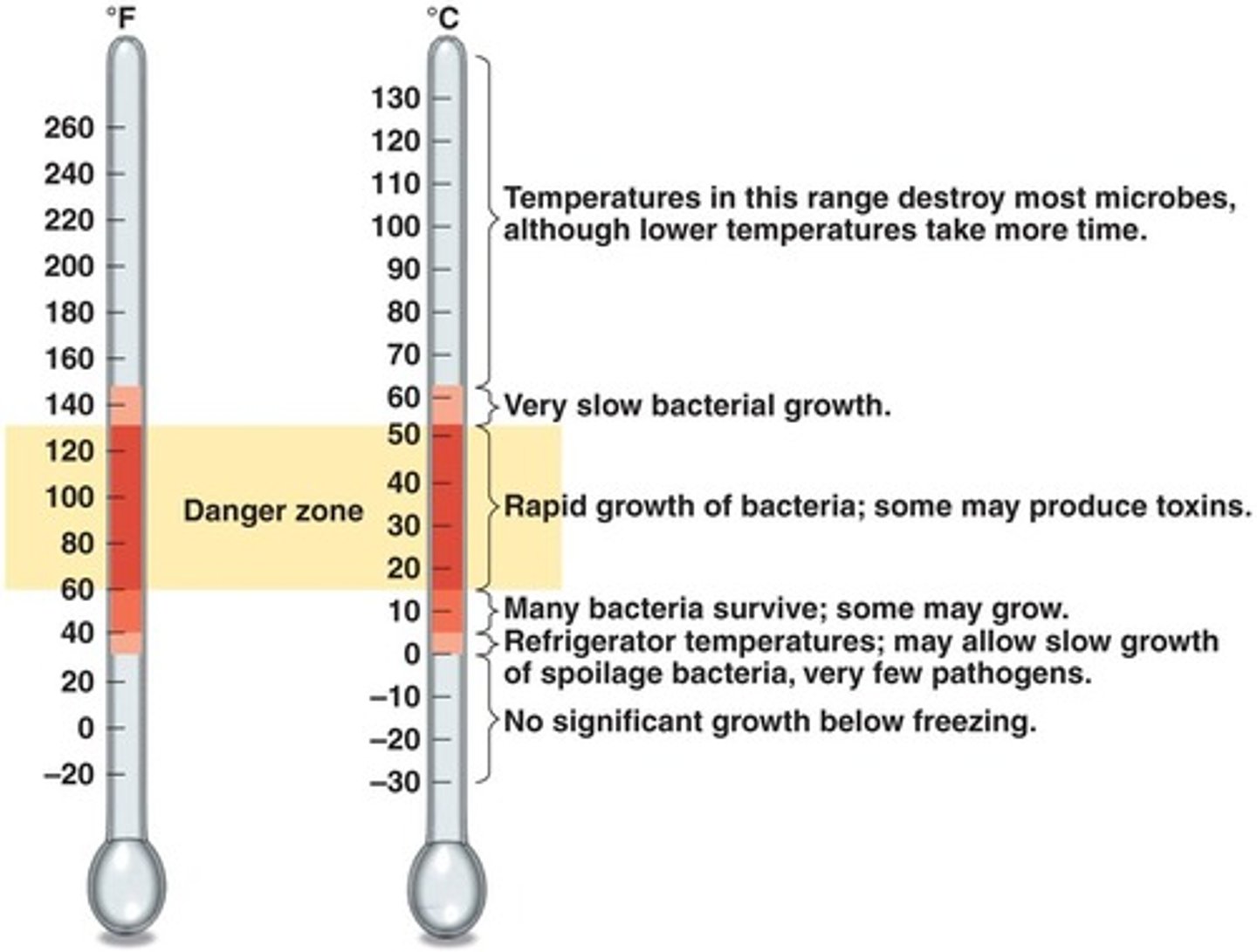
T/F: some of the most dangerous human pathogens grow at refrigerator temperatures
False: very few pathogens grow in this temperature and those that do are relatively harmless
pH is a measure of ___________________ of a solution
hydrogen ion activity
pH of the human body ranges between what two numbers making bodily pH more ________________ (acidic/basic)
7.2-7.4; slightly more basic
T/F: microbes have indefinite pH growth ranges that can change as they adapt to new environments
False: each species has a definite pH growth range
Give the optimum pH range for most organisms
pH 6-8
How do overly acidic or basic conditions damage organisms? (damages 4 things)
Damaging to....
proteins (especially enzymes), cell membrane, DNA, some organelles
The substrate binds to the _____________ of an enzyme
active site
Define denaturing as it relates to enzymes
changes the enzyme shape
How does acidosis or alkalosis affect patients?
It denatures their enzymes and kills them very quickly if not caught
What are enzymes made of?
Protein
T/F: enzymes contain some charged amino acids
true
How do negatively charged amino acids affect the shape of an enzyme?
When positively charged hydrogen ions bind to these negative amino acids, the charge becomes neutral and the enzyme changes from a circular shape to be straight
The effects of pH are related to what two things?
the concentration of acid in the medium and the protection that bacterial cell walls can sometimes provide
Changes in pH can lead to what two things?
1) denaturing of enzymes and other proteins
2) interference with pumping ions at the cell membrane
T/F: many bacteria produce large quantities of bases as they metabolize and grow leading to a toxic environment
False: many bacteria produce large quantities of ACIDS as they metabolize and grow leading to a toxic environment due to the high acid concentration
What is the end product of metabolism?
Acid
T/F: most organisms grow best at a neutral pH range
True
T/F: humans tolerate basic substances better because the body is more basic
False: humans tolerate ACIDIC substances better (think of soda, stomach acid, vinegar, etc)
T/F: most of the substances humans consume are very basic
False: most substances consumed are ACIDIC
HIGH Hydrogen ion concentration indicates?
More acidic
T/F: hot springs are highly acidic thus providing a great environment for archaea
True
Acidophiles prefer what pH range? What is an example of an acidophile?
0-5.5; archaea
T/F: nothing can grow at a pH of zero
False: acidophiles can
Fungi grow at ______________ (higher/lower) pH than bacteria
lower
Give the shape and mobility of heliobacter pylori
spirochete, high mobility rate
Natronomonas pharaonis is isolated from ________________ (what environment) where it has to cope with two extreme conditions: ___________ and _____________
Soda lakes; high salt concentration and alkaline pH of 11
List the optimum growth conditions for natronomonas pharaonis
3.5 M NaCl, pH of 8.5
T/F: natronomonas pharaonis takes up lots of O2 and returns lots of CO2 to its environment via photosynthesis
False: it returns lots of O2 to the environment via photosynthesis
Where are Heliobacter pylori found? What pH is this environment?
In the stomach; 2.5pH
Irregular stomach pH can lead to what three conditions?
stomach cancer, esophageal cancer, peptic ulcers
T/F: heliobacter pylori is an acidophile thus why it is found in the human stomach
False: it is NOT acid tolerant
Heliobacter pylori produces _________ that cause inflammation and damage. Symptoms are made worse by what three things
toxins; high stress, environmental factors, diet
How does Heliobacter pylori survive in the stomach?
it grows in protective layers of the stomach
Heliobacter pylori breaks down _______________ and produces ________________ which is ________________ (acidic/basic)
breaks down urea, produces ammonia which is basic
T/F: the ammonia produced by heliobacter pylori increases the acidity of the stomach environment
False: it NEUTRALIZES its microenvironment bc it is basic and the stomach is acidic
How is excessive Heliobacter pylori treated?
Antibiotics
As O2 is utilized, what happens?
It is transformed into several toxic products: singlet O2, superoxide ion O2-, H2O2, OH- (hydroxyl radicals)
T/F: most cells have developed protective enzymes that prevent the production of toxic O2 products
False: most cells have developed protective enzymes that NEUTRALIZE toxic O2 products

