AP Bio: Unit 7: Evolution
 Call Kai
 Learn
Learn Practice Test
 Spaced Repetition
 Match
Match Flashcards
 Knowt Play
1/106

Earn XP
Description and Tags
I will get an A I will get an A I will get an A I will get an A
Name | Mastery | Learn | Test | Matching | Spaced | Call with Kai |
|---|
No analytics yet
Send a link to your students to track their progress
107 Terms
Charles Darwin
English naturalist whose most notable research was done at the Glapagos Islands.
What was Darwin interested in?
biogeography: the geographic distribution of species
Darwin’s hypothesis:
Organisms left South America and colonized
the Galapagos Islands where they then
diversified and gave rise to a new species
What was Darwin specifically interested in?
Finches
The following questions will be True or False
Practice!
“Natural selection gives organisms what they need to survive”
FALSE: natural selection has no knowledge of what organisms “need.” Natural selection
simply acts on genetic variations that lead to
survival and reproduction
“Natural selection acts for the good of a species”
FALSE: Natural selection has no intentions. It only acts on traits that lead to survival and
reproduction.
Ex: A trait that makes a species the best predator will lead them to eat all their prey → starvation
“Natural selection is a process involving organisms trying to adapt to their surroundings”
FALSE: Natural selection acts on random
mutations that have led to a genetic variation in the population.
“Survival of the fittest” is a common phrase you may have heard. The term “fittest” refers to the organisms in a population that are the strongest, healthiest, and fastest.
FALSE: the fittest organism simply refers to
the organism that (you guessed it) can survive and reproduce
Ex: Organisms with sickle cell anemia are NOT “the healthiest,” but CAN survive malaria.
Back to Definitions!
Learn!
Evolution
Change in the genetic makeup of a population over time; descent with modification
(This definition was proposed by Darwin)
Natural Selection
A process in which individuals that
have certain traits tend to survive and reproduce at higher rates than other individuals because of those traits
Fitness
Ability to survive and reproduce
(Evolutionary fitness is measured by
reproductive success)
What do phenotypes and fitness have to do with each other?
Some phenotypes will increase or decrease an organism’s fitness
biotic
living
abiotic
nonliving
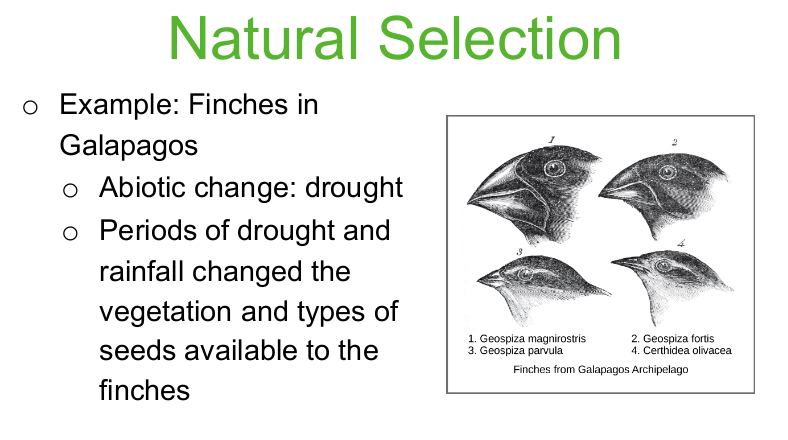
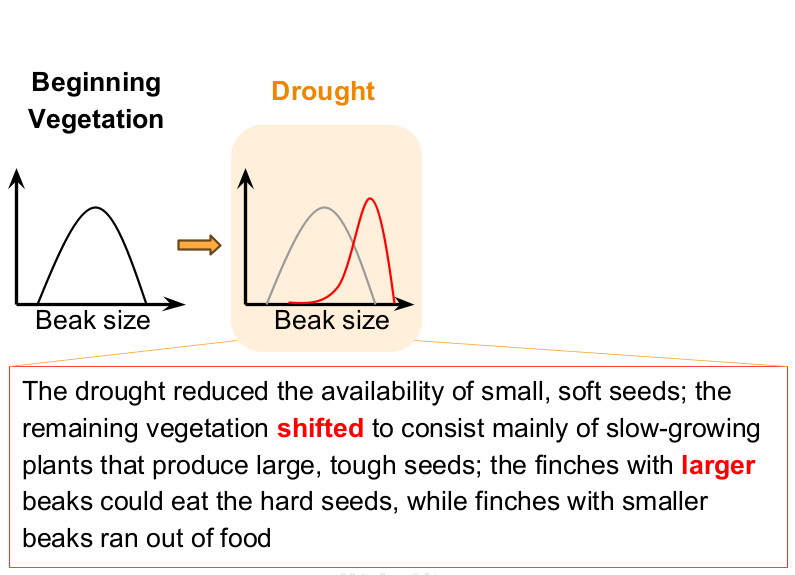
What causes selective pressures to populations?
Environmental change
What affects the rate and direction of evolution?
The fluctuation of biotic and abiotic factors
flip to see the effect
it changed woww
The more genetic diversity in a population…
the better it can respond to changes in the environment
The theory of natural selection is based on two main observations that Darwin made:
1) traits are heritable
2) More offspring are produced than can survive
Traits are heritable
Characteristics can be passed from parent to offspring
More offspring are produced than can survive
This leads to competition for limited resources, which results in differential survival
The traits that lead to survival (“favorable”
traits) will accumulate in the population
Adaptations
inherited characteristics of organisms
that enhance their survival and reproduction
WHAT evolves?
populations evolve, NOT individuals
Artificial Selection
the selective breeding of
domesticated plants and animals to
encourage the occurrence of desirable traits
Natural Selection
Nature “selects” traits that are better suited for survival and reproduction
Artificial Selection
Humans select traits that are desirable
Domestication of plants and animals
Can both natural and artificial selection lead to evolutionary change in an organism?
Yes, but natural selection occurs in nature without the influence of humans
Population
a group of individuals of the same species that live in the same area and interbreed
to produce fertile offspring
Gene pool
a population’s genetic makeup
(consists of all copies of every type of allele)
What is a fixed population?
If the population only has one allele present for a particular locus in the population
Many fixed alleles= less genetic diversity
Locus
The specific, physical location or position of a gene on a chromosome
Microevolution
small scale genetic changes in a population
What RANDOM occurences drive evolution?
Mutations
Genetic Drift
Migration/gene flow
Natural selection
Mutations
*Results in genetic variation
*can form new alleles
can be harmful, neutral, or beneficial. Most mutations are in the neutral to harmful range. Not all mutations lead to evolution.
What is the difference between mutations in eukaryotes and prokaryotes?
Mutation rates tend to be slow in plants and
animals and fast in prokaryotes due to a faster generation time
Genetic drift:
chance events that cause a change
in allele frequency from one generation to the next
*Most significant to small populations
*Can lead to a loss of genetic variation
*Can cause harmful alleles to become fixed
*Does NOT produce adaptations
What are the two types of genetic drift?
Bottleneck effect
Founder effect
Bottleneck effect
when a large population is
drastically reduced by a non-selective disaster.
(some alleles may become overrepresented, underrepresented, or absent).
Ex: Flood, famine, hunting, etc.
Founder effect
when a few individuals become isolated from
a large population and establish a new small
population with a gene pool that differs from the large population
(loses genetic diversity)
Gene flow
the transfer of alleles into or out of a
population due to fertile individuals or gametes
(alleles can be transferred between populations)
Ex: pollen being blown to a new location
AGAIN, what is reproductive success measured by?
Relative fitness: The number of surviving offspring that an individual produces compared to the number left by others in the population
How can you check the effects of natural selection?
By examining the changes in the mean of phenotypes
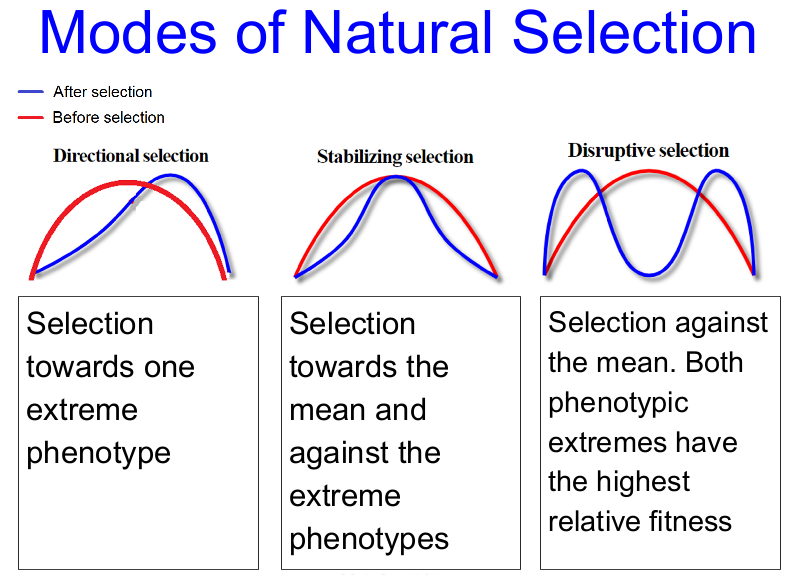
What are the three modes of natural selection?
Directional selection
Stabilizing selection
Disruptive selection
Sexual selection
a type of natural selection that
explains why many species have unique/showy traits
(can produce traits that are harmful to survival)
Ex. Colorful feathers in male peacocks makes them easier to spot by predators
Hardy Weinberg Equilibrium
A model used to assess whether natural selection or other factors are causing evolution at a particular locus
Determines what the genetic make up of the
population would be if it were NOT evolving
This is then compared to actual data:
If there are NO differences, then the
population is NOT evolving
If there ARE differences, then the
population MAY BE evolving
The Hardy Weinberg principle states:
The frequencies of alleles and genotypes in a population will remain constant from
generation to generation, provided that only
Mendelian segregation and recombination of
alleles are at work (hypothethical w/ no evolution taking place, irl, allele and genotype freequencies do change over time)
What five conditions must be met to be in Hardy Weinberg Equilibrium?
No mutations
Random mating
No natural selection
Extremely large population size
No gene flow
If the Hardy Weinberg Equilibrium conditions are not met, what happens?
microevolution occurs (mutation, gene flow, genetic drift, natural selection, and non-random mating).
Genetic drift
the random fluctuation of allele frequencies within a population due to chance events, typically reducing genetic variation, especially in small populations.
(tthrough bottleneck or founder effect)
What are the Hardy Weinberg formulas?
Look!
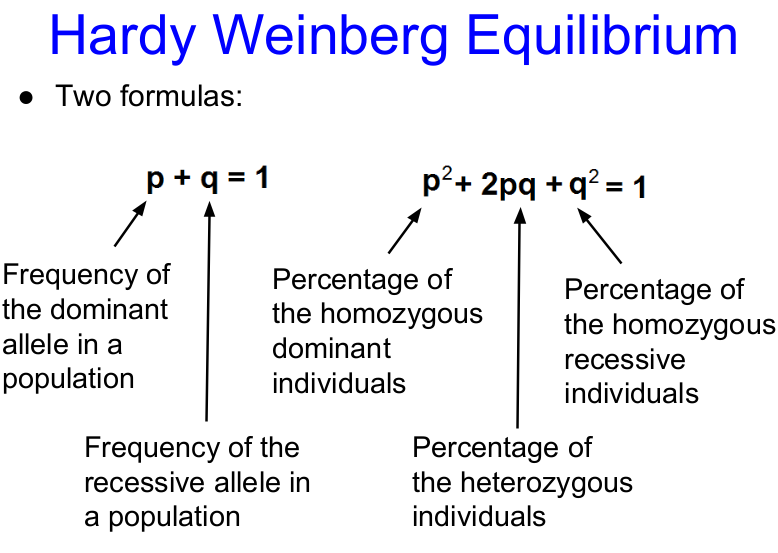
When a question gives “allele frequencies,” what formula do you use?
p+q=1
When a question asks about individual organisms or populations, what formula do you use?
p2+ 2pq+ q2 =1
What should you do first when solving?
Find both p and q first!
What is the difference between genotype
frequencies and allele frequencies in a population?
genotype frequencies refer to how alleles
combine. Allele frequencies refer to an allele’s relative distribution in the population (ie how common is the allele).
Hardy Weinberg equilibrium is often referred to as a null model of evolution. What does this mean?
a null model of evolution is one where no
evolution occurs, which is assumed with Hardy Weinberg if all conditions are met
Is genetic diversity good for survival?
Yes, because the more genetic diversity in a population, the better it can respond to changes in the environment
In contrast, species with low genetic diversity are at risk of decline or extinction
Species
a group able to interbreed and produce
viable, fertile offspring
Speciation
formation of new species
(Results in diversity of life forms)
What has an impact on speciation?
Geography has an impact on speciation
What are the two modes of speciation?
Allopatric speciation
Sympatric speciation
Allopatric speciation
Physical barrier divides population or a small
population is separated from main population.
Populations are geographically isolated
*Prevents gene flow
*Often caused by natural disasters
Sympatric speciation
A new species evolves while still inhabiting
the same geographic region as the ancestral
species.
Usually due to the exploitation of a new niche
Niche
the functional role and position of a species within an ecosystem, encompassing its use of resources (food, water, light) and tolerance for abiotic conditions (temperature, pH). It describes how an organism "makes a living"—where it lives, what it eats, and how it interacts with other organisms.
Why does speciation occur?
because of reproductive isolation
what are the two types of reproductive isolation?
Prezygotic barriers
Postzygotic barriers
(Both types maintain isolation and prevent gene flow between the populations)
Prezygotic barriers:
prevent mating or hinder fertilization
Five types:
Habitat isolation
Temporal isolation
Behavioral isolation
Mechanical isolation
Gametic isolation
Habitat isolation:
Species live in different areas
or they occupy different habitats within the same area
Temporal isolation:
species breed at different
times of the day, year, or season
Behavioral isolation:
unique behavioral patterns
and rituals separate species
Mechanical isolation:
the reproductive anatomy of one species does not fit with the anatomy of another species
Gametic isolation:
proteins on the surface of
gametes do not allow for the egg and sperm to fuse
Postzygotic barriers:
prevent a hybrid zygote from developing into a viable, fertile adult
Three types:
Reduced hybrid viability
Reduced hybrid fertility
Hybrid breakdown
Reduced hybrid viability:
The genes of different
parent species may interact in ways that impair the hybrid’s development or survival
Example: domestic sheep can fertilize
domestic goats, but the hybrid embryo dies
early on
Reduced hybrid fertility:
a hybrid can develop into a healthy adult, but it is sterile.
Usually results due to differences in number of chromosomes between parents
Example: a male donkey and a female horse
can mate to produce a mule, but mules are
sterile
Hybrid breakdown:
the hybrid of the first generation may be fertile, but when they mate with a parent species or one another, their offspring will be sterile
Example: farmers have tried crossing different types of cotton plants, but after the first generation the plants do not produce viable seeds
What is speciation a bridge of?
The concepts of microevolution and macroevolution
Microevolution:
change in allele frequencies within a single species or population (natural and sexual selection, genetic drift, gene flow)
Macroevolution:
large evolutionary patterns
(adaptive radiation, mass extinction)
Stasis
no change over long periods of time
Punctuated equilibrium:
when evolution occurs rapidly after a long period of stasis
Gradualism:
when evolution occurs slowly
over hundreds, thousands, or millions of years
Divergent evolution:
groups with the same common ancestor evolve and accumulate differences resulting in the formation of a new species
Adaptive radiation:
if a new habitat or niche becomes available, species can diversify rapidly
Convergent evolution:
two different species develop similar traits despite having different ancestors
*Analogous traits
Extinction:
the termination of a species
How many mass extinctions have occurred throughout the Earth’s history?
5 mass extinctions
What things can affect extinction rates?
*Human activity
*Ecological stress —> extinction rates can quicken
What happens if a species goes extinct?
A new niche opens up (like they lost their job, so someone else is replacing them) and it can be exploited by a different species.
What are the primary sources of evidence for the theory of evolution?
The fossil record
Comparative morphology
Biogeography
Fossils:
remains or traces of past organisms
Fossil record:
gives a visual of evolutionary change over time
Fossils can be dated by examining the rate of carbon 14 decay and the age of rocks where the fossils are found
Gives geographical data for the organisms found
Comparative morphology:
analysis of the structures
of living and extinct organisms
Homology:
characteristics in related species that
have similarities even if the functions differ
Embryonic homology:
many species have similar
embryonic development
Vestigial structures:
structures that are conserved even though they no longer have a use
Example: tailbone and appendix in humans
Molecular homology:
many species share similar DNA and amino acid sequences
Homologous structures:
characteristics that are similar in two species
because they share a common ancestor
Example: arm bones of many species
Convergent evolution:
similar adaptations that have evolved in distantly related organisms due to
similar environments

