TTM AP Bio Evolution
 Call Kai
 Learn
Learn Practice Test
 Spaced Repetition
 Match
Match Flashcards
 Knowt Play
1/72

There's no tags or description
Looks like no tags are added yet.
Name | Mastery | Learn | Test | Matching | Spaced | Call with Kai |
|---|
No analytics yet
Send a link to your students to track their progress
73 Terms
Charles Darwin
1809-82; British naturalist, proposed the idea of evolution by natural selection
basic timeline of evolution theory
Hutton gradualism
Lamarck (pre-Darwin) “giraffe with short neck can stretch his neck out to aquire a long neck, his babies will have long necks” + “if you got a nose job your nose would be passed to babies”
Darwin: natural selection selects the fittest giraffes (long necks), short necks can’t reach food, no energy to mate; long necks can reproduce and grow larger in number
You fit the environment and …
or You don’t fit the environment and …
you fit the environment and leave your genes behind
or
you don’t fit your environment and don’t leave your genes behind
adaptive radiation
rapid diversification of a single ancestral lineage into a multitude of new species, each adapted to exploit specific ecological niches
(think Galapagos finches beaks)
darwin 2 observations
members of a population often vary in their inherited traits
all species can produce more offspring that the environment can support, and many of these offspring fail to survive and reproduce (think seahorses)
artificial selection
humans have modified other species by selecting and breeding individuals with desired traits (most obvious ex is dogs)
darwin 2 inferences
individuals whose inherited traits give them a higher probability of surviving and reproducing in a given environment tend to leave more offspring than other individuals (differential reproduction)
unequal ability of individuals to survive and reproduce will lead to the accumulation of favorable traits in the population over generations
Darwin, origin of species, mechanism to explain evolution
natural selection - the process whereby organisms better adapted to their environment tend to survive and produce more offspring
natural selection in depth
depends on the environment
acts on existing heritable variation
whoever fits the environment better, leave more offspring being (differential reproduction again)
whoever best FITS their environment
mutations are random and can be:
advantageous, deleterious, or silent
after observing finches + Galapagos tortoise, Darwin proposed that
species can change over time
that new species come from pre-existing species
all species share a common ancestor
darwin’s theory of evolution is basically
descent with modification: all organisms are related through descent from an ancestor that lived in the remote past and accumulated adaptations to help them survive their environment (pizzly bear?)
parthenogenesis
form of asexual reproduction where embryos develop from unfertilized eggs.. downside being limited genetic variety
evidences of evolution (list)
direct observation
homology
vestigial structures
embryology
DNA
biogeography
fossils
Direct Observation
through observable events, some changes in species have been observed and studied: what stays and remains, observing survivability
observable events - shows evolution is an ongoing process
ex. antibiotic resistance in bacteria, Galapagos finches beak size
Homology (2 structure types)
homologous structures: similar structures with different functions
ex. vertebra forelimb similar structure but for different functions (human, dog, horse, bat) ; also leaves
analogous structures: similar structures without shared ancestry — these structures evolved independently to serve the same purpose.
ex. wings in insects and birds
convergent vs divergent evolution
convergent: streamlined shaped bc of similar environment despite being different animal groups (process of developing analogous structures)
divergent: branching into different family groups
vestigial structures
vestigial structures: structures that have no apparent function and appear to be residual parts from a past ancestor.
ex. human appendix, pelvic bone of a snake
Embryology
Act of comparing embryos to look for common ancestry, provides evidence for evolution since the embryonic form of divergent groups are extremely similar
ex. homologous structures such as gills/tails
Fossils
Documents pattern of evolution
a. shows evidence of existence of now-extinct past species
b. showing a chronological progression of life forms over time
index fossil: widespread geographically but existed for specific time period, helps date correlating rock layers its found in
models of evolution
gradualism - evolution generally occurs uniformly and by the steady and gradual transformation of whole lineages. In this view, evolution is seem as generally smooth and continuous.
punctuated equilibrium - most species will show little change throughout most of their geological history, remaining in a state of stasis. Any change generally occurs rapidly and abruptly.
both correct: gradualism over long periods and punctuated in rapid breaks within long periods of stability
biochemical evidence: DNA/protein sequences
because all living organisms share a universal genetic code, inherited from a common ancestor, …
similarities in DNA + AA demonstrate evolutionary relationships, with fewer differences indicating a more recent common ancestor
Biogeography
the study of geographical distribution of organisms, where evolution/species distribution aligns with geological and evolutionary events over time
showing that species' geographic distributions reflect their evolutionary histories and movement, rather than just environmental similarity
ex. Continental drift
macroevolution
macro
large scale changes in gene frequencies
longer time period
at/above level of species
not directly observed, rather fossil evidence
ex. reptiles —> birds
microevolution
micro'
small scale changes in gene frequencies
few generations
within a species/population
observable, with experimental evidence
ex. antibiotic resistance
the common misconception
individual organisms evolve
no, rather populations evolve over generations
but natural selection CAN act on individuals
- each individual’s traits affect its survival and reproductive success to other individuals in the population and can leave their genes behind
adaptation
an inherited characteristic of an organism that enhances its survival and reproduction in an environment
gene pool
a way to characterize a population’s genetic makeup
consists of all copies of every type of alelle at every locus in all members of the population
evolution does not mean perfection
selection can only act on existing variation, and variation is from mutations
chance, natural selection and the environment interact dynamically
evolution is not directed
causes of evolution list
Change in allele frequencies in a population over generations
Causes: Mechanisms that can alter allele frequencies in a population
Variation
Natural selection
Non random mating
Genetic drift
Gene flow (migration)
Genetic Variation (sources of)
a. new genes and alleles can arise by mutation
only mutations in cells lines that form gametes passed on to offspring
most mutations happen in somatic cell and are lost when the individual dies
b. sexual reproduction (crossing over, indep assortment) can shuffle existing alleles into new combinations
c. altering gene number or position
Genetic Variation
at the gene level: genetic variation is qualified by the % of heterozygous loci in a population: quantified as avg heterozygosity
at the molecular level: genetic variation is quantified by comparing the nucleotide sequence of individuals (rare)
natural selection
acts on an organism’s phenotype
only NS consistently increases the frequency of alleles that provide reproductive advantage
selection results in allele being passed to the next generation in proportions that differ from those in the present generation
ex. DDT resistance fruit flies
can cause adaptive evolution - a process in which traits that enhance survival or reproduction increase in frequency over time
relative fitness
the contribution an individual makes to the gene pool of the next generation relative to the contribution of other individuals
NS alters frequency distribution of heritable traits in 3 ways, depending on which phenotypes are favored
A. directional selection (one extreme)
B. stabilizing selection (mid-range)
C. disruptive selection (both extremes)
heterozygous advantage
heterozygous genotype has a higher relative fitness than either the homozygous dominant or homozygous recessive genotype
Non-random mating (sexual, intra, inter selection)
sexual selection - individuals with certain inherited characteristics are more likely than others to obtain mates
intrasexual selection - males compete for mate
intersexual selection: females choose mate
sexual dimorphism
a difference in sexual characteristics between males and females
one sex (typically male) is more brightly colored
Migration/Gene Flow
population integration leads to increase in genetic diversity
genetic drift
chance events cause allele frequencies to fluctuate unpredictably from one generation to the next, especially in small populations
two examples of genetic drift:
founders effect
bottleneck
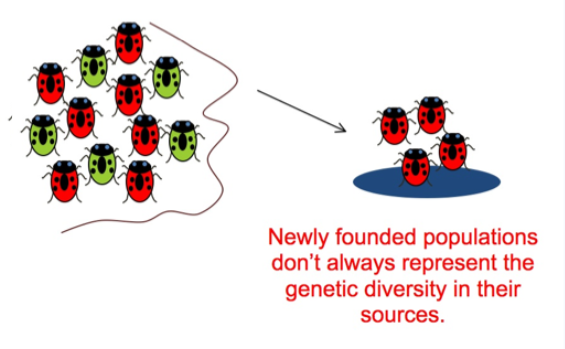
founders effect
occurs when a new colony is started by a few members of the original population
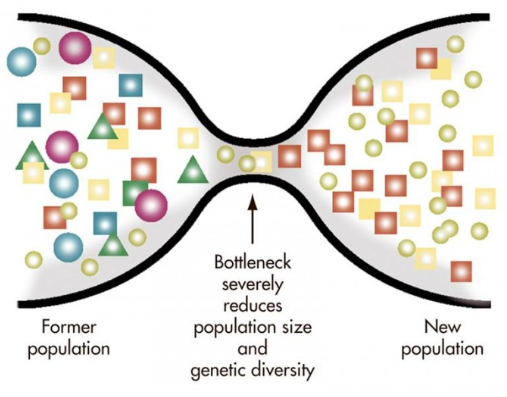
population bottlenecks
occur when a population’s size is reduced for at least one generation, always leads to loss of genetic diversity
rare alleles most likely to be lost in population bottlenecks, sometimes losing them means loss of resistance to rare disease/environment
is a population evolving
genetic variation is required, with one or more factors that cause evolution necessary to be at work
population - group of individuals of same species that interbreed
gene pool - all copies of every allele at every locus in all member of the population
fixed locus vs two alleles or more
fixed locus - all are homozygous for same allele
2+ alleles - homozygous or heterozygous
hardy-weinberg equilibrium conditions
not evolving and alleles frequencies will stay the same across generations
assumes
no mutation
random mating
no gene flow
infinite pop size
no selection
fossil records and macroevolution
fossil record shows macro evolution changes over large time scales including
emergence of terrestrial vertebrates
origin of photosynthesis
long term impacts on mass extinctions
chemical/physical processes + NS produced simple cells in 4 steps
abiotic synthesis of small organic molecules, such as amino acids + nucleotides
joining of these small molecules into macromolecules, including proteins + nucleic acids
molecules packed into probionts/protocells
origin of self-replicating molecules eventually makes inheritance possible
Oparin-Haldane hypothesis
Earth’s early atmosphere is reducing enviro (lack of O2), organic compounds could have formed from simple molecules.
Energy for this organic synthesis could have come from lightning and intense UV radiation
ocean as primitive soup where life arose
Miller-Urey test
made a lab similar to early Earth conditions, yielded a variety of amino acids + organic compounds.
showed that abiotic synthesis of organic molecules in a reducing atmosphere is possible
but instead of forming in atmosphere, first organic compounds prob synthesized near submerged volcanoes/deep sea vents
AA also found in meteorites
abiotic synthesis of macromolecules (monomers → polymers)
small organic molecules polymerize when they are concentrated on hot sand, clay, or rock
replication and metabolism are key properties of life
protobionts/protocells
aggregates of abiotically produced molecules surrounded by a membrane or membrane like structure
exhibit simple reproduction and metabolism and maintain an internal chemical environment
could have formed spontaneously from abiotically produced organic compounds (ex. liposomes from lipids added to water)
first genetic material
was RNA not DNA
RNA molecules called ribozymes have been found to catalyze many different reactions
ex. ribozymes can make complementary copies of short stretches of their own sequence or other short pieces of RNA
sedimentary rock and fossils
sedimentary strata reveal the relative ages of fossils
absolute ages of fossils can be determined by radiometric dating
parent isotope decays to daughter isotope at a constant rate
geologic record divided into (A, P, P)
Archean, Proterozoic, and Phanerozoic eons
Phanerozoic: encompasses multicellular eukaryotic life
divided into three eras: the paleozoic, mesozoic, and cenozoic
oldest known fossils
stromalites, rock like structures composed of many layers of bacteria and sediment (3.5 bya)
prokaryotes were earth’s sole inhabitants from 3.5-2.1 bya
oxygen revolution
2.7 bya
posed a challenge for life
provided opportunity to gain energy from light
allowed organisms to exploit new ecosystems
first eukaryotes
2.1 bya
hypothesis of endosymbiosis: mitochondria/chloroplast consumery
serial endosymbiosis: supposes that mitochondria evolved before plastids through a sequence of endosymbiotic events
evidence: similarities in inner membrane structures and functions, these organelles transcribe and translated their own DNA, ribosomes more similar to prokaryotic than euk ribosomes
origins of multicellularity
1.5 bya
second wave of diversification gave rise to algae, plants, fungi, animals: oldest known fossil is small algae 1.2 bya
snowball Earth hypothesis confined life to equatorial region
Cambrian explosion
sudden appearance of fossils resembling modern phyla 535 mya
first evidence of predator-prey interactions
colonization of land
500 mya
fungi, plants, and animals began to colonize land
arthropods/tetrapods are the most widespread and diverse land animals
pangea
formed 250 mya, effects:
reduction in shallow water habitat
colder and drier climate inland
changes in climate as continents moved towards/away from the poles
changes in ocean circulation patterns leading to global cooling
breakup leads to allopatric speciation
the five extinction events
Time Period Name | Millions of years ago | % of species on Earth killed | Main type of species killed | Cause |
Ordovician Extinction | 450 mya | 50% | Marine invertebrates (brachiopods, trilobites | glaciation, leading to dramatic falls in sea level |
Devonian Extinction | 360 mya | 70% | Marine life and early land dwellers | global cooling, ocean anoxia, asteroid impact |
Permian Extinction | 251 mya | marine: 96% | marine, mammal-like reptiles and insects | Siberian trap volcanoes during Pangea formation |
Triassic | 200 mya | 50% | large amphibians, therapsids, archosaurs | volcanic eruptions during the breakup of pangea, global warming |
Cretaceous Tertiary Extinction | 65.5 mya | 75% | non-avian dinosaurs | asteroid impact and massive volcano eruptions |
mass extinction
when more than 50% species extinct
can alter ecological communities and the niches available to organisms
paves way for adaptive radiations
adaptive radiation
the evolution of diversely adapted species from a common ancestor upon intro to new environmental opportunities
mammals went under adaptive radiation after extinction of terrestrial dinosaurs
disappearance of dinosaurs (except birds) allowed for the expansion of mammals in diversity and size
Hawaii as regional adaptive radiation: organisms colonize new environments with little comp
heterochrony
evolutionary change in the rate or timing of developmental events
can have significant impact on body shape
can alter timing of reproductive development relative to the development of non reproductive organs
paedomorphosis
paedomorphosis
rate of reproductive development accelerates compared with somatic development
sexually mature species may retain body features that were juvenile structures in an ancestral species
homeotic genes + hox genes
determine such basic features as where wings and legs will develop on a bird or how a flower’s parts are arranged
hox: class of homeotic genes that provide positional info during development
if hox expressed in the wrong location, body parts can be produced in the wrong location
evolution of vertebrates from invertebrates associated with alterations in Hox genes
dupilcating Hox important in evolution of new vertebrate characteristics
evolution is not goal oriented
most novel biological structures evolve in many stages from previously existing structures
the appearance of an evolutionary trend does not imply there is some intrinsic drive toward a particular phenotype
phylogeny tree vs cladogram
phylogram shows evolutionary/genetic distance, the branch lengths infer time
cladograms only show related characteristics
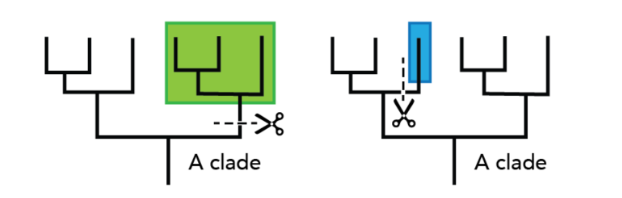
clade
clade is a group of species that includes an ancestral species and all its descendants
clades can be nested in larger clades
phylogeny three things to keep in mind
evolution produces tree-like, not ladder-like relationships
left to right reading has no correlation with levels of advancement
choice of formatting left or right doesn’t matter
you can rotate branches around nodes without changing evolutionary relationships
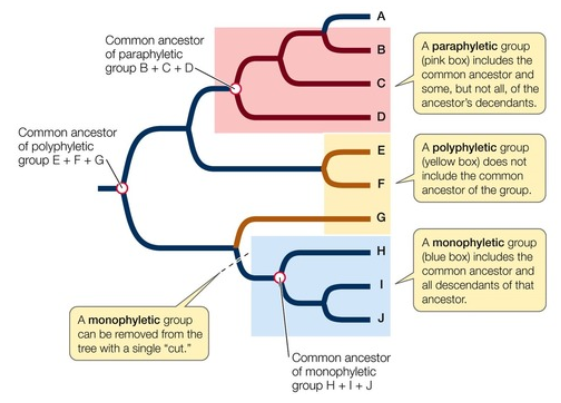
validity of phylogenetic tree
valid
monophyletic - signifying that it consists of the ancestor species and all its descendants
invalid
paraphyletic - grouping consists of an ancestral species and some, but not all, of the descendants
polyphyletic - grouping consists of various species with different ancestors