Working memory model
 Call Kai
 Learn
Learn Practice Test
 Spaced Repetition
 Match
Match Flashcards
 Knowt Play
1/24

There's no tags or description
Looks like no tags are added yet.
Name | Mastery | Learn | Test | Matching | Spaced | Call with Kai |
|---|
No analytics yet
Send a link to your students to track their progress
25 Terms
What is the Working Memory Model?
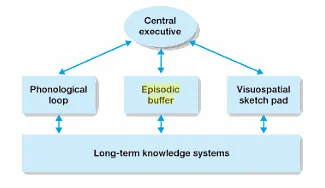
The Working Memory Model was created by Baddeley and Hitch (1974) and explains short-term memory as an active system that processes and manipulates information.
Why was the Working Memory Model proposed?
Because STM was seen as too simple; it must be an active processor holding multiple pieces of information while working on them.
What does the Working Memory Model replace?
It replaces the Short-Term Memory store in the Multi-Store Model.
How many components does the Working Memory Model have?
Initially three components, later expanded to four with the addition of the episodic buffer.
How does the Working Memory Model interact with LTM?
It interacts with long-term memory to store and retrieve information.
What is the central executive?
The central executive is the main control system that directs attention and processes information before passing it to slave systems.
What are the features of the central executive?
Limited capacity, can only hold one piece of information at a time, and switches attention between inputs.
What is the phonological loop?
The phonological loop processes auditory information (sound-based memory).
What are the features of the phonological loop?
Limited capacity, 2-second duration, and confusion occurs with similar sounding words.
What are the two components of the phonological loop?
The primary acoustic store (“inner ear”) and the articulatory process (“inner voice”).
What does the primary acoustic store do?
Stores sounds recently heard.
What does the articulatory process do?
Uses subvocal rehearsal to keep information in memory.
What is the visuospatial sketchpad?
The visuospatial sketchpad is the “inner eye” that processes visual and spatial information.
What are the features of the visuospatial sketchpad?
Limited capacity, 2-second duration, stores visual and spatial information.
What are the two components of the visuospatial sketchpad?
The visual cache and the inner scribe.
What does the visual cache do?
Stores form and colour of objects (passive store).
What does the inner scribe do?
Processes spatial relationships and rehearses visual information (active store).
What is the episodic buffer?
A temporary store that combines information from the phonological loop, visuospatial sketchpad, and central executive.
Why was the episodic buffer added?
To explain how different types of information are integrated and transferred to long-term memory.
How are memory models tested experimentally?
Through lab studies using interference tasks and dual-task experiments.
What are the strengths of experimental testing?
High control, large samples, high internal validity, and replicable results.
What are the limitations of experimental testing?
Low ecological validity, low mundane realism, and limited external validity.
How does clinical evidence support memory models?
Brain-damaged individuals show impairments in specific components, supporting separate systems.
How does brain scanning support the Working Memory Model?
fMRI scans show different brain areas are active during different memory tasks, supporting separate components.
working memory model diagram