CH19 TEST REVIEW ‘AIR PRESSURE AND WIND’
 Call Kai
 Learn
Learn Practice Test
 Spaced Repetition
 Match
Match Flashcards
 Knowt Play
1/63

There's no tags or description
Looks like no tags are added yet.
Name | Mastery | Learn | Test | Matching | Spaced | Call with Kai |
|---|
No analytics yet
Send a link to your students to track their progress
64 Terms
Which of the following is true about air pressure acting on an object? a. The amount pushing down on the object will gradually decrease with time. b. The amount pushing up on the object will gradually increase with time. c. There is more air pressure pushing up on the object than there is pushing down. d. There is just as much air pressure pushing up as there is pushing down on the object.
d
In a mercury barometer, when air pressure increases, the mercury in the tube a. rises. b. falls. c. rises, then falls. d. falls, then rises.
a
Which of the following is a difference between a mercury barometer and an aneroid barometer? a. The mercury barometer is smaller. b. The mercury barometer can provide a continuous record of pressure changes. c. The aneroid barometer does not use mercury to measure pressure changes. d. The aneroid barometer is not as portable.
c
What is the ultimate source of energy for most wind? a. air pressure b. solar radiation c. changes in humidity d. air temperature
b
The pressure differences that make wind happen are caused a. by a sudden drop in humidity. b. when water vapor in the air rises then falls. c. by accumulations of clouds in different areas. d. by the unequal heating of Earth's surface.
d
Pressure decreases from the outer isobars toward the center in a. cyclones. b. anticyclones. c. polar fronts. d. jet streams.
a
Because of the Coriolis effect, wind in the Northern Hemisphere a. is deflected to the left. b. rises higher into the atmosphere. c. is deflected to the right. d. sinks lower into the atmosphere.
c
What are the most prominent features of airflow above the friction layer? a. jet streams b. vertically moving winds c. right-deflected winds d. left-deflected winds
a
On a weather map, what do isobars placed close together indicate? a. a steep pressure gradient and high winds b. a steep pressure gradient and weak winds c. a weak pressure gradient and high winds d. no pressure gradient and therefore no wind
a
In the Northern Hemisphere, pressure gradients and the Coriolis effect applied to low-pressure centers produce winds that blow a. outward and clockwise. b. outward and counterclockwise. c. inward and clockwise. d. inward and counterclockwise.
d
The effect of friction on the net flow of air around cyclones is that it causes air to flow a. inward in the Northern Hemisphere. b. outward in the Southern Hemisphere. c. inward in either hemisphere. d. outward in either hemisphere.
c
The net inward movement of air in a surface low-pressure system that causes the air mass to shrink is called a. surface convergence. b. surface divergence. c. horizontal convergence. d. horizontal divergence.
c
The atmosphere balances the unequal heating of Earth's surface by moving a. cool air toward high latitudes and warm air toward the equator. b. warm air toward high latitudes and cool air toward the equator. c. cool air toward the east and warm air toward the west. d. warm air toward the east and cool air toward the west.
b
Local winds are caused by either topographic effects or by variations in a. temperature. b. surface composition. c. air pressure. d. the Coriolis effect.
b
Weather in the United States is moved by the westerlies in a(n) a. east to west direction across the continent. b. northwest to southeast direction across the continent. c. west to east direction across the continent. d. southeast to northwest direction across the continent.
c
What is an instrument commonly used to measure wind speed? a. aneroid barometer b. mercury barometer c. wind vane d. anemometer
d
Which of the following is the initial major effect of an El Niño? a. Cold nutrient-rich offshore waters are replaced by warm equatorial waters. b. Warm nutrient-rich equatorial waters are replaced by cold offshore waters. c. Cold offshore waters are replaced by warm nutrient-rich equatorial waters. d. Warm offshore waters are replaced by cold equatorial waters.
a
How often does an El Niño event occur? a. about every other year b. every 10 years c. about every 2 to 3 years d. about every 3 to 7 years
d
Which of the following best describes a La Niña? a. It is the name for an unusually long El Niño event. b. It has the opposite effect than does an El Niño event. c. It is the cause of an El Niño event. d. Its effects are localized, not global.
b
According to researchers, how is a La Niña event triggered? a. by warmer than average surface temperatures in the eastern Pacific b. by colder than average surface temperatures in the eastern Pacific c. by warmer than average coastal water temperatures in the eastern Pacific d. by colder than average coastal water temperatures in the eastern Pacific
b
The force exerted by the weight of the air above is called a. air pressure. b. convergence. c. the Coriolis effect. d. divergence.
a
In which direction is air pressure exerted? a. upward b. downward c. sideways d. all of the above
d
Which of these instruments is NOT used to measure air pressure? a. mercury barometer b. aneroid c. anemometer d. All are used to measure air pressure.
c
Standard sea level pressure in millibars is a. 750.1. b. 980.5. c. 1000. d. 1013.2.
d
Who invented the mercury barometer? a. Galileo b. Torricelli c. Newton d. Watt
b
What is the ultimate energy source for most wind? a. Earth's rotation b. Earth's revolution c. solar radiation d. tides
c
Which force generates winds? a. the Coriolis effect b. gravity c. pressure differences d. friction
c
Which of the following is NOT a force that influences wind? a. Coriolis effect b. magnetic field c. pressure gradient d. friction
b
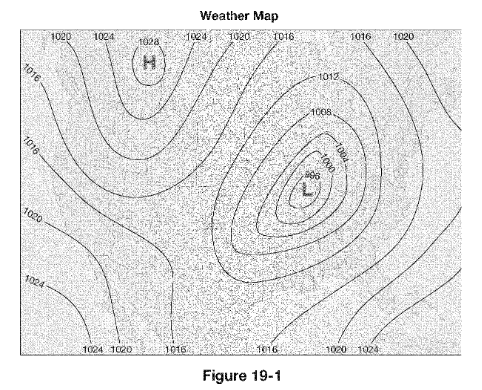
In Figure 19-1, the lines on the weather map that connect points of equal pressure are a. isobars. b. isogrids. c. contour lines. d. isotherms.
a
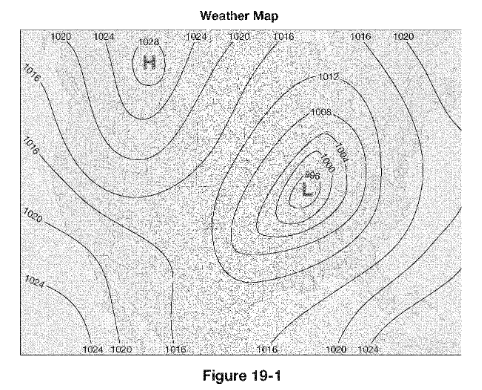
In Figure 19-1, closely spaced lines indicate a. high winds. b. light winds. c. variable winds. d. cyclonic winds.
a
A steep pressure gradient a. would be depicted by widely spaced isobars. b. produces strong winds. c. is only possible in the tropics. d. produces light winds.
b
Widely spaced isobars indicate a. high winds. b. variable winds. c. light winds. d. winds oriented north to south.
c
Variations in air pressure from place to place are the principal cause of a. snow. b. rain. c. wind. d. clouds.
c
Fast-moving currents of air that occur above the friction layer are called a. wind trains. b. mesocyclones. c. chinooks. d. jet streams.
d
High-altitude, high-velocity "rivers" of air are called a. cyclones. b. jet streams. c. anticyclones. d. tornadoes.
b
The Coriolis effect influences a. wind speed. b. wind direction. c. both wind speed and wind direction. d. neither wind speed nor wind direction.
b
The deflection of wind due to the Coriolis effect is strongest at a. the equator. b. the midlatitudes. c. midnight. d. the poles.
d
In the Northern Hemisphere, winds associated with a low-pressure system blow a. counterclockwise toward the center. b. clockwise toward the center. c. clockwise outward from the center. d. counterclockwise outward from the center.
a
In the Southern Hemisphere, winds associated with a low-pressure system blow a. clockwise toward the center. b. counterclockwise toward the center. c. clockwise outward from the center. d. counterclockwise outward from the center.
a
In the Northern Hemisphere, winds associated with a high-pressure system blow a. counterclockwise toward the center. b. clockwise toward the center. c. clockwise outward from the center. d. counterclockwise outward from the center.
c
Centers of low pressure are called a. anticyclones. b. air masses. c. jet streams. d. cyclones.
d
Air subsides in the center of a(n) a. low-pressure system. b. high-pressure system. c. jet stream. d. area of surface convergence.
b
Fair weather can usually be expected with the approach of which of the following? a. cyclone b. anticyclone c. low-pressure system d. none of the above
b
High-pressure systems are usually associated with which of the following? a. descending air b. clear weather c. relatively dry conditions d. all of the above
d
The general movement of low-pressure centers across the United States is from a. north to south. b. south to north. c. west to east. d. east to west.
c
Which of the following does NOT describe the surface air movement of a Northern Hemisphere low? a. inward b. counterclockwise c. net upward movement d. divergent
d
What is NOT true about lows that move across the United States? a. They can produce bad weather. b. Their paths are very predictable. c. They move in roughly a west-to-east direction. d. They may require up to a week to cross the country.
b
The net inward movement of air causes the area occupied by an air mass to shrink, a process known as a. horizontal divergence. b. horizontal convergence. c. vertical divergence. d. vertical convergence.
b
Seasonal changes in wind direction associated with large landmasses and adjacent water bodies are called a. polar fronts. b. jet streams. c. monsoons. d. trade winds.
c
Which surface winds blow between the subtropical high and the equator? a. trade winds b. polar easterlies c. sea breezes d. westerlies
a
The deserts of the Sahara and Australia are associated with the a. equatorial low. b. subtropical high. c. subpolar low. d. polar high.
b
In the winter, large landmasses such as Asia develop a seasonal a. high-pressure system. b. system of trade winds. c. low-pressure system. d. cyclonic circulation.
a
Near the equator, rising air is associated with a pressure zone known as the a. equatorial high. b. equatorial low. c. tropical low. d. tropical high.
b
If Earth did not rotate, how would air at the equator move? a. Air would sink and move toward the poles. b. Air would rise and move toward the poles. c. There would be no air movement. d. none of the above
b
Valley and mountain breezes are examples of a. global winds. b. trade winds. c. local winds. d. jet streams.
c
A sea breeze usually originates during the a. evening and flows toward the land. b. day and flows toward the land. c. evening and flows toward the water. d. day and flows toward the water.
b
A land breeze usually originates during the a. evening and flows toward the land. b. day and flows toward the land. c. evening and flows toward the water. d. day and flows toward the water.
c
When is a sea breeze most intense? a. during mid- to late afternoon b. in the late evening c. in the late morning d. at sunrise
a
A wind that consistently blows more often from one direction than from any other is called a a. local wind. b. prevailing wind. c. trade wind. d. jet stream.
b
Which instrument is used to measure wind speed? a. anemometer b. barometer c. thermometer d. all of the above
a
Winds are labeled according to which of the following? a. whether they originate on land or water b. the direction from which they blow c. the region in which they can be found d. none of the above
b
Which phenomenon is associated with surface temperatures in the eastern Pacific that are colder than average? a. La Niña b. El Niño c. global warming d. local winds
a
Which of the following is a warm countercurrent that periodically flows southward along the coasts of Ecuador and Peru? a. mountain breeze b. La Niña c. El Niño d. none of the above
c
Which of the following can be impacted by El Niño? a. the fish industry b. climate c. the farming industry d. all of the above
d

