Factor markets
 Studied by 0 people
 Call with Kai
 Learn
Learn Practice Test
 Spaced Repetition
 Match
Match Flashcards
 Knowt Play
1/9

There's no tags or description
Looks like no tags are added yet.
Name | Mastery | Learn | Test | Matching | Spaced | Call with Kai |
|---|
No analytics yet
Send a link to your students to track their progress
10 Terms
Marginal revenue product of labour
(Additional revenue generated from hiring one more unit of labour)
MRPL = MPL x MR
Under perfect competition in the goods market MR = P
so MRPL = MPL x P = VMPL (Value of marginal product of labour)
Under imperfect competition MR < P
Marginal revenue product of labour - issue
From producer theory we know marginal product of labour declines with additional labour due to diminishing marginal returns, therefore marginal revenue product of labour ALSO decreases as more labour is hired
Under imperfect competition MR falls with output so MRPL declines even faster
Inverse relationship between MRPL and the quantity of labour hired.
Therefore for a firm they will hire labour up to the point when MRPL = w
w = wage rate which represents the cost of hiring an additional unit of labour
Formula for optimal amount of labour employed
MRPL = w
Or
MR = w/MPL
Demand for labour
Derived demand as firms profit max output choice necessitates optimal labour hiring
Any factor that changes the MPL or MR will shift the labour demand curve
The MPL depends on the tech of the production process and the amount of capital employed
Effect of changes in wages
If there is no feedback from wages to output prices then a fall in wages only causes a movement along/down the labour demand curve - increasing quantity of labour demanded, but if there is feedback, the MR and demand for labour will shift inwards alongside the movement down the labour demand curve
Labour demand in the long run
In the short run capital is fixed so given a fall in wages the firm will hire more labour increasing productivity of labour, but in the long run the firm can adjust capital so will increase capital usage, and the demand for labour will be flatter (more elastic), due to increased responsiveness of labour demand to wages
Supply of labour - perfectly competitive market
Firm can hire any quantity at prevailing market wage, so wage is constant regardless of how much labour the firm demands/hires
Overall supply of labour depends on people’s willingness to work which varies with age, health, family responsibilities
Labour leisure trade off
Leisure - normal good, but comes at a cost - the forgone income from not working
Labour - generates income which enables consumption so trade off between leisure and consumption
Decomposing the wage effect
A change in wage triggers the substitution and income effect
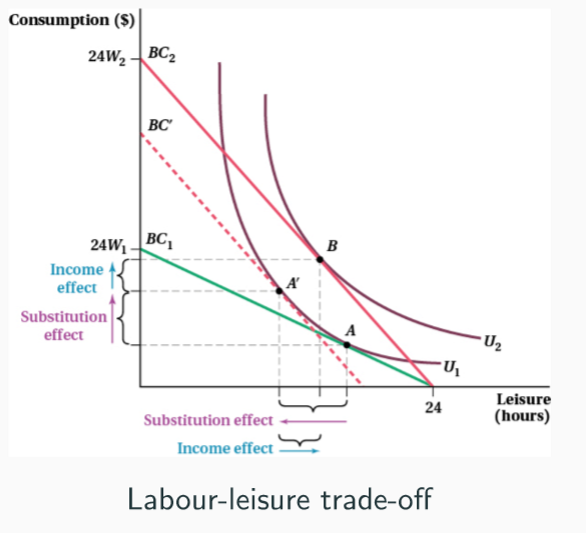
E.g. Increase in wage rate, means that the initial bundle of leisure and consumption chosen on the first indifference curve and budget line changes as the budget line pivots outwards, making leisure more expensive, and so there is a new bundle B on a new indifference curve and budget line
The substitution effect shows how the individual substitutes AWAY from leisure towards more work, as the budget line is shifted inwards so it crosses through the original indifference curve and the shift from A to A’ reflects this. Then the income effect shows how higher income (from higher wages) then increases demand for leisure, moving from A’ to B, so the total effect is shown by movement from A to B - on a higher indifference curve reflecting increased overall well-being.
The total effect depends on the relative strength/direction of the two effects and at lower wage levels the substitution effect dominates and vice versa
Monopsonist
A firm large enough that its hiring decision influence the market wage e.g. the NHS in the UK
As a large buyer of labour the firm faces an upward-sloping labour supply curve
The firm hires labour where its marginal expenditure (additional cost to hire one more unit of labour) = the marginal revenue product of labour
There is a dead weight loss which arises from underemployment of labour - workers willing to work at a higher wage but not hired even though their contribution exceeds the wage the firm would need to pay
 Note
Note  Flashcards (33)