Meteorology Chapter 6 - Air Pressure
 Studied by 0 people
 Call Kai
 Learn
Learn Practice Test
 Spaced Repetition
 Match
Match Flashcards
 Knowt Play
1/16

There's no tags or description
Looks like no tags are added yet.
Name | Mastery | Learn | Test | Matching | Spaced | Call with Kai |
|---|
No analytics yet
Send a link to your students to track their progress
17 Terms
Air Pressure
Force that is exerted on every surface due to collisions of gas
Barometer
Measures pressure in inches
Sea Level Pressure
14.7 lbs./in²
Pressure Gradient
Difference of pressure across some region
Created by heating differences
Caused the air to move from high pressure to low pressure
PGF
Due to heating differences air flowing is directed from high pressure to low pressure
Coriolis
Due to Earth’s rotation
NH - apparent deflection to the right
SH - apparent deflection to the left
Acts at a right angle to the wind
Affects wind direction
Wind speed - faster winds mean greater deflection
Latitude - strongest at poles weakest at equator
Centrifugal Force
Outward pull in a curved flow that is a function of wind speed
Friction
Acts opposite of the wind
Slows down wind speed and affects wind direction
Acts at the surface; no friction occurs in upper levels of the atmosphere
Gravity
Downward directed toward the center of the Earth
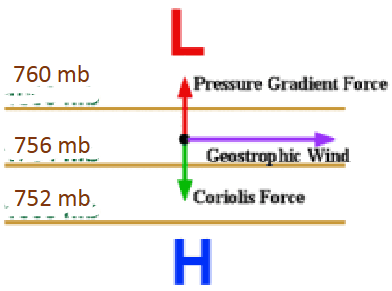
Geostrophic Wind
Balance between PGF and Coriolis → air flows parallel to straight line isobars
Gradient Winds
All upper-level winds are parallel to isobars
High vs Low Pressure Winds
High: clockwise & outward
Low: Counter-clockwise & inward
Flow Summary
SH Upper Level
H: CCW & parallel
L: CW & parallel
SH Surface
H: CCW & outward
L: CW & outward
NH Upper levels
H: CW & parallel
L: CCW & parallel
NH Surface
H: CW & outward
L: CCW & outward
Anticyclone
Area of high pressure
Flows anticyclonically
Pressure increases
Temperature increases
RH decreases
Air is stable, sinks and flows outward at the surface
Cyclone
Area of low pressure
Flows cyclonically
Pressure decreases
Temperature decreases
RH increases
Air is unstable
Wind Vane
Points into the wind and measures wind direction
Cup Anemometer
Measures wind speed

