Chapter 23 - Redox + Electrode Potentials
 Call Kai
 Learn
Learn Practice Test
 Spaced Repetition
 Match
Match Flashcards
 Knowt Play
1/19

There's no tags or description
Looks like no tags are added yet.
Name | Mastery | Learn | Test | Matching | Spaced | Call with Kai |
|---|
No analytics yet
Send a link to your students to track their progress
20 Terms
oxidising agent
species that is reduced + gains electrons in reaction causing other species to be oxidised
reducing agent
species that is oxidised + loses electrons in reaction causing other species to be reduced
writing redox equations from HALF EQUATIONS
-multiply half equations if needed so same number of electrons in both
-then cancel out electrons and combine equations to form redox equation
reduction half + oxidation half = redox equation
if OH- and H2O in half equation
subtract them from each other
e.g. 10OH- - 6OH- = 4OH- , 5H2O - 3H2O = 2H2O
writing redox equations from OXIDATION NUMBERS
1) write equation using species mentioned in question
2) then balance any atoms that are changing oxidation number first
3) then write out reduction equation and oxidation equation and multiply if needed so same number of electrons
4) then write out overall equation and to balance H and O, add H+, OH-, H2O
5) check if charge on left = charge on right
redox titration calculations
-find moles of thiosulphate ions
-then use molar ratio to find moles of iodine (I2)
-IGNORE molar numbers when going from one equation to another → will have same number of moles in both equations
-then find moles of oxidising agent
-then find mass of copper + percentage
half cell
comprises of an element in two different oxidation states
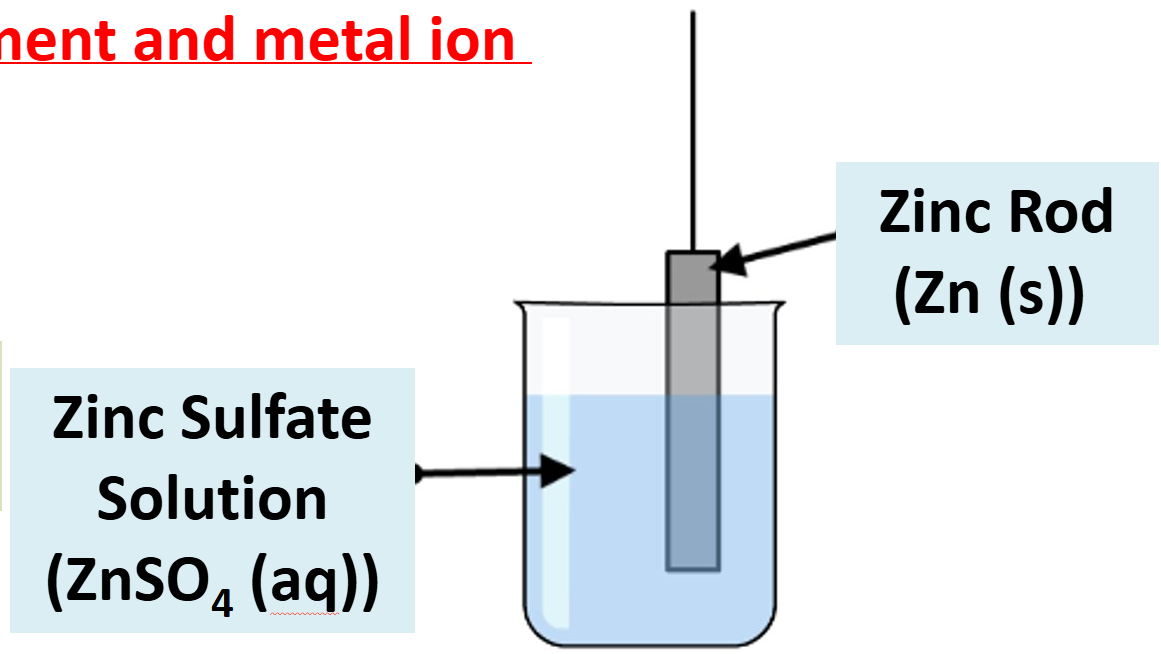
types of half cells 1) METAL/METAL ION (draw)
metal element placed in an aqueous solution of its ions
e.g. Zn2+(aq) + 2e- ⇌ Zn(s)
forward = reduction, backward = oxidation
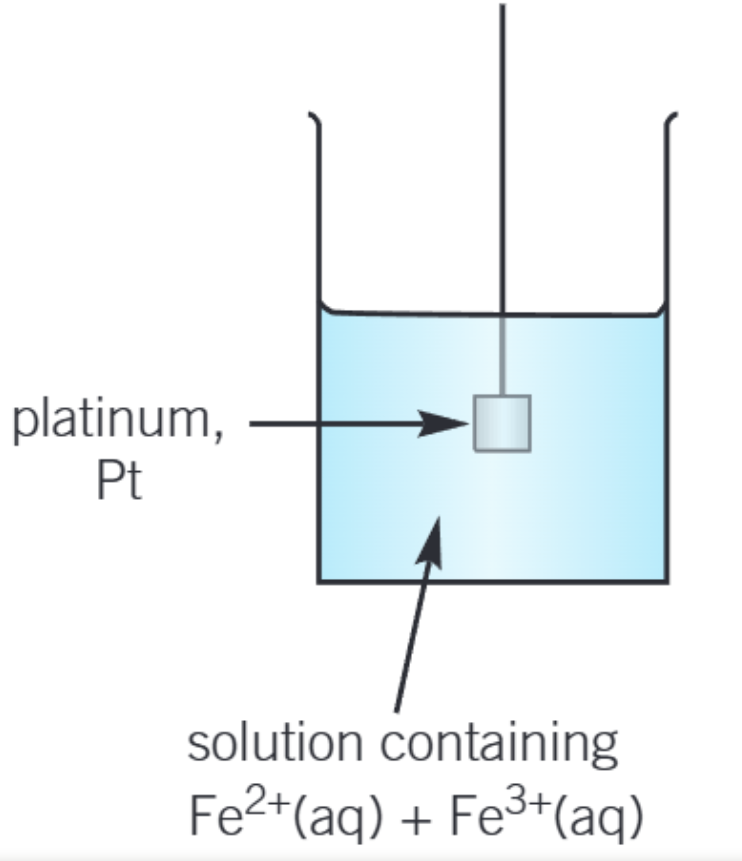
types of half cells 2) METAL ION/METAL ION (draw)
ions of the same element in different oxidation states
-consists of solution with same concentration of each ion, inert platinum electrode
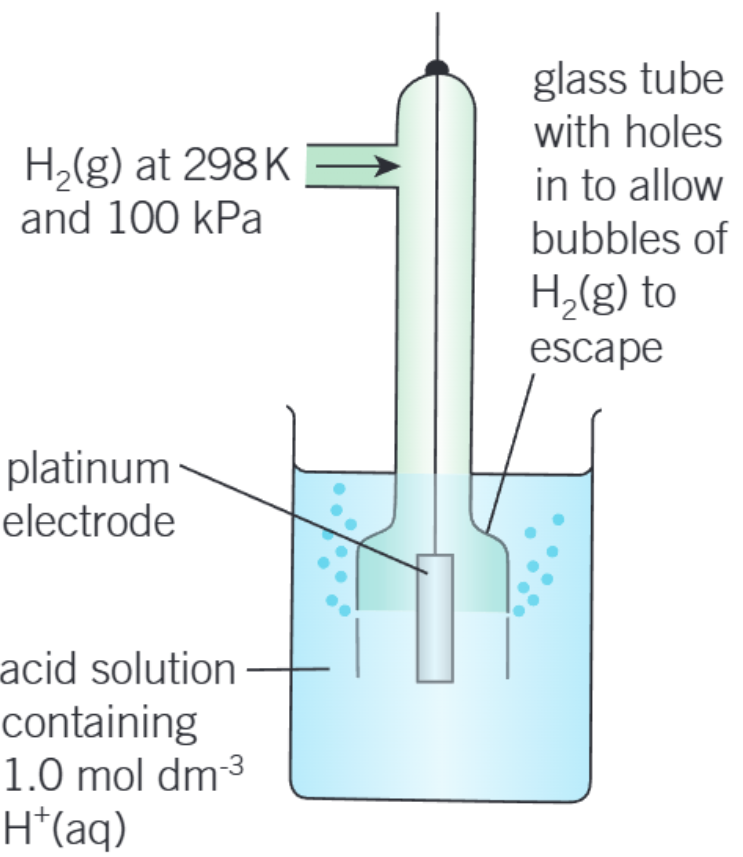
types of half cells 3) NON-METAL/NON-METAL ION (draw) = hydrogen half cell
standard cell made up of:
-1 mol dm-3 HCl acid
-H2 gas at 100kPa pressure
-temperature of 298K
-inert platinum electrode
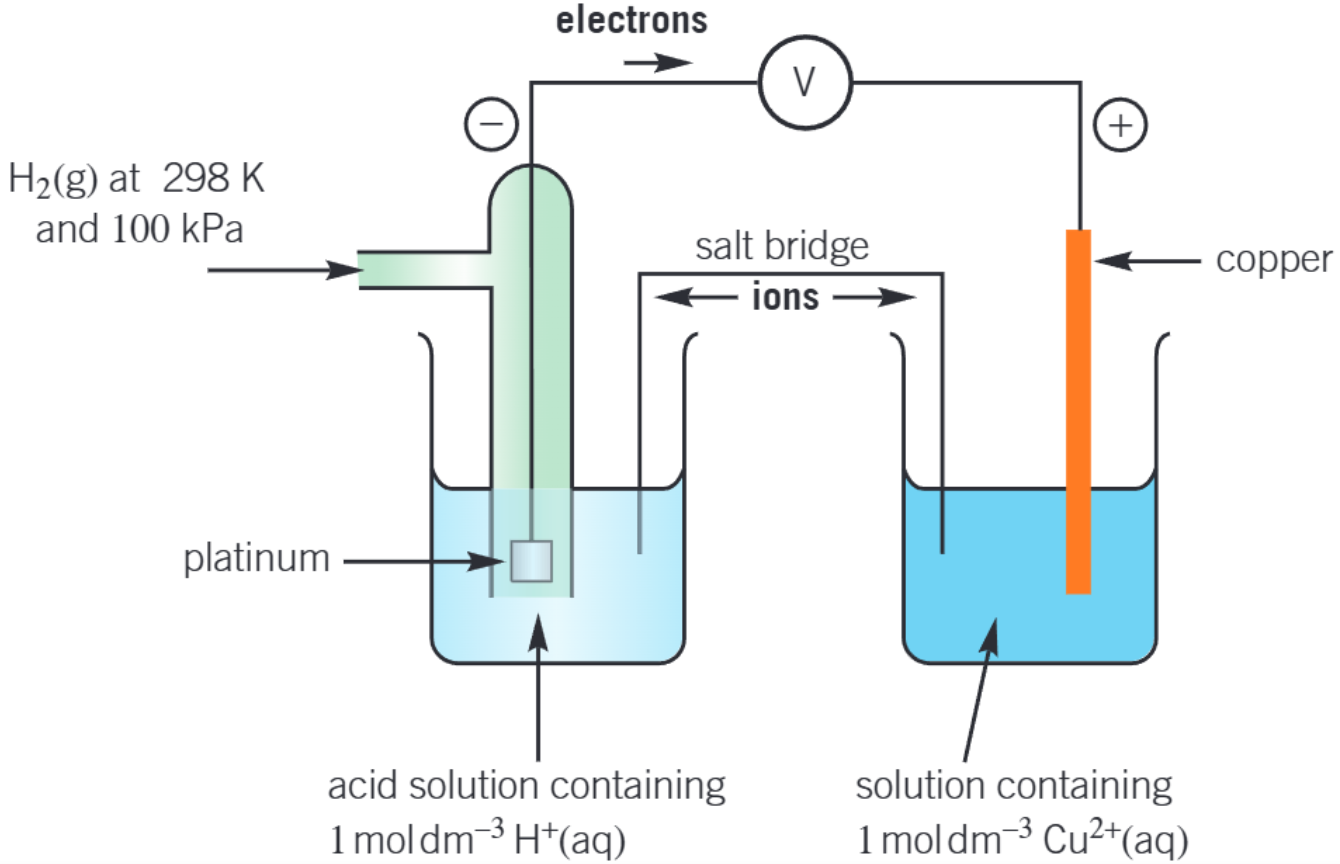
electrochemical cells structure (DRAW)
two half cells connected together
-electrodes connected by a wire from voltage source = voltmeter allows flow of electrons carrying charge
-has salt bridge between = connects solutions together so charge of ions can be transferred between half cells
standard electrode potential Eo
the emf (electromotive force) of a half cell compared with a standard hydrogen cell (0V) measured at 298K with solution concentration of 1mol dm-3 and gas pressure of 100kPa
electrode potential value
if more positive E value, is a stronger oxidising agent so is reduced
-need to talk about equilibrium shifting - redox system with more positive E value will have equilibrium shift to the right
VICE VERSA for more negative
calculating Eo of a cell
Eo (more positive) - Eo (more negative)
if Eo is positive then reaction is feasible
reasons why redox reactions may not occur even if feasible from Eo value
-activation energy is too high so rate of reaction is too slow
-reaction does not occur under standard conditions
-reaction does not occur under aqueous conditions
-standard cell potential is too small → Eo < 0.4V
types of electrochemical cells 1) non-rechargeable cells
provide electrical energy until all chemicals have reacted = only one use
-used in low current, long storage devices
types of electrochemical cells 2) rechargeable cells
provide electrical energy until all chemicals have reacted but can be regenerated when recharged = flow of electrons reversed so reactions will be reversed
common types: Ni + Cd batteries, Li ion batteries → portable/light density but are unstable at high temps
types of electrochemical cells 3) fuel cells
converts chemical energy to electrical energy where the fuel reacts with oxygen to give electrical energy
-however fuel + oxygen must be continuously supplied
EXAMPLE of fuel cell = hydrogen fuel cell
overall equation = ½O2 + H2 → H2O = +1.23V
alkaline: ox = H2 + 2OH- → 2H2O +2e- , re = ½O2 + H2O + 2e- → 2OH-
acidic: ox = H2 → 2H+ + 2e- , re = ½ O2 + 2H+ + 2e- → H2O
advantages of using methanol fuel cell over hydrogen
-less volatile
-easier to store + transport
-can be sourced from renewable sources e,g, biomass