module 1: role of vessels & platelets
 Call Kai
 Learn
Learn Practice Test
 Spaced Repetition
 Match
Match Flashcards
 Knowt Play
1/33

Earn XP
Description and Tags
status: unfinished
Name | Mastery | Learn | Test | Matching | Spaced | Call with Kai |
|---|
No analytics yet
Send a link to your students to track their progress
34 Terms
hemostasis
the process by which the body stops bleeding, prevents spontaneous bleeding, and maintains blood in fluid state (bleeding vs. clotting)
triad of hemostasis
vasculature (blood vessels), platelets, & coagulation proteins. all 3 must function normally or one will bleed or clot
tunica adventitia (tunica externa)
fibrous connective tissue. strength & support. provides strength to resist damage
tunica media
smooth muscle, elastic fibers. contraction/dilation
tunica intima (tunica interna)
endothelium
what are the 3 primary roles in hemostasis?
vascular integrity, reduce blood loss upon vascular injury, activate platelets (2nd arm) & clotting proteins (3rd)
role of vascular integrity
prevent blood loss from intact vessels. tunica externa provides strength to resist damage. clotting initiated upon vascular damage. platelets nurture endothelium: natural endothelial death & sloughing of dead endothelial cells, platelets replace lost endothelial cells, release PDGF to produce new endothelial cells
role of blood loss upon vascular injury
vasoconstriction. diversion of blood flow around damaged vessel
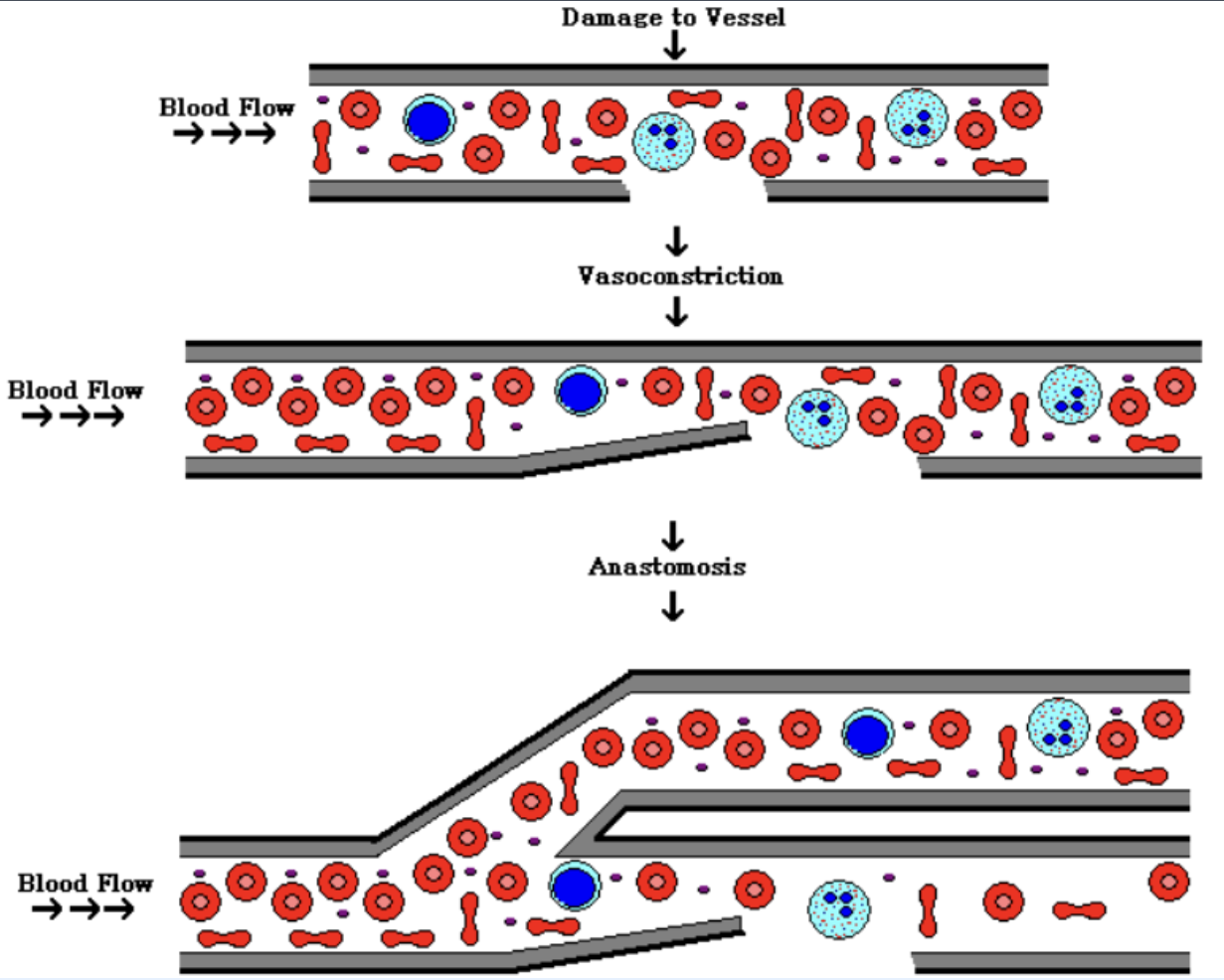
role of activating platelets (2nd arm) & clotting proteins (3rd)
initiation of platelet plug formation. activation of the coagulation factors (cascade)
peripheral zone (external surface)
one of the 3 layers of platelet ultrastructure. consists of glycocalyx, plasma membrane, and open canalicular system (OCS).
glycocalyx
outer membrane (glycolipids & glucoproteins). holds surface antigens (ABO) & receptors
plasma membrane
provides containment for the cytoplasm
open canalicular system (OCS)
tubular invaginations of the plasma membrane
sol-gel zone (sub-membranous)
one of the 3 layers of platelet ultrastructure. consists of circumferential microtubules & microfilaments
circumferential microtubules
organized bundles of contractile proteins (actin/myosin). maintains discoid shape & changes shape upon aggregation. circumferentially located
microfilaments
unorganized contractile proteins. connects ends of plasma membrane
organelle zone (cytoplasmic)
one of the 3 layers of platelet ultrastructure. consists of mitochondria, dense tubular system (DTS), granules, peroxisomes, & lysosomes
dense tubular system (DTS)
stores calcium. site for protein synthesis (like ER). prostglandin synthesis
alpha granules
20-200/platelets. coagulation factors, coagulation inhibitors, heparin inhibitors, platelet effectors, vessel repair, fibroblast effectors, albumin
coagulation factors
V, XIII, fibrinogen, XII
coagulation inhibitors
PAI-1 (inhibits TPA), protein S (inhibits clotting)
heparin inhibitors
platelet factor 4 (PF4)
platelet effectors
von willebrand factor (platelet adhesion)
vessel repair
thrombospondin (anti-angiogenic), beta-thromboglobulin, PDGF & FGF
fibroblast effectors
beta-thromboglobulin (fibroblast chemokine), platelet derived growth factor (fibroblast growth factor)
albumin
abundant blood protein (carrier)
dense granules
2-10/platelets. platelet activation: ADP, calcium, serotonin, epinephrine. energy source: ATP.
factor i (fibrinogen)
3 globular domains connected by polypeptides. 3 individual polypeptide chains: alpha, beta, gamma. 4 fibrinopeptides: 2 alpha, 2 beta, amino termini of both pairs of chains. synthesized in liver. 200-400 mg/dL. substrate
maintenance of vascular integrity
platelets nurture endothelium. replace endothelial cells that die. stimulate fibroblast (FGF). endothelial cell division (PDGF)
platelet plug formation (2nd arm)
adhesion
aggregation
secretion (release reaction)
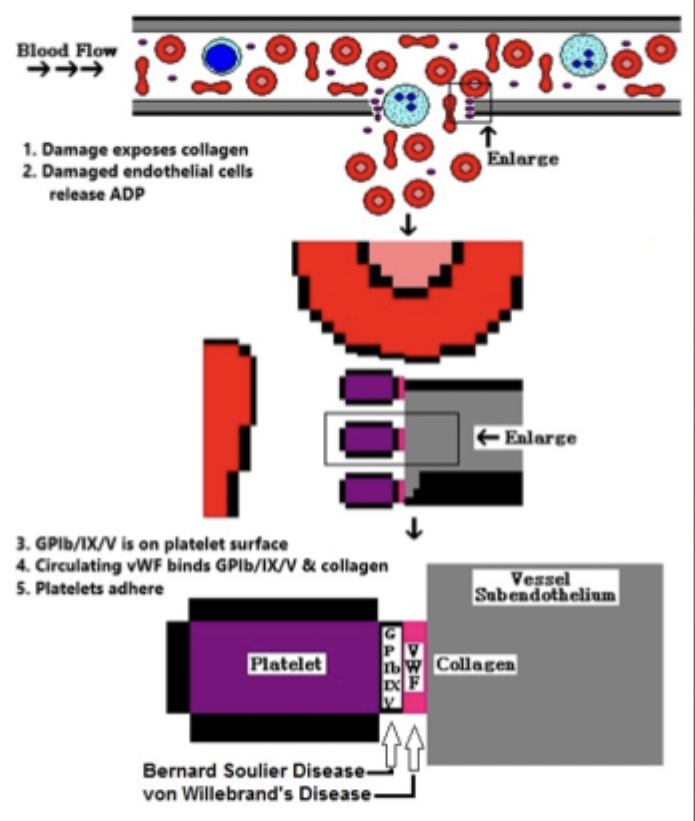
adhesion
platelets binding to damaged subendothelium. synthesis of TXA2 on DTS. activation of microtubules & microfilaments: plts change shape.
vWF functions in all vessels (arteries). plts bind collagen via GPIa/IIa & GPVI. plts bind a few hours, release, repeat. plts secrete FGF & PDGF to stimulate fibroblasts & endothelial cell growth
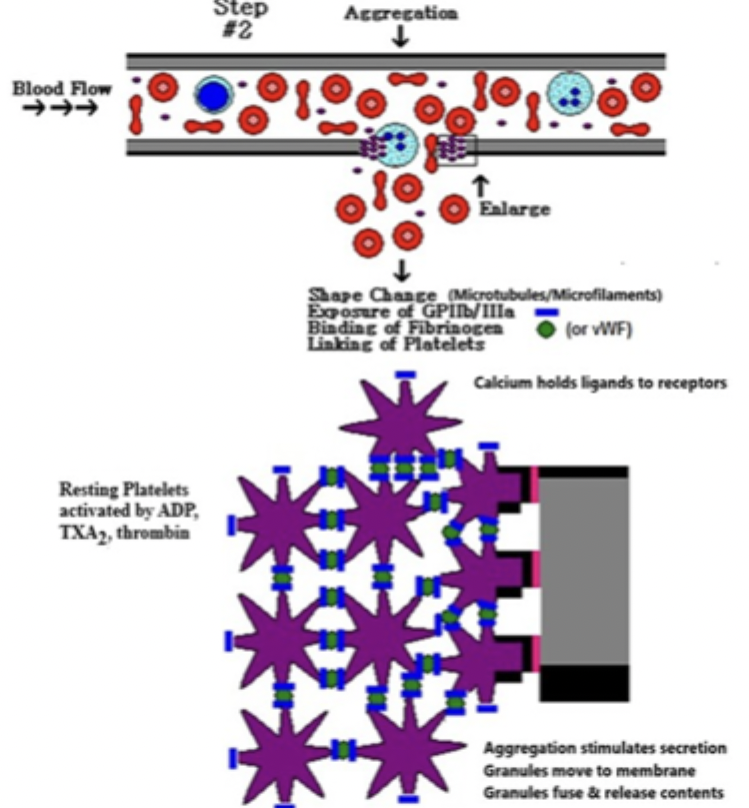
aggregation
platelets binding to adherent platelets
secretion (release reaction)
release of intracellular mediators that amplify aggregation
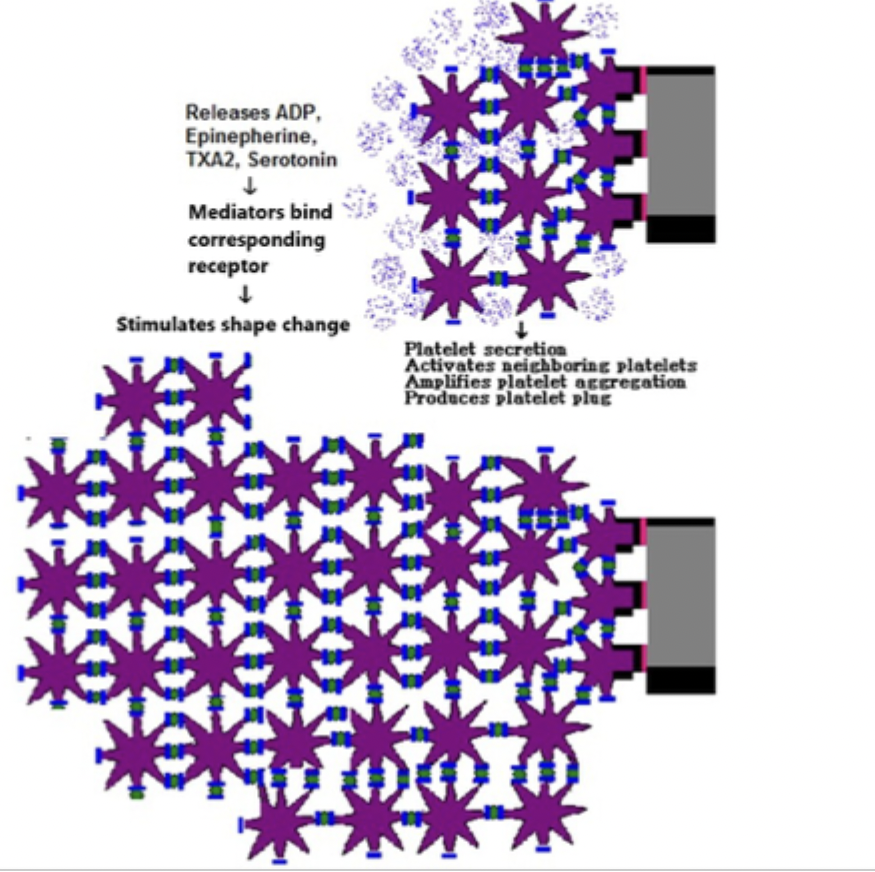
stabilization of platelet plug
plt plug unstable alone: would wash away from blood flow, dislodged from abrasion. requires coagulation proteins to stabilize