Environmental Microbiology - Exam 2
0.0(0)
 Studied by 1 person
 Call Kai
 Learn
Learn Practice Test
 Spaced Repetition
 Match
Match Flashcards
 Knowt Play
Card Sorting
1/161

Earn XP
Description and Tags
Last updated 7:54 PM on 3/6/23
Name | Mastery | Learn | Test | Matching | Spaced | Call with Kai |
|---|
No analytics yet
Send a link to your students to track their progress
162 Terms
1
New cards
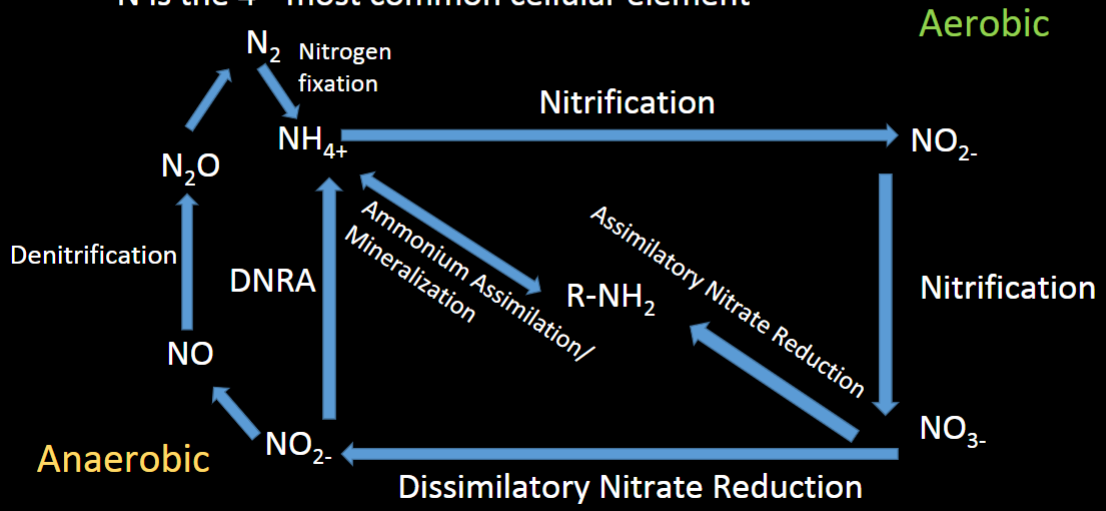
Nitrogen Cycle
process by which nitrogen moves through atmospheric, terrestrial, and marine ecosystems
2
New cards
Nitrogen Reservoirs
Largest: N2 Gas
Smallest: Earth’s crust
Smallest: Earth’s crust
3
New cards
Nitrogen Fixation
the conversion of atmospheric N2 gas to ammonia, energy intensive, 2/3 of all fixed nitrogen is performed by microbes
4
New cards
Ammonification
release of ammonia from dead or decaying cells \n Reverse process of assimilation \n Also called mineralization
5
New cards
Ammonium Assimilation
Two possible pathways: \n • High concentrations \n • Ammonium is reversibly incorporated into glutamate (amino acid) \n • Lower concentrations \n • Energy-dependent pathway involving the enzymes glutamine \n synthase and glutamate synthase \n • Most common pathway in soil and aquatic environments where \n NH4+ concentrations are generally low.
6
New cards
Assimilation
incorporation into cellular biomass
7
New cards
Mineralization
release from cellular biomass
8
New cards
Nitrification
Oxidation of ammonium to nitrate
Predominantly aerobic, chemoautotrophic
2 Step process:
Oxidizes NH4+ to NO2- (Nitrosomonas)
Oxidizes NO2- to NO3- (Nitrobacter)
Predominantly aerobic, chemoautotrophic
2 Step process:
Oxidizes NH4+ to NO2- (Nitrosomonas)
Oxidizes NO2- to NO3- (Nitrobacter)
9
New cards
Anammox
Anaerobic ammonium oxidation
Uses nitrite as the terminal electron acceptor
Produces Nitrogen gas
NH4+ + NO2- → N2 + NO3-
Responsible for 30 to 50% of N loss in oceans
Uses nitrite as the terminal electron acceptor
Produces Nitrogen gas
NH4+ + NO2- → N2 + NO3-
Responsible for 30 to 50% of N loss in oceans
10
New cards
Assimilatory nitrate reduction
Reduction of NO3 to NH4 to incorporate into \n biomass
11
New cards
\n Dissimilatory nitrate reduction to ammonium (DNRA)
oxidation of organics
12
New cards
Denitrification
Reduction of NO3 to N2
13
New cards
nitrate reductase
NO3 to NO2
14
New cards
nitrite reductase
NO2 to NO
15
New cards
nitric oxide reductase
NO to N2O
16
New cards
nitrous oxide reductase
N2O to N2
17
New cards
Sulfur Cycle
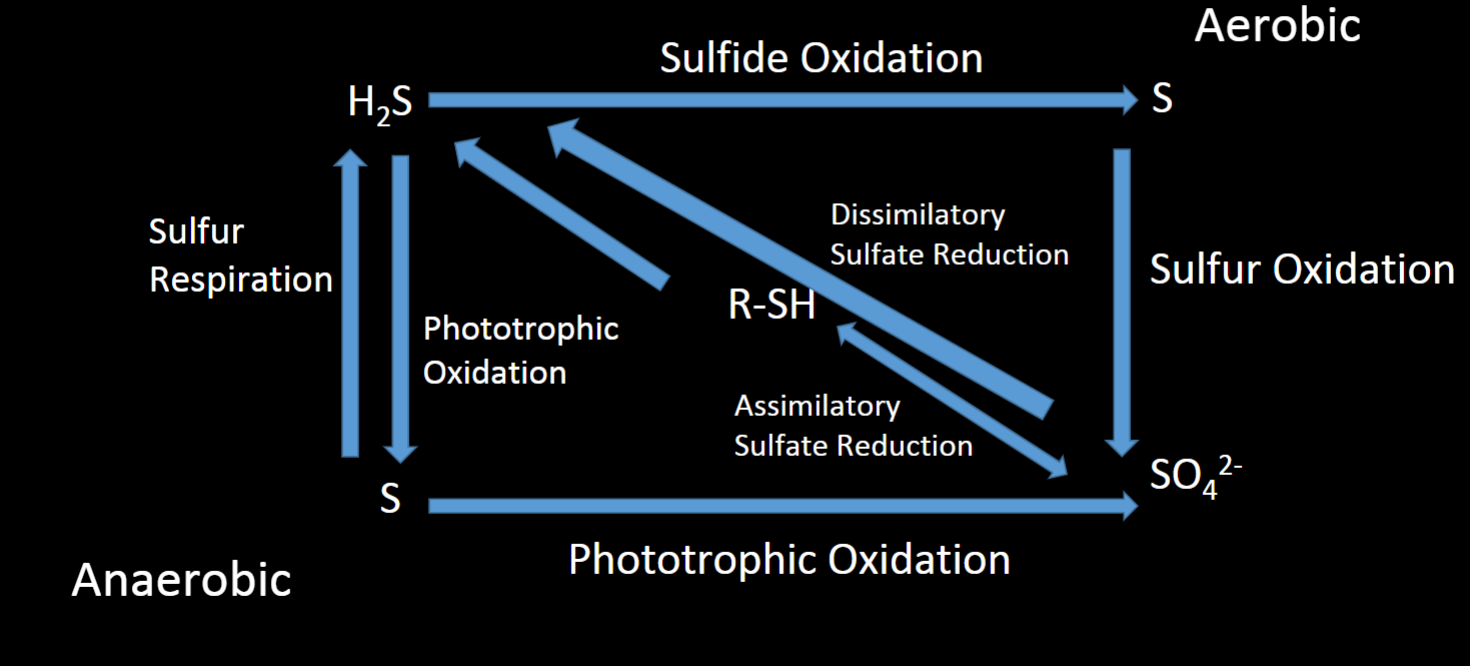
Not usually a limiting nutrient but still important!
Comprises 1% of bacterial biomass
Component of amino acids, coenzymes, hormones, and vitamins
Cycled between oxidized state (sulfate) and reduced state (sulfide)
Comprises 1% of bacterial biomass
Component of amino acids, coenzymes, hormones, and vitamins
Cycled between oxidized state (sulfate) and reduced state (sulfide)
18
New cards
Sulfur Reservoirs
Largest reservoir is the Earth’s crust
Released through volcanic activity
Human influences: fossil fuels, strip mining
Oceans are most significant reservoir of sulfate
Released through volcanic activity
Human influences: fossil fuels, strip mining
Oceans are most significant reservoir of sulfate
19
New cards
Assimilatory Sulfate Reduction (ASR
Sulfur taken into the cell as SO42- and reduced to sulfide to incorporate into cells
Sulfate is most abundant form
Sulfide is toxic to cells
Sulfate is most abundant form
Sulfide is toxic to cells
20
New cards
Sulfur mineralization
Release of sulfur from organic molecules
Serine sulfhydrylase: Removes sulfide from cysteine Cysteine sulfhydrylase: Removes sulfide and ammonia from cysteine
Serine sulfhydrylase: Removes sulfide from cysteine Cysteine sulfhydrylase: Removes sulfide and ammonia from cysteine
21
New cards
Chemoautotrophic sulfur oxidation
Sulfide oxidized to sulfur
Deposited in granules
H2S + 1/2O2 → S0 + H2O
Energy used to fix CO2
Microaerophilic
Some chemoautotrophs can oxidize elemental sulfur to sulfate
Deposited in granules
H2S + 1/2O2 → S0 + H2O
Energy used to fix CO2
Microaerophilic
Some chemoautotrophs can oxidize elemental sulfur to sulfate
22
New cards
Photoautotrophic Sulfur Oxidation
green and purple sulfur bacteria
Fix C with light energy
But oxidize H2S to S0 instead of H2O to O2
Small contribution to primary production BUT important to the sulfur cycle
Remove sulfide
Fix C with light energy
But oxidize H2S to S0 instead of H2O to O2
Small contribution to primary production BUT important to the sulfur cycle
Remove sulfide
23
New cards
What are the three types of sulfur reduction?
Assimilate sulfate into cells
Sulfur respiration
Dissimilatory sulfate reduction
Sulfur respiration
Dissimilatory sulfate reduction
24
New cards
Assimilate sulfate into cells
both aerobic and anaerobic
25
New cards
Sulfur Respiration
Sulfur (S0) used as terminal electron acceptor
Anaerobic
Not important environmentally
Anaerobic
Not important environmentally
26
New cards
Dissimilatory sulfate reduction
Sulfate as terminal electron acceptor
Produces sulfide
Produces sulfide
27
New cards
Marine phototrophs in the spring
surface water bloom of eukaryotic algae, actinobacteria and Alphaproteobacteria
28
New cards
Marine phototrophs in the summer
stratification patterns feature *Pelagibacteria,* Gammaproteobacteria
29
New cards
Marine phototrophs in deep stable community
*Pelagibacteria,* Deltaproteobacteria*,* Chloroflexi*, Fibrobacter*
30
New cards
What are some other important phototrophs?
*Prasinophyceae - eukaryote,* Some of the smallest known eukaryotic cells, 1 chloroplast and 1 mitochondrion per cell
*Ostreococcus-* 0.8 um diameter, equivalent size of *Pro*, but 7x the genome size
*Micromonas -* Swims toward light, Tolerates wide range of temperatures
*Bathycoccus -* Nonmotile
*Ostreococcus-* 0.8 um diameter, equivalent size of *Pro*, but 7x the genome size
*Micromonas -* Swims toward light, Tolerates wide range of temperatures
*Bathycoccus -* Nonmotile
31
New cards
What are the three types of planktonic microbes?
phytoplankton: primary producers
zooplankton: larger heterotrophic bacteria
bacterioplankton: microbial populations
zooplankton: larger heterotrophic bacteria
bacterioplankton: microbial populations
32
New cards
Planktonic Food Web
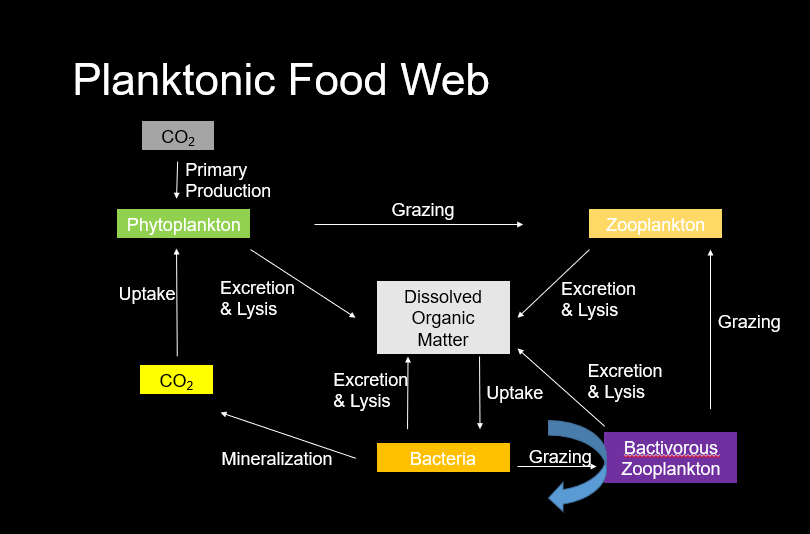
50% of global primary production is aquatic
33
New cards
What is the planktonic food web dependent upon?
inorganic nutrient availability
water temperature
turbidity
water temperature
turbidity
34
New cards
What is the viral shunt?
mechanism that prevents organic matter from moving up trophic levels by turning it into dissolved organic material
35
New cards
What is the microbial loop?
trophic pathway where dissolved organic carbon is returned to higher trophic levels via its incorporation into bacterial biomass
36
New cards
Where can heterotrophs be found in lake ecosystems?
Neuston layer
Thermocline
Upper layer of the benthos (bottom)
Thermocline
Upper layer of the benthos (bottom)
37
New cards
What is GOS?
Global Ocean Sampling
Expedition where they sailed all over the world collecting samples in order to assess genetic diversity in marine microbial communities and their role in nature.
Expedition where they sailed all over the world collecting samples in order to assess genetic diversity in marine microbial communities and their role in nature.
38
New cards
What are the major components of soil?
Inorganic mineral material (40%)
Organic matter (5%)
Air and water (50%)
Microbes and macro-organisms (5%)
Organic matter (5%)
Air and water (50%)
Microbes and macro-organisms (5%)
39
New cards
Why is *Trichodesmium* important in the open ocean? What is unique about its physiology?
important for sustaining marine life via release of nitrogen and carbon
It has the ability to fix nitrogen during the day without heterocysts.
It has the ability to fix nitrogen during the day without heterocysts.
40
New cards
Why is the genus *Pelagibacter* important?
Most cells in marine environments are Pelagibacter
Total population size of 2.4 x 1028 cells
Total population size of 2.4 x 1028 cells
41
New cards
What are the different layers of a freshwater system?
* Littoral Zone
* Limnetic Zone
* Profundal Zone
* Benthic Zone
* Limnetic Zone
* Profundal Zone
* Benthic Zone
42
New cards
Littoral Zone
* top, near-shore layer of a lake
* shallow
* plenty of sunlight and nutrients
* supports wide variety of plants and animals
* shallow
* plenty of sunlight and nutrients
* supports wide variety of plants and animals
43
New cards
Limnetic Zone
* lake’s sunlit surface layer
* where most photosynthesis takes place
* supports phytoplankton and zooplankton, along with freshwater fish
* where most photosynthesis takes place
* supports phytoplankton and zooplankton, along with freshwater fish
44
New cards
Profundal Zone
* lake’s deep, open-water layer
* too dark for photosynthesis
* water is cooler and contains less dissolved oxygen
* supports fish adapted to these cooler waters
* too dark for photosynthesis
* water is cooler and contains less dissolved oxygen
* supports fish adapted to these cooler waters
45
New cards
Benthic Zone
* soil and soil organisms that live at the bottom of a lake
* inhabited mostly by decomposers and other organisms that feed on dead and decaying material
* can withstand a low-oxygen environment.
* inhabited mostly by decomposers and other organisms that feed on dead and decaying material
* can withstand a low-oxygen environment.
46
New cards
What drives stratification in lakes?
Stratification is driven by temperature or salinity.
47
New cards
What is the thermocline?
middle layer characterized by a steady drop in water temperature, that prevents water mixing between the epilimnion and hypolimnion. Where this layer begins is dependent on the how far down into the water the sun’s rays reach
48
New cards
What is the Epilimnion?
less dense layer of warmer water, that is readily mixed by wind. Oxygen producing plants and algae typically live in this zone
49
New cards
What is the Hypolimnion?
This is the bottom, denser layer of cold water. Low light levels in the hypolimnion prevent growth of aquatic plants and algae.
50
New cards
polymictic mixing pattern
Mix several times per year
51
New cards
amictic mixing pattern
never mixes
52
New cards
monomictic mixing pattern
mixes once per year
53
New cards
Dimitic mixing pattern
mixes 2x per year
54
New cards
Why of all the Great Lakes is Lake Erie the most susceptible to harmful algal blooms?
Because of all the runoff pollution
55
New cards
Ocean Depth
Average Depth: 4000 m
Deepest: 11,000 m
Sediment thickness ranges from 0 m to 2000 m
Deepest: 11,000 m
Sediment thickness ranges from 0 m to 2000 m
56
New cards
The Photic Zone
0 - 200 m
majority of primary prodution
nutrient (N, Fe, P) limitation
majority of primary prodution
nutrient (N, Fe, P) limitation
57
New cards
The Mesopelagic Zone
200 - 1000 m
Only \~20% of Photic Zone 1° Prod. Transfers
Only \~20% of Photic Zone 1° Prod. Transfers
58
New cards
The Bathypelagic Zone
1000 - 4000m
no sunlight penetration
5% of Photic Zone 1° Prod. Transfers \n Pressure reaches 5,850 lbs/sq. inch
no sunlight penetration
5% of Photic Zone 1° Prod. Transfers \n Pressure reaches 5,850 lbs/sq. inch
59
New cards
The Abyssopelagic Zone
4,000 to 6,000 \n 75% of ocean floor
60
New cards
The Hadalpelagic Zone
6000 - 11000 m
4 successful manned dives
4 successful manned dives
61
New cards
Why are marine phototrophs important?
They generate energy and reduce carbon dioxide, providing the system with organic substrates and oxygen.
62
New cards
What limits the growth of marine phototrophs in the ocean?
•Inorganic nutrients (P, N, Fe)
•Temperatures
•Temperatures
63
New cards
What is the most abundant marine phototroph and how do scientists differentiate between the different “types?”
The most abundant marine phototroph is Prochlorococcus. Scientists differentiate between different ecotypes by temperature tolerance and what inorganic nutrients they use
64
New cards
What are high light ecotypes?
•Dominant in upper layer of stratified waters
•Found all over the world
•Found all over the world
65
New cards
What are low light ecotypes?
•Dominant in lower layer of stratified waters
66
New cards
What is a Whale Fall?
Whale carcass sinks to ocean floor (acts as a large carbon source)
67
New cards
What are the stages of a whale fall?
Mobile Scavenger Stage
Enrichment opportunist stage
Chemoautotrophic stage
Enrichment opportunist stage
Chemoautotrophic stage
68
New cards
Chemoautotrophic Stage
•Large and diverse assemblage lives in sulphides released from microbial breakdown of oil in bones
•Can last for decades
•Can last for decades
69
New cards
enrichment opportunist stage
•Sediments around the carcass colonized by invertebrates
•DENSE
•DENSE
70
New cards
mobile scavenger stage
•Deep sea scavengers remove soft tissue
•4 mos. to 1.5 years
•4 mos. to 1.5 years
71
New cards
How does soil formation happen?
1. Algae, lichens, mosses on exposed rock
2. Chemoorganotrophs produce CO2
3. Carbonic acid dissolves rock
4. Plant excretions promote microbial growth in rhizosphere
5. Decaying plants contribute to organic material
6. Soil profile forms
72
New cards
Where do we find hyperthermophilic bacteria?
In high temperature environments (>80C)
73
New cards
How do their adaptations to living in high heat environments differ from the other hyperthermophiles we have discussed this semester?
•Production of chaperonins
•Increased number of disulfide bridges
•Increased interactions among aromatic peptides
•Increased hydrogen bonding among peptides
•DNA gyrase
•Increased number of disulfide bridges
•Increased interactions among aromatic peptides
•Increased hydrogen bonding among peptides
•DNA gyrase
74
New cards
What is White Nose Syndrome?
Disease caused by Pseudogymnoascus destructans.
Causes abnormal active behavior, leads to loss of fat, wing damage, death
Causes abnormal active behavior, leads to loss of fat, wing damage, death
75
New cards
How does the organism infect/kill the host?
* Infects bats during winter hibernation
* invades and ingests the skin of hibernating bats, including their wings.
* invades and ingests the skin of hibernating bats, including their wings.
76
New cards
What are possible treatments for WNS?
•Cooling the hibernacula
•Probiotics (Bacterial and Fungal)
•Probiotics (Bacterial and Fungal)
77
New cards
How does primary production occur in cave systems?
•As gases: CO2, N2, aromatic hydrocarbons
•Hydrocarbons from soils that percolate down via surface water
•Reduced metal ions derived from the cave rock (Mn II and Fe II, etc)
•Hydrocarbons from soils that percolate down via surface water
•Reduced metal ions derived from the cave rock (Mn II and Fe II, etc)
78
New cards
Why would NASA be interested in funding cave microbiology?
Because cave microbiology may give insight as to terrestrial life on other planets.
79
New cards
When researchers set out to make a drill to reach an under-ice briny lake that had been closed off for up to 2 million years, what were the important considerations they had to make to ensure they were preserving the pristine ecosystem?
* Only drills downward- will get trapped when ice behind refreezes
* Can’t penetrate dust or dirt due to friction issues
* Can’t penetrate dust or dirt due to friction issues
80
New cards
Why is Blood Falls red?
The lake is highly saline and rich in iron, when the iron in the water reacts with oxygen it gets it’s red color.
81
New cards
How is Antarctica considered a desert when it’s covered in ice?
Low rainfall
82
New cards
What are the McMurdo Dry Valleys and why are they important for Antarctic science?
Snow free valleys in Antarctica, only permanent ice covered lakes on earth,
Leads to reduced mixing, light penetration, gas exchange, sediment deposition.
Considered to be the closest thing to terrestrial life on mars which could give insight into extraterrestrial life
Leads to reduced mixing, light penetration, gas exchange, sediment deposition.
Considered to be the closest thing to terrestrial life on mars which could give insight into extraterrestrial life
83
New cards
What is the role of cyanobacteria in Antarctic/Arctic ecosystems?
•Nitrogen cycling
•Carbon fixation
•Toxin production
•Carbon fixation
•Toxin production
84
New cards
Be able to give an example of a bacterium isolated from an extreme cold environment.
*Psychromonas antarcticus*
*Desulfotalea psychrophila*
*Thiomicrospira arctica* - sulfur oxidizer, Chemolithoautotroph, isolated off coast of Svalbard, important role in primary production (new organic C without sunlight)
*Desulfotalea psychrophila*
*Thiomicrospira arctica* - sulfur oxidizer, Chemolithoautotroph, isolated off coast of Svalbard, important role in primary production (new organic C without sunlight)
85
New cards
*Thiomicrospira arctica*
* sulfur oxidizer
* Chemolithoautotroph
* isolated off coast of Svalbard
* important role in primary production (new organic C without sunlight)
* Chemolithoautotroph
* isolated off coast of Svalbard
* important role in primary production (new organic C without sunlight)
86
New cards
*Desulfotalea psychrophila*
* *isolated from sediments samples in Svalbard*
* *chemoorganotroph*
* *chemoorganotroph*
87
New cards
*Psychromonas antarcticus*
* *aerotolerant*
* *isolated from high salt pond*
* *isolated from high salt pond*
88
New cards
What is watermelon snow? What organism is responsible for the phenomenon?
Watermelon snow is green alga that can grow in the snow, it gets it’s name from the red pigment it has.
*Chlamydomonas nivalis is responsible*
*Chlamydomonas nivalis is responsible*
89
New cards
What are some physiological adaptations microbes employ to survive extreme cold conditions?
enzyme adaptations, cytoplasmic membrane adaptations, and cold shock proteins
90
New cards
What are examples of enzyme adaptations for surviving in extreme cold temps?
•α-helices vs. β-sheets
•Polar vs. hydrophobic amino acids
•Fewer weak bonds
•Polar vs. hydrophobic amino acids
•Fewer weak bonds
91
New cards
What are examples of cytoplasmic membrane adaptations for surviving in extreme cold temps?
Higher unsaturated and short-chain fatty acid content
92
New cards
What are examples of cold shock protein adaptations for surviving in extreme cold temps?
•Cryoprotectants- antifreeze proteins or solutes (glycerol)
•Cold shock proteins- bind to mRNA to lead to translation
•Cold shock proteins- bind to mRNA to lead to translation
93
New cards
What a psychrophile?
maximum temperature for growth at 20 degrees C or below and are restricted to permanently cold habitats.
94
New cards
What is a psychrotroph?
maximum temperature for growth above 20 degrees C, widespread in natural environments
95
New cards
What are the conditions in the atmosphere that impact microbial growth?
Relative humidity, temperature, radiation, oxygen
96
New cards
What organism is known to be able to withstand high levels of radiation without mutating? How can it do this?
*Deinococcus radiodurans*
Its genome structure (2 chromosomes, 2 plasmids) could be the reason why it can withstand radiation, has multiple gene copies on each.
Its genome structure (2 chromosomes, 2 plasmids) could be the reason why it can withstand radiation, has multiple gene copies on each.
97
New cards
What are the 4 phases of *Streptomyces* growth?
1. Spores germinate into vegetative hyphae
2. Grow as filaments- growth is at the tip
3. **Sporophores** form
4. **Sporophores** give rise to **conidia**
98
New cards
What are the metabolites that *Streptomyces* produce?
Antibiotics
99
New cards
How do bacteria and acintomycetes differ? Do they differ?
Acintomycetes are a type of bacteria but are unique enough to be their own group.
They are generally one to two orders of magnitude smaller than the total bacterial population
They are generally one to two orders of magnitude smaller than the total bacterial population
100
New cards
What are the different microbial life forms that make up soil communities? Understand how they break down in terms of abundance and role in soil communities.
Bacteria, Actinomycetes, Fungi, Algae, and Protozoa
 Note
Note  Flashcards (22)