AP Calculus Ch. 5 Vocab
 Studied by 15 people
 Call Kai
 Learn
Learn Practice Test
 Spaced Repetition
 Match
Match Flashcards
 Knowt Play
1/16

There's no tags or description
Looks like no tags are added yet.
Name | Mastery | Learn | Test | Matching | Spaced | Call with Kai |
|---|
No study sessions yet.
17 Terms
Absolute Extreme Values
Let f(x) be a function defined on an interval [a,b].
Absolute maximum value:
f(c) is an absolute maximum on [a,b] iff(c)≥f(x) for all x in [a,b].
Absolute minimum value:
f(c) is an absolute minimum on [a,b] iff(c)≤f(x) for all x in [a,b].
Antiderivative
A function F(x) is an antiderivative of a function f(x) if F’(x)=f(x) for all x in the domain of f
Concavity Test
Uses the second derivative of a function to determine whether the graph is concave up or concave down on an interval
Critical Point
A value x=c in the domain of f where either
f’(c) = 0
f’(c) does not exist
Decreasing Function
Let f be a function defined on an interval I. Then f decreases on I of, for any two points x1 and x2 in I,
x1 < x2 → f(x1) > f(x2)
Differential
If y=f(x) is a differentiable function, the differential dx is an independent variable and the differential dy is dy = f’(x) dx
The Extreme Value Theorem
If f is continuous on a closed interval [a, b], then f has both a maximum value and a minimum value on the interval
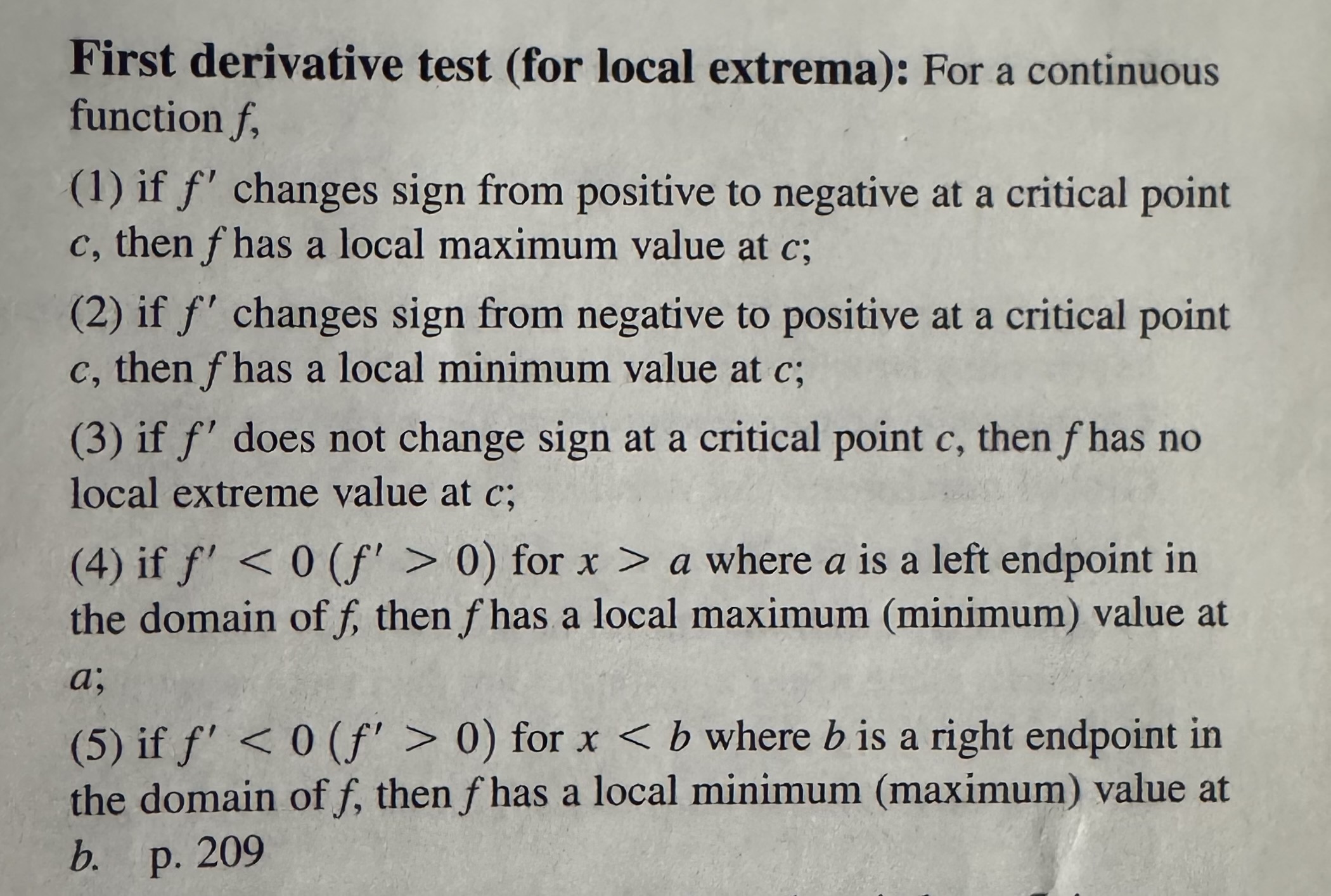
First Derivative Test
Increasing Function
Let f be a function defined on an interval I. Then f increases I if, for any two points x1 and x 2 in I,
x1 < x2 → f(x1) < f(x2)
Linearization
The approximating function L(x) = f(a) + f’(a)(x-a) when f is differentiable at x=a
Local Extreme Value Theorem
If a function f has a local maximum value or a local minimum value at an interior point c of its domain, and if f’ exists at c, then
f’(c) = 0
Maximum Profit
Maximum profit (if any) occurs at a production level at which marginal revenue equals marginal cost
Mean Value Theorem
If y = f(x) is continuous at every point of the closed interval [a, b] and differentiable at every point of its interior (a, b), then there is at least one point c in (a, b) at which
f’(c)= (f(b)-f(a)) / (b-a)
Newton’s Method (Formula)
xn+1 = xn - f(xn)/f’(xn)
Point of Inflection
A point where the graph of a function has a tangent line and the concavity changes
Second Derivative Test
If f’(c) = 0 and f’’(c) < 0, then f has a local maximum at x=c
If f’(c) = 0 and f’’(c) > 0, then f has a local minimum at x=c
Stationary Point
A point in the interior of the domain of a function f at which f’ = 0
 Note
Note  Flashcards (26)