Unit 8: Applications of Integration
Average Value of Functions
- Remember that to calculate the average we add everything up and then divide!
- The integral is the summation of everything, so we can use it to find the average of a function!
- The only thing we have to change is by dividing our integral!
- For example, if we had the interval 0 to 40, we can take the integral of our function and divide it by our interval! So it would be 1/40 * ∫f(x)
\n 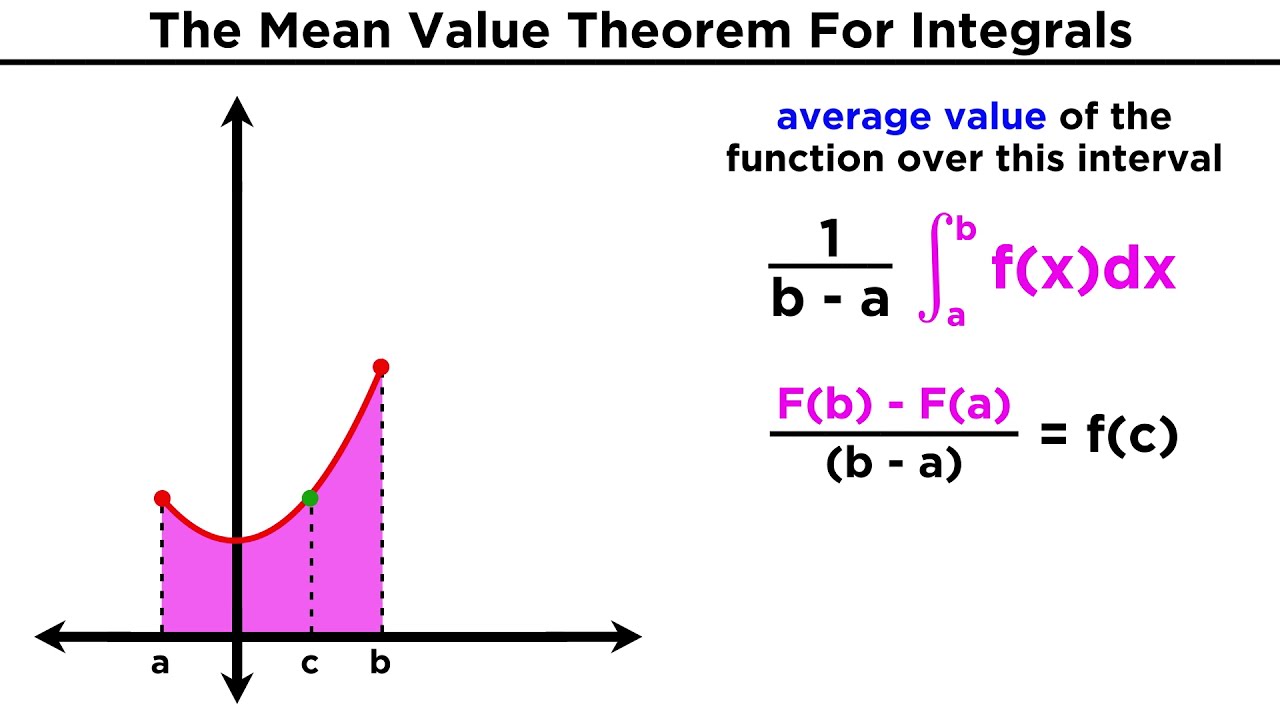
Position, Velocity, and Acceleration
- Similar to how we can go from position → velocity using the derivative, we can do the reverse using the integral!
| Displacement | ∫v(t) |
|---|---|
| Position | ∫|v(t)|(Absolute value) |
| Velocity | ∫a(t) |
- Remember that the FTC still applies, for example velocity will be equal to ∫a(t) from a to b which is: ∫a(t) = v(b) - v(a)
Area Between Two Curves
- The integral gives us the area below a function
- Therefore, we can subtract the area of one function and another to get the area between the two!
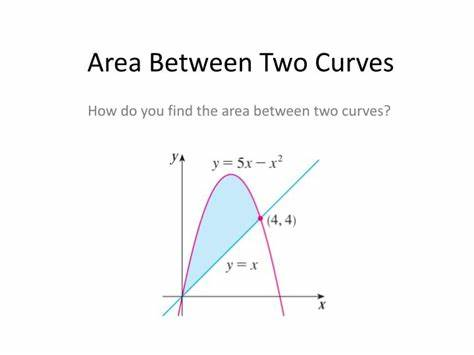
- Finding this area is pretty simple, all we have to do is integrate the top function & subtract the bottom function!
- We need to take the integral from where the functions start (normally zero) to where they intersect
- For the problem we would have ∫5x-x^2 from 0 to 4 - ∫x from 0 to 4
- Most all problems for area between two curves will be similar to this
Volume by Cross Sectional Area
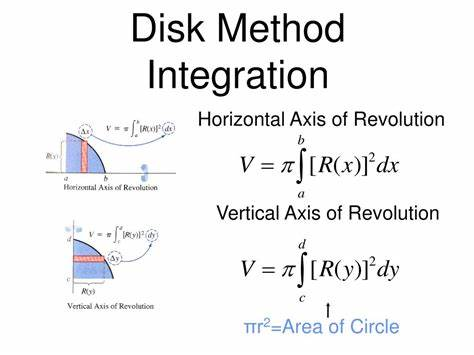
- We get a 2D shape from the area under a curve, if we rotate this shape → we get a 3D object
- To find the area we just integrate the volume formula!
- What is the formula for finding the volume of a shape using integrals?
To find the volume of a shape using integrals, we use the formula for the cross-sectional area (length times width) and multiply it by the height, which is represented by the variable "dx" in the integral. Therefore, the formula for the volume of a rectangular shape using integrals is:
V = ∫(length x width) dx
where V is the volume, and the integral is taken over the range of the height of the shape.
- That would give us the volume for a rectangle (because their area is just l * w)
- The majority of the time, when we are integrating a curve, we get discs or circles
- Therefore, we can almost always use the disc method to find our volume
- We know that the area of a circle is πr^2
- So using our integral we would have V = ∫πr^2
- You can combine this with area between two curves problems and have ∫πR^2 - ∫πr^2]