The cell #8 (pt 2: cell components - Plasma membrane)
 Studied by 0 people
 Call Kai
 Learn
Learn Practice Test
 Spaced Repetition
 Match
Match Flashcards
 Knowt Play
1/24

There's no tags or description
Looks like no tags are added yet.
Name | Mastery | Learn | Test | Matching | Spaced | Call with Kai |
|---|
No analytics yet
Send a link to your students to track their progress
25 Terms
Plasma membranes
Location: found on the outside of both prokaryote and eukaryote cells
found on the inside of eukaryotic cells as components of various organelles
Composition: Primarily made up of phospholipid bilayers
as well as steroids, carbohydrates, & proteins
Function: control what enters and what leaves the cell with its semi-permeable barrier btw the outside and inside of the cell
they sense and then tell the cell to responds to its environment
protect themselves and maintain their internal environment
generate electrochemical gradients
convert chemical or light energy to biological energy
they are found on the outside of both prokaryote and eukaryote cells & only on the inside of eukaryotic cells as components of organelles
Where are plasma membranes located?
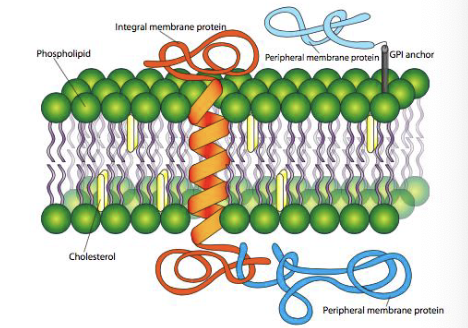
plasma membranes are primarily made up of phospholipid bilayers as well as some steroids, carbohydrates, and proteins
What are plasma membranes composed of?
Phospholipids
_______ naturally assemble into a fluid bilayer
hydrophilic heads on the outside
hydrophobic tails on the inside
individual molecules are constantly moving around (not locked in place)
by changing the fatty acid (hydrophobic) tails, the properties of the membrane can change
are mobile within the lipid bilayer

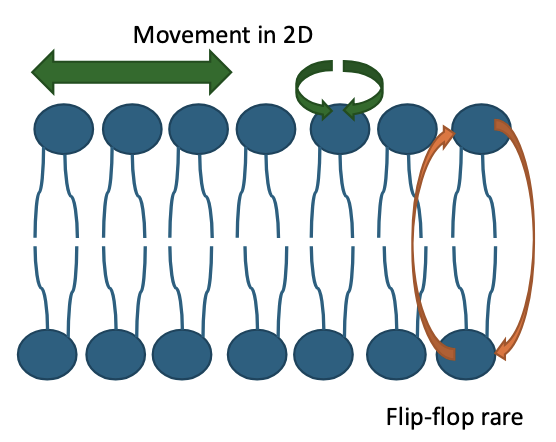
Phospholipids are mobile within the lipid bilayer: they turn on their axis, move laterally, and rarely flip across the membrane
Remember: Phospholipids are mobile within the lipid bilayer: they turn on their axis, move laterally, and rarely flip across the membrane
the membrane would be more fluid because the kinks in the unsaturated fatty acids would prevent them from packing closely together (too fluid = too permeable)
What would happen if a plasma membrane included mostly unsaturated fatty acids?
the membrane would be more solid (solid at room temp) because saturated fatty acids are able to pack tightly together
What would happen if a plasma membrane included mostly saturated fatty acids?
The steroid Cholesterol
within plasma membranes
amphipathic
Function: helps maintain the integrity of membranes by preventing them from becoming either too fluid or too rigid
Amphipathic means it has both hydrophobic and hydrophilic parts
What is the definition of Amphipathic:
cholesterol helps maintain the structural integrity of plasma membranes by preventing them from becoming either too fluid at high temperatures or too rigid at low temperatures
Function of the steroid cholesterol in plasma membranes:
Heating or cooling a phospholipid membrane will change its fluidity and ability to function correctly, so cells modify the biochemical components of their membranes to maintain optimal fluidity
Remember: Heating or cooling a phospholipid membrane will change its fluidity and ability to function correctly, so cells modify the biochemical components of their membranes to maintain optimal fluidity
increase the amount of unsaturated fatty acids, the amount of cholesterol, and the proportion of shorter-chain fatty acids, all of which will increase fluidity
In colder conditions what will the cell do to maintain optimal fluidity of the plasma membrane?
decrease the amount of unsaturated fatty acids, increase the amount of cholesterol, and the proportion of longer-chain fatty acids, all of which will decrease fluidity and increase solidity
In hotter conditions what will the cell do to maintain optimal fluidity of the plasma membrane?
Carbohydrates
within plasma membranes
Function: cell-to-cell recognition
act as “keys” fitting into matching protein “locks” on other cells to help cells recognize one another
Types:
Glycolipids- carbohydrates covalently bonded to lipids
Glycopeptides- carbohydrates covalently bonded to proteins
carbohydrates covalently bonded to proteins
Glycopeptides definition:
carbohydrates covalently bonded to lipids
Glycolipids definition:
Proteins
within plasma membranes
Functions:
Transporters
Receptors
Enzymes
ATP synthesis
Anchors
only Non-polar molecules can be exchanged through the membrane easily, and O2 and CO2 can only pass through freely when there is a concentration gradient
Remember: only Non-polar molecules can be exchanged through the membrane easily, and O2 and CO2 can only pass through freely when there is a concentration gradient
Polar molecules need assistance from special transport proteins in order to get through the membrane
Remember: Polar molecules need assistance from special transport proteins in order to get through the membrane
Diffusion gradient
Def: molecules in an area where they are highly concentrated will diffuse (spread out) to areas where they are less concentrated)
Concentration gradients
Def: molecules try to balance themselves out across a permeable membrane
Transport proteins
within the plasma membrane
aid polar molecules
Def: protein molecules that san the lipid membrane and provide a pathway for other molecules to enter or leave the cell
hydrophilic tips & hydrophobic centers
Types:
passive
active
Aquaporins
common passive transport protein
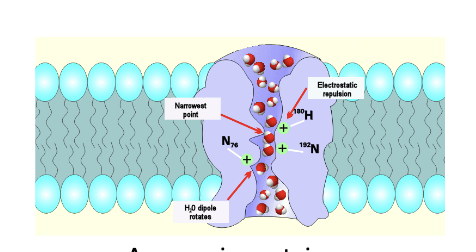
Def: protein channels allowing water molecules to move in and out of the cell
diffusion of water across concentration gradients = osmosis
Osmoregulation
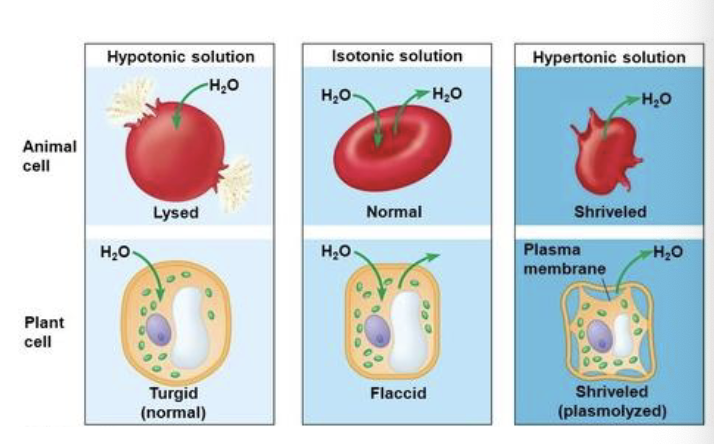
the regulation of the amount of water within the cell
maintain the cells integrity
Diffusion:
if concentration of solute is higher inside - water flows in
if concentration of solute is higher outside - water flows out
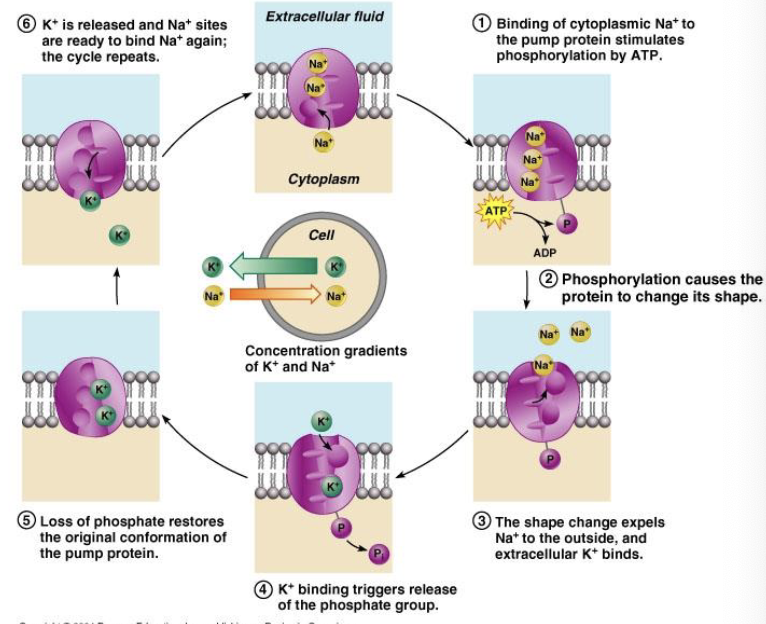
Active membrane Transport proteins
Def: transport proteins that work against concentration gradients (require energy to be added to the protein to work against the pressure)
gets this energy from the expansion of a molecules of ATP
common ______ protein: Na+/K+ pumps
push Na+ ions out of cell, and bring K+ ions into cell
30% of ATP spent of these pumps
 Note
Note  Flashcards (44)