6.1.3 manipulating genomes
 Call Kai
 Learn
Learn Practice Test
 Spaced Repetition
 Match
Match Flashcards
 Knowt Play
1/104

There's no tags or description
Looks like no tags are added yet.
Name | Mastery | Learn | Test | Matching | Spaced | Call with Kai |
|---|
No analytics yet
Send a link to your students to track their progress
105 Terms
What is a restriction enzyme
Enzyme that cuts DNA at specific recognition sites which produces DNA fragments
Where are Restriction enzymes normally found
Bacteria
what is a recognition site ?
Specific base sequence
Why are recognition sites palindromic ?
Read the same backwards and forwards
What are the types of cuts made by restriction enzymes
Sticky ends
Blunt ends
what is the difference between sticky and blunt ends
Sticky ends → there’s a overhang of DNA bases
Why are restriction enzymes used on Non - coding genes?
There are no mutations in Non- coding genes base sequence → easier to predict results
Function of non- coding genes
Control transcription by switching genes on and off
what is the function of Gel electrophoresis
Separate the DNA fragments as DNA is invisible
Why does DNA move through the gel when an electric current is applied?
DNA contains PO₄³⁻ anion on nucleotide this is attracted to the Positive electrode ( Anode)
what is the colour of DNA
Colourless
Control variables when using enzyme
Use the same restriction enzyme → creates same complementary sticky ends
Function of the gel in gel electrophoresis
Creates a matrix mesh that keeps large DNA fragments at top ( cant travel through mesh) and small at the bottom
which DNA fragments move faster and further in Gel electrophoresis
Small fragments
Function of Buffer ( Salt) solution in gel electrophoresis
maintains charge helps the current move
why are DNA fragments / banding pattern different?
Different alleles → different specific recognition sites
Different number and sizes of DNA fragment are produced
DNA fingerprinting ( Image)
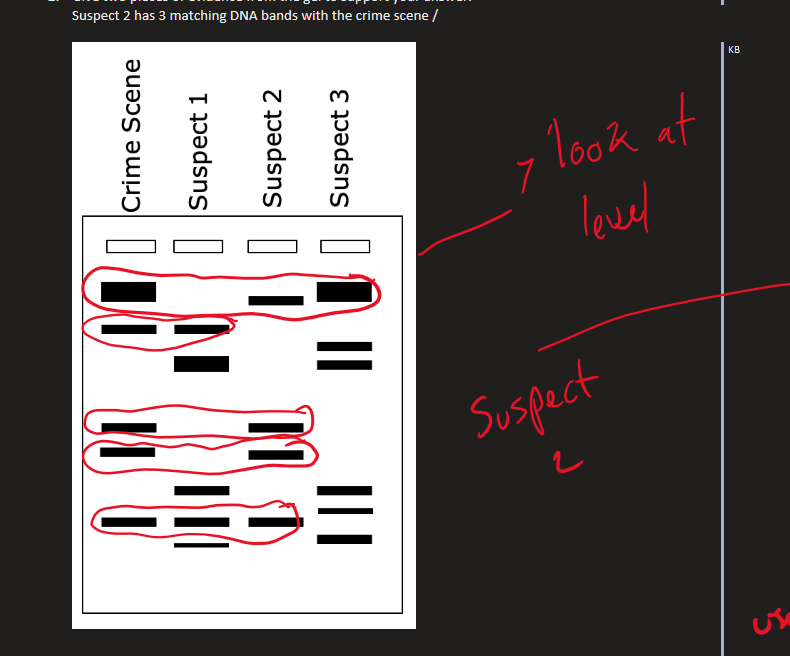
Limitations with gel electrophoresis
DNA fragments can get stuck in the gel
its not 100% could be related ( Identical twins)
Function of PCR in DNA fingerprinting
Used to amplify the DNA so there is enough to be analysed
DNA profiling method
Extract DNA
DNA fragments are placed into agarose gel
apply electric current
DNA moves to positive anode
smaller fragments move further and faster
compare banding pattern with DNA sample to see if there similar.
Function of PCR
Amplify DNA fragment for further study or processing
What does PCR stand for
polymerase chain reaction
Uses of DNA profiling
Forensics
diagnosis of genetic disorders
What are the steps of PCR
Denaturation → separate double helix
Annealing → Primers bind to the start of the target DNA
Synthesis → Building the new strand
PCR what are primers
short pieces of DNA that are complimentary to the bases of the fragment
PCR what happens during denaturation?
DNA mixture heated to 95°C → breaks Hydrogen bonds
separates DNA strands
Why can many cycles of PCR happen without needing new enzymes
DNA polymerase doesn’t denature at high temp
PCR what happens at annealing stage
55°C temp of reaction mixture
allows primers to bind to start of strands
PCR what happens at the synthesis stage
72°C temp allows DNA polymerase to work
DNA polymerase joins DNA nucleotides→ forms template strand using complimentary base pairings → forms 2 new complimentary strands
what type of DNA polymerase is used in PCR
Taq DNA polymerase → doesn’t denature at high temperatures
human does denature at 72°C
what molecules are required for PCR
DNA template
primers
nucleotides
DNA polymerase
Limitations of PCR
Expensive
Takes a long time
what molecules are required for chain termination method
DNA polymerase
Primer
DNA sample
nucleotides
Fluorescently-labelled modified nucleotide / terminator base
Chain termination method first step
Mixture of required molecules is added to separate tubes
chain termination method second step
Tubes undergo PCR
strands produced are different lengths → terminator bases terminates the strand ( cant extend strand)
terminator nucleotide is added on different points
why do fluorescently-labelled modified nucleotides terminate the strand
No bases can be added after
Hydrogen instead of hydroxyl group on carbon 3 so cant form phosphodiester bond with next nucleotide
methods to read data in DNA sequencing
Gel electrophoresis
Capillary sequencing
electrophoresis method in DNA sequencing
electrophoresis separate DNA fragments
shine under UV light / Fluorescent tags
Read from top to bottom ( smaller fragments are near top / move furtherest)
How can DNA be sequenced ?
chain termination method
Advantages of using chain termination method for DNA sequencing ?
allows for massive parallel sequencing
sequence many DNA at same time
what are the solutions that are used in electrophoresis
Buffer solution → helps the current move down due to ions
Loading dye → increases contrast ( Visualise Patterns / see fragments)
why is temp 72°C - 75°C used for synthesis stage
Taq polymerase optimum temp is ( named temp)
Taq polymerase can withstand high temp
Fastest rate of reaction
In electrophoresis what does the sample have to be
Has to be negatively charged
( protein denature)
What is synthetic Biology ?
The design and construction of new biological systems or redesign
Explain how gene sequencing can be used to compare genomes between different species
The two organism are likely to be closely related as they have a similar base sequence
what is the difference between Bioinformatics and Computational biology?
Bioinformatics → Storing data sets, making data base
Computational → analysis of large data sets
How is Gene sequencing used in production of protein
Determine order of Bases
Determine order of amino acids
Primary structure of protein
How is Bioinformatics used in production of protein
Stores large amounts of data
Produces database of gene sequencing and protein structure
used to share information → Format is universal
How is Computational Biology used in production of protein
Analysis of large data sets
predict amino acid sequence
modelling protein structure + function
Function of primers in PCR
bind to template strand → allows DNA polymerase to work
Uses of GE
GE to increase crop yield → disease, herbicides and pesticides resistance
GE of livestock → pest and disease resistance
GE of bacteria → produce insulin
GE process ?
Use a restriction enzyme to cut desired gene out of cell → produces sticky ends
Cut plasmid with the same Restriction enzyme at Marker gene → Gene inserted into a plasmid of bacteria using DNA Ligase
Insert recombinant gene into Host cell
increase rate with electroporation.
Function of DNA ligase
Forms phosphodiester → sticks desired gene and plasmid
differences and Similarities between DNA polymerase and ligase
similarities → Both form Phosphodiester bonds, both catalyse condensation reactions, both made from DNA
differences → DNA polymerase joins individual nucleotides in DNA replication
Function of electroporation / Heat shock in GE
Make the bacterial membrane more permeable → increases rate of plasmid up take from bacteria
Advantages of using bacteria used in GE?
Bacteria replicate rapidly
easy to maintain & produce in a Lab
(GE) How to increase efficiency of DNA uptake
place bacteria in a solution of Ca²⁺ → neutralise the negative charge on cells outer membrane so DNA can enter cell
Electroporation
in GE why are bacteria kept cold
stabilise the cell membrane → closes phospholipid bilayer pores
What is meant by DNA sequencing ?
Determining the sequence / Order of nucleotides in DNA
How are virus tracked over time for mutations ?
Bioinformatics
Why would DNA profiling be used in Agriculture
Prevent inbreeding in selective breeding → reduces gene pool
DNA profiling what does 2 identical bands mean for 1 individual
They are homozygous for the trait
In GE what is a marker and give example?
marker → allows the scientists to test which bacteria have taken up the recombinant plasmid ( millions of bacteria)
Antibiotic resistance gene → Grow on agar containing antibiotics → only bacteria who have taken up plasmid successfully will survive
Describe a PCR graph
Exponential Growth
free nucleotides are limiting factor → graph plateaus
How to work out number of Nucleotides / length of a gene
number of amino acids x 3 ( there are 3 nucleotides in codon)
How to read sequence of bases in DNA (Roche pyrosequencing) ( Image)
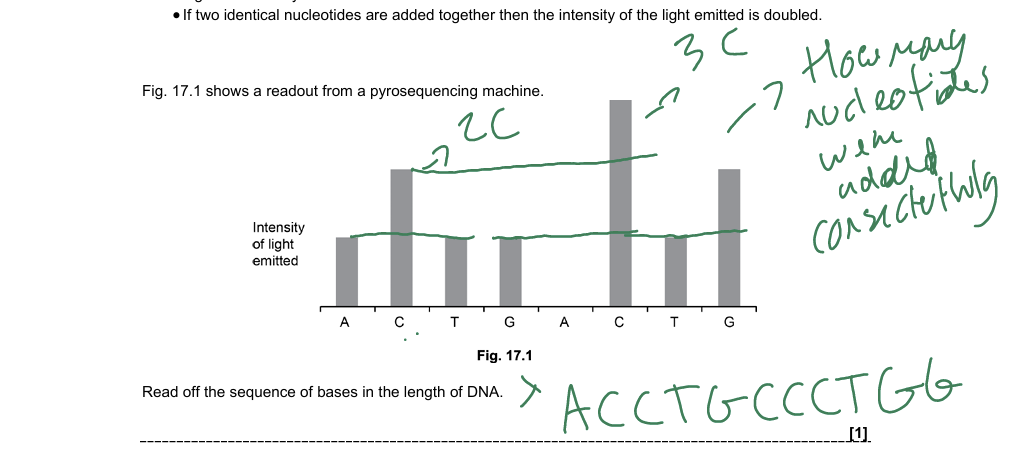
State two development that has lead to a increase in the rate of DNA sequencing ?
WGS ( Whole genome sequencing)
Massive parallel sequencing
How can DNA sequencing allow the sequence of amino acids in polypeptide to be predicted ?
Determine the Order of bases that code for the amino acid sequence
Codons code for each amino acid
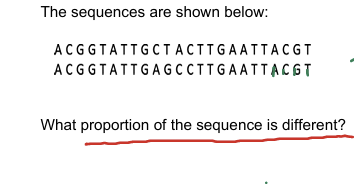
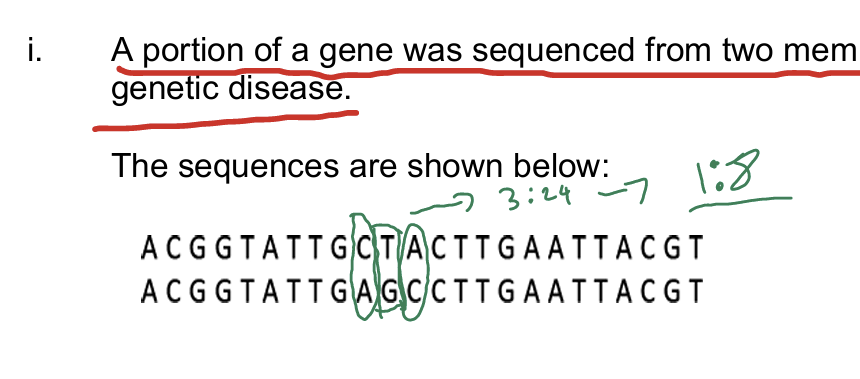
Explain how How occurrence of disease is example of Artificial selection
Shows inbreeding → small gene pool
What section of DNA is used when profiling humans
Non- coding DNA
Why are only selected sections of non-coding DNA used when profiling humans ?
Humans have similar genomes
coding sequence doesn`t produce unique profile
sections of non coding DNA contain variable numbers of repeating sequences
How to work out number of fragments in PCR
Log (x) → if they want in Log value
What are the advantages of GM organisms ( plants)?
Reduces concentration of chemical pesticides used → harm environment
designed to be more nutritious
Negative ethical issues about using GM organisms ( Plants)
Encourages monoculture → reduces biodiversity
GM plant could interbreed with wild plants → superweeds ( resistant to herbicides)
What is meant by pharming ?
using GM organisms to make drugs
Pharming ( Image)
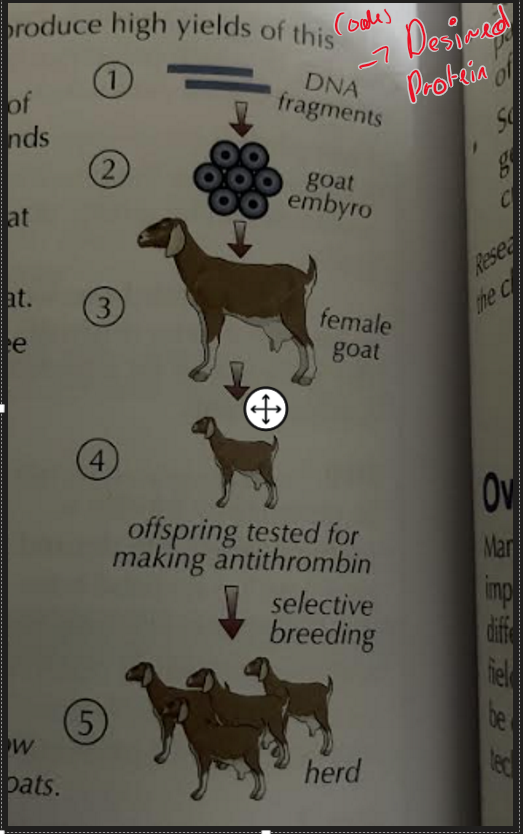
Advantages and advantages of using Pharming
A: Large quantities of Drug → more available to people
D: Potential harmful side effects
Disadvantages of using GM pathogens
could potentially be used in Biological warfare
Lead to a outbreak of disease
Advantages of using GM pathogens
previously Untreatable diseases can be treated
What is meant by Technology Transfer?
Scientists sharing knowledge, tech and skills of GM products
What is a patent?
Companies obtaining legal protection and ownership over their product
Advantages of patents?
Owners will get more money from selling product → encourages competition for new beneficial GE ideas
Disadvantage of Patents?
Farmers from poorer countries cant afford patented GM seeds → legally cant grow crop / seeds
How is gene therapy used on Homozygous recessive conditions ?
Add a working dominant gene
How is gene therapy used Dominant conditions ?
silence the Dominant allele → insert DNA using vector ( altered virus)
What are the types of Gene therapies?
Somatic therapy
Germ line therapy
What is somatic therapy?
Altering alleles in body cells
Disadvantage of Somatic therapy
Doesn`t alter Sex cells → Offspring could still inherit disease
Effects may be short- lived
What is Germ line therapy?
Altering alleles in Sex cells → offspring will not inherit disease
Positive ethical issues of Gene therapy
Prolong the lives of people with terminal genetic disorders
Decrease number of people that suffer from genetic disorder → economical fewer people require treatment
Allow carrier of Genetic disorders to conceive baby without disorder
what are the Negative ethical issues of gene therapy?
Gene therapy is expensive → health service could be spent on better treatments
Could be used in ways other then medical treatment → cosmetics
risk of overexpression of genes
what are the Disadvantages of gene therapy
inserted allele could get overexpressed
Body could identify vectors as foreign and immune response against them
Difficult to get allele into specific body cells ₂
What is meant by Gene therapy
Altering the alleles inside cells to cure genetic disorders
Disadvantages of Chain-termination method ?
Cant sequence entire genomes only DNA fragments up to 750 bp
Differences between Synthetic biology and GE
GE involves direct transfer of DNA between organisms
Synthetic biology → creates DNA
Process of creating GM plant ( resistance)
Use restriction enzyme to cut out desired gene from bacteria
use the same RE to cut out plasmid from vector → creates complementary sticky ends
Insert gene into plasmid, use DNA ligase → forms phosphodiester bonds → creates recombinant plasmid
insert recombinant plasmid into bacteria → transfer recombinant plasmid DNA into plant cells
Use marker genes ( antibiotic / fluorescent gene) to show which cells have successfully taken up gene
electroporation → get plasmid inside cell
How can mRNA be altered so it can be used in GM in bacteria ?
Use reverse transcriptase to convert mRNA → cDNA
Use DNA polymerase to make double stranded DNA
advantages of using mRNA instead of DNA during GM?
mRNA has been spliced → contains Exons only
DNA contains introns ( non- codin
How can Scientists use PCR to compare growth of bacteria on tissues
Extract DNA from both sources ( named)
compare rate of amplification after 30 cycles of PCR

