Series & Sequences - Calculus

0.0(0)
studied byStudied by 66 people
0.0(0)
call with kaiCall with Kai
learnLearn
examPractice Test
spaced repetitionSpaced Repetition
heart puzzleMatch
flashcardsFlashcards
GameKnowt Play
Card Sorting

1/42

encourage image

There's no tags or description

Looks like no tags are added yet.

Study Analytics
Name
Mastery
Learn
Test
Matching
Spaced
Call with Kai

No study sessions yet.

43 Terms

1
New cards
term image
knowt flashcard image
2
New cards
term image
knowt flashcard image
3
New cards
term image
knowt flashcard image
4
New cards

Fixed point

knowt flashcard image
5
New cards
term image
knowt flashcard image
6
New cards
term image
knowt flashcard image
7
New cards

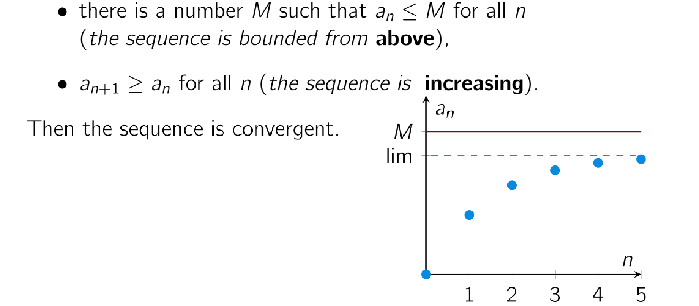
Explain monotone convergence for a sequence

If a sequence is bounded (that is a(n) <= M for all n)
AND
the sequence is increasing, a(n+1) >= a(n)

Then the sequence is convergent.
This also applies for a decreasing sequence bounded from below

8
New cards
term image
knowt flashcard image
9
New cards
term image
knowt flashcard image
10
New cards
term image
knowt flashcard image
11
New cards
<p>Explain why: </p>

Explain why:

knowt flashcard image
12
New cards
term image
knowt flashcard image
13
New cards
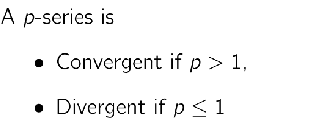
<p>What is the behaviour of a p-series?</p>

What is the behaviour of a p-series?
knowt flashcard image
14
New cards
term image
knowt flashcard image
15
New cards
term image
knowt flashcard image
16
New cards
term image
knowt flashcard image
17
New cards
term image

s - s(n) is basically the error margin
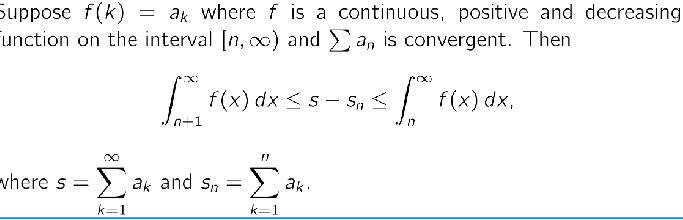
<p>s - s(n) is basically the error margin</p>
18
New cards
term image

Basically we can confidently say that s is within these 2 bounds
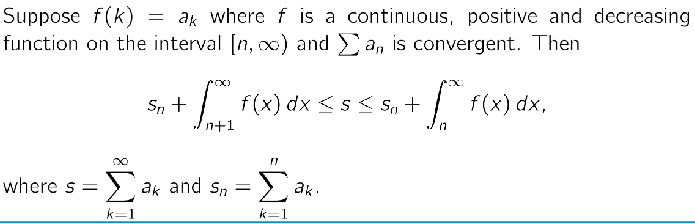
<p>Basically we can confidently say that <strong>s </strong> is within these 2 bounds</p>
19
New cards
term image

What this basically says is that the error bound is maximally as large as the next absolute value in the series
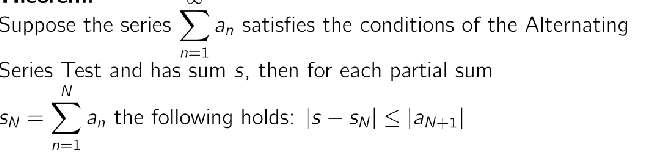

<p>What this basically says is that the error bound is maximally as large as the next absolute value in the series</p>
20
New cards
term image

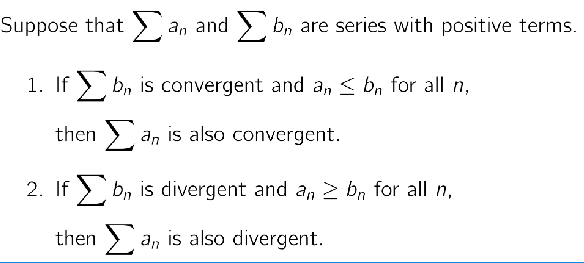
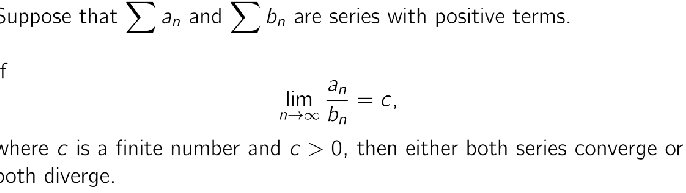
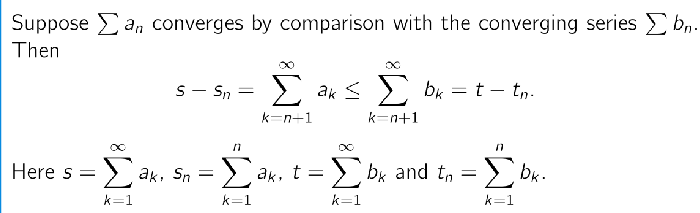
Usually, it is impossible to calculate the error for a messy series a directly.

However, if you compare it to a Geometric Series b, you can easily calculate the error for b using a simple formula.

This theorem allows you to say: "I don't know the exact error of my messy series, but I know for a fact it is smaller than 0.001 because the geometric series error is 0.001."

If every single term in list A is smaller than the matching term in list B (0 < a < b), and you know the total sum of B is finite, then the total sum of A must also be finite.

—> "If the total sum is smaller, then the Error (the leftover part) is also smaller."
<p>Usually, it is impossible to calculate the error for a messy series  <strong>a </strong>directly.</p><p>However, if you compare it to a Geometric Series <strong>b</strong>, you can easily calculate the error for <strong>b </strong>using a simple formula.</p><p>This theorem allows you to say: <em>"I don't know the exact error of my messy series, but I know for a fact it is </em><strong><em>smaller</em></strong><em> than 0.001 because the geometric series error is 0.001."</em><br><br>If every single term in list A is smaller than the matching term in list B (<span>0 &lt; a &lt; b</span>), and you know the total sum of B is finite, then the total sum of A <strong>must also be finite</strong>. <br><br>—&gt; <em>"If the total sum is smaller, then the </em><strong><em>Error</em></strong><em> (the leftover part) is also smaller."</em></p>
21
New cards
term image
knowt flashcard image
22
New cards

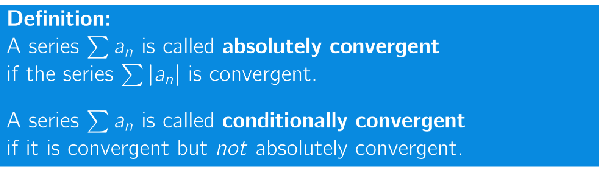
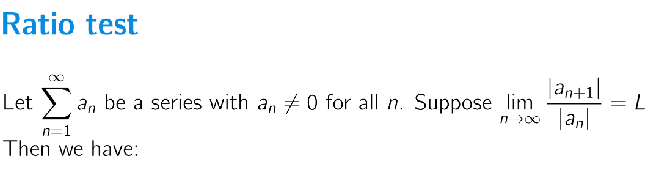
Riemann's rearrangement theorem:

Rearranging the terms of an AC series produces another AC series with the same sum.

Given a CC series and a real number r there exists a rearrangement of terms such that the sum of the rearranged series equals r.
23
New cards
term image
knowt flashcard image
24
New cards
term image
knowt flashcard image
25
New cards
term image

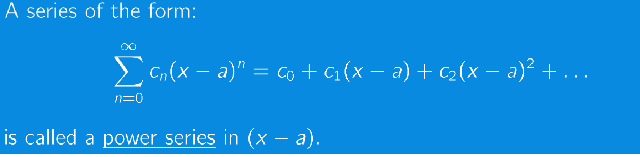
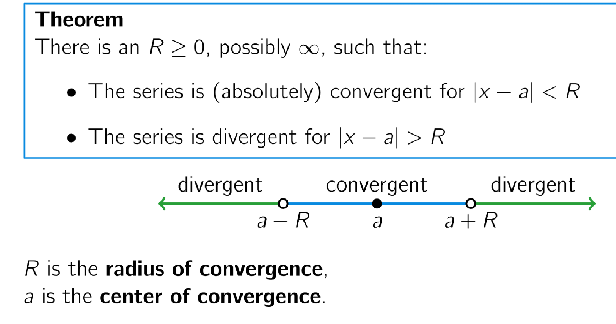
the edge points can either be convergent or divergent, we have to calculate that
<p>the edge points can either be convergent or divergent, we have to calculate that</p>
26
New cards

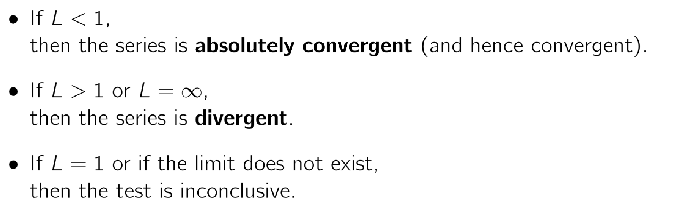
How do you find the radius of convergence?

You use the Ratio Test!
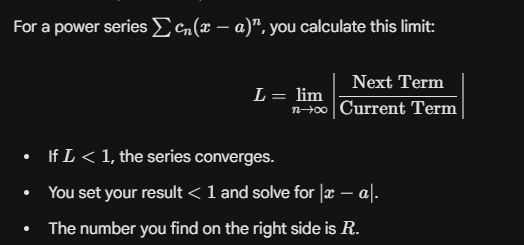
<p>You use the Ratio Test!</p>
27
New cards

How do you find the center of convergence?

Often you just read it off:

<p>Often you just read it off: </p>
28
New cards

How do you find the coefficients of a function f(x)?
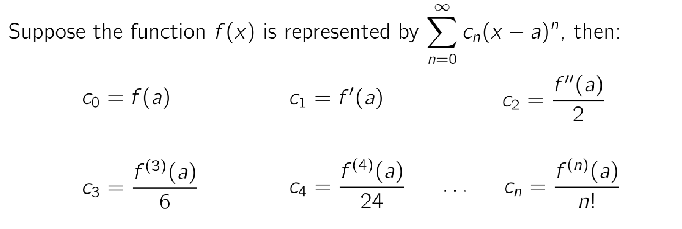
knowt flashcard image
29
New cards

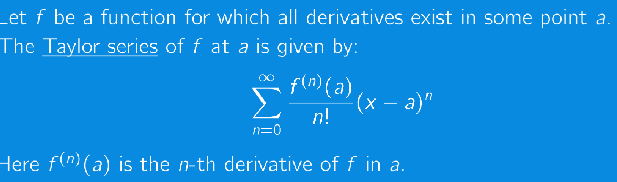
Taylor Series Definition

knowt flashcard image
30
New cards

What’s the Maclaurin Series of f?

It’s basically the Taylor Series at a = 0

31
New cards

When is a function analytic?

To be called analytic at a, the function must equal its power series representation on an open interval containing a.
==> So not only does the Taylor Series converge to the function value at a, it also does this around a. (This radius can be variable)


<p>To be called <strong>analytic</strong> at <span><strong><span>a</span></strong></span>, the function must equal its power series representation <strong>on an open interval containing </strong><span><strong><span>a.</span></strong><span> </span></span><br><span><span>==&gt; So not only does the Taylor Series converge to the function value at </span><strong><span>a</span></strong><span>, it also does this around </span><strong><span>a</span></strong><span>. (This radius can be variable)</span></span></p>
32
New cards
term image

Basically that the difference between the Taylor Result & the actual result is marginal
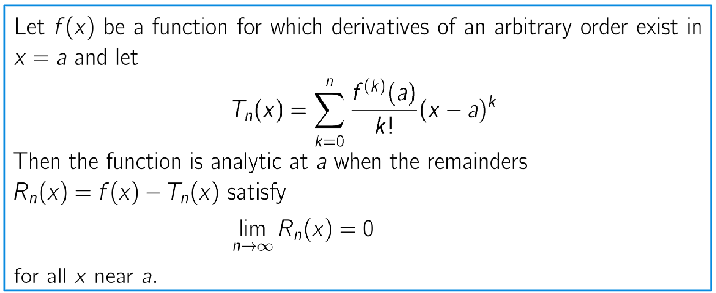
<p>Basically that the difference between the Taylor Result &amp; the actual result is marginal</p>
33
New cards
term image
knowt flashcard image
34
New cards
term image
knowt flashcard image
35
New cards
term image
knowt flashcard image
36
New cards
term image
knowt flashcard image
37
New cards
term image
knowt flashcard image
38
New cards
term image
knowt flashcard image
39
New cards
term image
knowt flashcard image
40
New cards
term image
knowt flashcard image
41
New cards

Taylor’s theorem

Taylor’s theorem essentially says that the Taylor Series are a great approximation because:
As you get closer to a, the error becomes so tiny that it is negligible compared to the polynomial terms. This guarantees that Tk(x) is the "best possible" polynomial fit for the curve at that point.

—> It is provent using L’Hopital
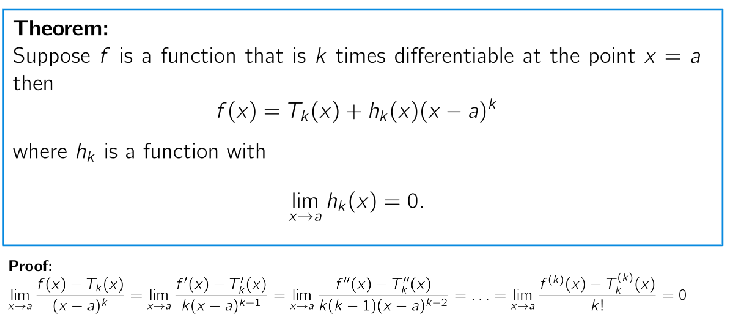
<p>Taylor’s theorem essentially says that the Taylor Series are a great approximation because:<br>As you get closer to <span><strong><span>a</span></strong></span>, the error becomes so tiny that it is negligible compared to the polynomial terms. This guarantees that <span><strong><span>Tk(x)</span></strong></span><strong> </strong>is the "best possible" polynomial fit for the curve at that point.<br><br>—&gt; It is provent using L’Hopital</p>
42
New cards

Taylor’s Theorem with Lagrange remainder

Basically we now know the maximal error / remainder!
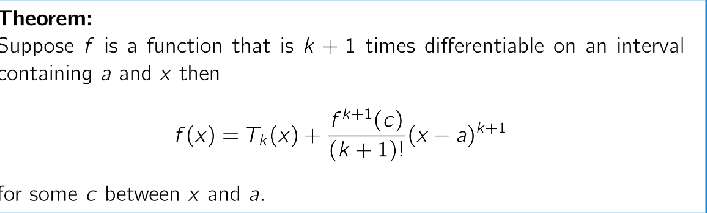
<p>Basically we now know the maximal error / remainder!</p>
43
New cards

Taylor’s Inequality

"The error is less than a term built using the maximum possible derivative (M) found in the interval. —> it’s not the derivative at A but worst case scenario the largest value of that derivative between the interval (x-a) (so within d)
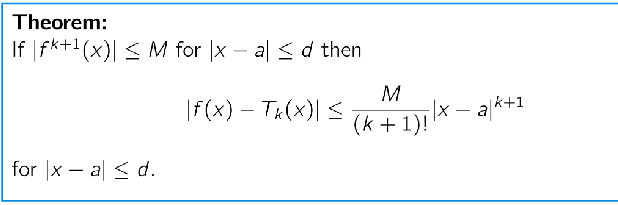
<p>"The error is less than a term built using the <strong>maximum possible derivative (M)</strong> found in the interval. —&gt; it’s not the derivative at A but worst case scenario the largest value of that derivative between the interval (x-a) (so within d)</p>