Skeletal concepts
 Call Kai
 Learn
Learn Practice Test
 Spaced Repetition
 Match
Match Flashcards
 Knowt Play
1/5

There's no tags or description
Looks like no tags are added yet.
Name | Mastery | Learn | Test | Matching | Spaced | Call with Kai |
|---|
No analytics yet
Send a link to your students to track their progress
6 Terms
Explain the length-tension relationship?
The length-tension relationship describes how the amount of tension/force a muscle can create is dependent on the length of the muscle.
When the muscle is at optimal length, the max amount of tension can be created because the greatest amount of cross bridges can form. When the muscle stretches too far, myosin and actin overlap decreases, and when shortened myosin and actin overlap excessively both leading to a decrease in tension.
Explain the sliding filament theory. Go through all the steps starting with the action potential.
The sliding filament theory describes how muscle contraction occurs and its dependency on the contractile proteins (actin & myosin).
Action potential occurs and gets sent down the t-tubules opening the Ca+ channels
Once calcium is released from the SR, it binds to troponin which knocks tropomyosin off and exposes the myosin-binding site.
Once myosin binds to actin the cross bridge cycle begins where actin fibers get pulled toward the middle of the sarcomere using ATP
Ca+-ATPase pumps Ca+ back into the SR after ATP gets hydrolyzed
Once Ca+ leaves the troponin the tropomyosin blocks the myosin binding cite stopping the cycle and the muscle relaxes
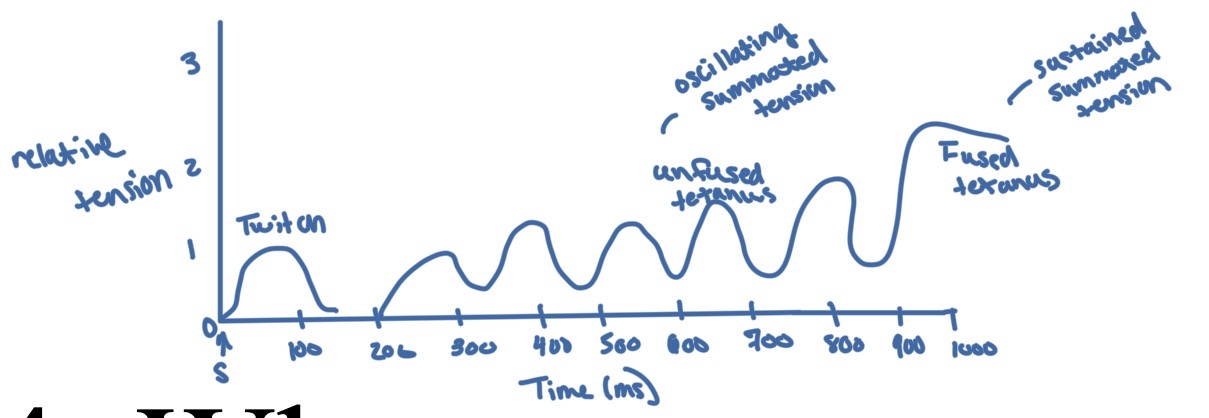
Graph a simple muscle twitch and a contraction that results in tetanus. Explain the 1st and 2nd stimulus and how it influences summation.
A muscle twitch is when one contraction occurs in response to one stimulus, and returns to base line when enough Ca+ is pumped back out to the SR. When there is not enough time between the 1st stimulus and the 2nd stimulus then summation occurs.
When the stimuli continue the muscle produces infused tetanus where force is fluctuating but still elevated.
When the stimuli are rapid enough, fused tetanus occurs which is a sustained Mac contraction because the Ca+ remains and cross-bridges just keep forming.
What are some potential explanations for peripheral fatigue? Include short- duration, heavy contractility, later on exercise and prolonged exercise with fatigue.
Peripheral fatigue can be caused by a decreased in ATP or PCR, or even an increase in inorganic P, ADP, lactate, or H+.
During short-duration exercise fatigue is mainly caused by the increase in inorganic phosphate, ADP, and H+ which reduce force, velocity, and power at the cross-bridge.
Later on fatigue during exercise is mainly caused by a reduce in Ca+ releasing, limiting force production.
Prolonged fatigue is mainly caused by the depletion of glycogen making the muscle rely on slower energy sources decreasing performance.
Explain the myonuclear domain theory. Where do the additional myonuclei come from and how is it related to muscle growth.
Myonuclear domain theory states that the more the cytoplasm expands the more nuclei are needed because once a nuclei reaches its max capacity, it cannot perform transcription which is needed for protein synthesis. The additional nuclei come from satellite cells that fuse and donate or help repair damages/ injuries muscle cells, allowing greater protein synthesis leading to muscle hypertrophy.
What exercise load, sets/reps, frequency of exercise should be used to have max strength vs growth? What concepts did we discuss that can help answer this question?
For max muscle strength someone should increase the load to roughly 80% of their 1-RM, with low reps and moderate frequency.
For max growth someone should lower the load to about 30-80% of their 1-RM, increase reps and frequency.
Some of the concepts we discussed that help answer this question is that for muscle growth to occur, it is driven by muscle activation over time which leads to protein synthesis exceeding protein breakdown. For strength, it relies on the neural output going to the motor neurons and the specificity of the motor neurons and muscle activation. You need to target the specific muscle during higher intensity exercise to get to max strength.

