Comprehensive Taxation and Business Law Review for CPA Exam

0.0(0)
studied byStudied by 0 people
0.0(0)
full-widthCall Kai
learnLearn
examPractice Test
spaced repetitionSpaced Repetition
heart puzzleMatch
flashcardsFlashcards
GameKnowt Play
Card Sorting

1/230

encourage image

There's no tags or description

Looks like no tags are added yet.

Study Analytics
Name
Mastery
Learn
Test
Matching
Spaced

No study sessions yet.

231 Terms

1
New cards

What is the filing requirement for individuals regarding gross income?

Individuals must file if their income is equal to or greater than the sum of their gross income and the regular standard deduction amount.

2
New cards

What is the definition of a qualifying child under the CARES criteria?

A qualifying child must be a close relative (son, daughter, stepchild, sibling, stepsibling, or their descendants), must obtain an SSN, and must be younger than the taxpayer and under 19 (or 24 for full-time students).

3
New cards

What is the adjusted gross income (AGI) requirement for filing?

Taxpayers must file if their self-employment income is $400 or more.

4
New cards

What is the deadline for filing individual income tax returns?

Taxpayers must file by April 15th, with an extension available until October 15th.

5
New cards

What is the requirement for a full-time student to be considered a qualifying child?

A full-time student must attend an educational institution for at least part of 5 months of the taxable year.

6
New cards

What is the residency requirement for a qualifying child?

The child must have the same principal place of abode as the taxpayer for more than half of the tax year.

7
New cards

What is the citizenship requirement for a qualifying child?

The child must be a citizen of the US or a resident of the US, Canada, or Mexico.

8
New cards

What does the Support Test entail for a qualifying relative?

The taxpayer must have supplied more than half of the support for a person to claim them as a relative.

9
New cards

What is the significance of the Under Gross Income Limitation for qualifying relatives?

The gross income test does not apply to a qualifying child, meaning they can still be claimed even if they have some income.

10
New cards

What is the filing status for single taxpayers?

Single status is based on the taxpayer's status at the end of the year; they must be unmarried or legally separated.
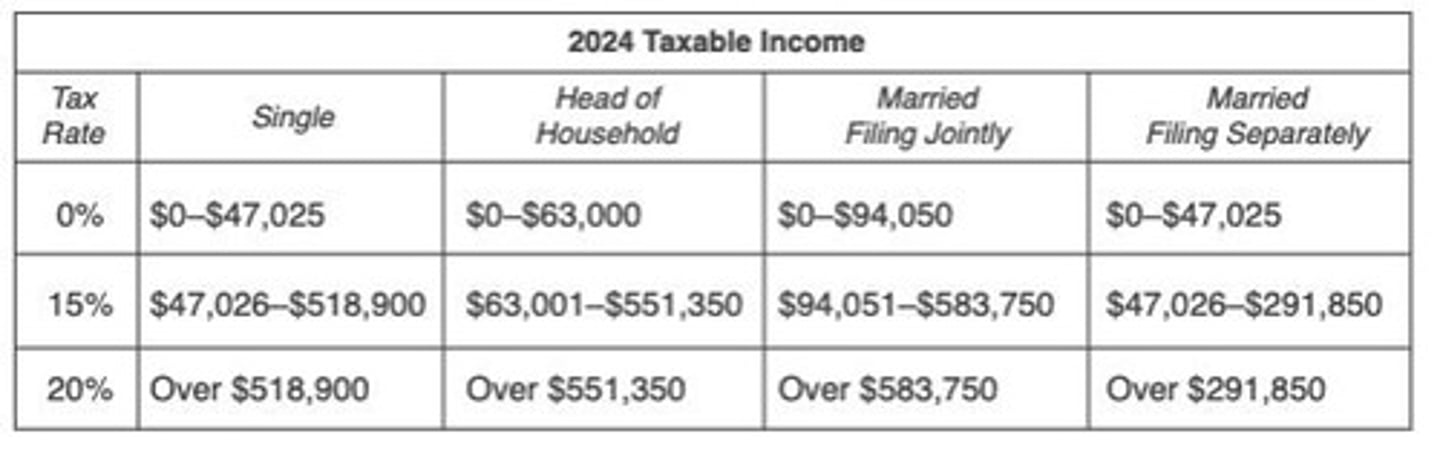
<p>Single status is based on the taxpayer's status at the end of the year; they must be unmarried or legally separated.</p>
11
New cards

What are the conditions for filing a joint return for married couples?

Married couples can file jointly if they are married at year-end or living together in a common law marriage.

12
New cards

What happens if parents have equal custody of a child?

The parent with the higher adjusted gross income qualifies to claim the child as a dependent.

13
New cards

What is the impact of divorce on filing a joint return?

If divorced during the year, a joint return may not be filed; if a spouse dies during the year, a joint return may be filed.

14
New cards

What form is used to request an extension to file taxes?

Form 4868 is used to request a 6-month extension to file.

15
New cards

What is the additional standard deduction for taxpayers aged 65 and older?

Taxpayers aged 65 and older are eligible for an additional standard deduction amount.

16
New cards

What is the significance of the term 'Qualifying Relative' in tax filing?

A qualifying relative must meet the Support Test, meaning the taxpayer must provide more than half of their support.

17
New cards

What is the requirement for a child to be considered a qualifying child in terms of support?

A qualifying child must not have contributed more than half of their own support.

18
New cards

What is the tax filing requirement for individuals with self-employment income?

Individuals must file if their self-employment income is $400 or more.

19
New cards

What is the income threshold for a qualifying relative in a separate property state?

The gross income must be less than $5,050.

20
New cards

How is income treated in a community property state?

Most incomes are split 50/50, and only taxable income is included.

21
New cards

What is the definition of a qualifying widower with a dependent child?

A taxpayer who can use the joint tax deduction for two years following the death of their spouse.

22
New cards

What is the accrual method of income recognition?

Recognition occurs when income is earned, similar to GAAP with exceptions.

23
New cards

What are the requirements for a qualifying child?

Must be a child, stepchild, legally adopted child, or sibling.

24
New cards

What is the cash method of income recognition?

Recognition occurs in the period the revenue is actually or constructively received.

25
New cards

What are the conditions to qualify as Head of Household?

Must be unmarried, not a qualifying widower, and maintain a home for more than half the year.

26
New cards

What is included in gross income under dividend income?

Includes taxable dividends from earnings and profits (E&P).

27
New cards

What are qualified dividends?

Dividends paid by domestic or certain qualified foreign corporations.

28
New cards

What is the tax treatment of employer contributions to a Roth 401k?

Contributions made by the employer are included in income.

29
New cards

What are nontaxable fringe benefits?

Benefits like employer-paid health insurance premiums that are excludable from income.

30
New cards

What is tax-exempt interest income?

Interest from state and local government bonds, which is reportable but not taxable.

31
New cards

What is the exclusion limit for employee educational expenses?

Up to $5,250 may be excluded from gross income for payments on behalf of student loans.

32
New cards

What is the tax treatment of stock dividends?

Stock dividends are nontaxable.

33
New cards

What is the maximum exclusion for adoption expenses paid by an employer?

$16,810 can be excluded from taxable income.

34
New cards

What is the tax treatment of rental income?

Net rental income is calculated as rental income minus total rental expenses.

35
New cards

What is the tax treatment of unemployment compensation?

All of unemployment compensation is taxable.

36
New cards

What are the income thresholds for Social Security benefits to be taxable?

Up to 50% of benefits are taxable for middle-income earners.

37
New cards

What is the tax treatment of gifts and inheritances?

Not taxable unless the property is sold in future terms.

38
New cards

What is the tax treatment of life insurance proceeds?

Excluded from the gross income of the beneficiary.

39
New cards

What is the treatment of payments made pursuant to a divorce before December 2018?

Alimony received is not included in gross income.

40
New cards

What is the tax treatment of cancellation of debt?

Cancellation of debt is taxable and included in gross income.

41
New cards

What is the maximum exclusion for first-time homebuyer distributions?

$10,000 can be excluded for first-time homebuyer distributions.

42
New cards

What is the tax treatment of personal injury awards?

Compensation for lost profit is taxable, but wrongful death awards are not.

43
New cards

What is the treatment of rental income for properties rented less than 15 days?

Not required to report rental income.

44
New cards

What is the Bona Fide Residence Test for foreign-earned income exclusion?

The filer must have been a bona fide resident of the country for an entire taxable year.

45
New cards

What is the Physical Presence Test for foreign-earned income exclusion?

The filer must be present in the country for 330 full days.

46
New cards

What is the tax treatment of gambling winnings?

Winnings are included in gross income, and losses are deductible only to the extent of winnings.

47
New cards

What is the tax treatment of prizes and awards?

FMV of prizes and awards is taxable unless selected without entering a contest.

48
New cards

What are the tax implications of qualified tuition reductions?

Exclusions apply for undergraduate and graduate level tuition reductions.

49
New cards

What is the treatment of payments for medical expenses under FSAs?

Must be used within the plan year; forfeited if not used within 2.5 months after year-end.

50
New cards

What is the exclusion limit for dependent care assistance benefits?

$5,000 of benefits can be excluded from gross income.

51
New cards

What is the treatment of rental income in taxation?

Rental income is excluded from gross income, but depreciation of business assets and employee benefits are deductible.

52
New cards

What is the Nine Factor Test used for?

It determines if an activity is engaged in for profit, considering factors like business-like manner, expert advice, and personal time devoted.

53
New cards

What are hobby losses in tax terms?

Hobby losses are limited deductions for activities not engaged in for profit; income must be included but expenses cannot be deducted.

54
New cards

What is the maximum deduction for self-employment tax?

50% of self-employment tax is deductible to arrive at AGI.

55
New cards

What is the standard deduction for married taxpayers?

$1,550 per issue per taxpayer.

56
New cards

What is the standard deduction for unmarried taxpayers?

$1,950 per issue per taxpayer.

57
New cards

What is the maximum contribution to an IRA for individuals under 50?

$7,000.

58
New cards

What is the maximum contribution to an IRA for individuals over 50?

$8,000.

59
New cards

What is the maximum allowable deduction for organization costs?

$5,000 for both organization and start-up costs.

60
New cards

What is the treatment of personal interest in tax deductions?

Personal interest is not deductible.

61
New cards

What is the maximum deduction for charitable contributions?

Cash contributions are limited to 60% of AGI, while ordinary income property is limited to 50% of AGI.

62
New cards

What is the tax treatment for education loan interest?

Education loan interest is an adjustment to AGI and limited to $2,500.

63
New cards

What is the penalty for early withdrawal of savings?

A penalty is assessed on early withdrawal, which is deductible when arriving at AGI.

64
New cards

What is the tax treatment for moving expenses?

Moving expenses are only allowed for members of the armed services with a permanent change of station.

65
New cards

What is the definition of Qualified Business Income (QBI)?

Qualified Business Income must be generated in the USA and is eligible for a deduction of 20%.

66
New cards

What is the maximum deduction for self-employed health insurance?

All health insurance premiums for dependents are deductible.

67
New cards

What is the tax treatment for casualty losses?

Casualty losses are deductible only for areas in a declared disaster.

68
New cards

What is the maximum credit for the Adoption Credit?

The maximum credit is $16,810 for qualified adoption expenses.

69
New cards

What is the maximum credit for the Child Tax Credit?

Taxpayers may claim a $2,000 credit for each qualified child under 17.

70
New cards

What is the Earned Income Credit?

The Earned Income Credit applies to low-income individuals and families, providing a refundable tax credit.

71
New cards

What is the treatment of alimony payments for tax purposes?

Alimony payments are deductible for divorces finalized before December 2018.

72
New cards

What is the treatment of student loan interest for tax purposes?

Student loan interest is an adjustment for AGI, limited to $2,500.

73
New cards

What is the maximum contribution for a Coverdell Education Savings Account?

The maximum contribution per beneficiary is $2,000 annually.

74
New cards

What is the tax treatment of gifted property?

The donee's basis in gifted property is generally the donor's adjusted basis at the date of the gift.

75
New cards

What is the holding period for gifted property?

The recipient of a gift absorbs the donor's holding period.

76
New cards

What is the maximum allowable deduction for Section 179 depreciation?

$1.22 million.

77
New cards

What is the phase-out amount for Section 179 depreciation?

The phase-out begins when the total cost exceeds $3,050,000.

78
New cards

What is the treatment of bad debts for tax purposes?

Accrual basis taxpayers must write off bad debts when they are uncollectible; cash basis taxpayers cannot deduct bad debts.

79
New cards

What is the maximum deduction for moving expenses?

Moving expenses are only deductible for members of the armed services with a permanent change of station.

80
New cards

What is the treatment of capital gains and losses?

Gains are recognized if sales price exceeds adjusted basis; losses are recognized if sales price is less than FMV.

81
New cards

What is the tax treatment of ordinary and necessary expenses?

Ordinary and necessary expenses are deductible if they are common and accepted in the industry.

82
New cards

What is the tax treatment for energy-efficient home improvements?

The maximum credit for energy-efficient home improvements is 30% of the cost.

83
New cards

What is the treatment of personal losses in tax deductions?

Personal losses are not deductible.

84
New cards

What is the tax treatment of non-deductible medical expenses?

Non-deductible medical expenses include elective procedures and illegal drugs.

85
New cards

What is the maximum deduction for health savings accounts (HSA)?

Individuals can make up to $4,150 of pre-tax contributions, increasing by $1,000 for those 55 and older.

86
New cards

What is the maximum deduction for qualified medical expenses?

Qualified medical expenses are deductible if they exceed 7.5% of AGI.

87
New cards

What is the tax treatment of interest paid on business loans?

Interest paid on business loans is generally deductible unless the firm exceeds the $30 million threshold.

88
New cards

What limits the deduction of interest expenses when average gross receipts exceed the threshold?

The sum of business interest income, 30% of adjusted taxable income, and floor plan financing.

89
New cards

What happens to disallowed business interest expenses?

They can be carried forward indefinitely.

90
New cards

What is the maximum deduction for charitable contributions before considering DRD?

10% of taxable income.

91
New cards

How are installment sales recognized for income tax purposes?

Income is recognized when received.

92
New cards

What is the treatment of state tax refunds for income tax?

State tax refunds are treated as income.

93
New cards

What is the income recognition for rent and royalties received in advance?

Income is recognized when earned.

94
New cards

What is the treatment of life insurance proceeds for key staff?

They are not included in taxable income.

95
New cards

What is the limit on business gifts for tax deductions?

Deductible up to $25 per recipient per year.

96
New cards

What is the limit on deductions for business meals?

50% of the cost is deductible.

97
New cards

What is the maximum deduction for organizational expenditures and start-up costs?

$5,000 for each cost, with excess amortized over 15 years.

98
New cards

What is the depreciation limit under Section 179?

$1,160,000.

99
New cards

What is the treatment of penalties, bribes, and kickbacks in tax deductions?

They are not deductible.

100
New cards

What is the treatment of federal income taxes for corporations?

They are not deductible.

Explore top notes

Imperialism Rise in Nationalism • During the French and Industrial Revolution, nationalism continued to inspire nations to increase their political and economic power. • Nationalism became the ideal force in the political, economic, and cultural life in the world, becoming the first universal ideology-organizing all people into a nation state. Nationalism Defined • The strong belief that the interest of a particular nation-state is of primary importance. o Nation-State – a state where the vast majority shares the same culture and is conscious of it. It is an ideal in which cultural boundaries match up with political ones. • As an ideology, it is based on the idea that the individual’s loyalty and devotion to the nation-state surpass other individual/group interests. • Exalting one nation’s belief above all others and placing primary emphasis on promotion of its culture and interests, excluding the interests of others. Changing the World through a Nationalistic Vision • The French Revolution significantly changed the political world and how countries govern. • The Industrial Revolution significantly changed the economic world. • The Age of Imperialism (1870-1914) dramatically changed the political, economic, and social world. What is Imperialism? • Imperialism- The policy of extending the rule of authority of an empire or nation over foreign countries, or of acquiring and holding colonies and dependencies. Power and influence are done through diplomacy or military force. Reasons for Imperialism • There are 5 main motives for empires to seek to expand their rule over other countries or territories: 1. Exploratory • Imperial nations wanted to explore territory unknown to them. • The main purpose for this exploration of new lands was for resource acquisition, medical or scientific research. o Charles Darwin • Other reasons: o Cartography (map making) o Adventure 2. Ethnocentric • Europeans acted on the concept of ethnocentrism o Ethnocentrism- the belief that one race or nation is superior to others. • Ethnocentrism developed out of Charles Darwin’s “survival of the fittest” theory. Philosophers used the theory to explain why there were superior races and inferior races. o This became known as Social Darwinism. • Most imperial nations believed that their cultural values or beliefs were superior to other nations or groups. • Believed imperial conquest would bring successful culture to inferior people. 3. Religious • Imperial expansion promoted a religious movement of people setting out to convert new members of conquered territories. • With the belief that Christianity was superior, missionaries believed it was their duty to spread Christianity to the world. • Christian missionaries established churches, and in doing so, they spread Western culture values as well. • Typically, missionaries spread the imperial nation's language through education and religious interactions. 4. Political • Patriotism and Nationalism helped spur our imperial growth, thus creating competition against other supremacies. • It was a matter of national pride, respect, and security. • Furthermore, European rivalry spurred nations for imperial conquest. Since land equaled power, the more land a country could acquire the more prestige they could wield across the globe. • Empires wanted strategic territory to ensure access for their navies and armies around the world. • The empire believed they must expand, thus they needed to be defended. 5. Economic • With the Industrial Revolution taking place during the same time, governments and private companies contributed to find ways to maximize profits. • Imperialized countries provided European factories and markets with natural resources (old and new) to manufacture products. • Trading posts were strategically placed around imperialized countries to maximize and increase profits. o Such places as the Suez Canal in Egypt which was controlled by the British provided strategic choke hold over many European powers. o Imperial powers competed over the best potential locations for resources, markets, and trade. History of Imperialism • Ancient Imperialism 600 BCE-500 CE o Roman Empire, Ancient China, Greek Empire, Persian Empire, Babylonian Empire. • Middle Age Imperialism (Age of Colonialism-1400-1800s) o Great Britain, Spain, Portugal, France, Netherlands (Dutch), Russia. • Age of Imperialism 1870-1914 o Great Britain, Spain, Portugal, France, Germany, Belgium, Italy, Japan, United States, Ottoman Empire, Russia. • Current Imperialism...? o U.S. Military intervention (i.e. Middle East) o Russia’s Invasion of Ukraine. Imperialism Colonialism • Refers to political or economic control, either legally or illegally. • Refers to where one nation assumes control over the other. • Creating an empire, expanding into neighboring regions and expanding the dominance far outside its borders. • Where a country conquers and rules over other regions for exploiting resources from the conquered country for the conqueror's benefit. • Foreign government controls/governs a territory without significant settlement. • Foreign government controls/governs the territory from within the land being colonized. • Little to no new settlement established on fresh territory. • Movement to settle to fresh territory. Age of Colonialism WHEN? • Started around the late 1400s and ended around the late 1700s/early 1800s. WHY? • Primary Reason: European countries, wished to find a direct trade route to Asia (China & India) and the East Indies. o Quicker and relatively more effective than land routes over Asia. • Secondary Reason: Empire expansion (land power) WHO? • Countries involved: Great Britain, France, Spain, the Dutch & Portugal. • Individuals’ knowns as Mercantilists believed that maintaining imperialized territory and colonizing the region could serve as a source of wealth, while personal motives by rulers, explorers, and missionaries could therefore promote their own agenda. o This agenda being “Glory, God and Gold”. Mercantilism • Mercantilism was a popular and main economic system for many European nations during the 16th to 18th centuries. • The main goal was to increase a nation’s wealth by promoting government rule of a nation’s economy for the purpose of enhancing state power at the expense of rival national power. • It was the economic counterpart of political absolutism. Why did mercantilists want colonies? • Mercantilists believed that a country must have an excess of exports over imports. • By colonizing territory, it provided the nation with indispensable wealth of precious raw materials. • Therefore, the claimed territory served as a market and supplier of raw materials for the mother country. Which, in time, provided an excess of exports for the nation and thus created wealth. o Development of Trading Companies to support this economic system. Hudson Bay Company – (1670). Controlled primarily North America. o Dutch East Indie Trading Company (1682) o East Indian Trading Company (1600) o Royal African Trade Company (1672) WHERE? • European nations begun to colonize the America, India and the East Indies to create a direct trade route. • Great Britain was the leading power in India, Australia and North America, South Africa. • Spain colonized central and South America. • French held Louisiana, coastal land of Africa and French Guinea. • The Dutch built an empire in the East Indies. • The Portuguese was able to take control of present-day Brazil and the southern tip of South America and Japan. Age of Colonialism • As countries started to imperialize these regions, eventually the concept of colonization took hold: • This is what makes the Age of Colonialism extremely different! End of Colonialism • By 1800, colonialism became less popular • Why? o Revolutions (Spain, France & American) o The Napoleonic Wars o Struggle for nationalism and democracy. o Exhausted all money and energy to supervise their colonies. Waiting to wake again • Imperialism would stay quiet for close to 50 years before Great Britain and France’s economies revitalized. • The outbreak of the Industrial Revolution only encouraged and revitalized European nations to begin their conquest for new territory and resources. Age of Imperialism THE SCRAMBLE FOR AFRICA 1870-1914 Conditions Prior to Imperialism of Africa  European interest in exploiting Africa was minimal.  Their economic interests & profit in Africa primarily came through coastal trade that took place during the 1500-1700s.  The slave trade became the main source of European profit.  Furthermore, disease, political instability, lack of transportation and unpredictable climate all discouraged Europeans from seeking territory. Slave Trade & the Trans-Atlantic Slave Voyages  Forced labor was not uncommon during the 13-17th Centuries. Africans and Europeans had been trading goods and people across the Mediteranea for centuries.  This all changed from 1526 to 1867, as a new system of slavery was introduced that became highly “commercialized, racialized and inherited”  By 1690, the America and West Indies saw approximately 30,000 African people shipped from Africa. A century later, that number grew to 85,000 people per year.  By 1867, approximately 12.5 million people (about twice the population of Arizona) left Africa in a slave ship. What Changed? 1. End of the Slave Trade- Left a need for trade between Europe and Africa. 2. Innovation in technology- The steam engine and iron hulled boats allowed Europe 3. Discovery of new raw materials- Explorers located vast raw materials and resources and this only spurred imperialism with Europe in the wake of the Industrial Revolution. 4. Politics- Unification of Germany and Italy left little room to expand in Europe. Germany and Italy both needed raw materials to “catch up” with Britain and France so they looked to Africa. The Scramble for Africa  The scramble started in 1870.  Although some coastal land had previously been acquired before 1870, the need for territory quickly accelerated as European countries looked t get deeper into Africa.  Within 20 years, nearly all continents were placed under imperialistic rule. Who was Involved?  Great Britain  France  Germany  Italy  Portugal  Belgium  Spain (kind) Violent Affairs  Violence broke out multiple times when European nations looked to claim the same territory.  Germ Chancellor. Otto van Bismarck. Attempted to avert the possibility of violence against the European powers.  In 1884, Bismarck organized a conference in Berlin for the European nations. The Berlin Conference (1884-85)  The conference looked to set ground rules for future annexation of African territory by European Nations.  Annexation is the forcible acquisition and assertion of legal title over one state’s territory by another state, usually following military occupation of the territory.  From a distant perspective, it looked like it would reduce tensions among European nations and avert war.  At the heart of the meeting, these European countries negotiated their claims to African territory, made it official and then mapped their regions.  Furthermore, the leaders agreed to allow free trade among imperialized territory and some homework for negotiating future European claims in Africa was established. Further Path  After the conference, european powers continued to expand their claims in Africa so that by 1900. 90% of the African territory had been claimed. A Turn towards Colonization?  Upon the imperialization of African territory, European nations and little interest in African land unless it produced economic wealth.  Therefore, European governments put little effort and expertise into these imperialized regions.  In most cases, this emat a form of indirect rule. Thus, governing the natin without sufficient settlement and government from within the mother country. Some Exceptions  There were some exemptions through in Africa as colonization was a necessary for some regions i n Africa.  Some regions where diamonds and gold were present. Government looked to protectorate the regions and establish rule and settlement in the regions.  Protectorates: A state controlled and protected by another state for defense against aggression and other law violations. Would  Some examples include South Africa, Botswana, Zimbabwe and Congo. Conclusion  Although it may appear that the Berlin Conference averted war amid the African Scramble, imperialism eventually brought the world into worldwide conflict.  With the continued desire to create an empire by European nations. World War 1 would break out which can be linked to this quest at imperialism.
Updated 450d ago
note Note
Imperialism Rise in Nationalism • During the French and Industrial Revolution, nationalism continued to inspire nations to increase their political and economic power. • Nationalism became the ideal force in the political, economic, and cultural life in the world, becoming the first universal ideology-organizing all people into a nation state. Nationalism Defined • The strong belief that the interest of a particular nation-state is of primary importance. o Nation-State – a state where the vast majority shares the same culture and is conscious of it. It is an ideal in which cultural boundaries match up with political ones. • As an ideology, it is based on the idea that the individual’s loyalty and devotion to the nation-state surpass other individual/group interests. • Exalting one nation’s belief above all others and placing primary emphasis on promotion of its culture and interests, excluding the interests of others. Changing the World through a Nationalistic Vision • The French Revolution significantly changed the political world and how countries govern. • The Industrial Revolution significantly changed the economic world. • The Age of Imperialism (1870-1914) dramatically changed the political, economic, and social world. What is Imperialism? • Imperialism- The policy of extending the rule of authority of an empire or nation over foreign countries, or of acquiring and holding colonies and dependencies. Power and influence are done through diplomacy or military force. Reasons for Imperialism • There are 5 main motives for empires to seek to expand their rule over other countries or territories: 1. Exploratory • Imperial nations wanted to explore territory unknown to them. • The main purpose for this exploration of new lands was for resource acquisition, medical or scientific research. o Charles Darwin • Other reasons: o Cartography (map making) o Adventure 2. Ethnocentric • Europeans acted on the concept of ethnocentrism o Ethnocentrism- the belief that one race or nation is superior to others. • Ethnocentrism developed out of Charles Darwin’s “survival of the fittest” theory. Philosophers used the theory to explain why there were superior races and inferior races. o This became known as Social Darwinism. • Most imperial nations believed that their cultural values or beliefs were superior to other nations or groups. • Believed imperial conquest would bring successful culture to inferior people. 3. Religious • Imperial expansion promoted a religious movement of people setting out to convert new members of conquered territories. • With the belief that Christianity was superior, missionaries believed it was their duty to spread Christianity to the world. • Christian missionaries established churches, and in doing so, they spread Western culture values as well. • Typically, missionaries spread the imperial nation's language through education and religious interactions. 4. Political • Patriotism and Nationalism helped spur our imperial growth, thus creating competition against other supremacies. • It was a matter of national pride, respect, and security. • Furthermore, European rivalry spurred nations for imperial conquest. Since land equaled power, the more land a country could acquire the more prestige they could wield across the globe. • Empires wanted strategic territory to ensure access for their navies and armies around the world. • The empire believed they must expand, thus they needed to be defended. 5. Economic • With the Industrial Revolution taking place during the same time, governments and private companies contributed to find ways to maximize profits. • Imperialized countries provided European factories and markets with natural resources (old and new) to manufacture products. • Trading posts were strategically placed around imperialized countries to maximize and increase profits. o Such places as the Suez Canal in Egypt which was controlled by the British provided strategic choke hold over many European powers. o Imperial powers competed over the best potential locations for resources, markets, and trade. History of Imperialism • Ancient Imperialism 600 BCE-500 CE o Roman Empire, Ancient China, Greek Empire, Persian Empire, Babylonian Empire. • Middle Age Imperialism (Age of Colonialism-1400-1800s) o Great Britain, Spain, Portugal, France, Netherlands (Dutch), Russia. • Age of Imperialism 1870-1914 o Great Britain, Spain, Portugal, France, Germany, Belgium, Italy, Japan, United States, Ottoman Empire, Russia. • Current Imperialism...? o U.S. Military intervention (i.e. Middle East) o Russia’s Invasion of Ukraine. Imperialism Colonialism • Refers to political or economic control, either legally or illegally. • Refers to where one nation assumes control over the other. • Creating an empire, expanding into neighboring regions and expanding the dominance far outside its borders. • Where a country conquers and rules over other regions for exploiting resources from the conquered country for the conqueror's benefit. • Foreign government controls/governs a territory without significant settlement. • Foreign government controls/governs the territory from within the land being colonized. • Little to no new settlement established on fresh territory. • Movement to settle to fresh territory. Age of Colonialism WHEN? • Started around the late 1400s and ended around the late 1700s/early 1800s. WHY? • Primary Reason: European countries, wished to find a direct trade route to Asia (China & India) and the East Indies. o Quicker and relatively more effective than land routes over Asia. • Secondary Reason: Empire expansion (land power) WHO? • Countries involved: Great Britain, France, Spain, the Dutch & Portugal. • Individuals’ knowns as Mercantilists believed that maintaining imperialized territory and colonizing the region could serve as a source of wealth, while personal motives by rulers, explorers, and missionaries could therefore promote their own agenda. o This agenda being “Glory, God and Gold”. Mercantilism • Mercantilism was a popular and main economic system for many European nations during the 16th to 18th centuries. • The main goal was to increase a nation’s wealth by promoting government rule of a nation’s economy for the purpose of enhancing state power at the expense of rival national power. • It was the economic counterpart of political absolutism. Why did mercantilists want colonies? • Mercantilists believed that a country must have an excess of exports over imports. • By colonizing territory, it provided the nation with indispensable wealth of precious raw materials. • Therefore, the claimed territory served as a market and supplier of raw materials for the mother country. Which, in time, provided an excess of exports for the nation and thus created wealth. o Development of Trading Companies to support this economic system. Hudson Bay Company – (1670). Controlled primarily North America. o Dutch East Indie Trading Company (1682) o East Indian Trading Company (1600) o Royal African Trade Company (1672) WHERE? • European nations begun to colonize the America, India and the East Indies to create a direct trade route. • Great Britain was the leading power in India, Australia and North America, South Africa. • Spain colonized central and South America. • French held Louisiana, coastal land of Africa and French Guinea. • The Dutch built an empire in the East Indies. • The Portuguese was able to take control of present-day Brazil and the southern tip of South America and Japan. Age of Colonialism • As countries started to imperialize these regions, eventually the concept of colonization took hold: • This is what makes the Age of Colonialism extremely different! End of Colonialism • By 1800, colonialism became less popular • Why? o Revolutions (Spain, France & American) o The Napoleonic Wars o Struggle for nationalism and democracy. o Exhausted all money and energy to supervise their colonies. Waiting to wake again • Imperialism would stay quiet for close to 50 years before Great Britain and France’s economies revitalized. • The outbreak of the Industrial Revolution only encouraged and revitalized European nations to begin their conquest for new territory and resources. Age of Imperialism THE SCRAMBLE FOR AFRICA 1870-1914 Conditions Prior to Imperialism of Africa  European interest in exploiting Africa was minimal.  Their economic interests & profit in Africa primarily came through coastal trade that took place during the 1500-1700s.  The slave trade became the main source of European profit.  Furthermore, disease, political instability, lack of transportation and unpredictable climate all discouraged Europeans from seeking territory. Slave Trade & the Trans-Atlantic Slave Voyages  Forced labor was not uncommon during the 13-17th Centuries. Africans and Europeans had been trading goods and people across the Mediteranea for centuries.  This all changed from 1526 to 1867, as a new system of slavery was introduced that became highly “commercialized, racialized and inherited”  By 1690, the America and West Indies saw approximately 30,000 African people shipped from Africa. A century later, that number grew to 85,000 people per year.  By 1867, approximately 12.5 million people (about twice the population of Arizona) left Africa in a slave ship. What Changed? 1. End of the Slave Trade- Left a need for trade between Europe and Africa. 2. Innovation in technology- The steam engine and iron hulled boats allowed Europe 3. Discovery of new raw materials- Explorers located vast raw materials and resources and this only spurred imperialism with Europe in the wake of the Industrial Revolution. 4. Politics- Unification of Germany and Italy left little room to expand in Europe. Germany and Italy both needed raw materials to “catch up” with Britain and France so they looked to Africa. The Scramble for Africa  The scramble started in 1870.  Although some coastal land had previously been acquired before 1870, the need for territory quickly accelerated as European countries looked t get deeper into Africa.  Within 20 years, nearly all continents were placed under imperialistic rule. Who was Involved?  Great Britain  France  Germany  Italy  Portugal  Belgium  Spain (kind) Violent Affairs  Violence broke out multiple times when European nations looked to claim the same territory.  Germ Chancellor. Otto van Bismarck. Attempted to avert the possibility of violence against the European powers.  In 1884, Bismarck organized a conference in Berlin for the European nations. The Berlin Conference (1884-85)  The conference looked to set ground rules for future annexation of African territory by European Nations.  Annexation is the forcible acquisition and assertion of legal title over one state’s territory by another state, usually following military occupation of the territory.  From a distant perspective, it looked like it would reduce tensions among European nations and avert war.  At the heart of the meeting, these European countries negotiated their claims to African territory, made it official and then mapped their regions.  Furthermore, the leaders agreed to allow free trade among imperialized territory and some homework for negotiating future European claims in Africa was established. Further Path  After the conference, european powers continued to expand their claims in Africa so that by 1900. 90% of the African territory had been claimed. A Turn towards Colonization?  Upon the imperialization of African territory, European nations and little interest in African land unless it produced economic wealth.  Therefore, European governments put little effort and expertise into these imperialized regions.  In most cases, this emat a form of indirect rule. Thus, governing the natin without sufficient settlement and government from within the mother country. Some Exceptions  There were some exemptions through in Africa as colonization was a necessary for some regions i n Africa.  Some regions where diamonds and gold were present. Government looked to protectorate the regions and establish rule and settlement in the regions.  Protectorates: A state controlled and protected by another state for defense against aggression and other law violations. Would  Some examples include South Africa, Botswana, Zimbabwe and Congo. Conclusion  Although it may appear that the Berlin Conference averted war amid the African Scramble, imperialism eventually brought the world into worldwide conflict.  With the continued desire to create an empire by European nations. World War 1 would break out which can be linked to this quest at imperialism.
Updated 450d ago
note Note