Biostats exam 2
 Call Kai
 Learn
Learn Practice Test
 Spaced Repetition
 Match
Match Flashcards
 Knowt Play
1/24

There's no tags or description
Looks like no tags are added yet.
Name | Mastery | Learn | Test | Matching | Spaced | Call with Kai |
|---|
No analytics yet
Send a link to your students to track their progress
25 Terms
Null hypothesis
specific statement about a population parameter made for the purpose of an argument
alternative hypothesis
includes all other feasible values for the population parameter besides those in the null
test statistic
value calculated from the data used to evaluate compatibility to the result expected under the null
general addition rule
pr [ A or B] = pr [A] + pr [B] - pr [A and B]
general multiplication rule
pr [A | B] = pr [B | A] x pr [A]
bayes rule
pr [B|A] = (pr [A|B] x pr [B] )/ pr [A]
Mutually exlcusive
events cannot occur at the same time
pr[A and B] = 0 pr[A or B] = pr[A] + pr [B]
Independence
the occurrence of one event doesn’t inform us about the probability that the 2nd will occur
pr [A and B] = pr [A] x pr [B]
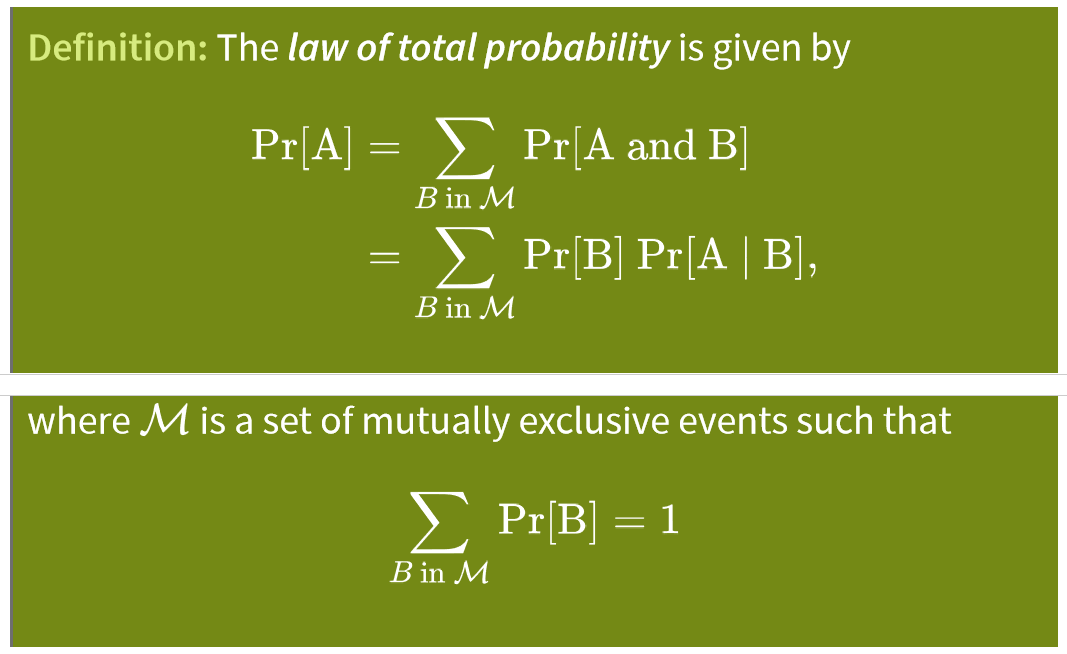
Law of total probability
the total probability of an event is the sum of the probabilities of the different ways it can occur
hypothesis
a clear statement articulating a plausible candidate explanation for observations
hypothesis testing
compares data to what we would expect to see if a specific null hypothesis were true
p-value
probability of obtaining the data (or more extreme) if the null were true
significance level (α)
probability used as criteria for rejecting the null
if the p is low, reject the Ho
NOT the same as biological importance
Type 1 error
Falsely claiming significance; rejecting the null when the null is true
In the power of the researcher cause we set α
pr [reject Ho| true Ho] = α
Type 2 error
Failing to reject a false null
pr [ not rejecting Ho | false Ho] = ß
Statistical Power
probability of correctly claiming significance
pr [reject Ho| false Ho] = 1 - ß = 1 - pr [ type II error]
Standard Error for a proportion
On formula sheet
SE= sqrt (p-hat(1-p-hat))/n
Wald’s Confidence Interval
NOT on formula sheet
p-hat ± 1.96SE
Acresti-Coull CI
On formula sheet
p’ ± sqrt ( (p’ * (1-p’))/ n+4)
where p’ = (X + 2)/(n + 4)
X = number of successes
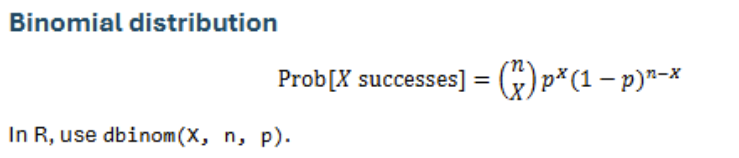
Binomial distribution formula
On formula sheet
Binomial mean
mu = np
Binomial variance
sigma squared = np (1-p)
Binomial standard deviation
sigma = sqrt(np (1-p))
binomial standard error
SE = sqrt ((p*(1-p))/n
Binomial p-value
2 * sum (pr[ extreme values])

