Geo revision
 Call Kai
 Learn
Learn Practice Test
 Spaced Repetition
 Match
Match Flashcards
 Knowt Play
1/124

Earn XP
Description and Tags
:)
Name | Mastery | Learn | Test | Matching | Spaced | Call with Kai | Chat |
|---|
No analytics yet
Send a link to your students to track their progress
125 Terms
List of structure from inside to outside:
inner core, outer core, mantle, crust
Crust thickness
5-50 km
Mantle thickness
2900 km
Outer core thickness
2200 km
Inner core thickness
1300 km
Crust temperature
Increases with depth between 0-400 degrees celsius
Mantle temperature
1400-3000 degrees celsius
Outer core temperature
4000—6000 degrees celsius
Inner core temperature
5000-6000 degrees celsius
Crust - what is it made up of?
It is made up of solid rock of two types - the Oceanic which carries water and the Continental which carries land.
Mantle - what is it made up of?
It is made up of solid material that can flow slowly. The semi-molten rock is called magma. The upper portion is a weak layer called the asthenosphere, which can deform like plastic.
Outer core - what is it made up of?
Liquid iron and nickel
Inner core - what is it made up of?
Solid iron and nickel
Constructive (Divergent) plate boundaries: Plates are moving _______ (diverge). As they move apart a ______ is created between the ______. Magma rises from the mantle and plugs this gap creating ______ ridges.
apart, gap, plates, mid-ocean
Features of Constructive Plate boundary:
Mid-ocean ridge volcano
Example of Constructive Plate boundary:
North American plate and Eurasian plate move apart to create the Mid-Atlantic ridge
Destructive (convergent) - subduction zone: An oceanic and _______ plate move towards each other (converge). As they come together the ______ plate is _______ under the ______ plate creating a deep sea ______. As the plates pass ________ occurs. This creates ______. This builds and creates _________ when it is suddenly released. The _______ _______ in the _____ melts and the extra molten rock (magma) finds weaknesses in the continental plate and rises to create ___________.
continental, oceanic, forced, continental, trench, friction, pressure, earthquakes, oceanic plate, mantle, volcanoes
Destructive (convergent) - subduction zone features
Deep sea trench, subduction volcano, earthquakes
Destructive (convergent) - subduction zone examples
Nazca plate and South American plate move towards each other to create the Andes Mountain range and the Peru-Chile deep sea trench
Destructive (convergent) - collision zone: Two _________ plates move towards each other (_____). As they come together the two plates _______, forcing the land to ________ and create ___________.
continental, converge, crumple, buckle, fold mountains
Destructive (convergent) - collision zone features
Fold mountain, earthquakes
Destructive (convergent) - collision zone example
Indo-Australian plate and Eurasian plate come together to create the Himalaya mountains
Conservative plate boundary: Two plates are moving _______ each other - this can be in the same _______, different _________ or at different _______. As they move ________ each other, the movement is not smooth - ___________ allows __________ to ________. The sudden _______ of ________ creates earthquakes.
past, direction, directions, speeds, past, friction, pressure, build, release, pressure
Conservative plate boundary features
Earthquakes
Conservative plate boundary example
Cocos plate moves past the North American plate at the San Andreas faul
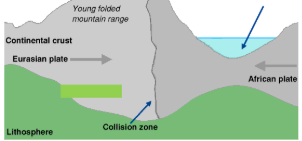
What type of plate boundary is this image?
Destructive (Convergent) - collision zone
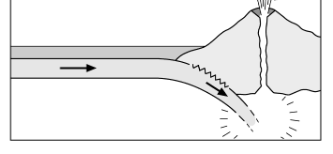
What type of plate boundary is this image?
Destructive (convergent) - subduction zone
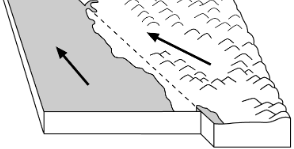
What type of plate boundary is this image?
Conservative plate boundary
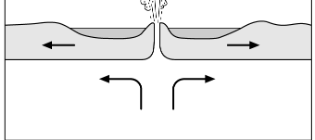
What type of plate boundary is this image?
Constructive (Divergent plate boundary)
1st step of convection currents:
Heat from the inner core, generated by radioactive decay, heats the mantle
2nd step of convection currents:
Magma in the mantle, heated by the inner core, rises towards the top of the mantle
3rd step of convection currents:
As the magma moves under the crust it drags and pulls the tectonic plates with it.
4th step of convection currents:
The magma cools and sinks back to the inner parts of the mantle and the convection currents start all over again.
Conduction:
Heat energy can move through a substance (solids) by conduction.
Conduction is the process by which heat energy is transmitted through collisions between neighboring atoms or molecules
Convection:
Liquids and gases are fluids. The particles in these fluids can move from place to place.
Convection occurs when particles with a lot of heat energy in a liquid or gas move and take the place of particles with less heat energy.
Radiation:
All objects give out and take in infrared radiation.
Infrared radiation involves waves. No particles are involved, unlike in the processes of conduction and convection, so radiation can even work through space.
Which of the 3 processes occur in the inner core?
solid - so conduction
Which of the 3 processes occur in the outer core?
Liquid - so convection
Which of the 3 processes occur in the mantle?
Solid but behaves in a plastic fashion so convection occurs here too.
Which of the 3 processes occur in the crust?
Solid so conduction occurs, but because it is connected to the mantle below and when that is moving the Crust actually moves around too.
Is it shield volcanoes or composite volcanoes that have very gentle eruptions and no volcanic bombs?
Shield Volcanoes
Is it shield volcanoes or composite volcanoes that have Mauna Loa as its example?
Shield volcanoes
Shield volcanoes have ____, _________ lava that moves very _________. This lava runs downhill __________ and has spread over a long distance when it ________. Because it travels very ____, when it sets at the ________ of the volcano it makes it ______ (its dome-like shape). Its slopes are very gentle.
thin, runny, quickly, quickly, cools, far, base, wide
Shield volcanoes are only made of _______ which escapes through a ______ ______________. This means more _______ can reach the surface.
lava, very large, vent, lava
Composite volcanoes: They have very ______ eruptions which force _____ ________ out of the ______.
violent, volcanic, bombs, vent
Composite volcanoes: They have layers of _____ and ________. These form when a solid plug of _________ is blasted out of the vent of a volcano and the fragments of it settle as _____. The lava can then ______ until it ______ down and forms a new layer on top of the ____ and a _________ _________.
lava, ash, lava, ash, flow, cools, ash, new, plug
Composite volcanoes: Have a _____ base due to the _____ _______ _______ which sets before it travels ____ - this causes ______ sides.
narrow, slow, moving, lava, far, steep
Composite volcanoes: The lava, which is ____ as ______, escapes through many ______ and ___________ ________.
thick, treacle, vents, secondary, cones
Composite volcanoes: They also cause ______ (mudflows) which can happen when _______ / melted snow mixes with the _____. As well as this they may have a ___________________ flow instead of a lava ______ (_______ flows are a mixture of hot _____, ash, ______ and dust)
lahars, rain, ash, pyroclastic, flow, pyroclastic, steam, rock
A tsunami is..
a series of ocean waves, sometimes reaching heights of over 30 m, onto land.
How are tsunamis triggered?
They are triggered by an earthquake or volcanic eruption underneath the sea.
For magnitudes under 6.5 -
unlikely to cause a tsunamis, not strong enough
For magnitudes between 6.5 and 7.5 -
Earthquakes of this size do not usually produce destructive volcanos. However, small sea level changes may be observed in the vicinity of the epicentre.
For magnitudes greater than 7.5 -
May produce a tsunami, depending on the type and direction of the ‘thrust’ of the earthquake.
Result of the boxing day tsunami 2004: The cause of the tsunami on ____ ____________ 2004 was a very violent earthquake of a magnitude of _____. It originated on a ______ in a _______ area between the Indo-_________ plate and the ________ plate. Its hypocenter was at a depth of about ____ km, 160 km east of Sumatra. The death toll was approximately __________ in _____ countries. The cost of damage was ______ billion dollars. The people homeless were _______.
26, December, 9.3, fault, subduction, Australian, Burma, 30, 275,000, 14, 9.9, 500,000
Belief of the geographical Structure of the Earth: a very large ________ struck Earth, knocking a chunk of the Earth’s ________ out. Part of this began to ______ around the Earth, namely the _____. The creation/formation of the ___, via the crash, _________ Earth. Therefore as the Earth spun, while orbiting the _______, one ________ was exposed to the sun, ______, while the other faced away from the sun, ______, temporarily. This created the _______. After a couple hundred million years, the Earth reached _______ degrees celsius, due to _______ collisions, ___________ decay and planetary __________. When the mostly molten Earth cooled down, it formed the ________ and the ________ of the Earth. These triggered plate __________.
planetismal, crust, orbit, moon, moon, tilted, sun, hemisphere, Summer, Winter, seasons, 2000, meteorite, radioactive, compression, mantle, crust, tectonics
Stage 1 of a tsunami: Tsunamis are caused by…
earthquakes at sea which occur when plates suddenly move against each other.
Stage 2 of a tsunami: A Tsunami forms when…
energy from a earthquake vertically jolts the seabed by several metres displacing hundreds of cubic kilometres of water.
Stage 3 of a tsunami: Large waves begin…
moving through the ocean away from the earthquakes epicentre.
Stage 4 of a tsunami: In deep water a tsunami moves very quickly. When it reaches shallow water near the coastal areas…
it slows but increases in height.
Stage 5 of a tsunami: Sometimes there is no/little warning that a tsunami is approaching. The only sign comes just before the tsunami strikes (when the…)
waterline suddenly retreats, exposing hundreds of metres of beach and seabed.
Stage 6 of a tsunami: The several waves of a tsunami come at…
intervals between 5 - 40 minutes, and can reach up to 1km inland.
The oceanic crust is the ____, dense, and young outermost solid layer of Earth that forms the floor of the ocean ______. It is primarily composed of dark, _______ basaltic rocks, typically measuring 5–10 km thick, and is constantly created at __________ ridges and destroyed at ________ zones.
thin, basins, igneous, mid-ocean, subduction
__% of Wildfires are human caused…
90
Ignition sources include… (8 in total) L_______/ B___________/ V__________ E__________/ D____________ C____________/ F______________ P_________________ C______________/ C_________/ V_________________/ A_______________ F__________________ T_______________ G_________________ O__________________ O_ C________________
lightning, BBQs, volcanic eruptions, dropped cigarettes, fallen power cables, campfires, deliberately started by vandals and agricultural fires that get out of control
What is the fuel for wildfires?
A large amount of dry vegetation
Which conditions favour wildfires?
Strong winds, steep slopes, drought, lots of vegetation, lightning storms
What is wildfire the generic name for?
An uncontrolled rural fire.
Steps for a wildfire to occur: It is an unusually or overly dry day. An _______ source starts a small fire. Ambient winds push the fire ______ the slope and heat from the fire ______ and dries out the fuels ( large amounts of ____________) uphill, making them too easily ________ by the moving fire.
ignition, up, rises, vegetation, flammable
Which areas have the most high probability of having wildfires?
Areas above and below the equator
Is soil erosion a local, regional, national or global effect of wildfires?
local
Is reduced air quality a local, regional, national or global effect of wildfires?
regional
Are government costs to reduce fire risk a local, regional, national or global effect of wildfires?
national
Is risk to life a local, regional, national or global effect of wildfires?
local
Is disturbance of air travel a local, regional, national or global effect of wildfires?
global
Is disruption to transport a local, regional, national or global effect of wildfires?
local
Are government costs to reduce fire risk a local, regional, national or global effect of wildfires?
national
Is reduction in water quality a local, regional, national or global effect of wildfires?
local
Is reduced air quality a local, regional, national or global effect of wildfires?
regional
Is loss of crops a local, regional, national or global effect of wildfires?
local
Are health impacts a local, regional, national or global effect of wildfires?
regional
Is the release of CO2 contributing to the greenhouse effect a local, regional, national or global effect of wildfires?
global
Are impact on tourism a local, regional, national or global effect of wildfires?
regional
Are temporary changes to weather patterns a local, regional, national or global effect of wildfires?
global
Is loss of habitat a local, regional, national or global effect of wildfires?
local
Are government costs of redevelopment a local, regional, national or global effect of wildfires?
national
Is damage to property a local, regional, national or global effect of wildfires?
local
Steps to prevent wildfires: (before)(3)
Burning trees / fallen leaves, creating firebreaks, increasing gaps between houses and vegetation
Steps to prevent wildfires: (during)(3)
Beat out flames in the ground, spray fire with water and retardants from the ground and air, and bulldoze breaks in vegetation
Steps to prevent wildfires: (after)(3)
Repair damage, replant trees, prepare people for the next fire
Japan’s Tsunami Case study: what caused it?
A very violent earthquake of magnitude 9
Japan’s Tsunami Case study: social impacts: Many lives were ____, families were ____ apart, people ____ their homes and prized belongings potentially as well, it induced in survivors _____, fear and shock, could have caused life-long ______ to survivors, any people that survived the tsunami could have been swallowed up by the _______ that grew from the aftermath of the tsunami.
lost, torn, lost, trauma, injuries, flames
Continental crust is the _____, buoyant, and relatively low-density layer of rock that forms Earth's ________ and shallow continental shelves. Primarily composed of granite, it has an average thickness of __-70 km, is __ dense than oceanic crust (2.7g/cm3 approx. ), and contains the oldest __ on Earth.
thick, continents, 30, less, rocks
Japan’s Tsunami Case study: economic impacts: Many ________ lost their property and may have had to close down, homes and ________ were lost, public services like _______ _________ were destroyed / covered in ______ and to redevelop the government would face economic ____, and ____ which had been a hub for many _______ was now destroyed.
businesses, vehicles, train stations, rubble, loss, ports, jobs
A HDI is a summary _______ of average ______________ in key dimensions of human __________: a long and healthy ____, being _____________ and having a decent _________of living.
measure, achievement, development, life, knowledgeable, standard
In HDI’s the health dimension is assessed by life ________ at birth, the education dimension is measured by ____ of years of _______ for adults aged 25 years and more and _______ years of schooling for children of school entering ____.
expectancy, mean, schooling, expected, age
In HDI’s the standard of living dimension is measured by gross national ________ per _______ (a measure of the ________ income earned by a country’s ________)
income, capita, average, residents
HDI stands for…
Human Deveopment Indicator
HDI’s are used to question national _____ choices, asking how two countries with the _____ level of _____ per _____ can end up with different human development ___________. These contrasts can cause _________ about government policy _________.
policy, same, GNI, capita, outcomes, debate, priorities

The GDP per capita is the country’s economic ________ per person, calculated by dividing the ________ GDP by its total ________.
output, country’s, population