VIS 120A: Greek Art Final Exam
 Studied by 0 people
 Call with Kai
 Learn
Learn Practice Test
 Spaced Repetition
 Match
Match Flashcards
 Knowt Play
1/59

There's no tags or description
Looks like no tags are added yet.
Name | Mastery | Learn | Test | Matching | Spaced | Call with Kai |
|---|
No study sessions yet.
60 Terms
Classical Greece (Historical Context)
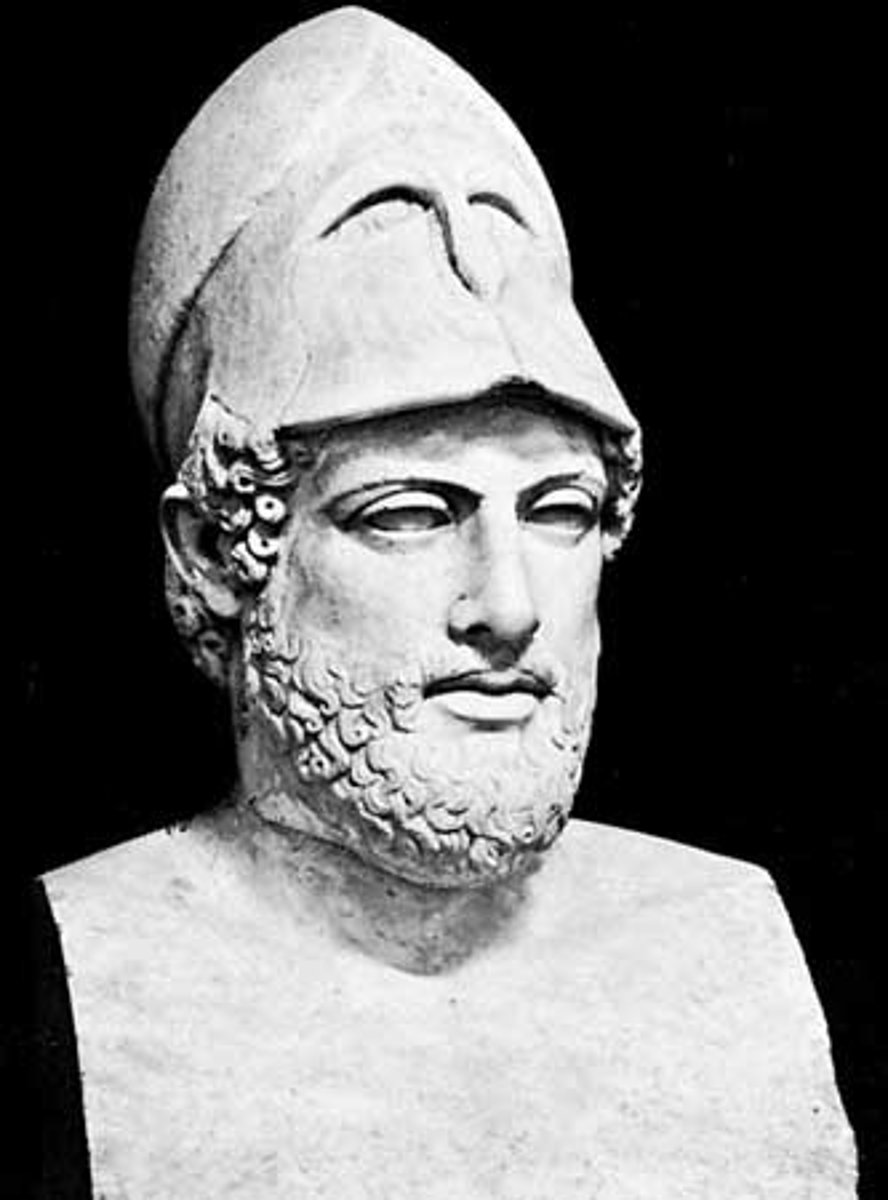
Portrait of Pericles (Roman Copy) - Classical
- Commemorative statue; Romans just copied the head, original would've been nude & Bronze
- Expressionless: No individualism, just idealism
- Pericles' goal: Beautify Athens & Stimulate the Athenian Economy w/ money from the Delian League
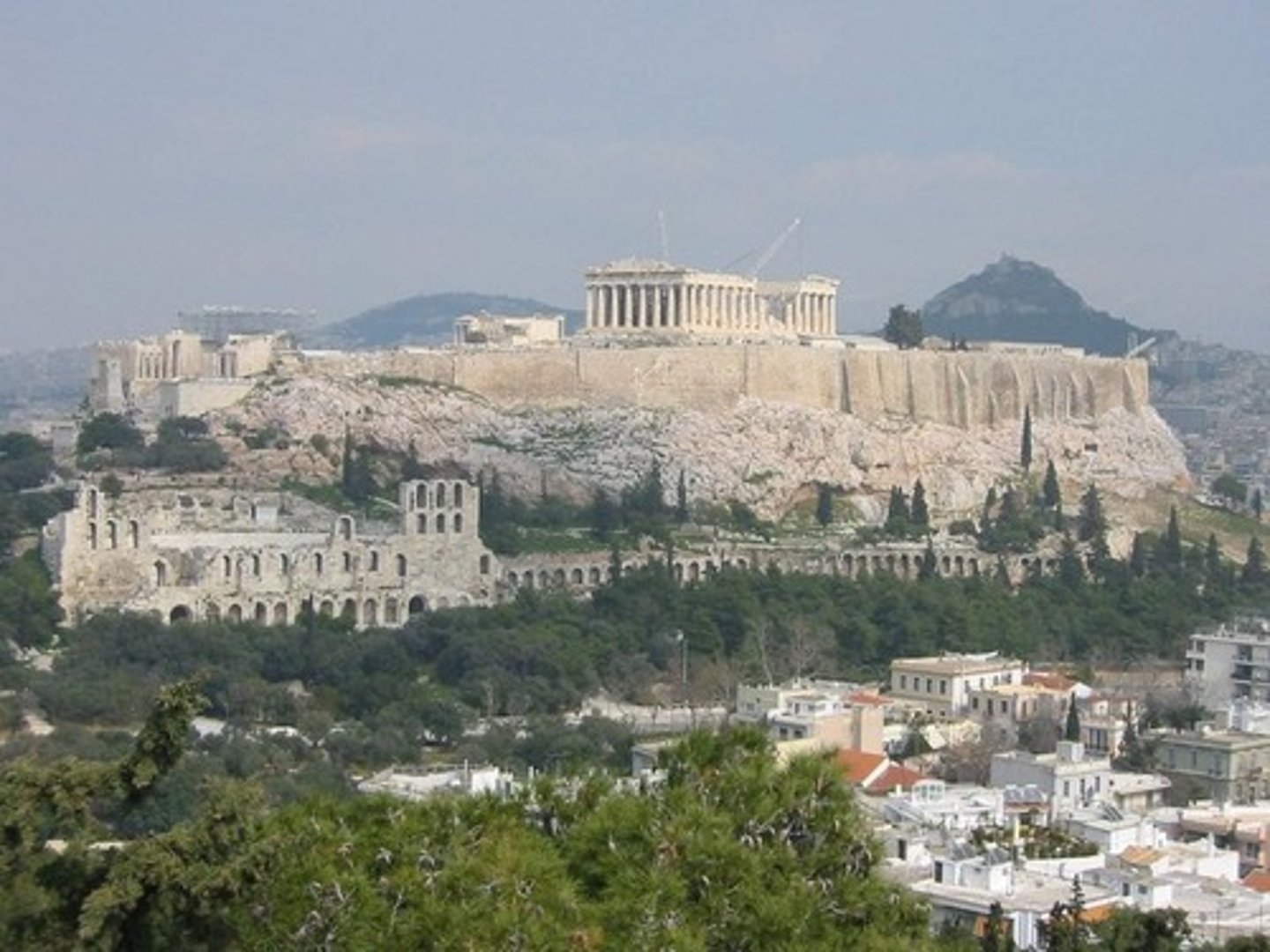
Athenian Acropolis (Rebuilt) - Classical
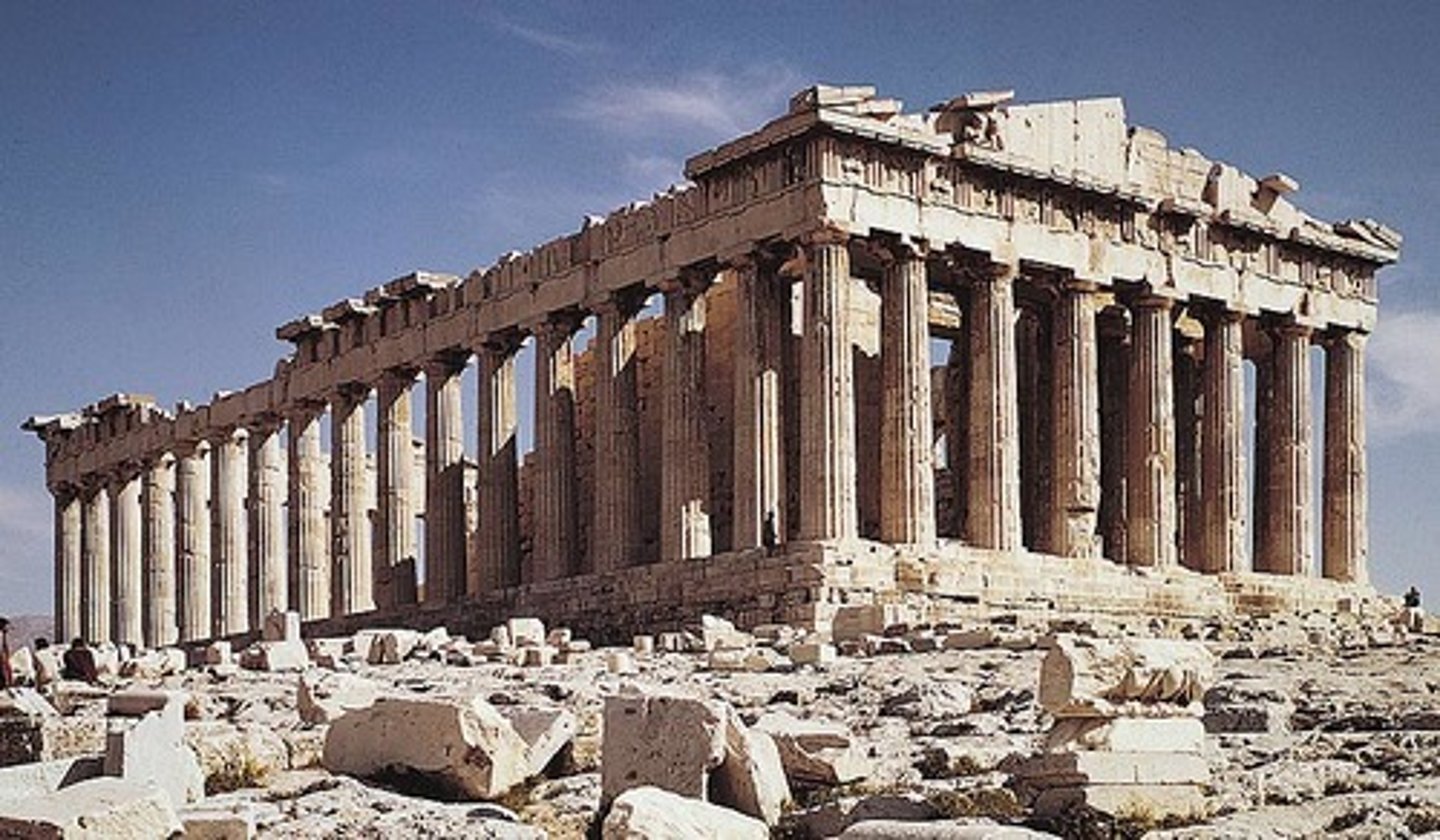
Parthenon - Classical (from the Acropolis)
- Doric temple exterior with Ionic Elements on the Interior; Doric order columns form the Peristyle, Ionic continuous frieze along inner chamber cella
- Political Statement: Athenians lead all Greeks
- No straight lines; very slight curves -> Correct optical distortions
- Symbol to the birth of democracy
- Function: Temple to Athena, Treasury (hold money form Delian League)
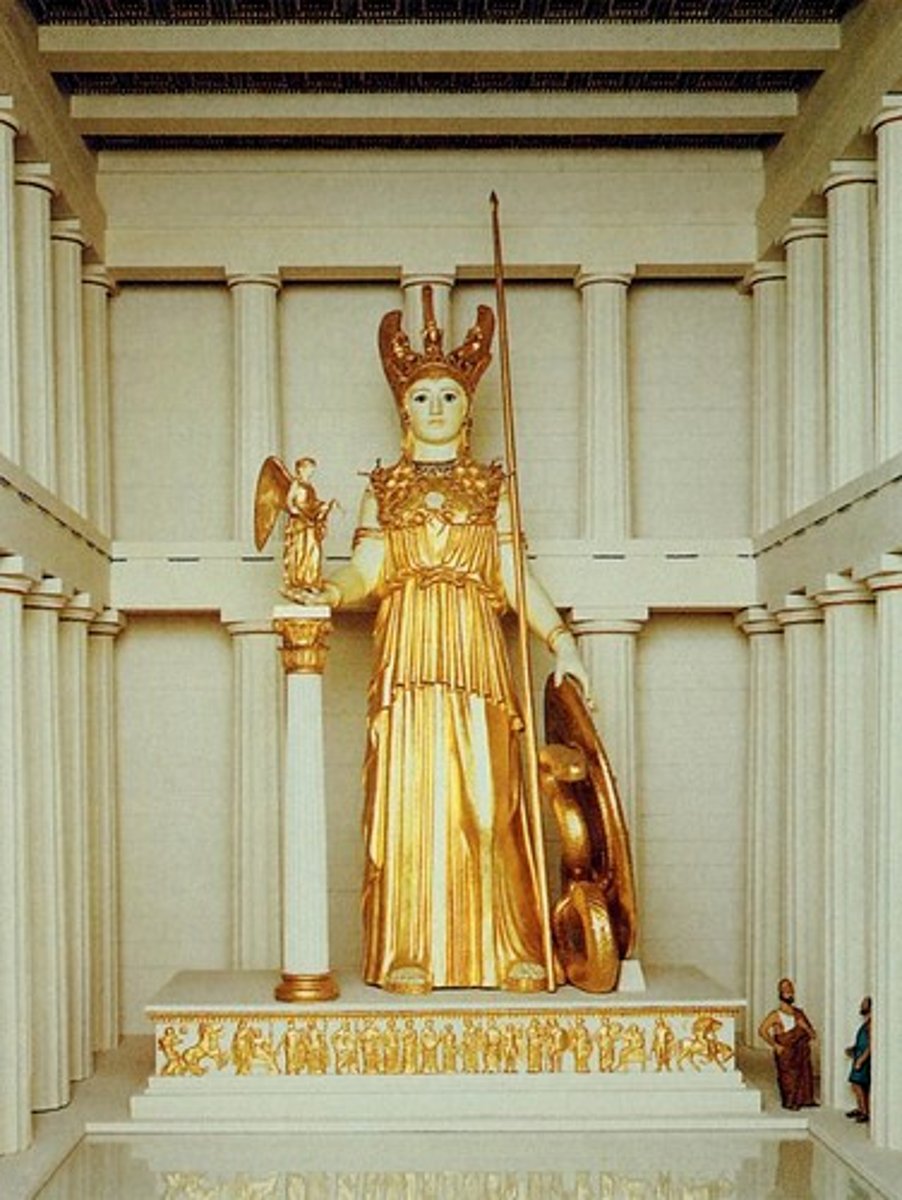
Statue of Athena Parthenos - Classical (from the Parthenon)
- "Athena the Virgin"
- 40ft tall; ivory & gold
- Acts as an Emergency bank; gold is removable but must be replaced
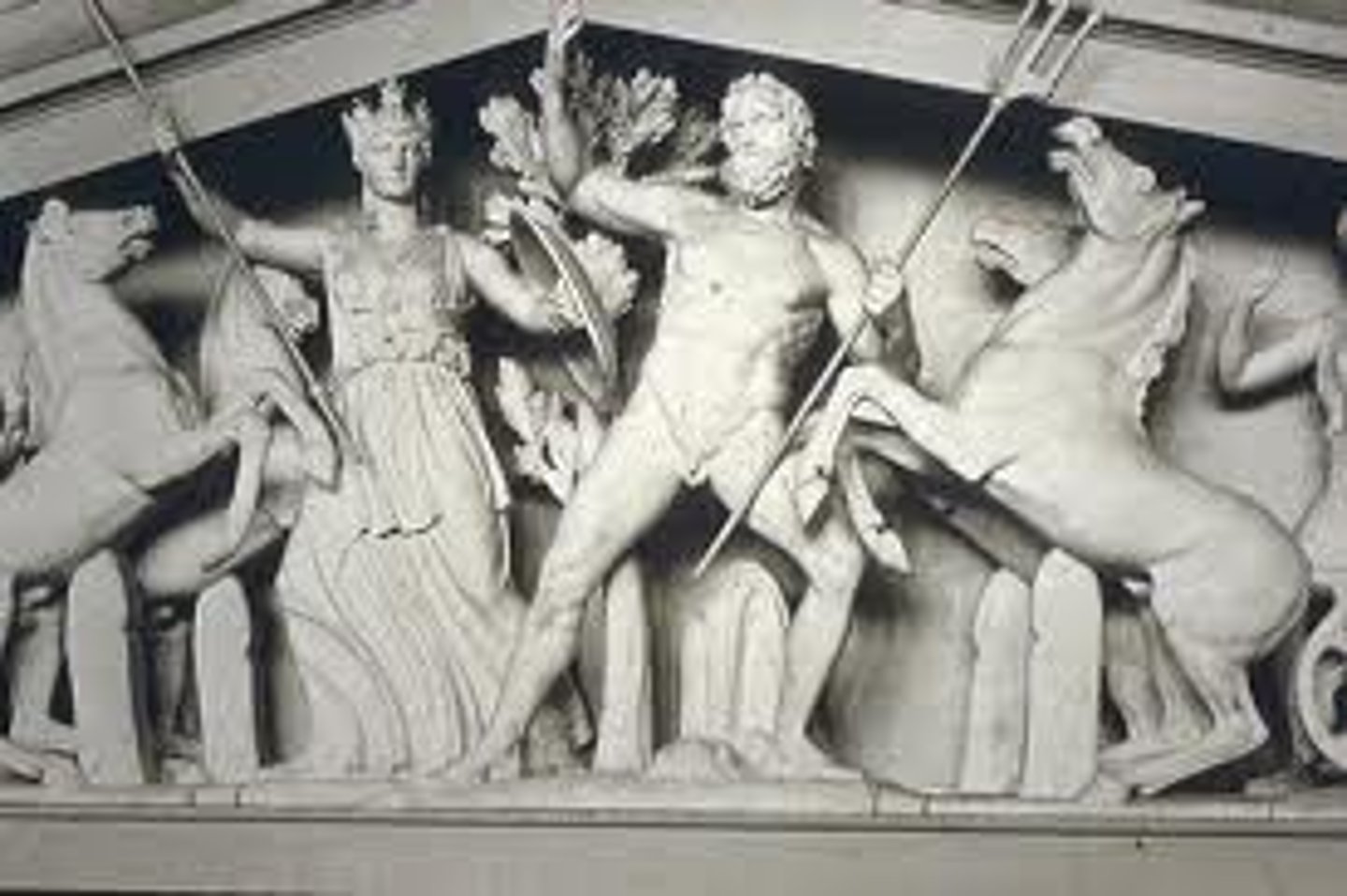
West Pediment: Contest of Athena and Poseidon for Athens - Classical (from the Parthenon)
- Chariot Race? Athena wins & an olive tree grows; Poseidon strikes his triton into the ground in frustration
- Best gift to man-kind? Poseidon gives horse (Expensive: requires food & water) Athena gives Olive Tree (Provides: Shade, food, oil for cooking; Symbol for Democracy)
- Idea: Athens is such a wonderful city that these great gods are competing to represent it
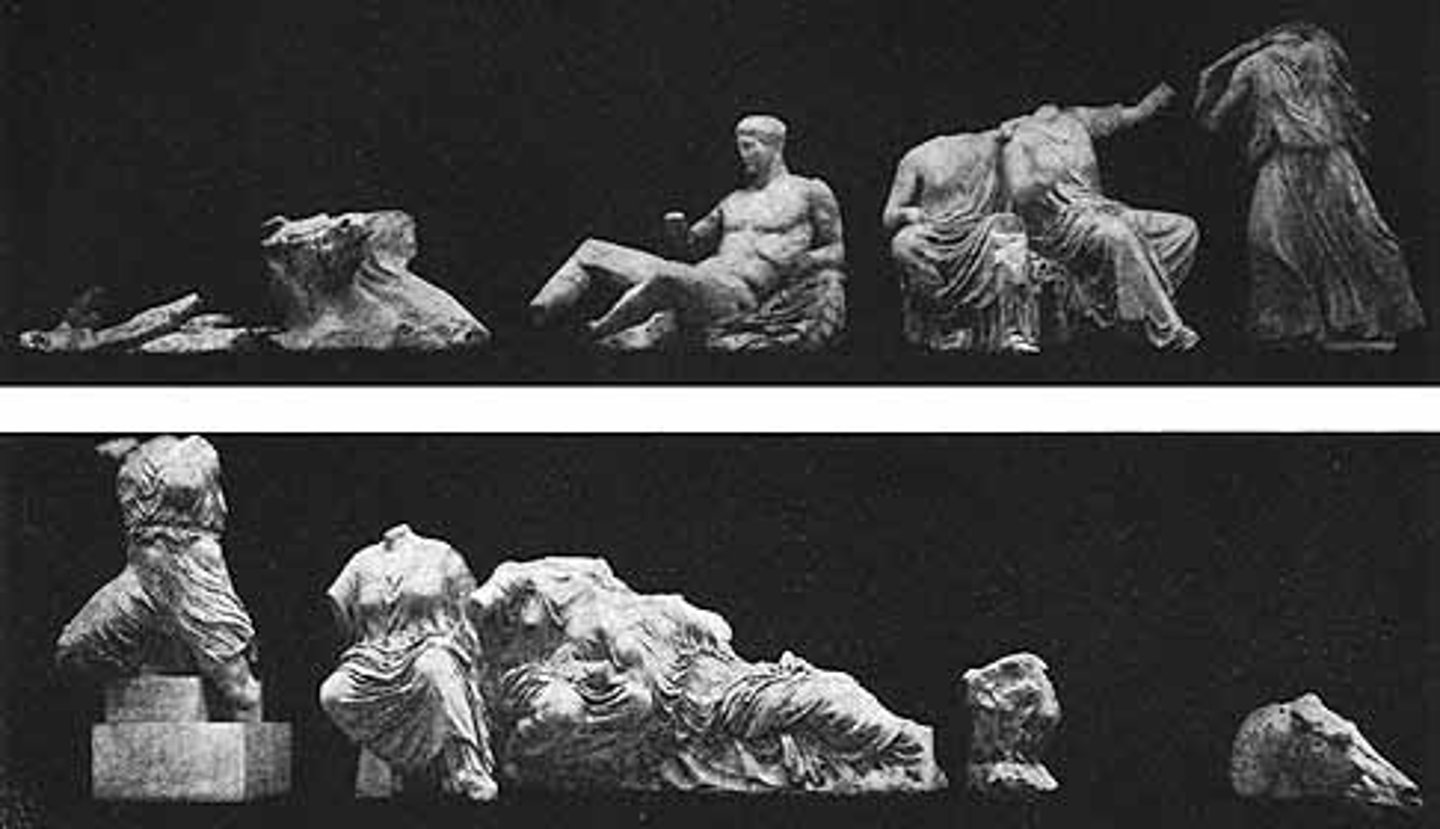
East Pediment: Birth of Athena, Classical - (from the Parthenon)
- According to myth: Zeus had a headache because Athena was in his head (fully grown and wearing a full suit of Armor)
- Hestia (Hearth), Aphrodite (Love & Sex), and her mother Dione are present; Emphasis on family groupings b/c birth scene
- Drapery creates drama
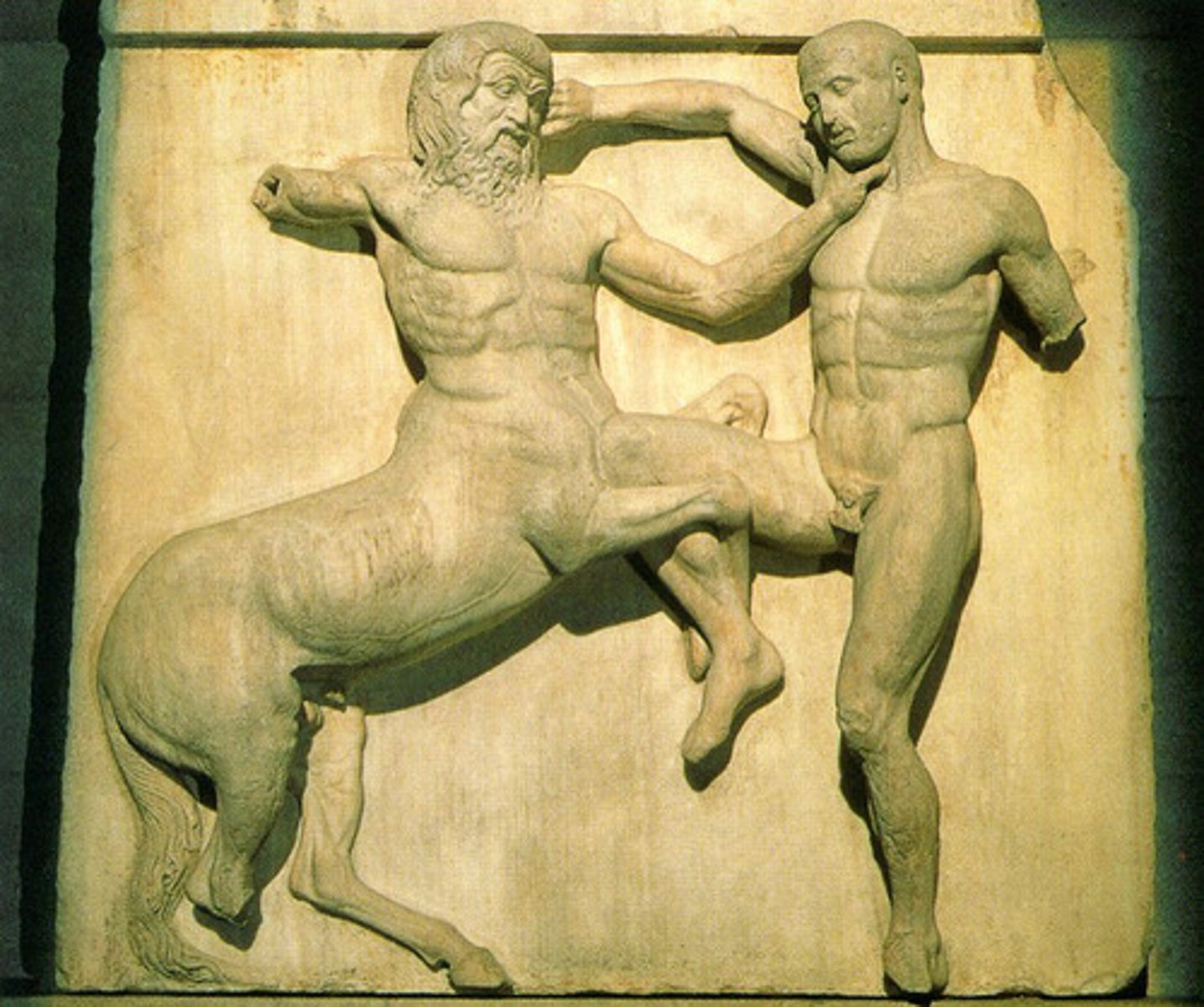
Metopes: Battles of Lapiths and Centaurs (Largely destroyed: Gods vs Giants, Greeks vs Trojans, Greeks vs Amazons) - Classical (from the Parthenon)
- Good vs Evil
- Metaphor for the destruction caused by the Persians & their barbarism
- Centaurs represent the animalistic Persians; grotesque face: he is ruled by his emotions
- Centaur grabs lapith by his throat; lapith remains expressionless and calm & in control
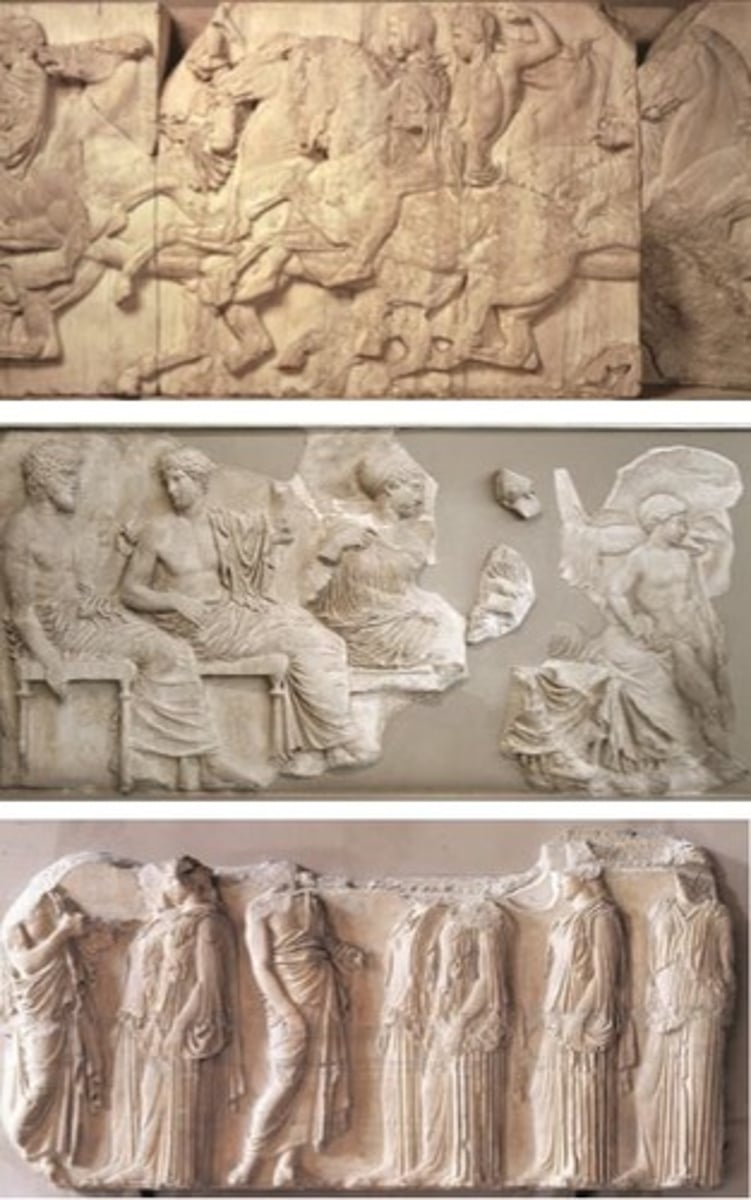
Frieze: Panathenaic Procession (?), Seated Deities - Classical (from the Parthenon)
- Ionic continuous frieze; shallow relief carvings
- Was hidden in the inner chamber along the ceiling, behind Doric columns
- Panathenaic Procession: Every citizen (even women) could participate in celebration of Athena's birthday
- The procession guides you from the back to the front (where the East pediment shows the Birth of Athena)
- Eternal celebration of Athena
- Athenians mingling with the gods? Perhaps the first Athenians from the first Panathenaic Procession who deserve to be recognized on temple
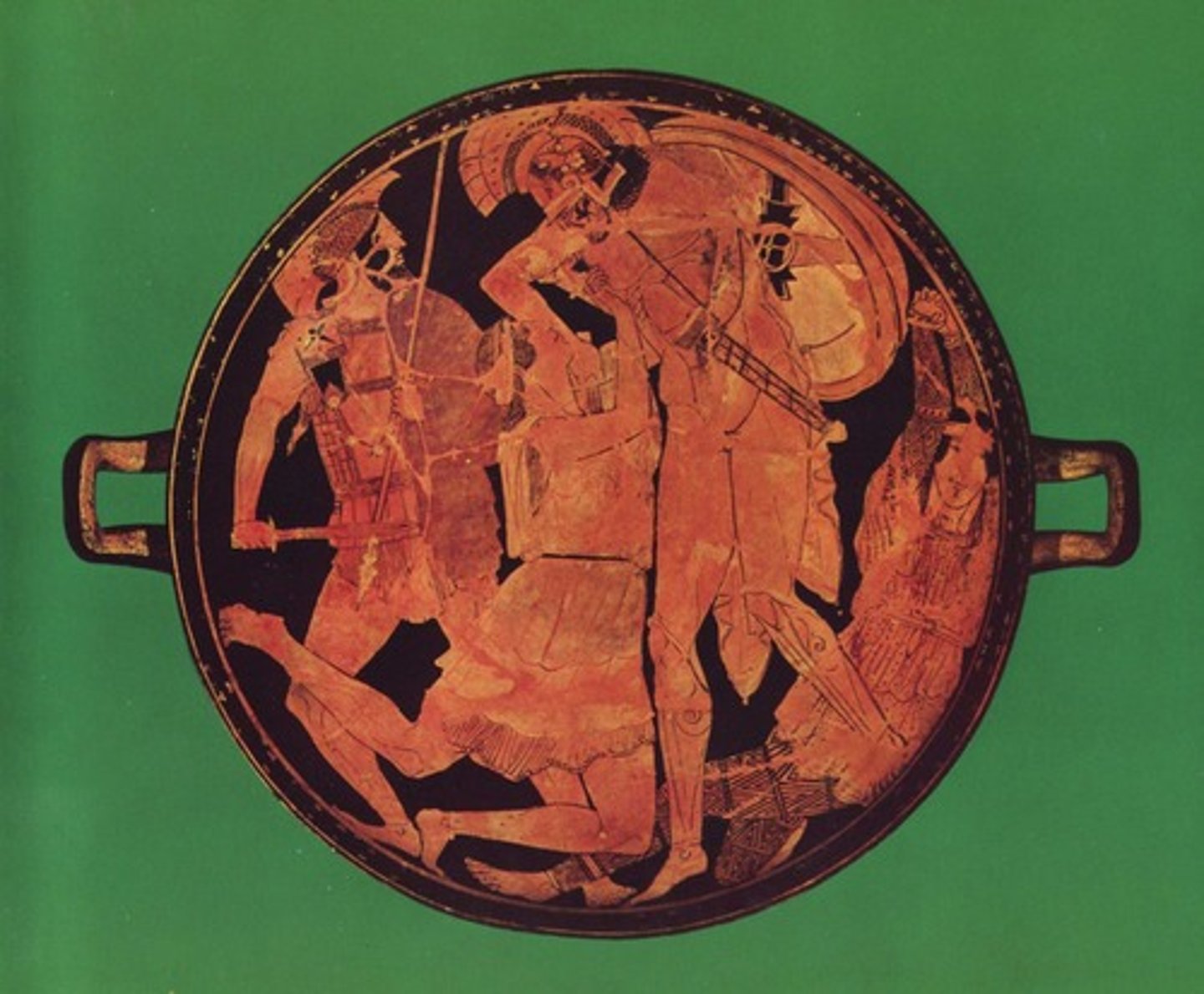
Achilles Killing Penthesila - Classical
- Penthesila = "Queen of the Amazons"
- Penthesila pleading w/ Achilles
- Erotic vibe; the artist was familiar with the possibility that they were falling in love in her last moments of life
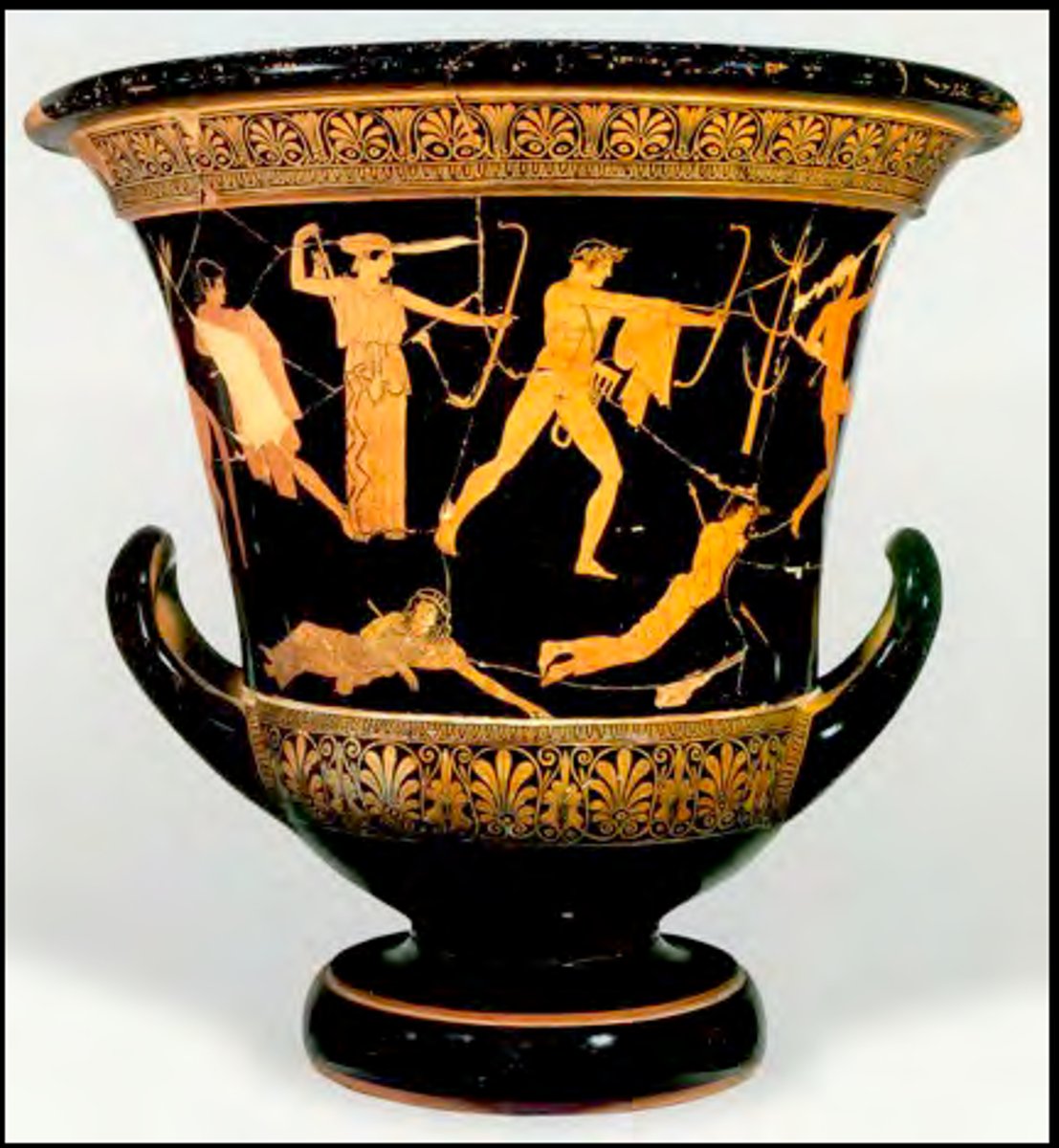
Slaughter of Niobe's Children, Heroes? - Classical
- Mixing bowl krater; red-figure
- Composition: scattered figures across field; sophisticated poses & showcase of depth
- Niobid = Granddaughter of Zeus; very fertile & wants to be worshipped because she has so many children opposed to Leo
- Leo is offended and sends her children (Apollo & Artemis) to Kill Niobe's children
- Niobid turns to stone from grieving
- Moral of the Story: do not offend the gods or compare yourself to the gods
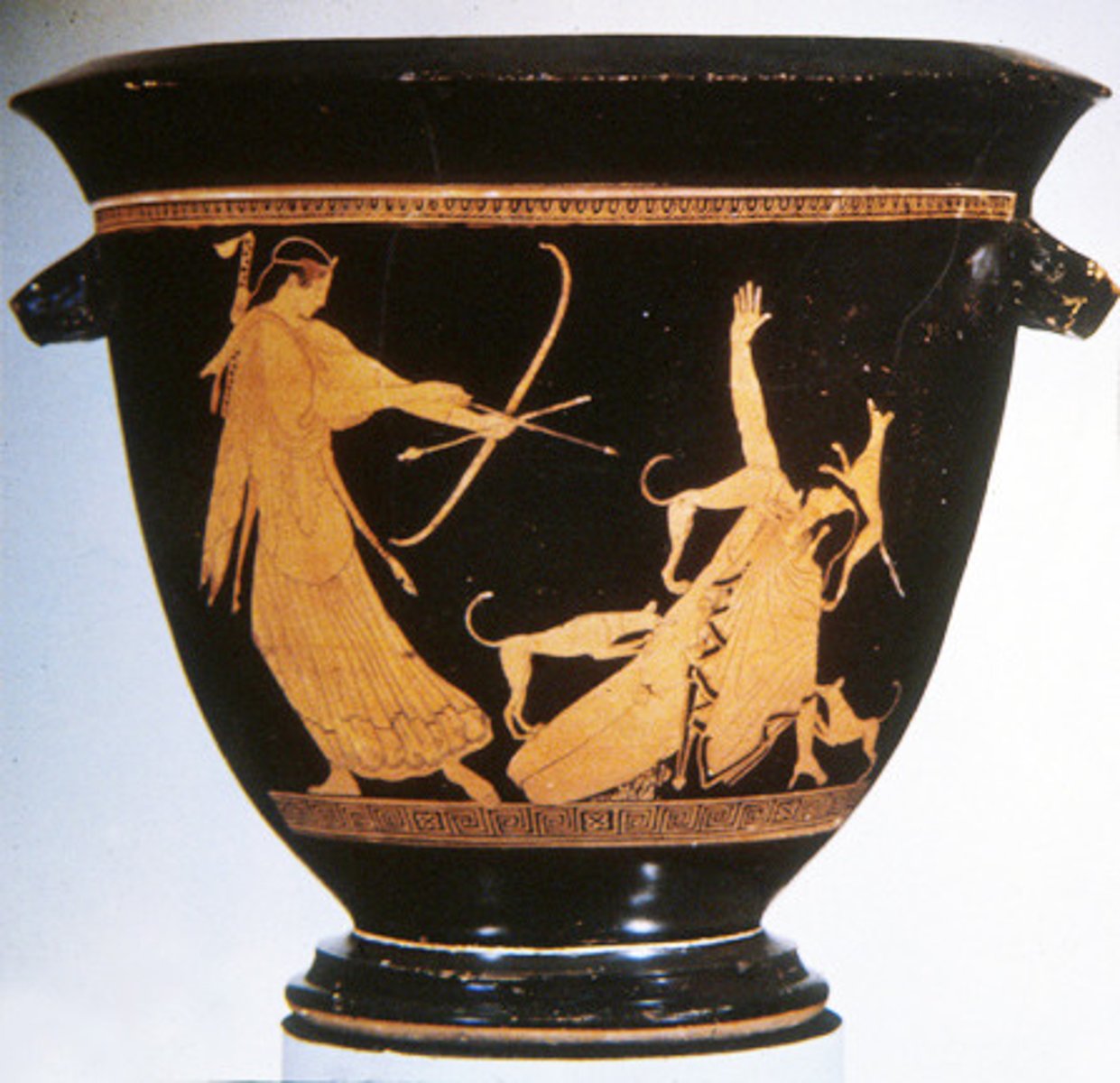
Artemis and Aktaeon = Classical
- Artemis: virgin goddess of hunters
- Aktaeon: famous hunter w/ big pack of dogs
- Aktaeon transgresses against Artemis (compares himself to her, wants to marry her, or sees her naked)
- she turns him into an animal and his own dogs tear him apart & kill him
- do not offend the gods!
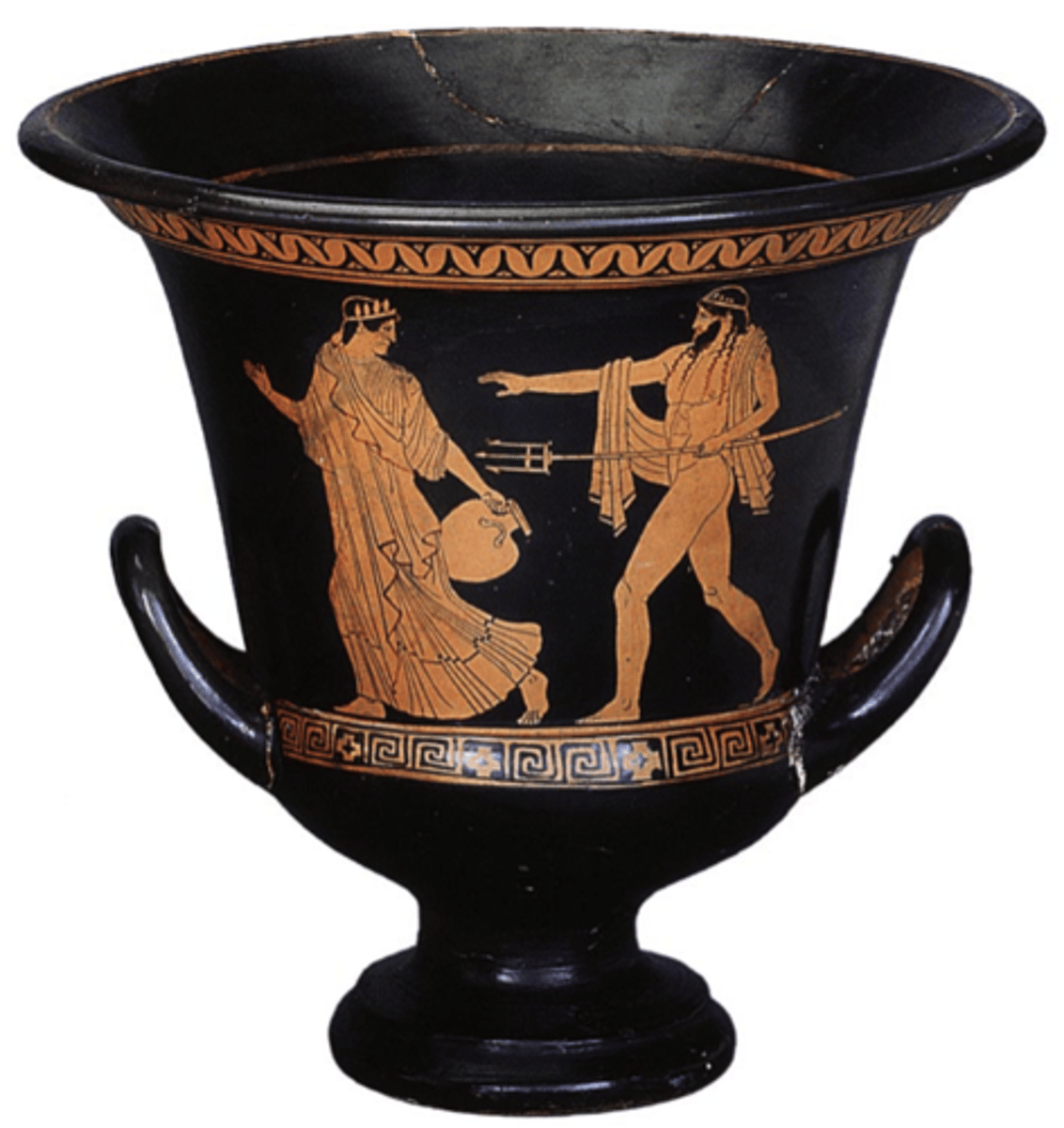
Poseidon and Amymone - Classical
- Princess Amymone's kingdom is in drought & her dad sends her out to get water
- Poseidon hunts her down & rapes her
- women compared to closed vessels in greek literature
- Amymone holds a closed vessel and points the opening toward Poseidon who is chasing behind her; this gestures that she is not completely opposed to his pursuit
- he turns her into a spring; drought solved
- story of a young woman who is sacrificed for the benefit of the community (Analogy for marriage as a deal between men for the benefit of the family)
- Made for Male enjoyment and viewing, probably in a symposium; images of women being receptive to their violence were appealing to men
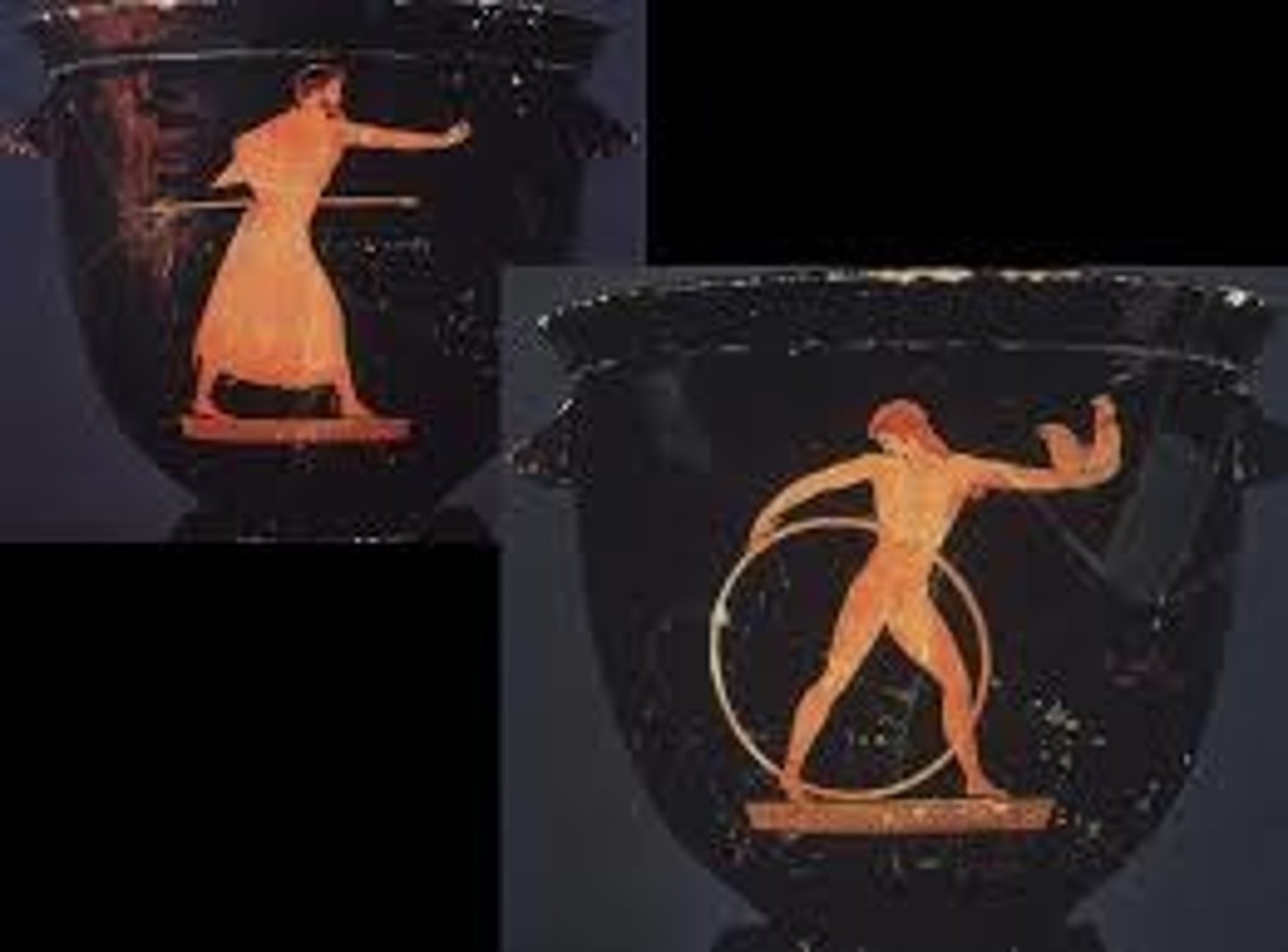
Zeus Pursuing Ganymede - Classical
- Zeus Pursues Ganymede
- Ganymede becomes a god himself
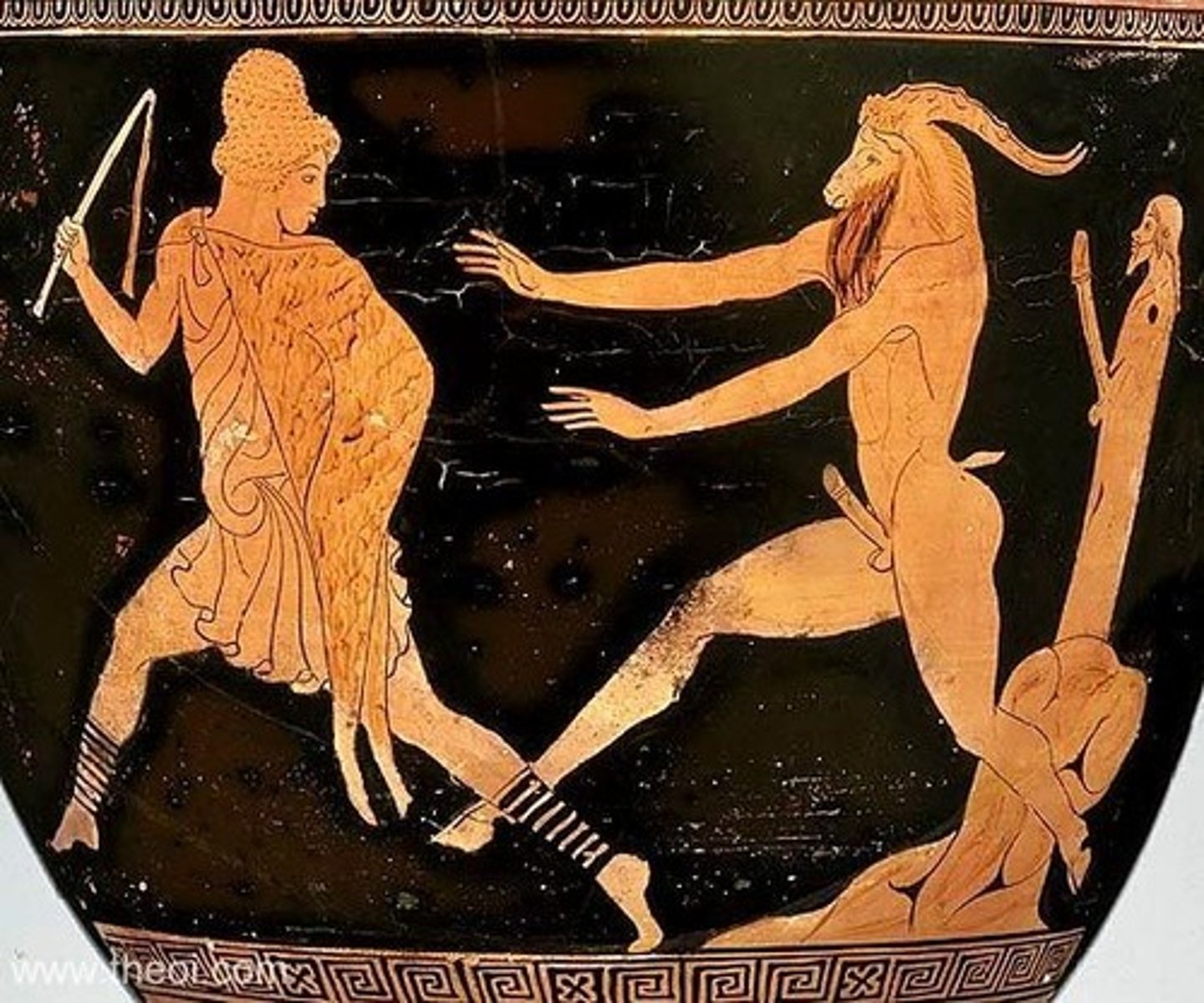
Pan Pursuing Goatherd - Classical
- Pan: son of Hermes (god of travelers); half-goat half-man; he's a god
- goatherds have bad reputation for committing bestiality with their goats; this is like the goats revenge
- communicates the power of the gods in a whimsical and humorous way
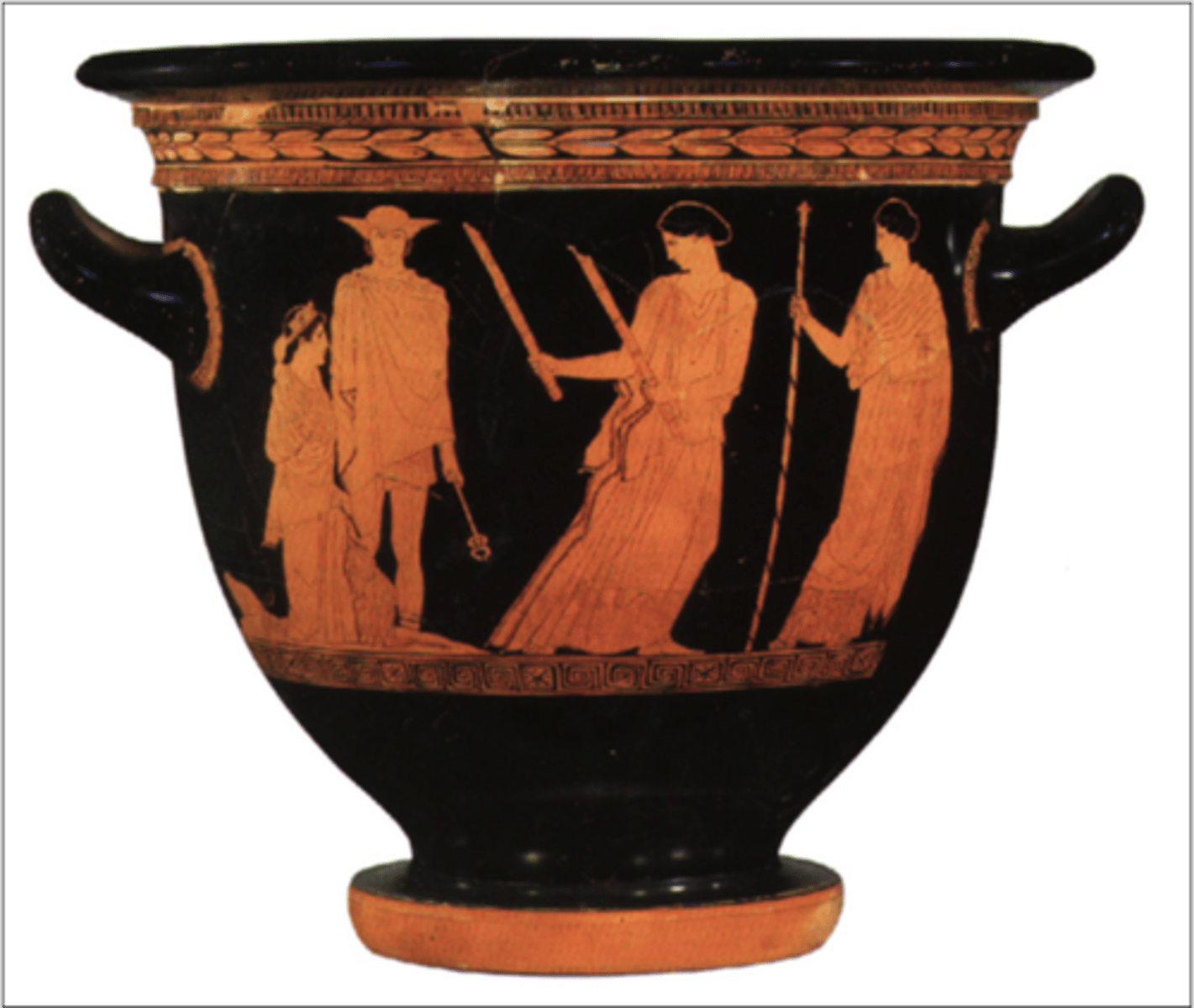
Demeter and Return of Persephone - Classical
- meant for male view in symposium
- Hades wants to marry Persephone; drags her into underworld
- Demeter (Persephone's mother and goddess of agriculture) grieves and lets everything die
- Zeus sends Hermes to bring Persephone back
- Persephone ate pomegranate seeds (forcefully by Hades?) so she must return to underworld for 3 months every year; eating the pomegranate seeds symbolize her losing her virginity; Demeter grieves again (seasons & winter)
- Metaphor for how marriage is a deal between men; women are voiceless
- Analogous to how women are ripped from their families and homes to marry a random man they may have never met before
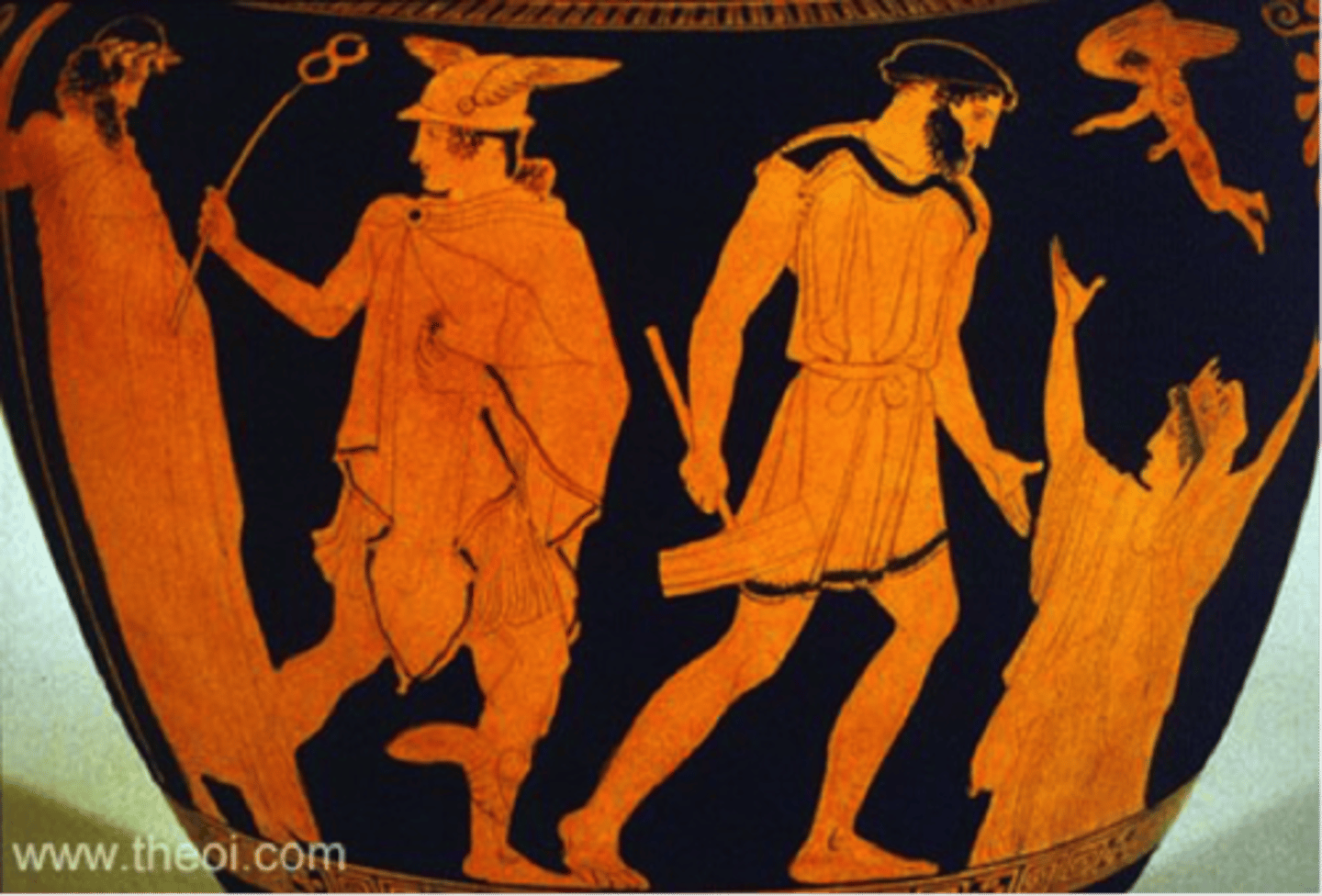
Group of Polygnotes, Birth of Pandora - Classical
- Pandora = "gift of all"
- before women: golden age; only men
- Zeus ordered Pandora's creation, the first woman
- She was sculpted of clay and given life by the gods who also bestowed traits to her.
- Aphrodite gave her beautiful looks and Hermes gave her a terrible personality
- She's given a vase and despite being told not to open it, she does, unleashing "death" and "suffering" into the world
- Portrays women as the plague of men
- Krater mixing bowl; likely for male view in a symposium
- Men are stuck with women because they want male heirs
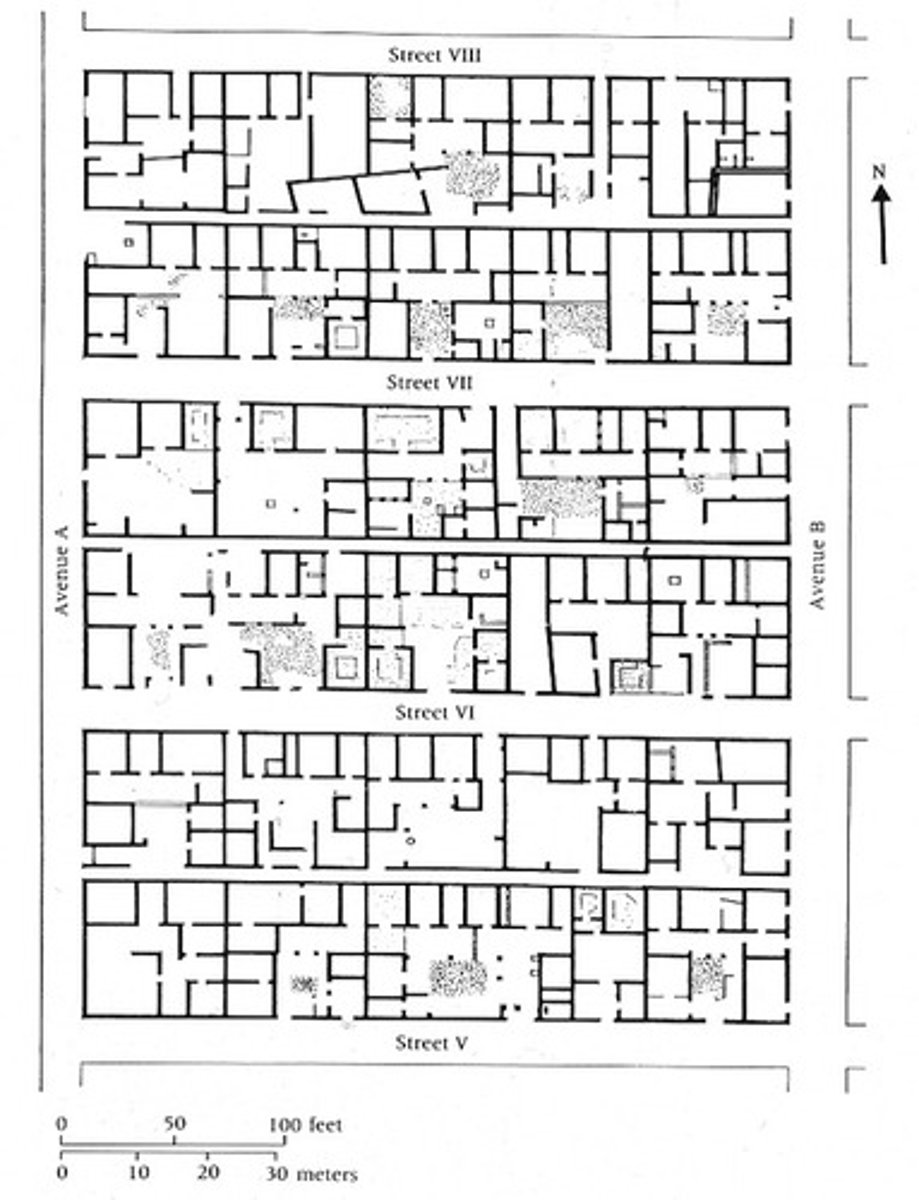
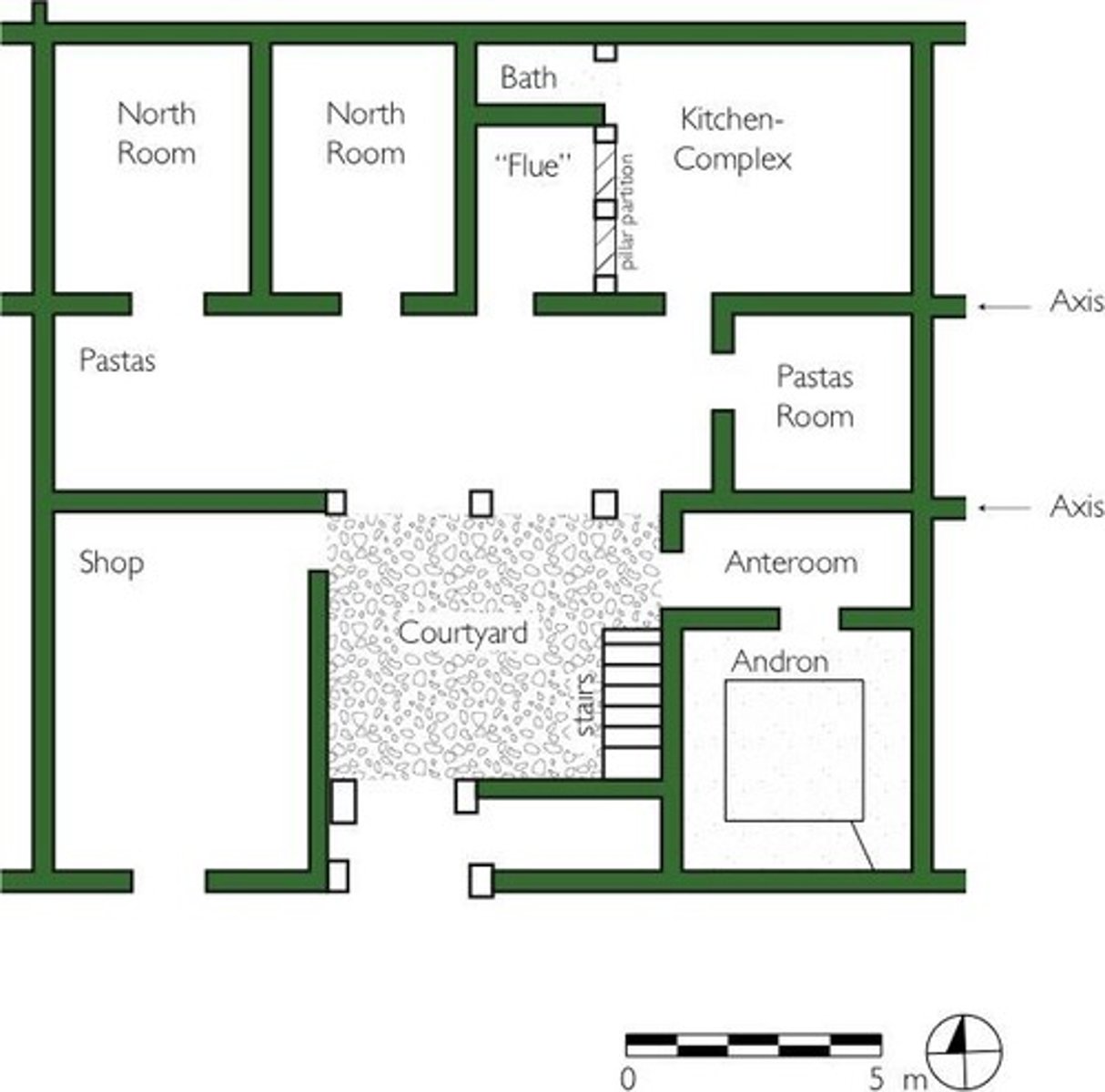
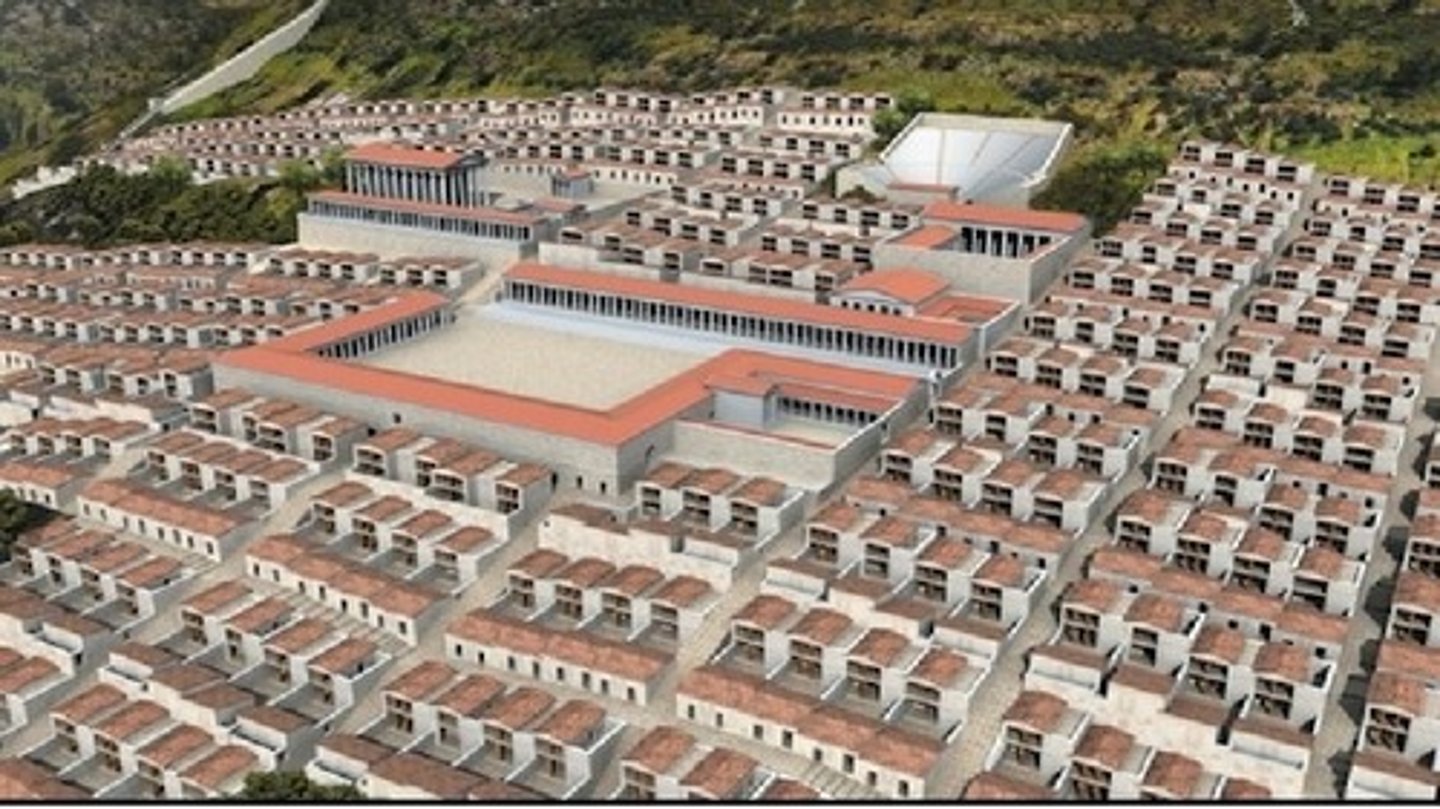
Olynthos (houses) - Classical
- Grid planned cities
- Modest homes for locking away women & children
- Men are never home anyway to enjoy a nicer home
Houses Near Agora - Classical
- No grid, organic streets
- Symposium for men to lay
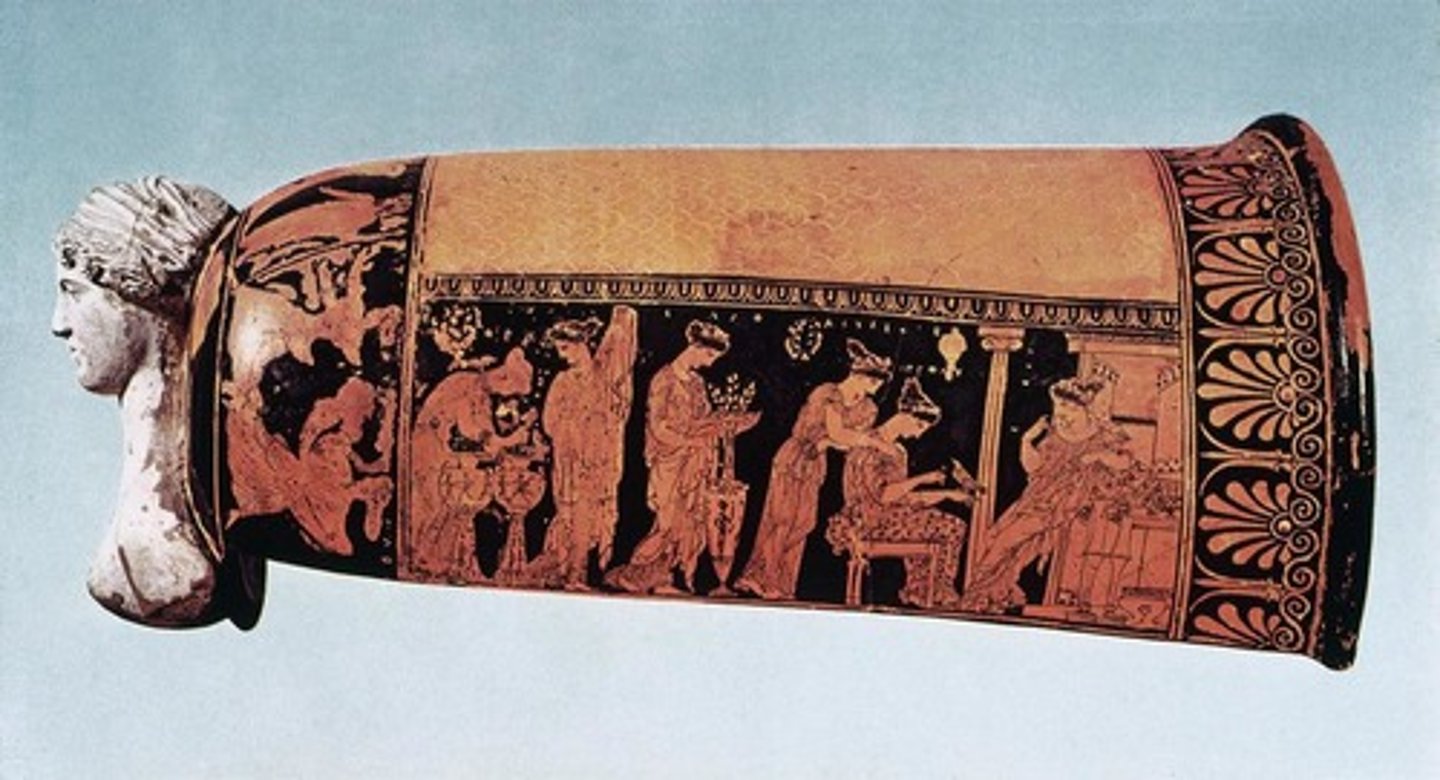
Vase paintings with bridal scenes - Classical
- Women can only take clothes and some personal items to her new home w/ husband
- Bridal procession: Women would be veiled until wedding
- morning after wedding night: portrayed as beautiful
- romanticized images of marriage as a constant reminder to women that marriage is beautiful, survival tactic? manipulation?
- women must weave cloth as a wedding gift for husband to prove she'll be useful
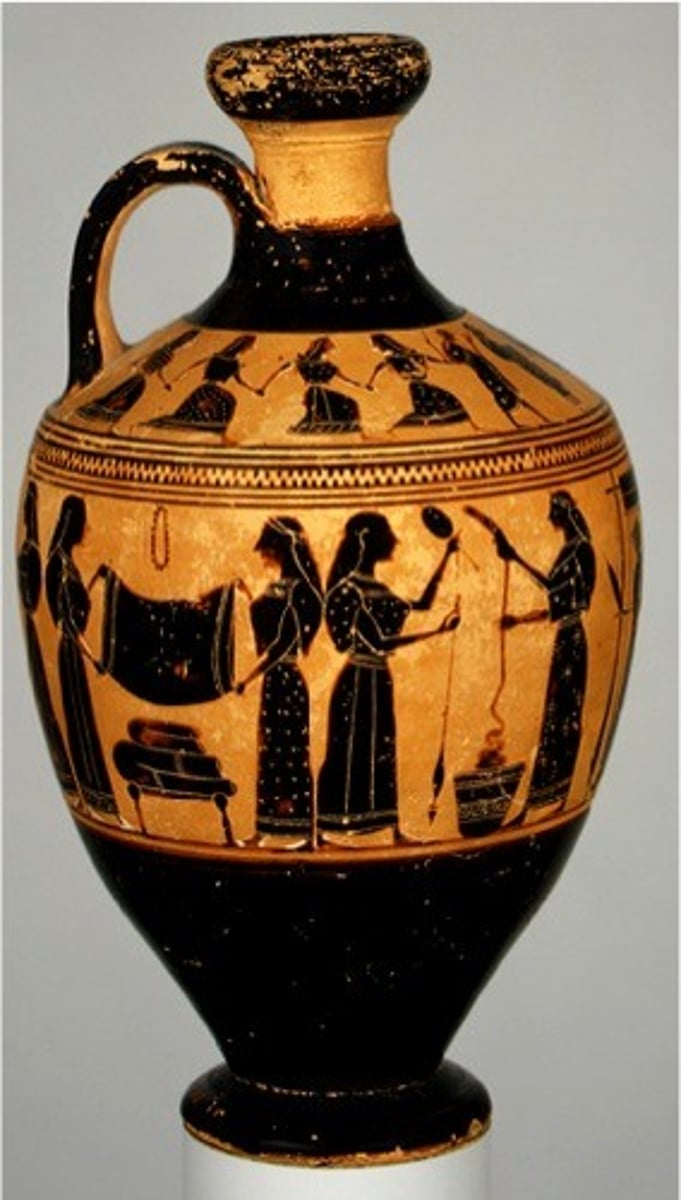
Vase paintings with domestic scenes, Classical
- When women aren't having babies, they're weaving
- Babies in art always male; female babies are unwanted bc dowry
- Female babies get left at trash dump & become slaves/prostitutes
- Women treated as a financial asset
- Men create these objects for female viewing, to show them what they should be doing (producing male heirs or weaving)
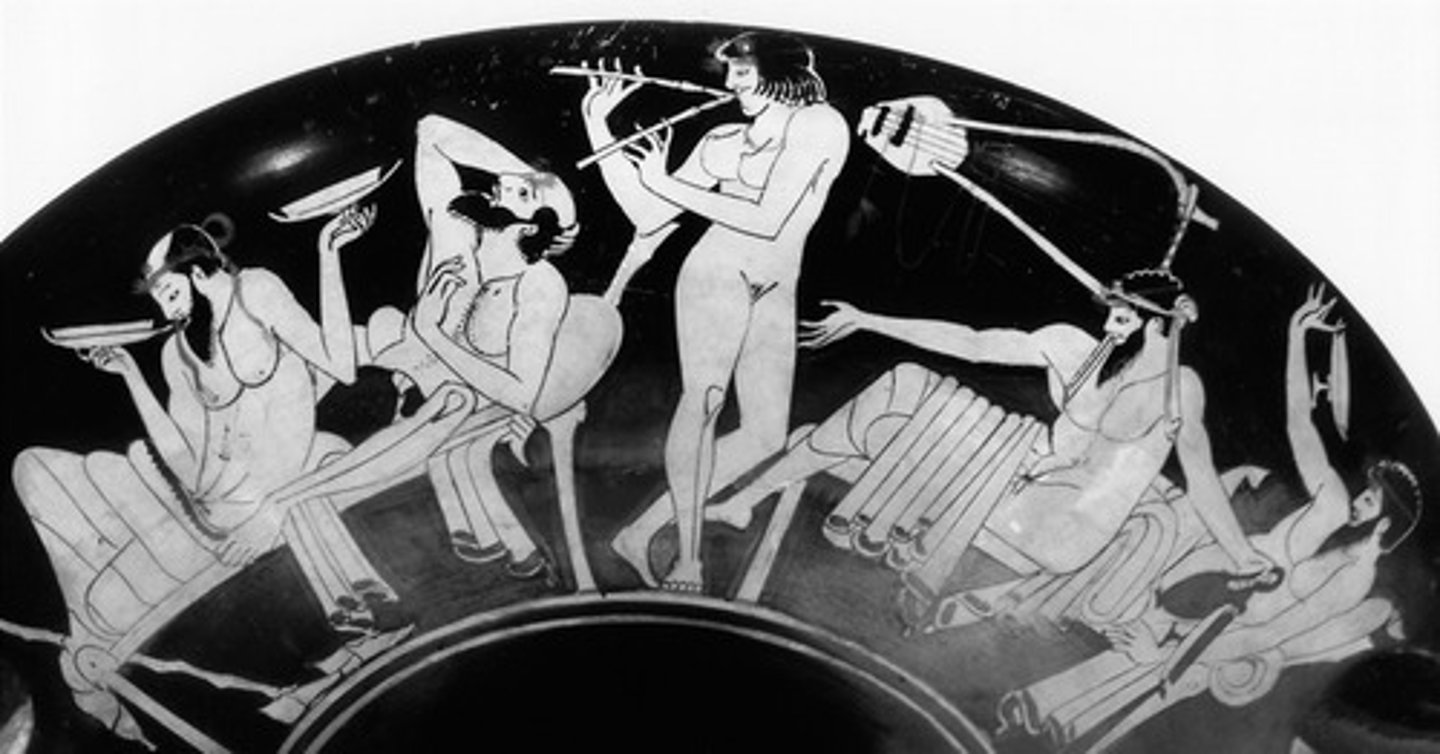
Vase paintings of hetaerai with customers, Classical
- Hetaerai = prostitutes
- Seen on many symposium vases for male enjoyment; men find these financial transactions exciting because its their only sexual interactions until age 30
- Depict the narrative that women love sex and enjoy it more than men
- Hetaerai are educated & skilled (musically); have more autonomy than other Athenian women can be financially independent
Late Classical Greece (Historical Context)
- Peloponnesian War: Athens VS Sparta, drag in neighboring cities
- Plague strikes Athens -> mass graves, cannot properly honor the dead, no individual monument grave markers
- Many men die; forced to give women more liberty (handle businesses and property)
- Anti-war movements: "Trojan Women" play; Mutilation of Herms
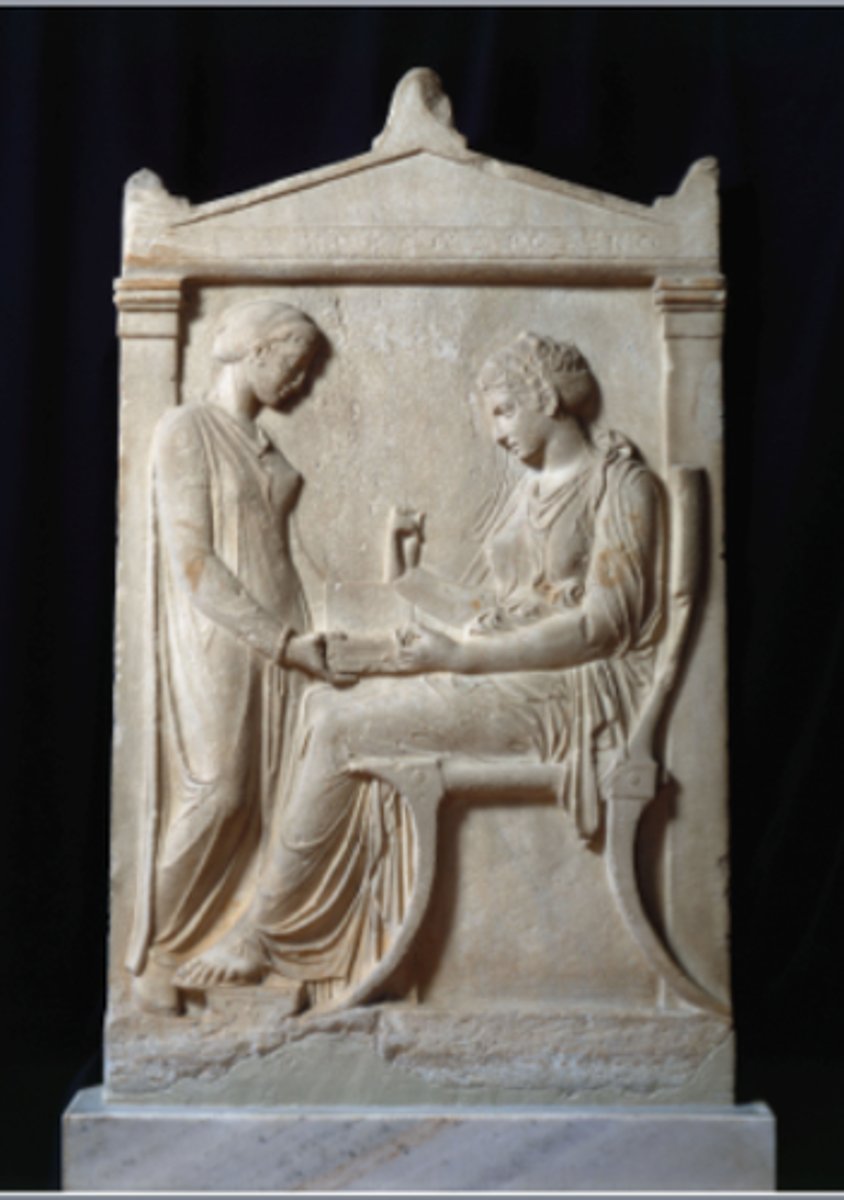
Grave Stele of Hegeso - Late Classical
- Tomb marker for a women; they were making grave markers for everyone now to make up for the lack of proper burials during Peloponnesian war & Plague
- Huge development: Woman's name out in public, although in relation to male (husband/father)
- Not stylistically different from classical, but this content would have never been seen prior to the plague
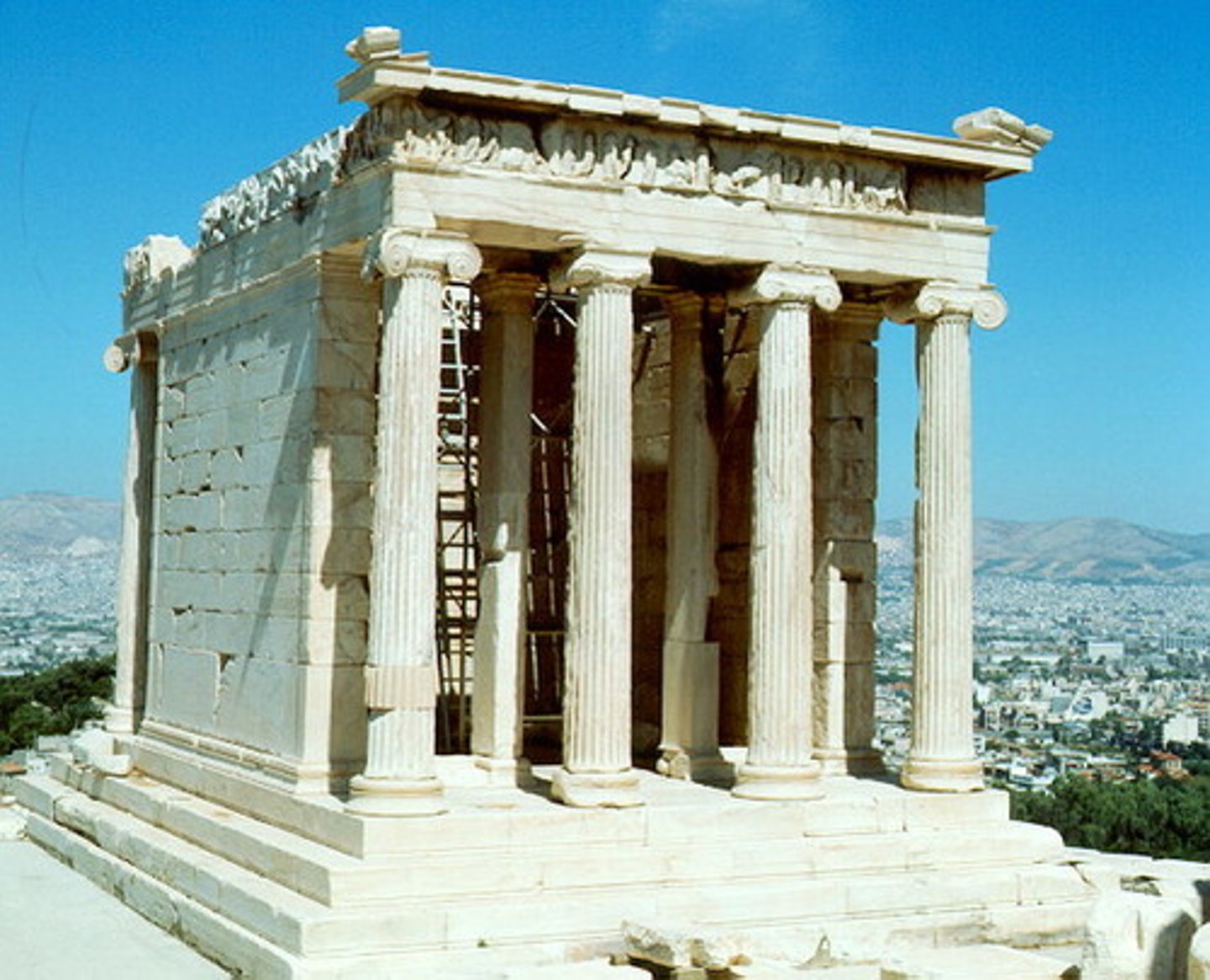
Temple of Athena Nike - Late Classical
- Prominent as you walk up Acropolis stairs
- "Athena Victorious"
- Athens fighting alongside Ionian Allies -> affirms their allyship & Athenians as the original Ionians
- Ionic temple (volutes on capital & continuous frieze); No peristyle
- Frieze: shows Greek victory over the Persians
- Theme Allyship with Ionian cities & victory; although there is no victory in this war (escapism; delusional)
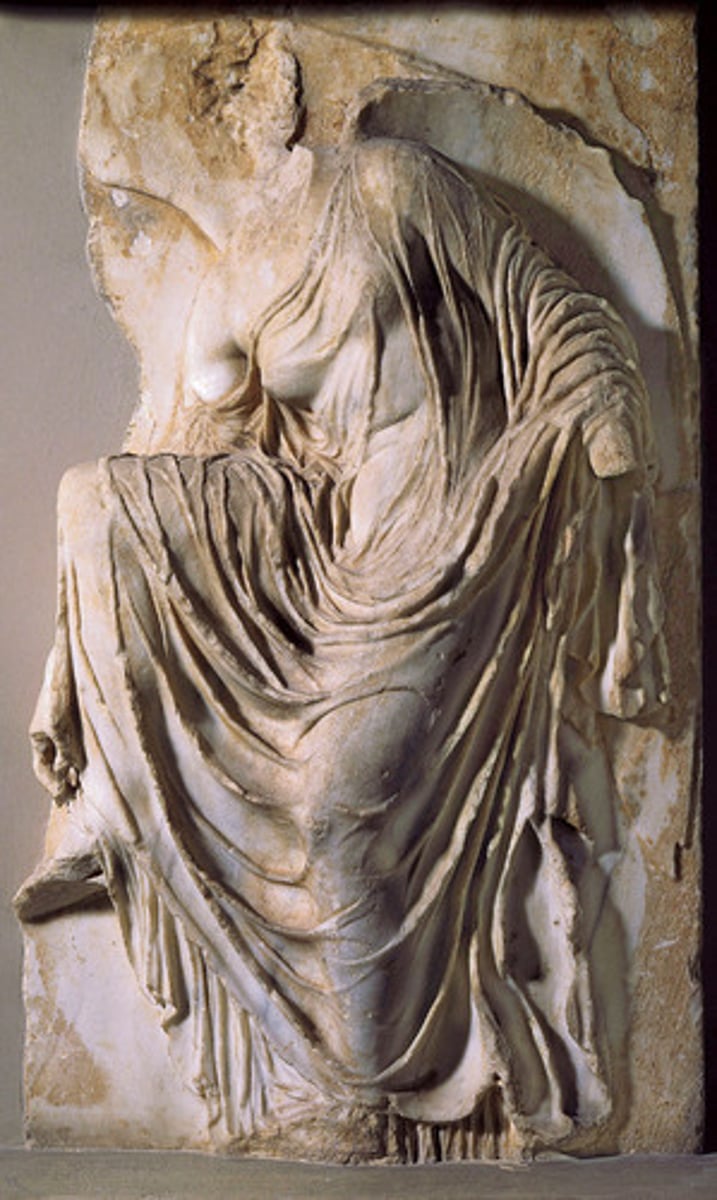
Balustrade: Figures of Nike - Late Classical (from Temple of Athena Nike)
- Nike represents victory
- Nike figures bringing Athena offerings
- Nike adjusting her sandal; off balance pose dispays beautiful drapery hugging her figure; feet are sexually suggestive sometimes
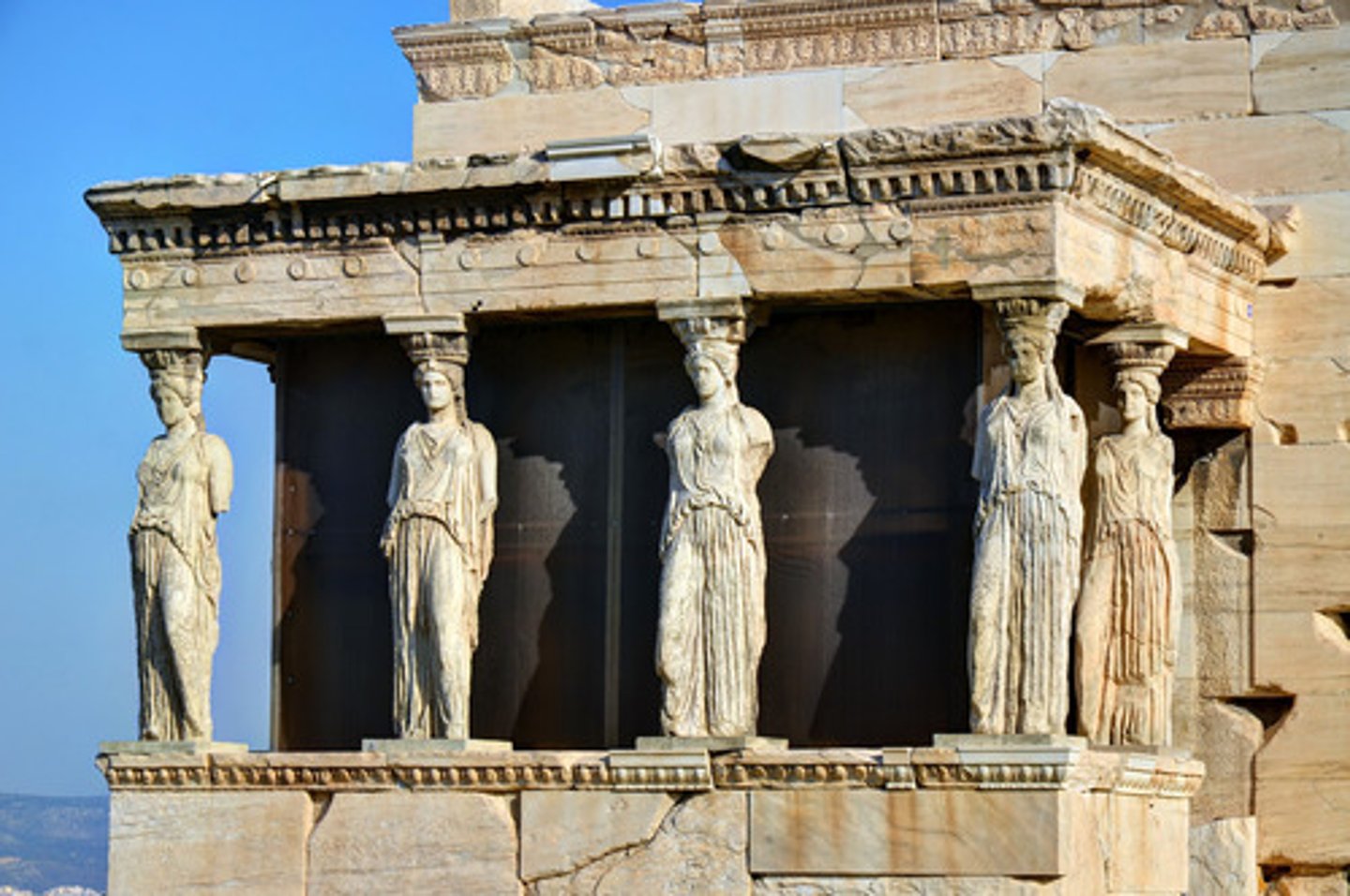
Erechtheion with Caryatids - Late Classical
- Ionian temple @ Acropolis; only Ionians can enter
- right next to original Parthenon ruins; an attempt to replace?
- Erechtheion: snake that guards the Acropolis
- Composite shrine: very strange temple; tried to incorporate so many different elements
- Continuous Frieze: different color stone (blue/grey) from rest of structure; very ornate & was gilded
- Columns: Very ornate & gilded capitals
- Porch with Caryatids: 6 statues of women holding the roof on their heads; stand in contrapposto
- Wear peplos & beaded hair, old fashioned like Archaic
- Maybe the female prisoners of war taken and forced to serve the Athenians
- Irrationality reflects the chaos of the war
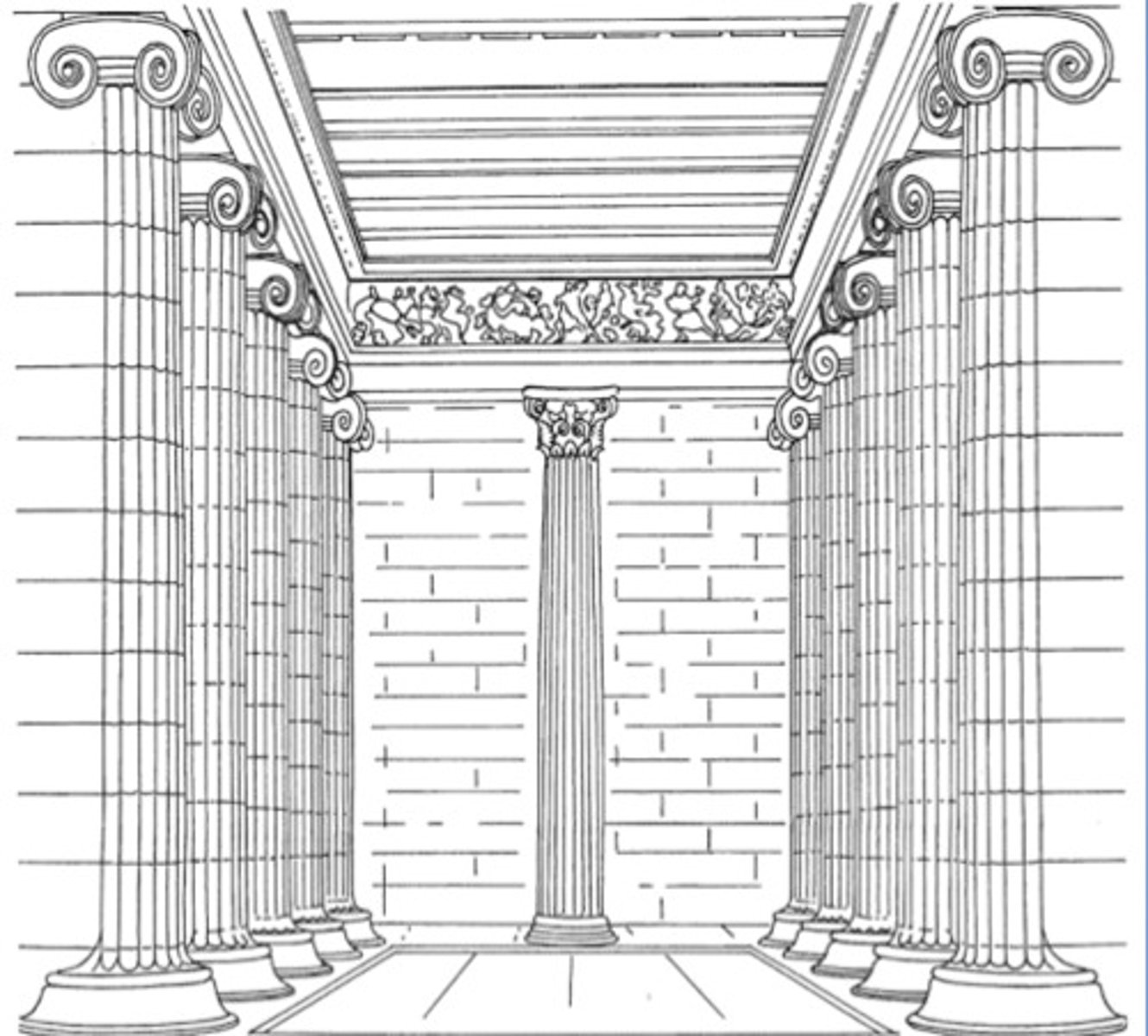
Temple of Apollo Epikourios (Bassae) - Late Classical
- Thanking Apollo for averting the Plague
- Doric exterior, Ionic interior
- 1st Corinthian column inside where you'd expect a cult statue -> something important happens here
- Mystery Religion (mystic religious experience): on summer solstice, a single ray of sun peaks thru the columns and illuminates a polished Bronze statue of Apollo as if he is manifesting himself in front of you
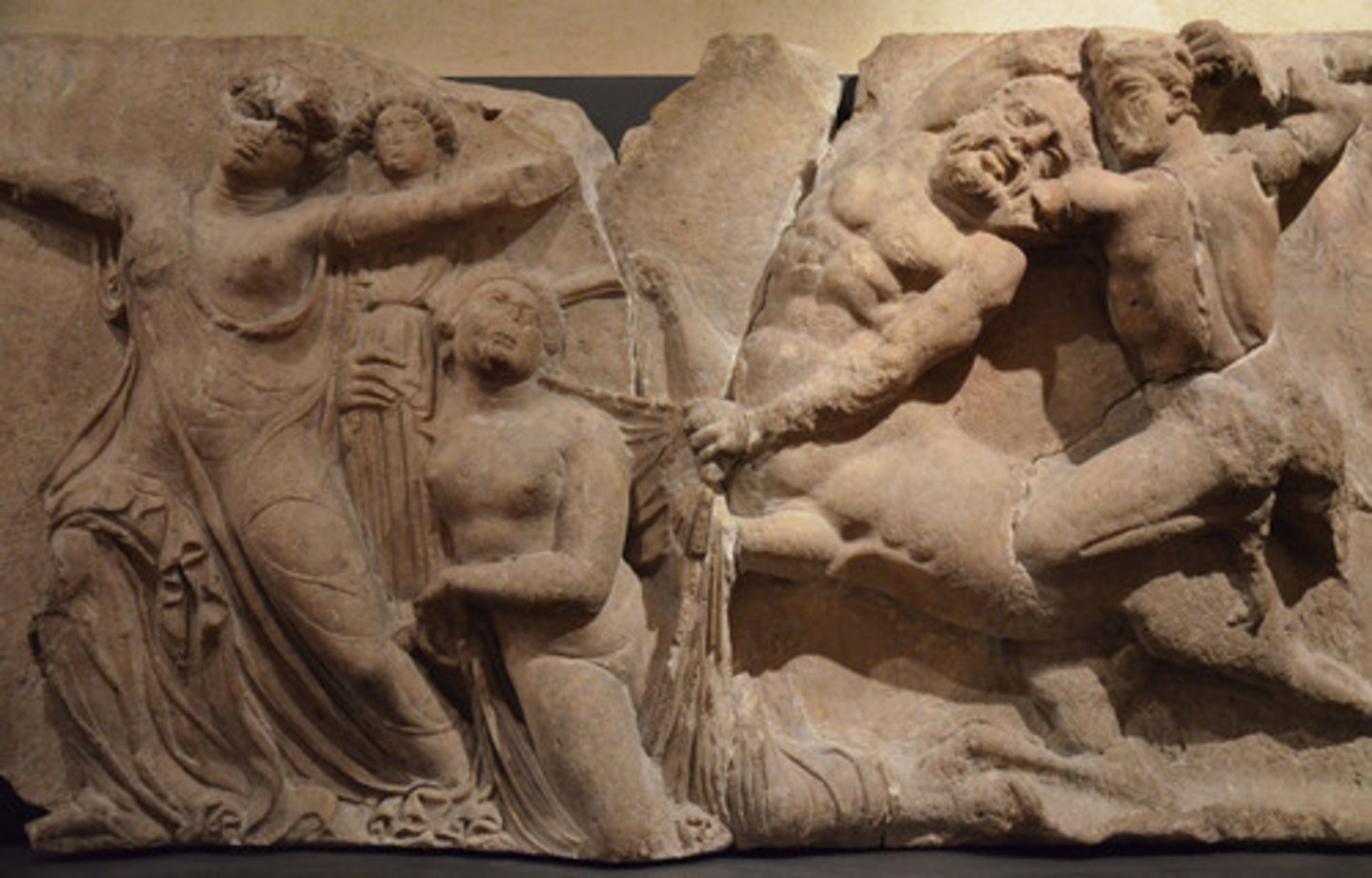
Frieze: Lapiths VS Centaurs, Amazonmachy - Late Classical (from Temple of Apollo Epikourios)
- Greeks vs Amazons: good vs evil
- Short & stocky figures; no necks
- Theatrical and dramatic poses, but ugly
- Continuous Ionic frieze
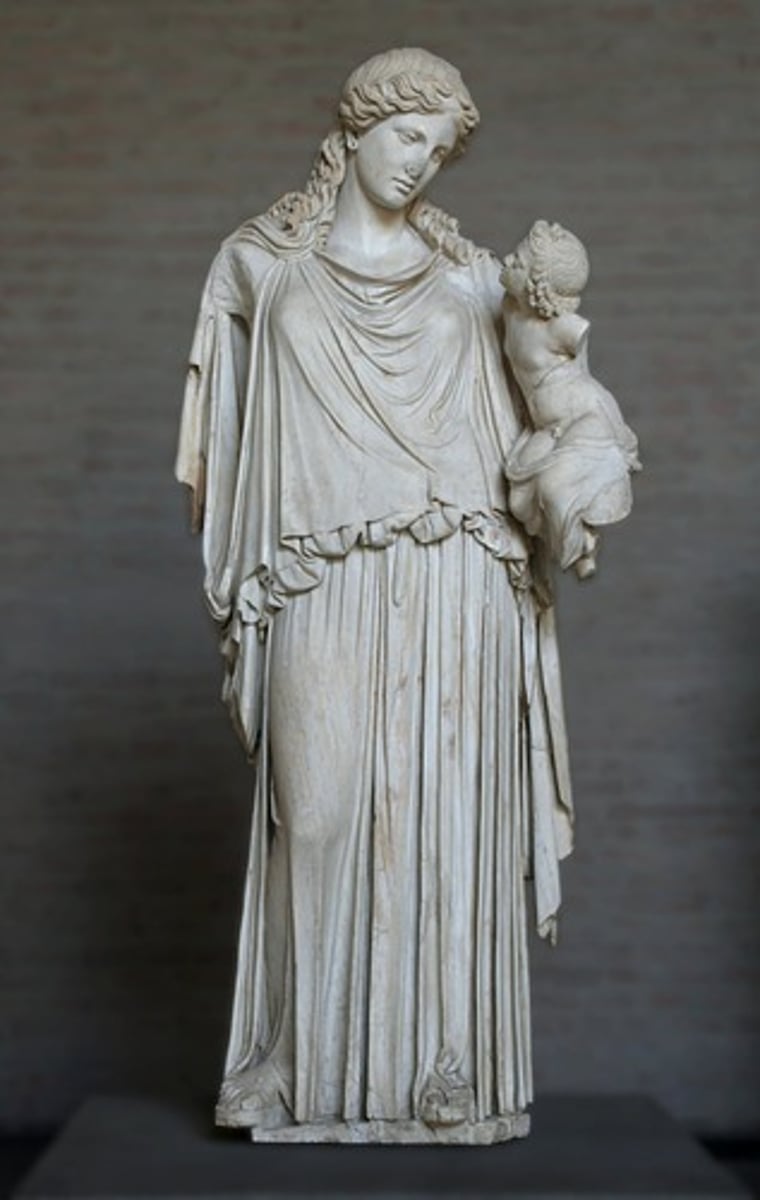
Eirene and Ploutos (Roman Copy) - Late Classical
- Eirene (Peace) and Ploutos (Wealth) : "With peace comes wealth"
- New type of god: a political idea; Athenians want peace
- Eirene has a kind and maternal expression
- Athens & Sparta endured great suffering from war/plague
Fourth Century Greece (Historical Context)
- Continuation of Late Classical Greece: instability and people questioning the gods
- Alexander the Great comes into power: uses art as political propaganda; very particular about his image
- He conquers the Persians and creates a multicultural empire
Temple of Asklepios (Epidauros) - Fourth Century
- People are disappointed in their traditional gods; want to believe in gods that help/care for them
- Asklepios: an ordinary person, physician said to be the son of Apollo because he cured ppl during the plague
- Health spa; patients sleep in stoa and wake up healed
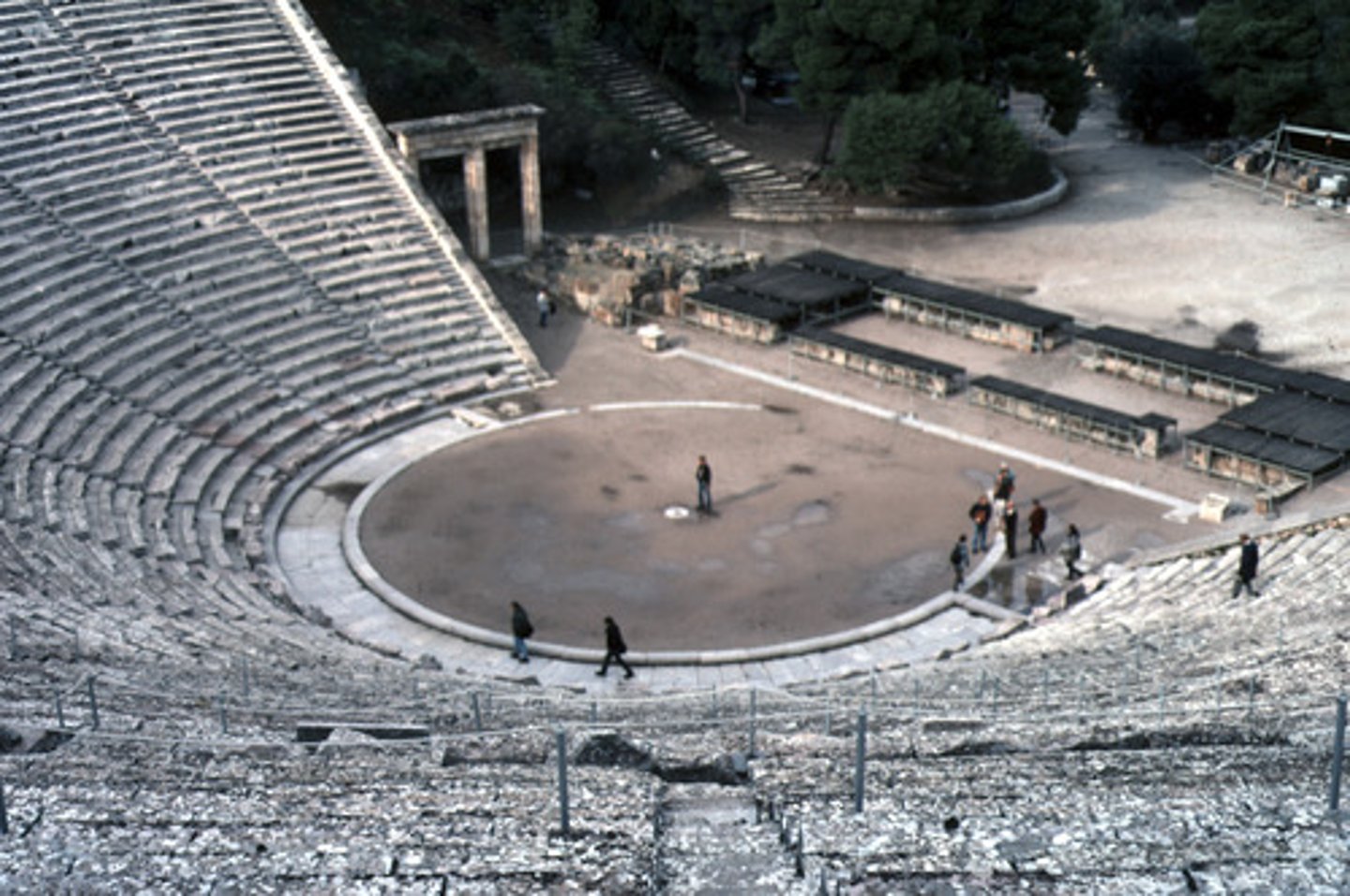
"Asklepios Blacas" - Fourth Century
- Bends his neck down; looks down and makes content w/ viewer
- soft face with kind expression; he cares about you & can heal you
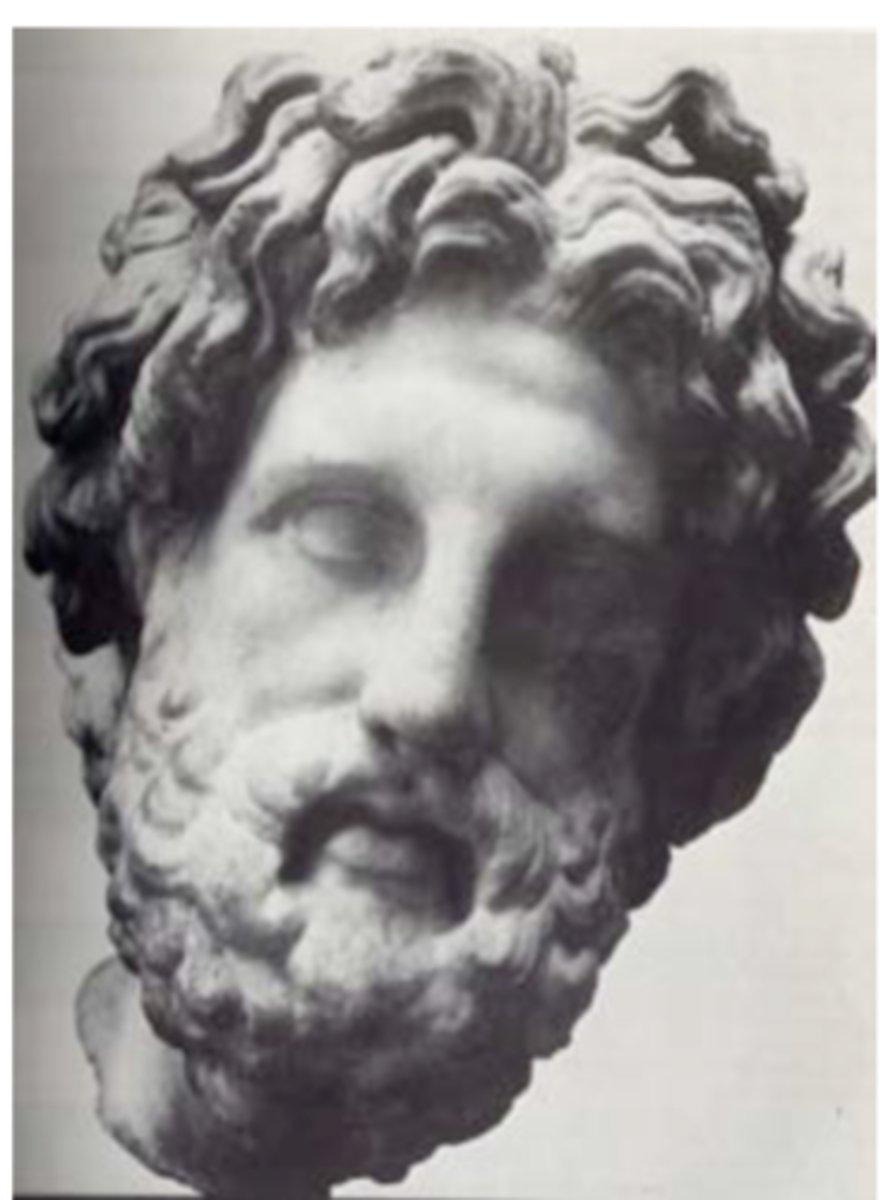
Theater and Tholos - Fourth Century (from Temple of Asklepios)
Theater
- Seats surround alter in the orchestra for wine (all plays in honor of Dionysis)
- Great acoustics
- Theater builds community and plays teach lessons
Tholos
- Round temple: Doric columns outside, Corinthian columns inside; very ornate with elaborate coffers
- Hole in center: Fountain house? Snake house (shed = rebirth/rejuvination)
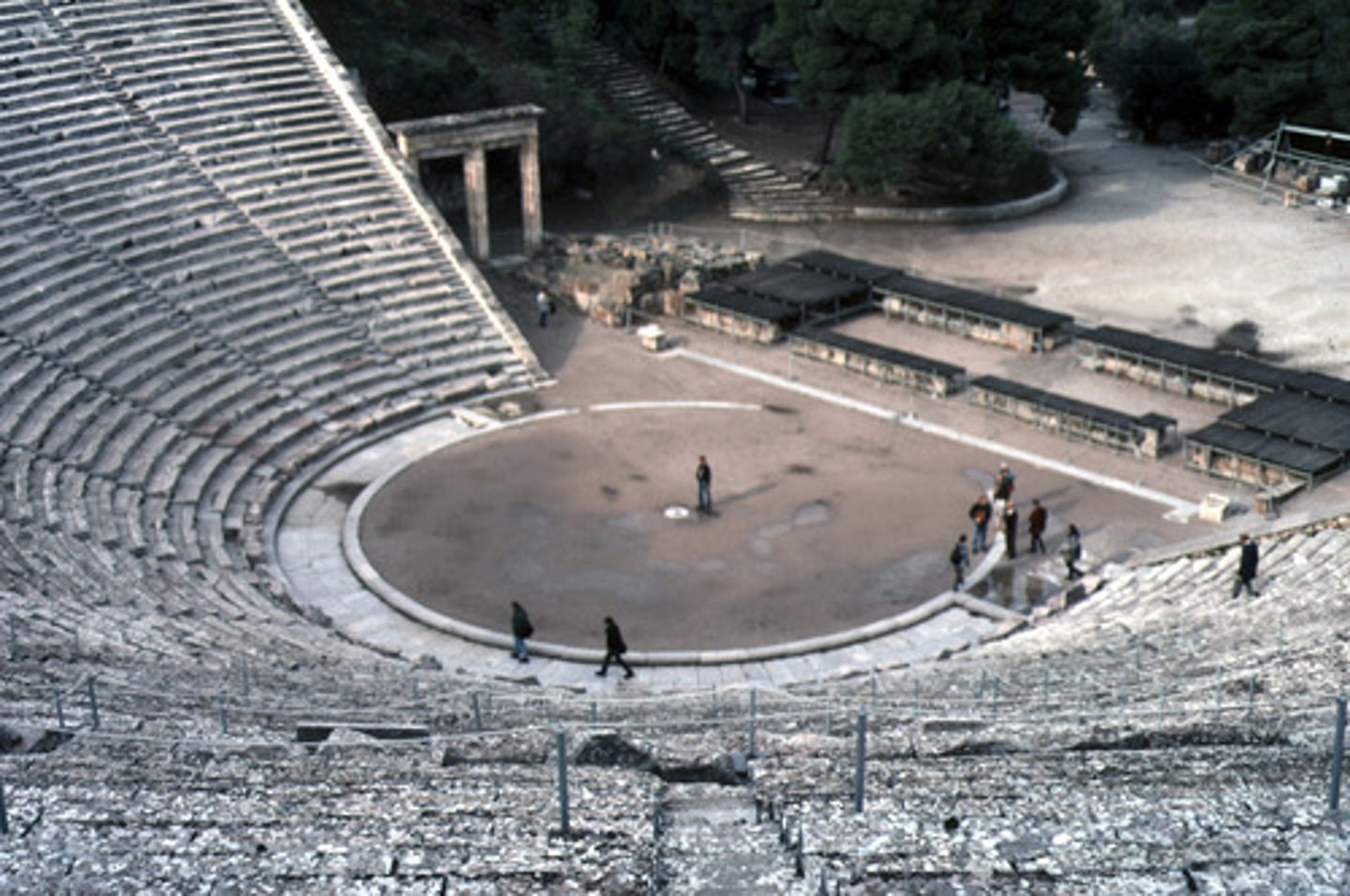
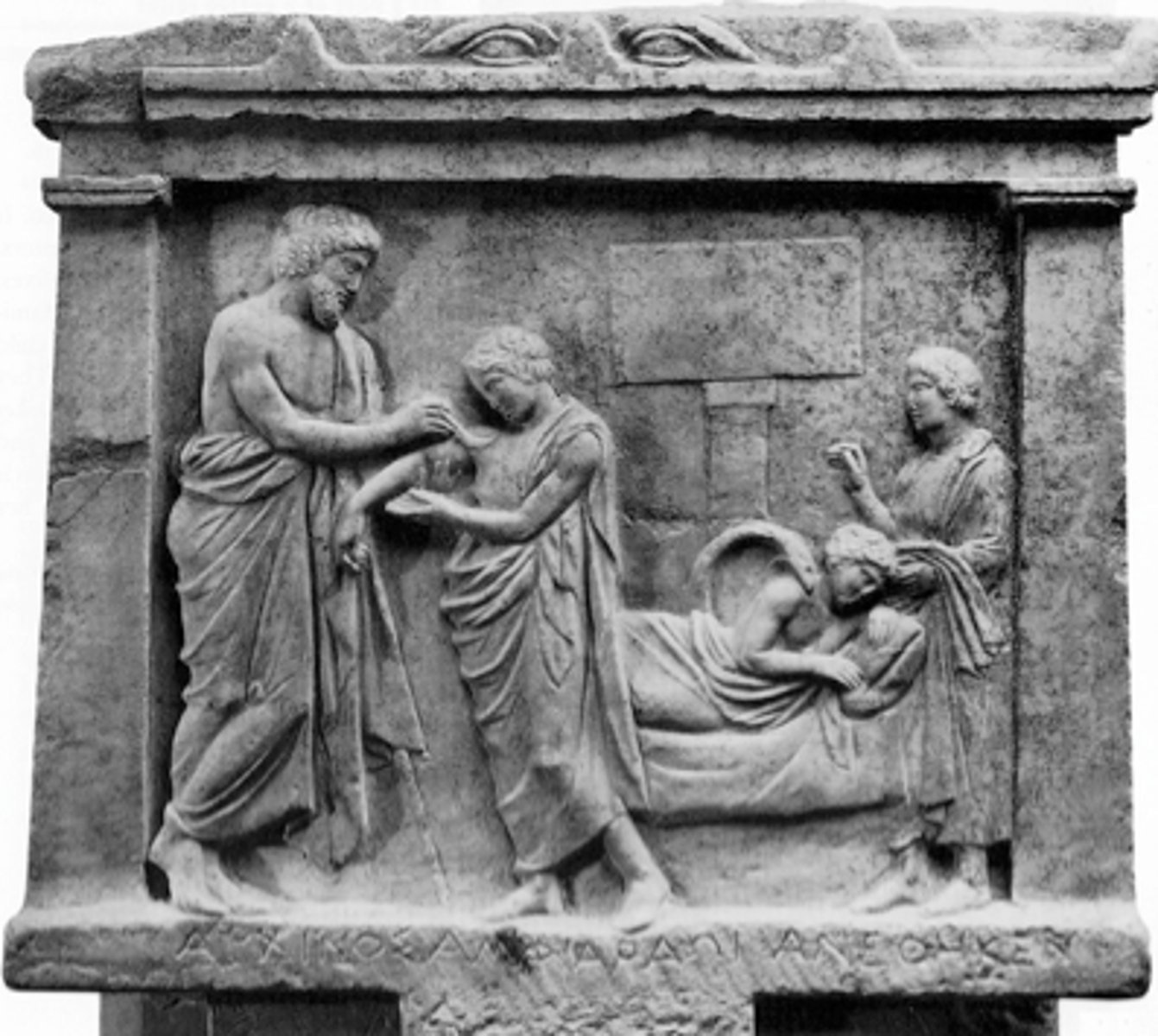
Votive Relief of Arkhinos to Amphiaraos - Fourth Century
- Steele relief carving
- People want to believe in gods who help and care for them
- Content: Amphiaraos healing Arkhinos; ppl in back sleeping in temple to wake up healed (similar to cult of Asklepios)
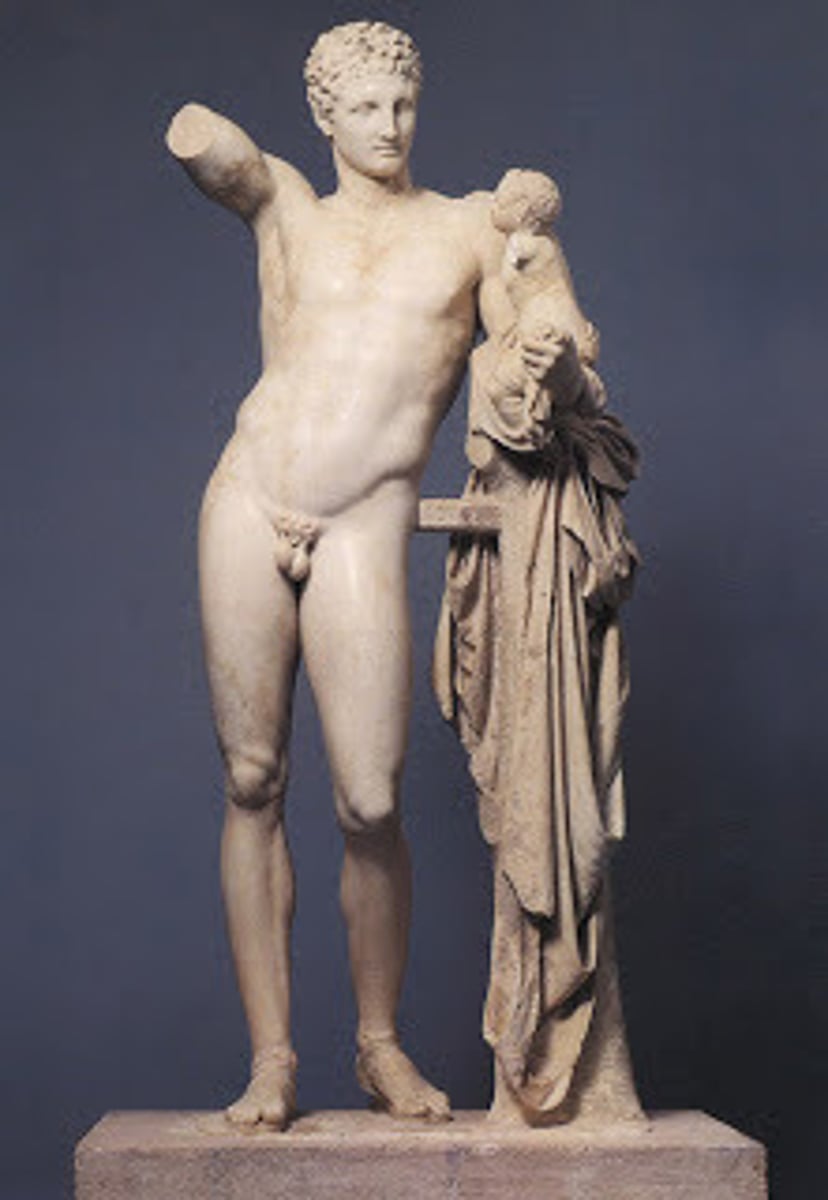
Hermes and Dionysis (copy?) - Fourth Century
- Zeus gives Dionysis to Hermes (1/2 brother) to raise him far away so Hera can't hurt him
- Hermes stands in contrapposto; leans left arm (holding Dionysis) on tree trunk draped in fabric
- Hermes' gaze is focused on baby with a sweet/soft expression
- Hermes dangles grapes & Dionysis reaches for it; sweet image of older brother playing/teasing his baby brother
- Depicting 2 mighty gods in humanly form; questioning their power
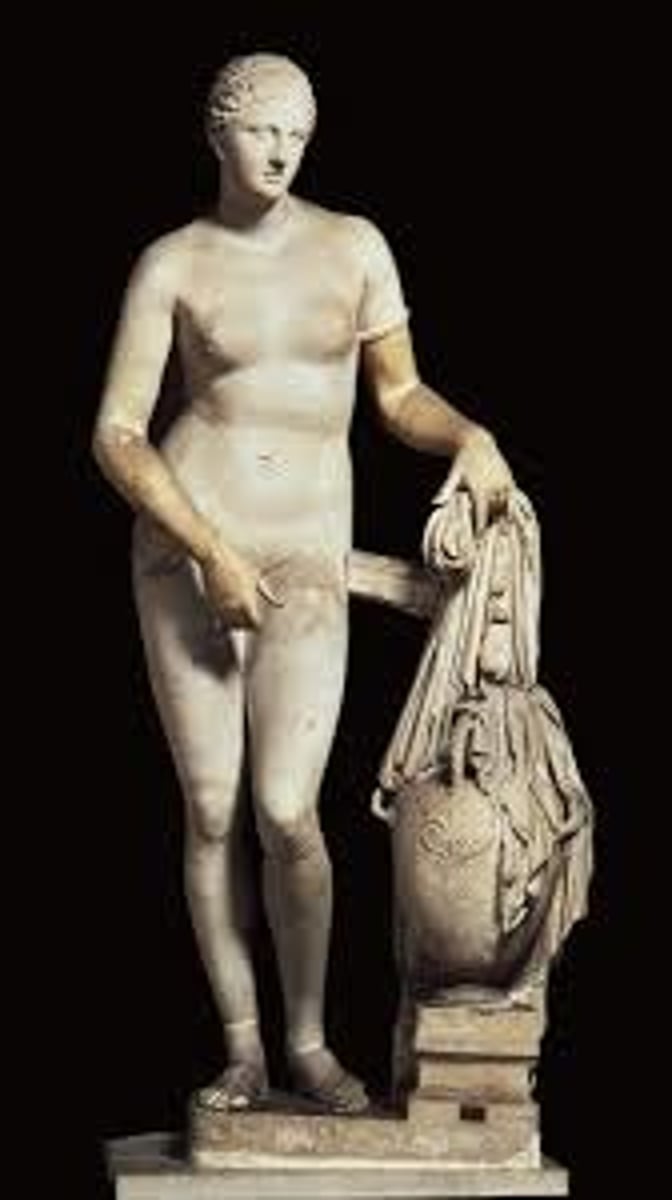
Aphrodite of Knidos (Roman copy) - Fourth Century
- Nude Aphrodite holding her clothes in left hand draping over water vessel; she is about to bathe
- Stands in contrapposto; erotic & beautiful
- Significance of water: she was born of sea foam; goddesses renew their virginity by bathing
- Right hand covers genitals: modesty? protecting viewer (dangerous to see goddesses nude, ex. Artemis & Aktaeon)? Gesturing towards her fertility?
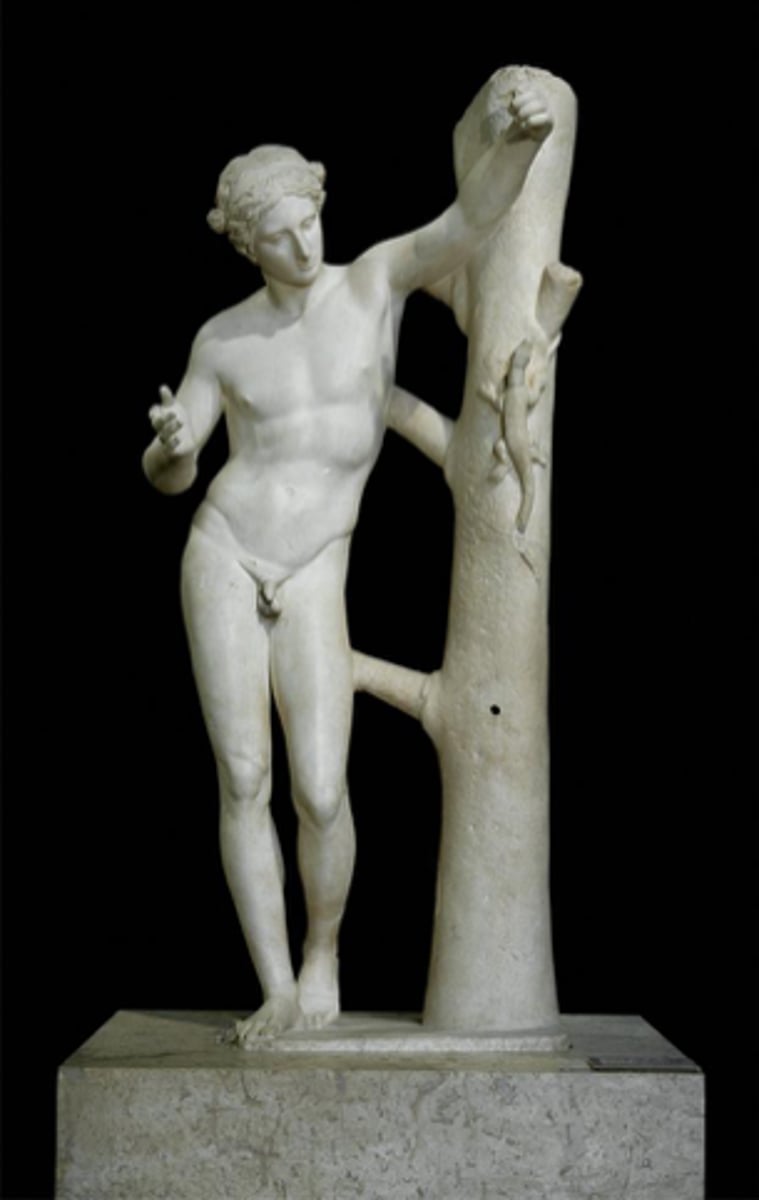
Apollo Lizard Slayer (Roman copy)
- Retelling of "Apollo and the Python"
- Apollo looks adolescent and effeminate; hair looks androgenous
- He leans on a tree trunk with a sharp object in his hand; tree has a little lizard he has to kill
- Doubt about the gods' power: no idealization; Apollo depicted in a more realistic human form
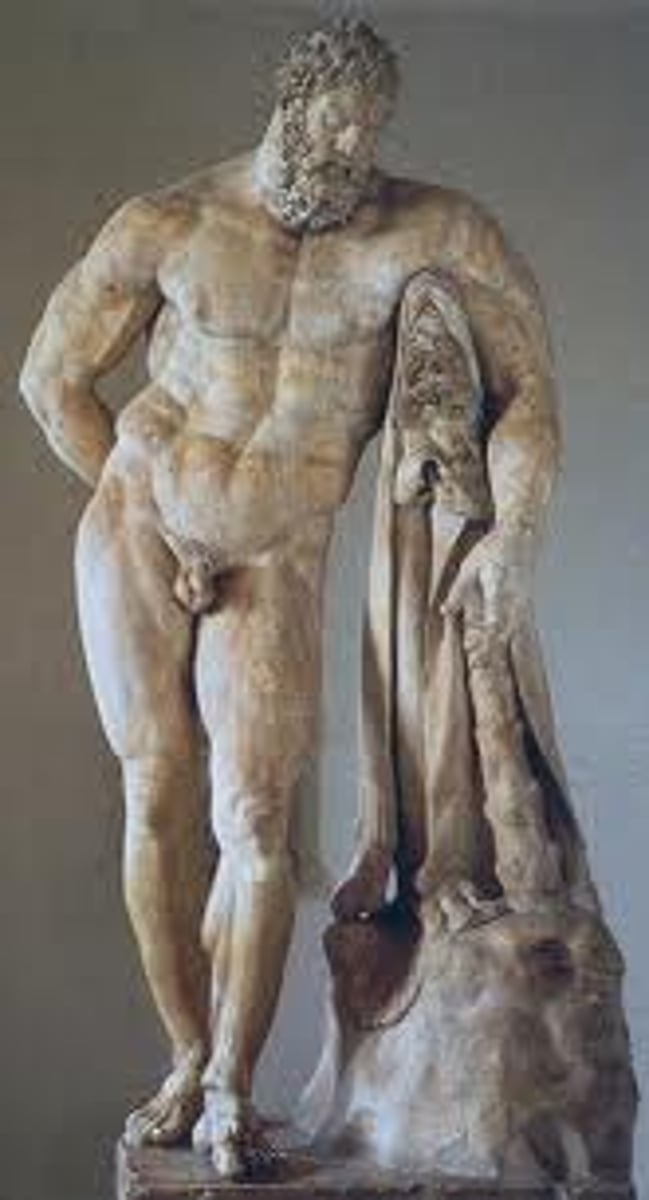
Farnese Herakles (Roman copy) - Fourth Century
- Large, powerful, muscular Herakles; but tired & worn out facial expression
- Holding golden apples of Hesparities from the 12 labors
- Exhausted from the 12 labors
- New perspective of Greek gods: human like faults
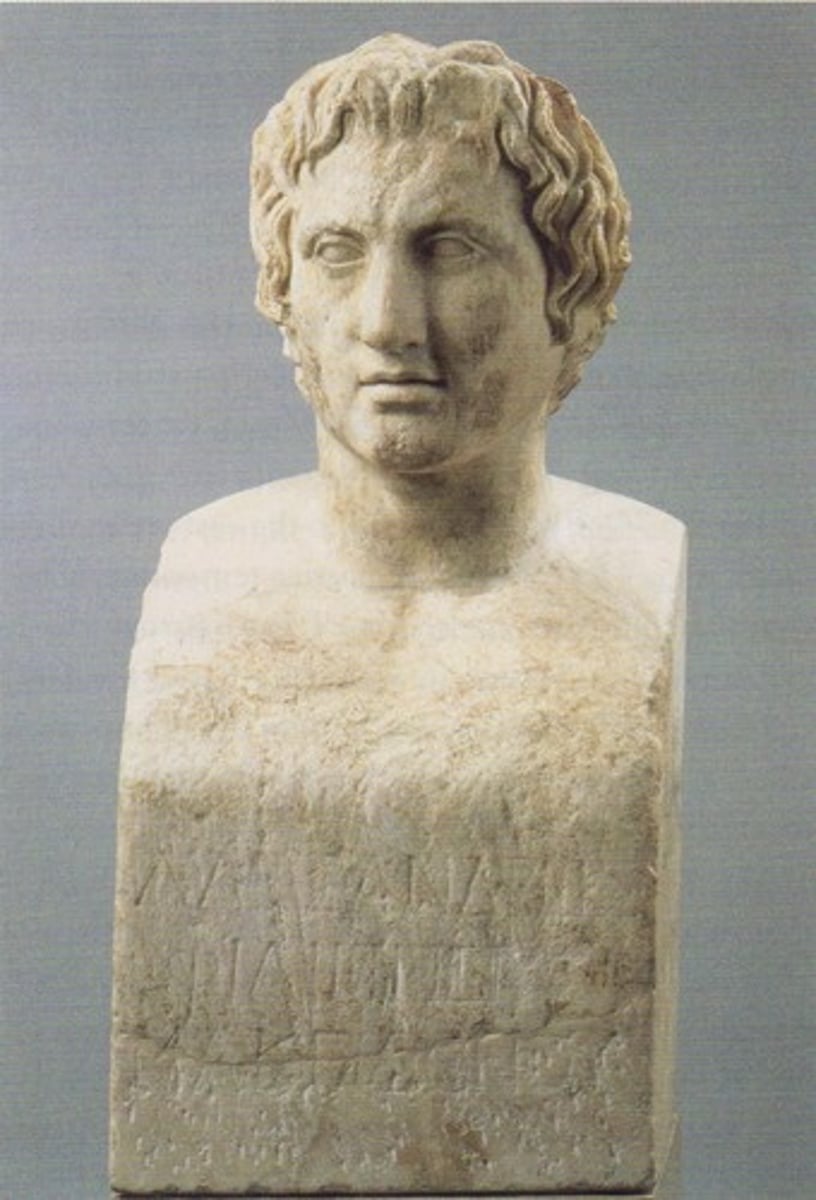
The "Azara Herm" (Roman Copy) - Fourth Century
- Deepset eyes with melting glance
- Inscribed with "Alexander son of Phillip"
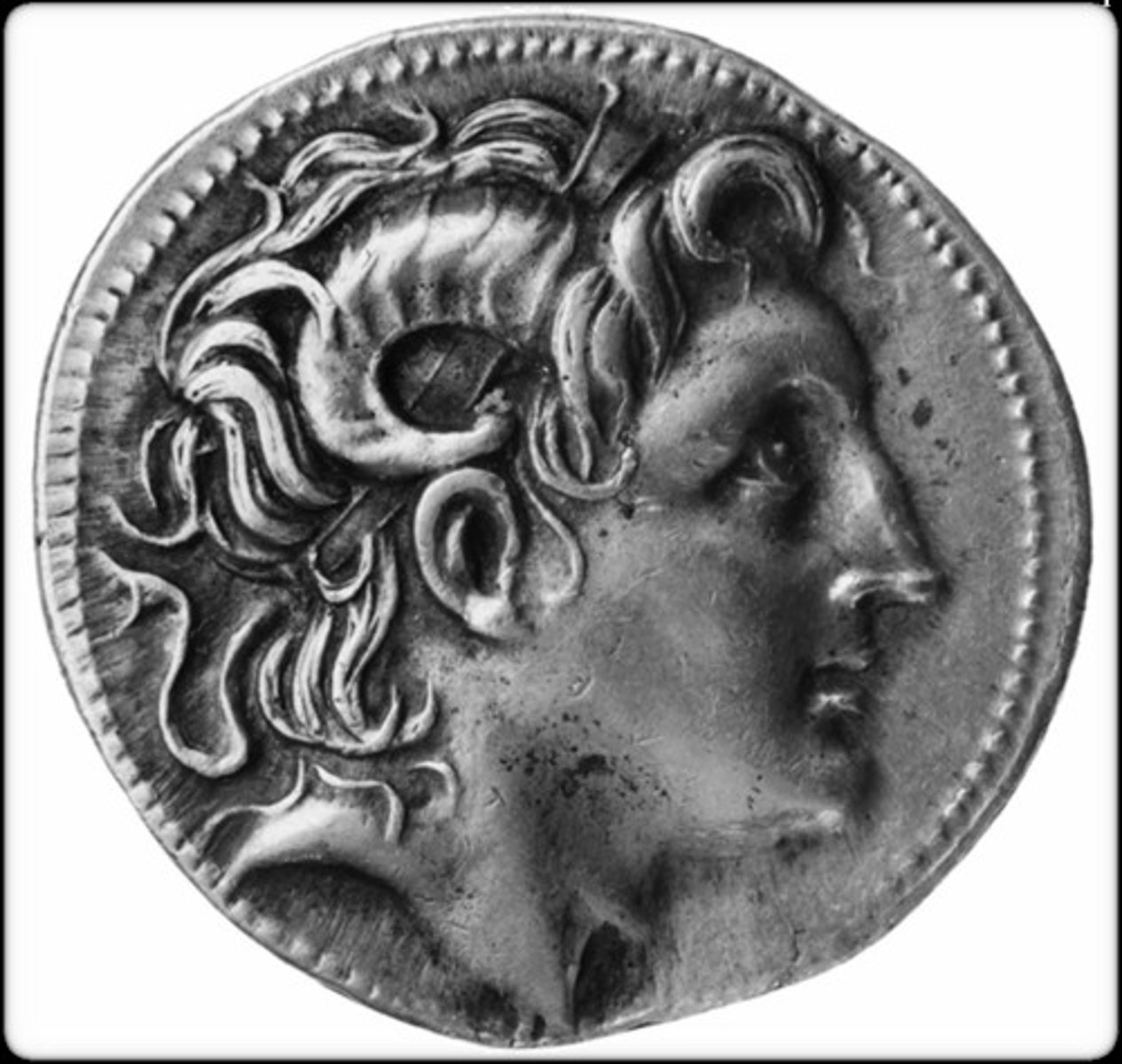
Coins with portrait of Alexander - Fourth Century
- Persians are first people to mint currency with historical figures
- good way of getting his image out, political propaganda
- lion skin of Herakles on Greek currency
- elements of ram on Egyptian currency
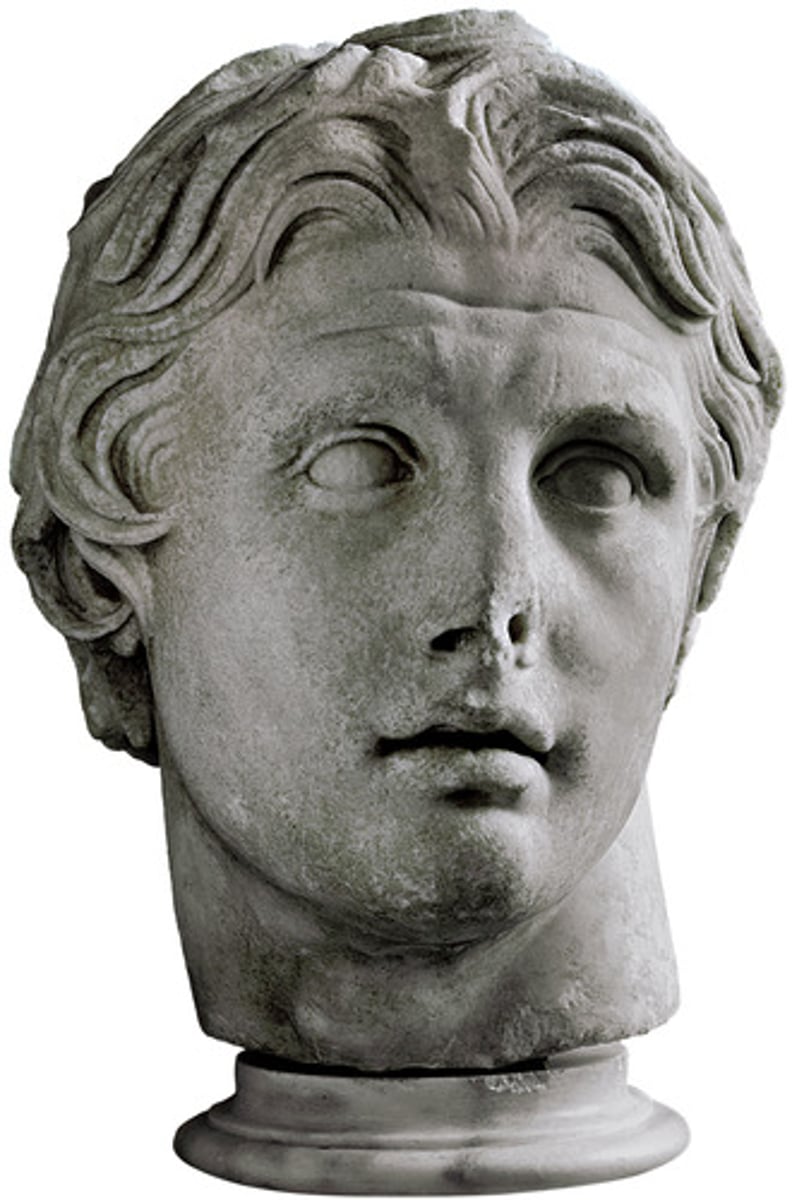
Head of Alexander from Pergamon - Fourth Century
- Slightly turned neck; large eyes look up with raised eyebrows, in communication with the gods
- Doesn't rely on symbols of power, focuses on displaying his unique personality (impulsive, irrational)
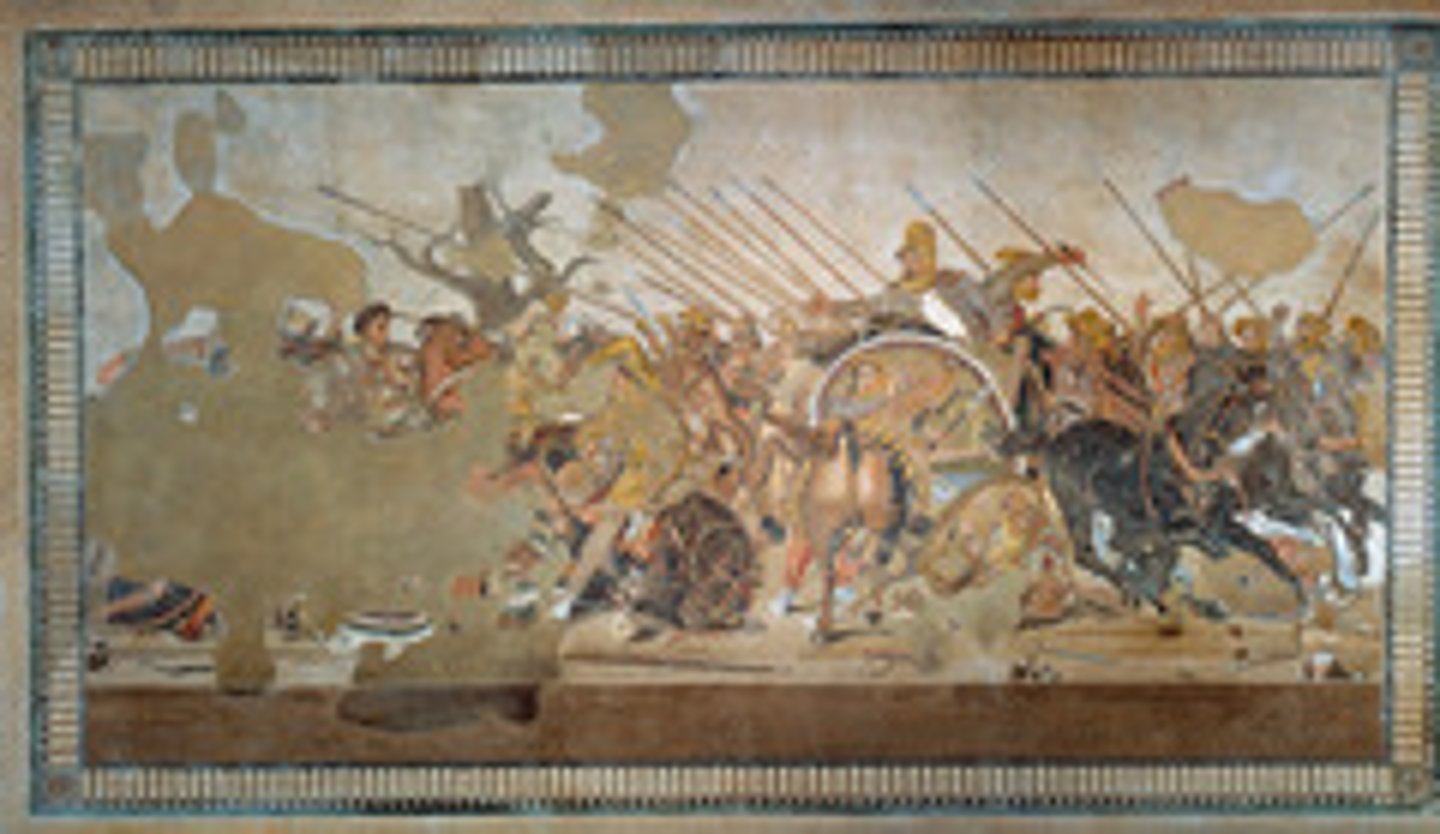
Alexander Mosaic (Battle of Isis) (Roman Copy) - Fourth Century
- Battle between Alexander's army and the Persians @ battle of Isis
- King's guard disarms Alexander so Persian King can escape; king reaches out like he doesn't want to leave soldier behind
- bow w/ no arrows shows he's helpless; Persian soldier getting trampled w defeated expression -> Sympathy for opponent
- Sense of respect & sympathy for non-Greeks different from earlier depictions of non-Greeks in Greek art -> supports idea Alexander was trying to create a unified multicultural society
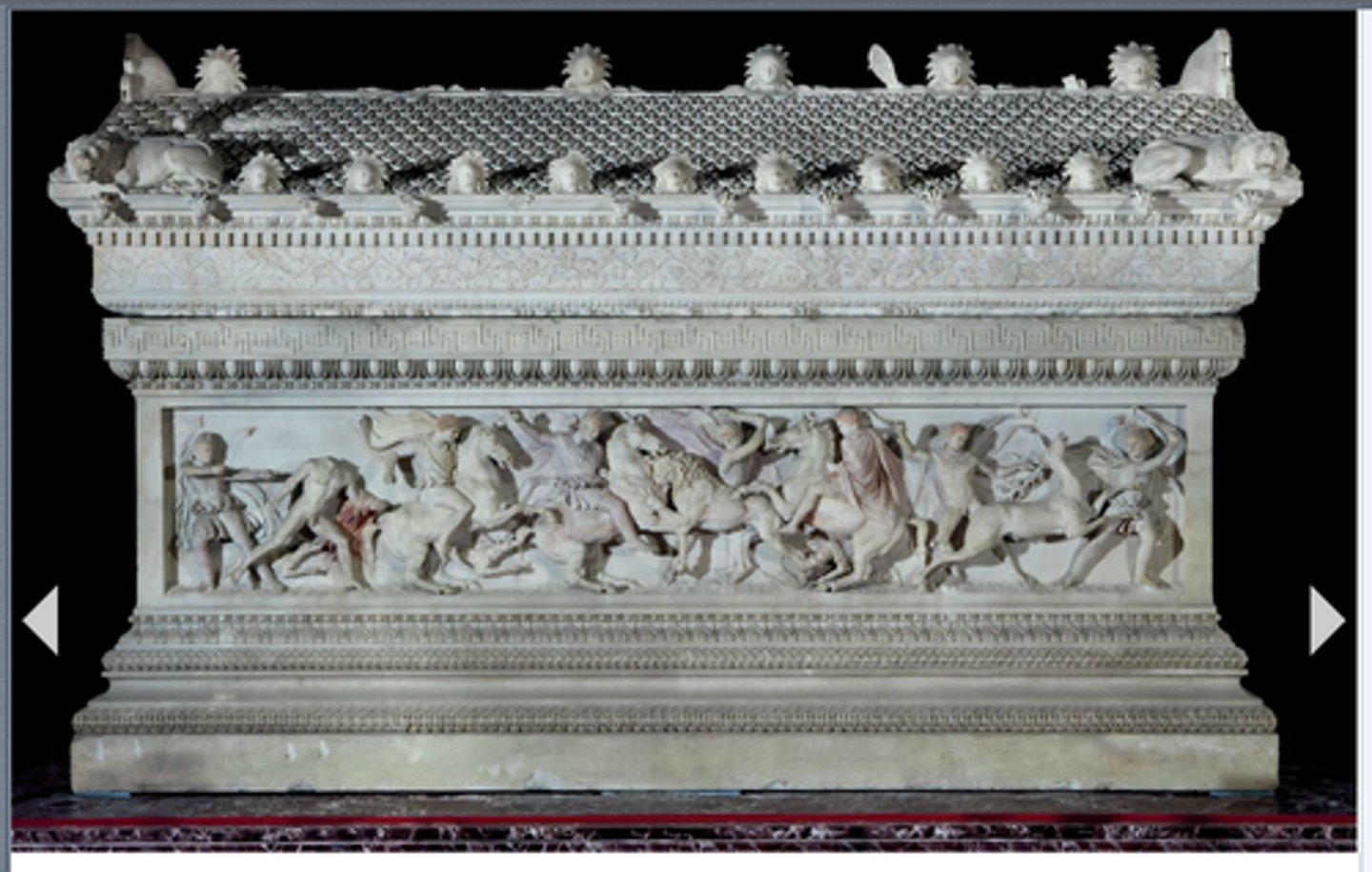
"Alexander Sarcophagus" - Fourth Century
- Very elaborate tomb for a local ruler appointed by Alexander (these people hated the Persians and wanted Alexander's help to drive them out)
- Shaped like a Greek temple: frieze, pediment, relief carving all around
- content: Battle of Isis (how this local ruler came into power), Hunting Scene (kill large animals to show power, persians & greeks working together)
Hellenistic Greece (Historical Context)
- From the Death of Alexander to the Death of the last of his Successors
- Alexander's Generals are his successors & try to present themselves similar to Alexander in art
- Rise om unique portrayals of individuality
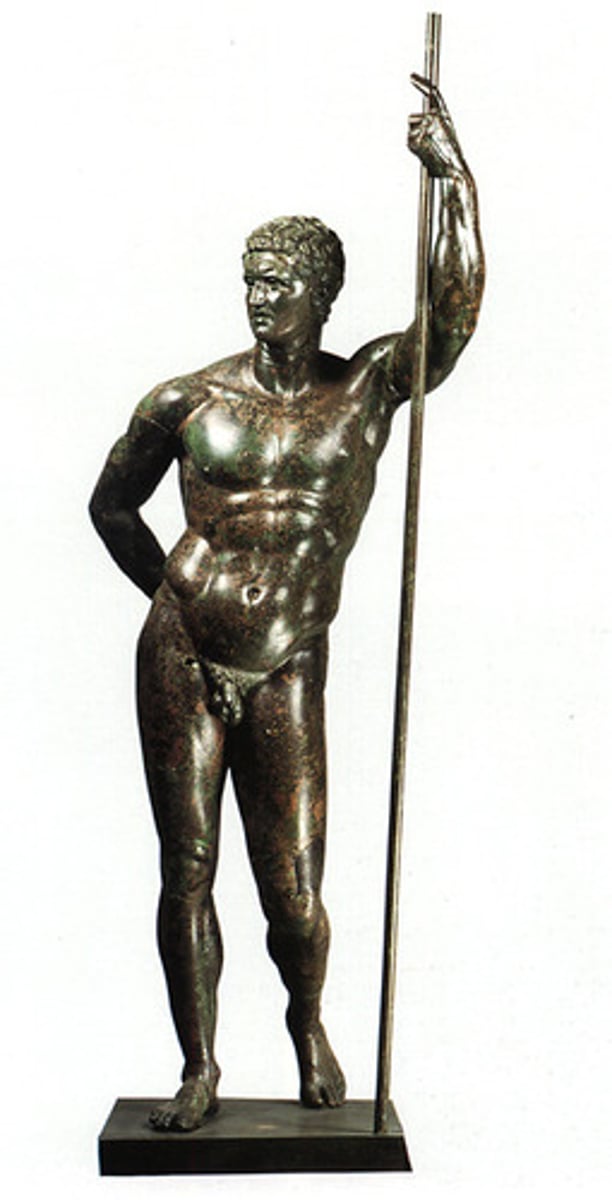
"Hellenistic Ruler" - Hellenistic
- Powerful muscular body standing in contrapposto, heroic nudity
- similar to Alexander's portraiture: Tousled hair, leaning on a lance similar to alexander's pose in a previous work
- expressive face: furrowed forehead with open mouth
- shift away from idealized forms and expressionless faces
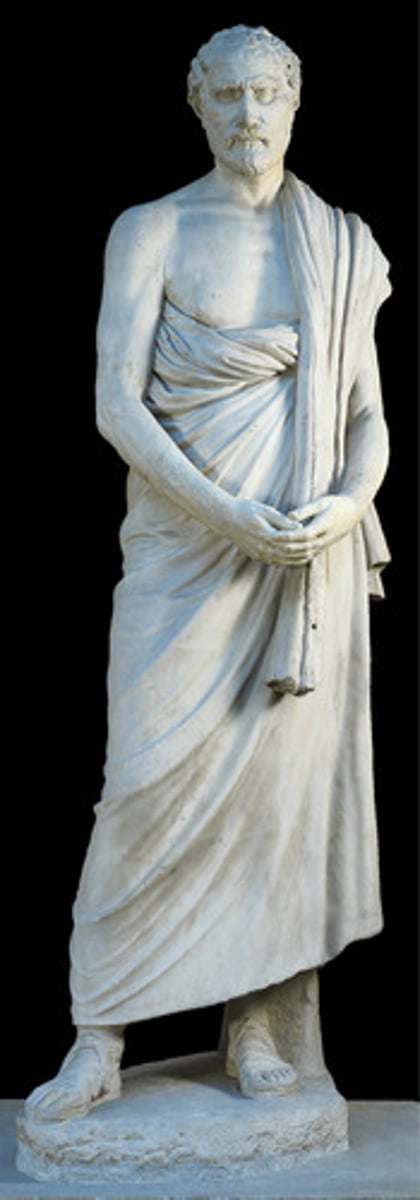
Demosthenes (Roman Copy) - Hellenistic
- Athenian politician devoted to democracy: warned about Macedonians, was exiled, tried to get Athens to resist Alexander's successors' rule, Athens failed, he flees and commits suicide
- His unique physical traits are portrayed: weak and couldn't train in gym -> skinny arms; looks frail
- elderly man looking down, lost in thought
- shift away from idealized forms and expressionless faces
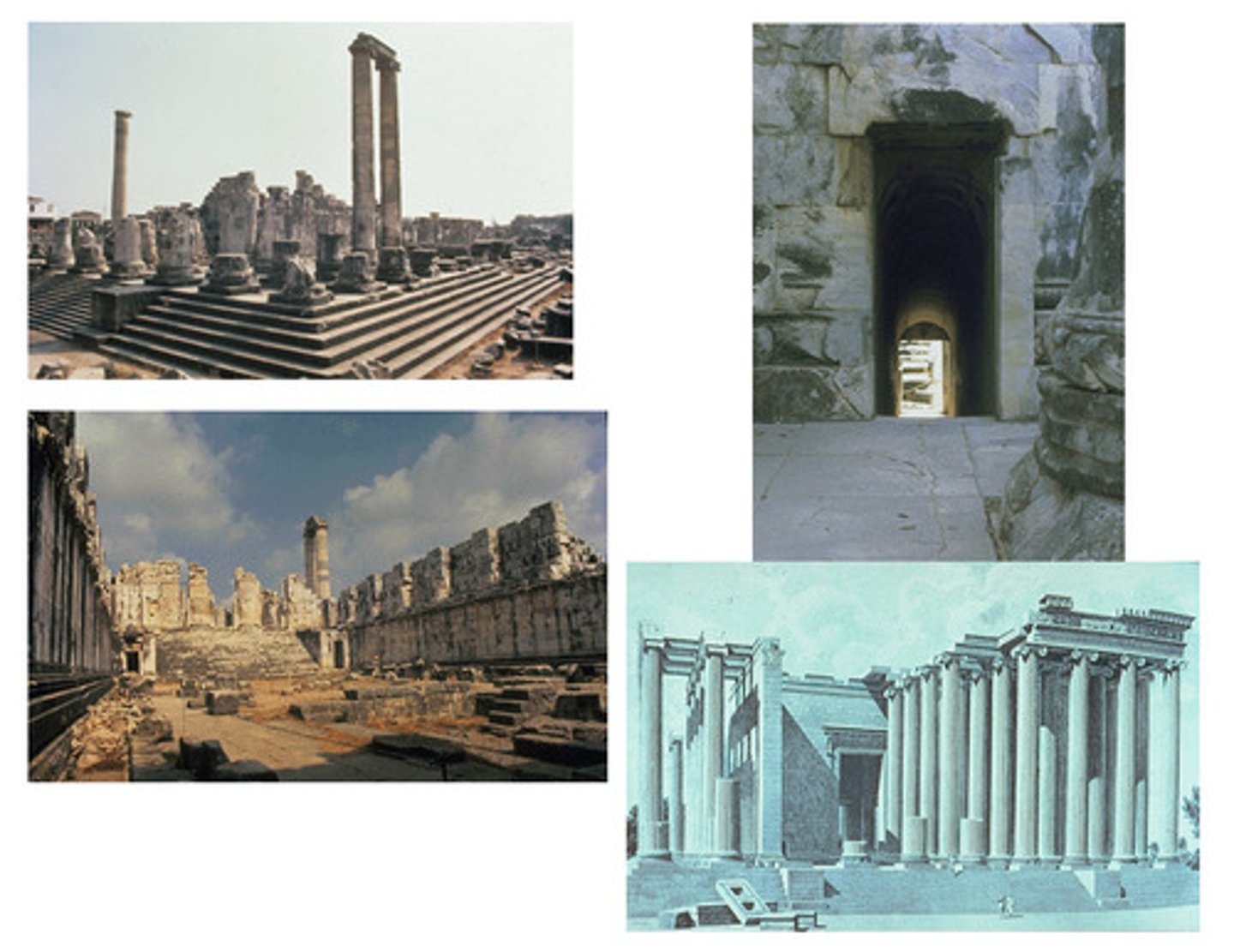
Temple of Apollo (Didyma) - Hellenistic
- HUGE temple: double peristyle w/ Ionic columns, huge stairs, huge door leads to stage for Priest (oracle)
- Tunnel w/ barrel vault to descent & enter the temple
- Inside: garden of laurel trees sacred to Apollo; small Ionic temple within to house statue of Apollo, Corinthian columns
- Flat roof (no pediment) -> could go on roof & admire view
Priene - Hellenistic
- City built at foot of mountain w/ grid plan, city center, theater, temple
- Agora enclosed by stoa, mainly for government use
- Temple: Ionic, dedicated to Athena
Theater: elaborate stagehouse; would show simple stories bc diverse population w/ non-Greeks in audience
- Gymnasium: people would be Hellenized
- Houses: courtyard w mini temple, didnt separate men and women
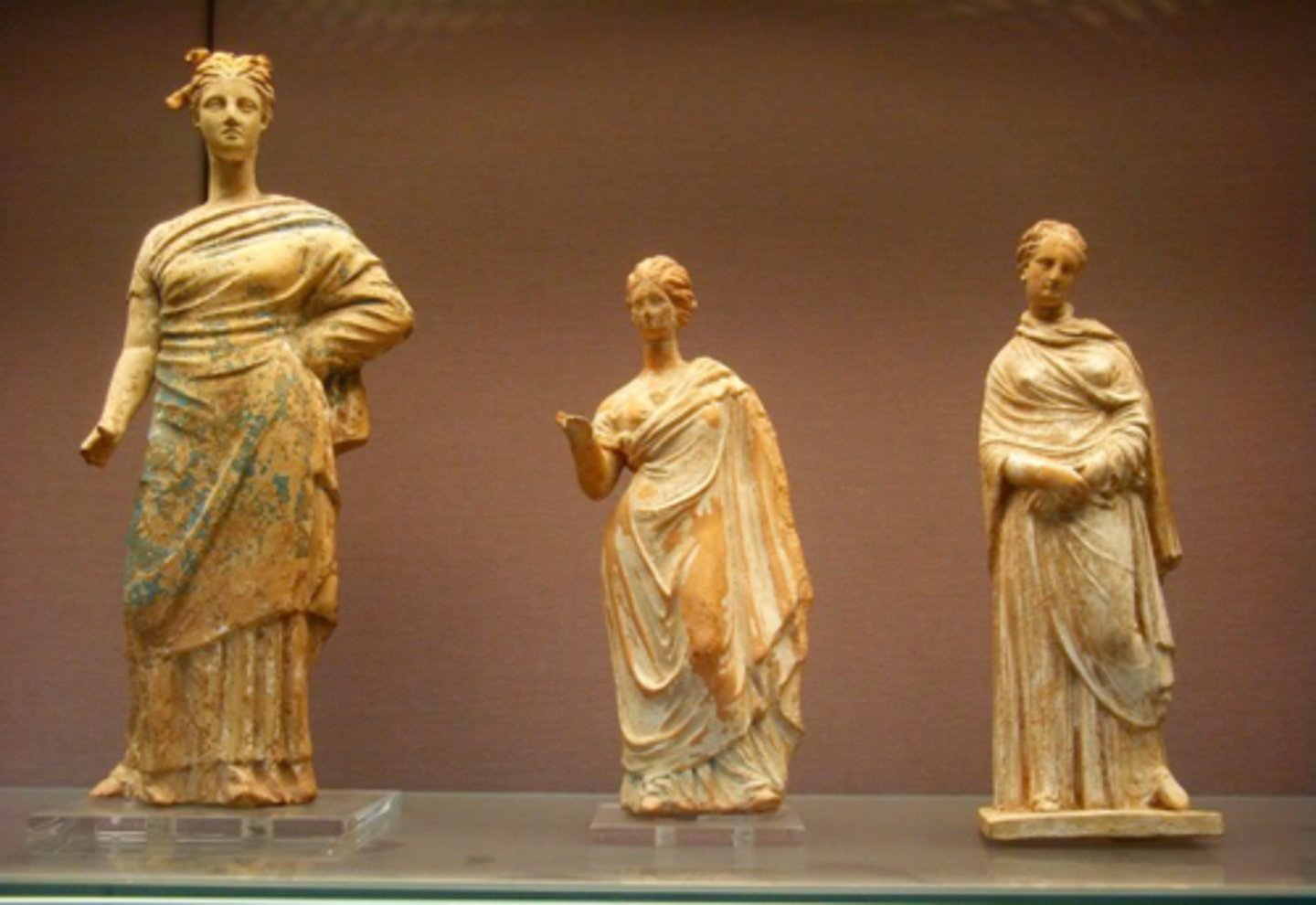
Tanagra Figurines - Hellenistic
-Ceramic figures, made with mold (mass produced & inexpensive)
- wear little hats & hold pretty fans like they were out in public
- women shown in various roles
- shows how the status of women was slightly improved since Classical Greek, especially for wealthy women who could make financial decisions (buy slaves)
- Increase in social mobility makes it hard to control women
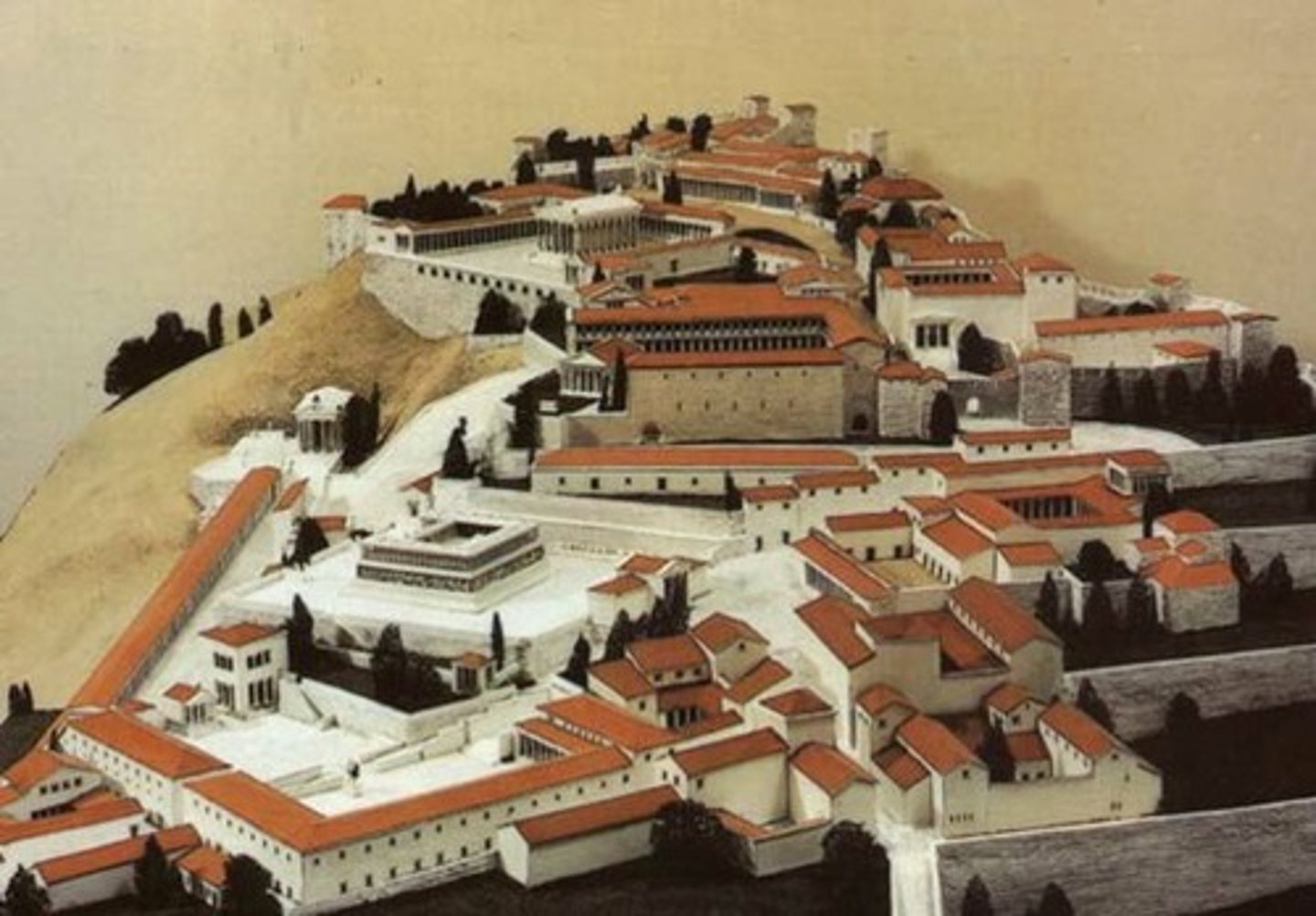
Pergamon Acropolis (model) - Hellenistic
-Attalus 1, ruler of Pergamon believes Pergamon's victory over Celts == Athen's victory over Persians -> will propel Pergamon into success; he declares Athena the Patron God
- Goal: Make Pergamon successful like Athens
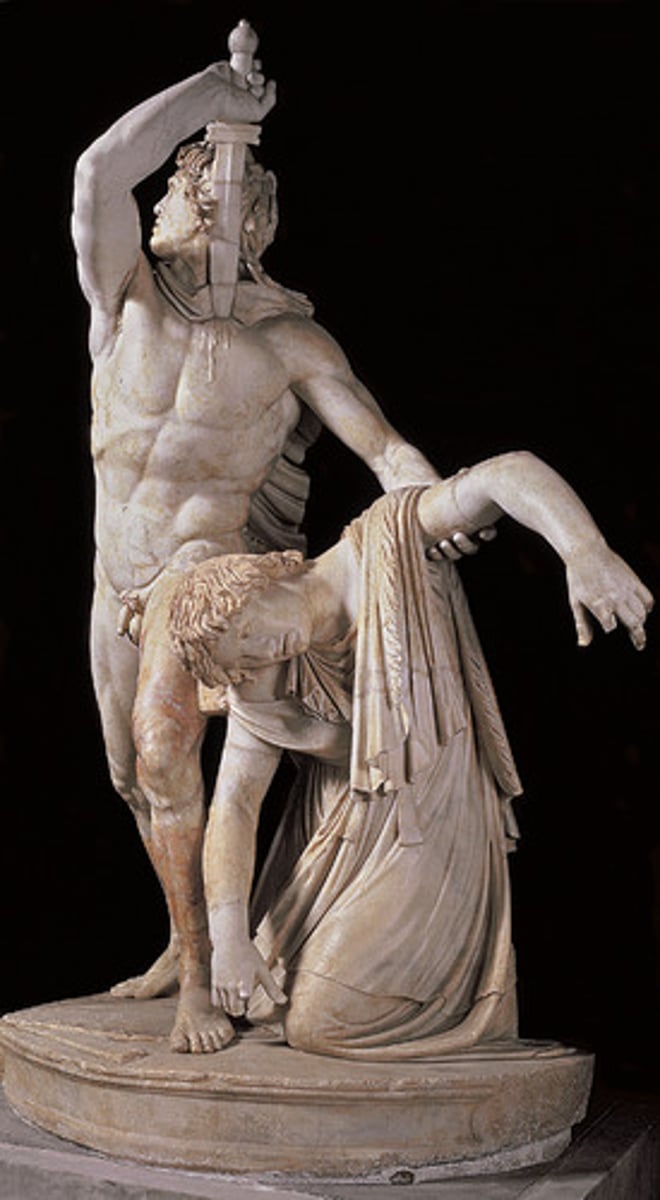
Gallic chieftain killing himself and his wife - Hellenistic
- Gallic = Celtic: wears a torc, coarse blond hair, mustache (w/o beard)
- sculpture in the round
- Heroic nudity with big muscles & expressive face
- he stabbed his wife already & she is on the brink of losing consciousness; he holds the sword and is driving it into his chest
- they would rather die than be taken prisoner
- he is so dynamic and she is so slumped; lots of expression
- Portray their enemies beautifully to emphasize the significance of their victory
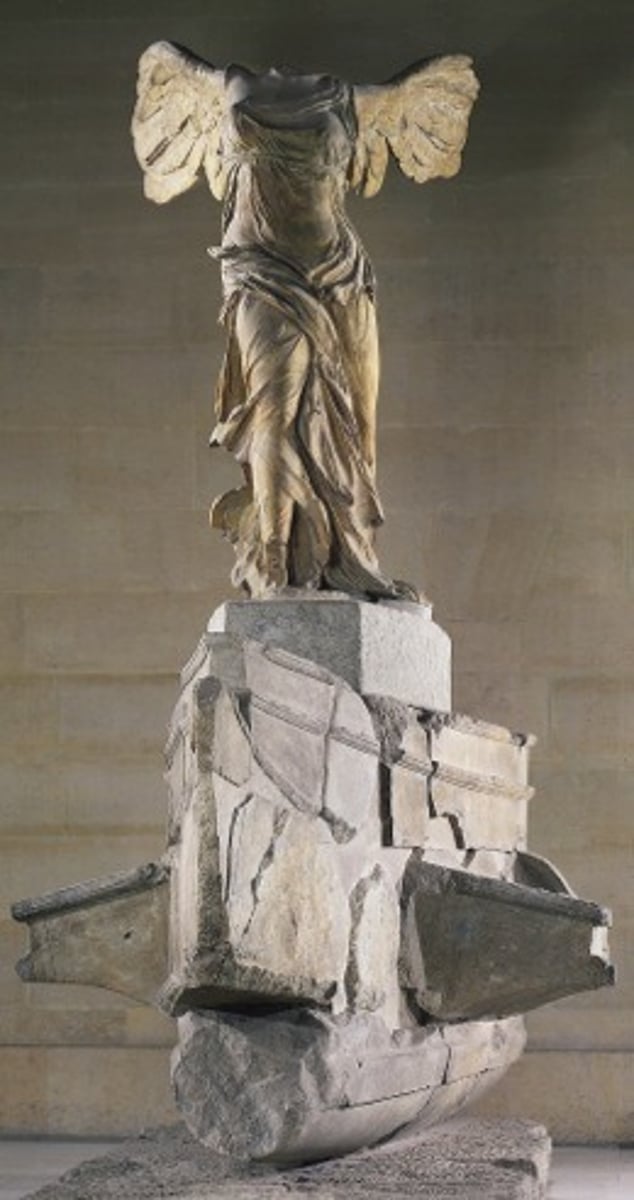
Dying Gaul - Hellenistic
- Celtic style shield & sword
- huge improvement in realism compared to archaic & early classical fallen warrior attempts
- used to dehumanize their enemies, now show sympathy
- Show the celts as impressive opponents which elevates their victory
- an increase in cultural diversity leads to more tolerance/acceptance/sympathy for non-greek opponents
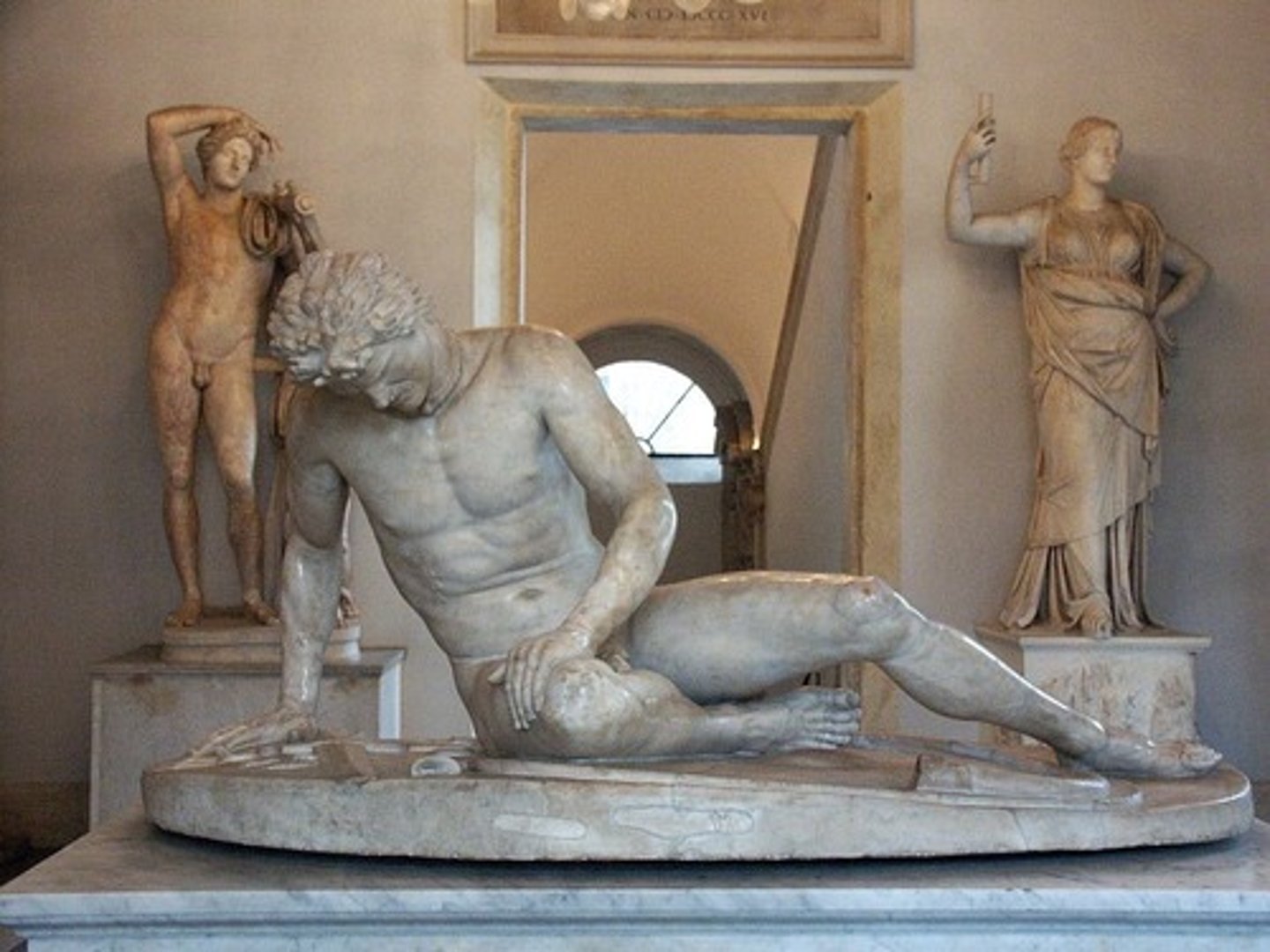
Great Alter of Zeus (Pergamon) - Hellenistic
- Quotes important Greek artworks (supports idea that Attalus I wanted to build Pergamon into a great Greek city that would preserve Greek culture
- Maybe originally dedicated to Zeus and Athena?
- Structure: flipped traditional Greek temple: columns on top with huge frieze at bottom so viewers could see the detail
- Frieze: Battle of Gods and Giants, goes back to early Greek traditions (myth as metaphor)
--Zeus fighting
--Athena fighting giant with mother Gaia while Nike crowns her
--Serene, expressionless Nix, callback to civilized Greeks who show no emotion
--Giants run away from gods & come into our space by crawling up the stairs
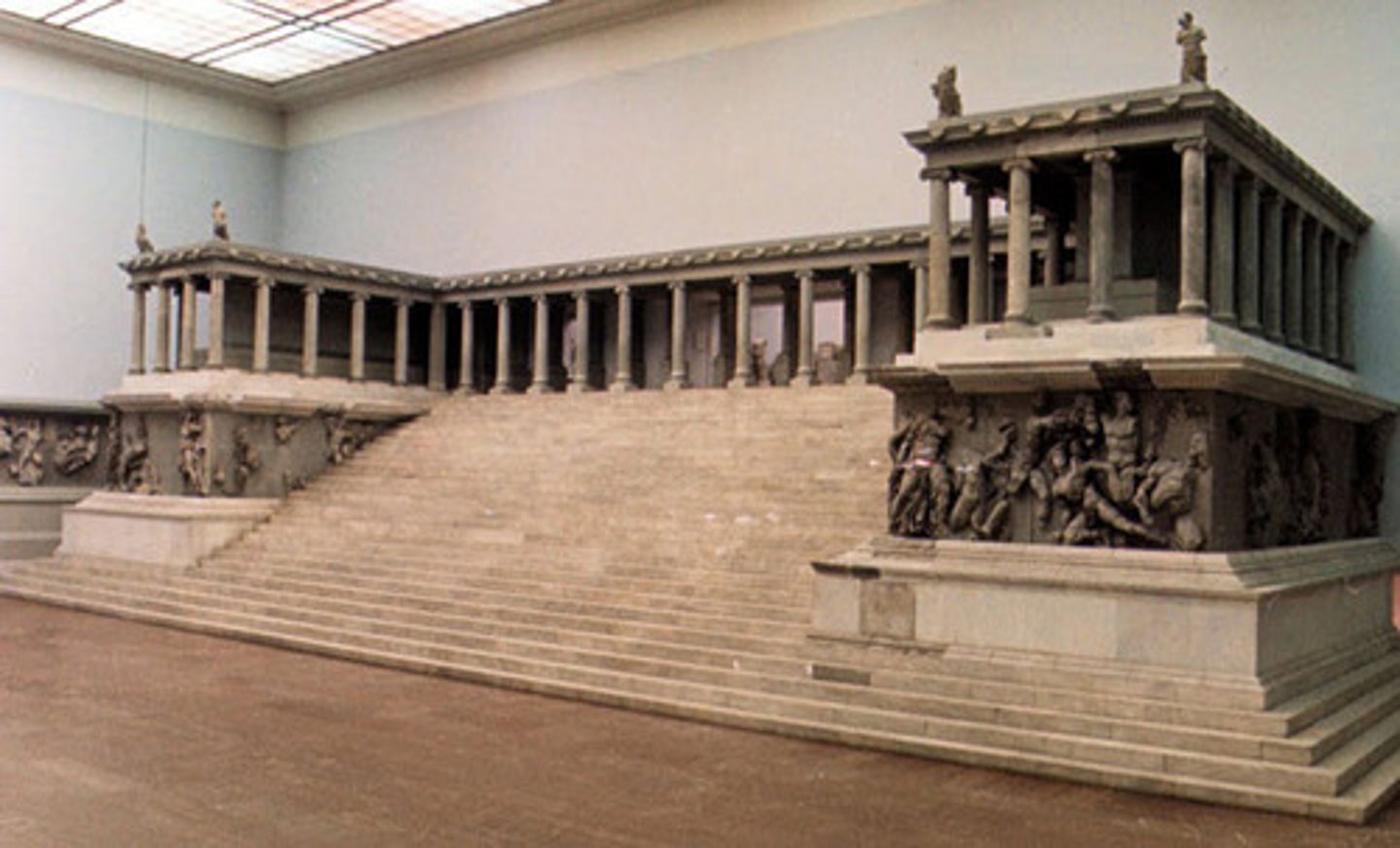
Laocoon (found in Rome) - Hellenistic
- Laocoon warns the Trojans not to accept the horse; this is against the god's plan so they summon serpents to kill Laocoon and his sons
- very expressive and dynamic: expressive face, powerful muscular body is contorted and entangled in the serpents; you can see his struggle as he cries out to the gods
- Humans vs divine fate; you cannot escape your fate, trying to will be more painful
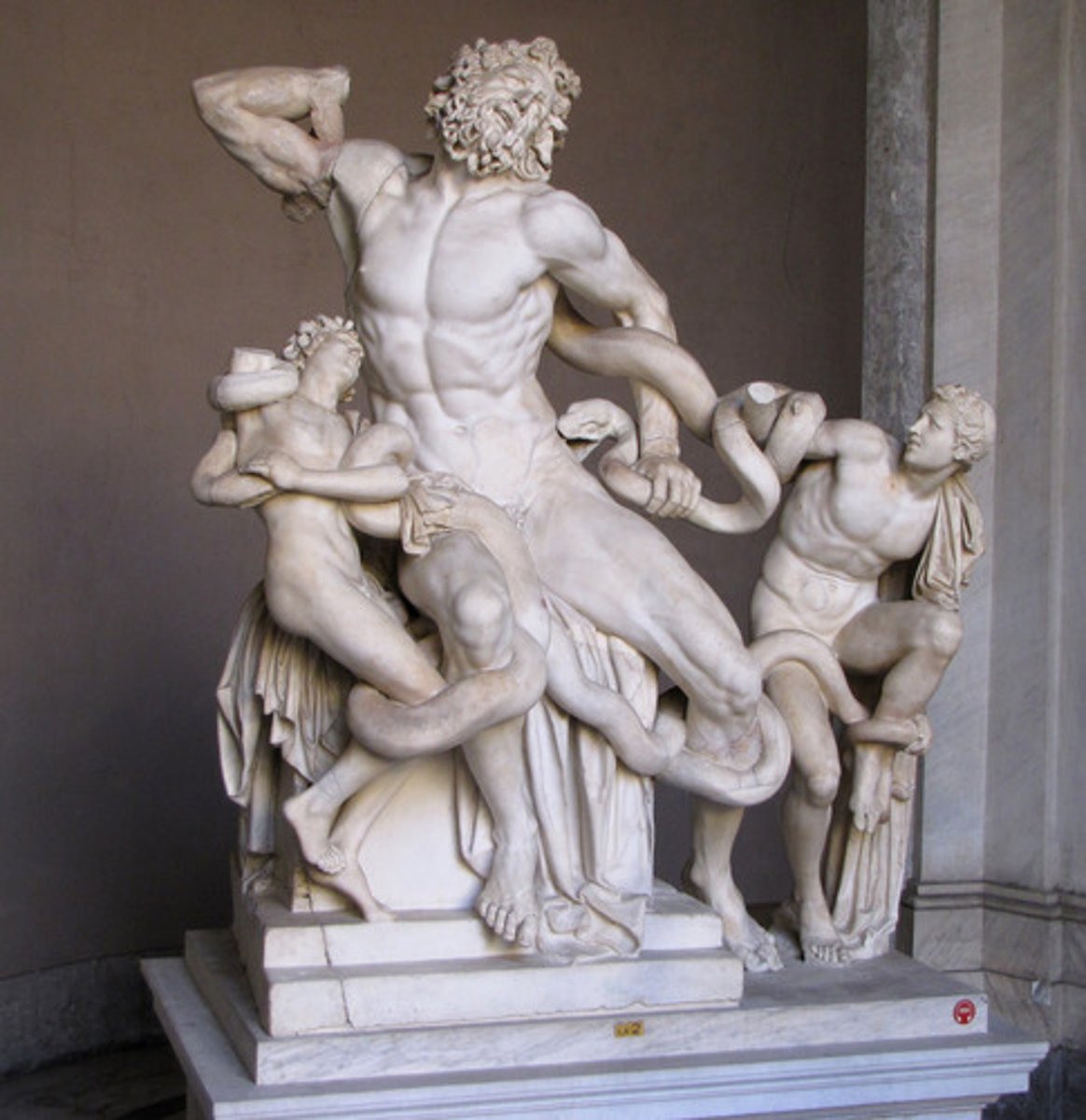
Nike of Samothrace - Hellenistic
- Nike == messenger god who delivers/announces victory
- stands on warship like she just landed; the fabric of her clothes clings to her body -> sense of windswept movement (on site you can feel those winds)
- maybe making a Greeting motion upon ships return
- maybe apart of a fountain w/ running water, sunlight reflecting creates additional movement
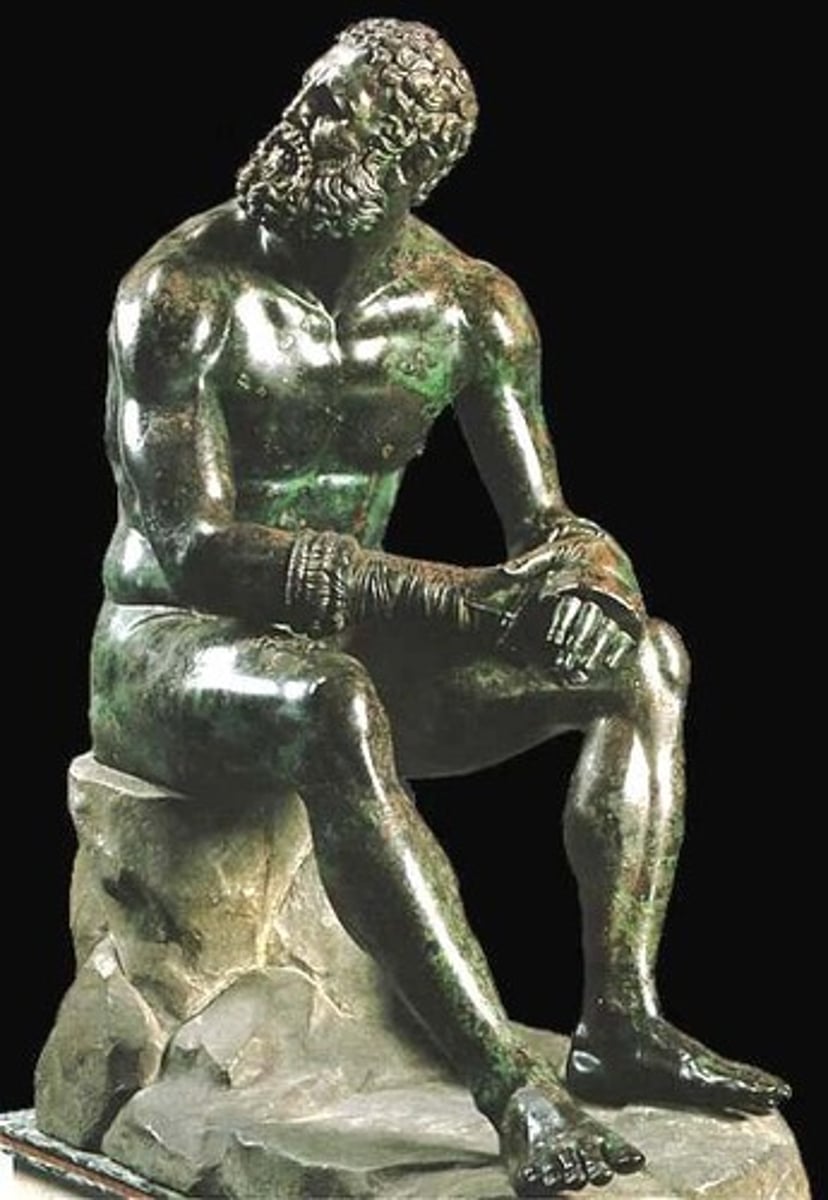
Seated Boxer - Hellenistic
- Sculpture in the round
- Very powerful muscular body; professional athlete
- older mature man
- slouched over w/ unhappy facial expression
- scars & bleeding & cauliflower ears; just got out of the ring w/ fresh wounds -> shows years of dedication to boxing but he looks defeated
- Emphasis on individual experience as a boxer, not idealized like Diskobolos
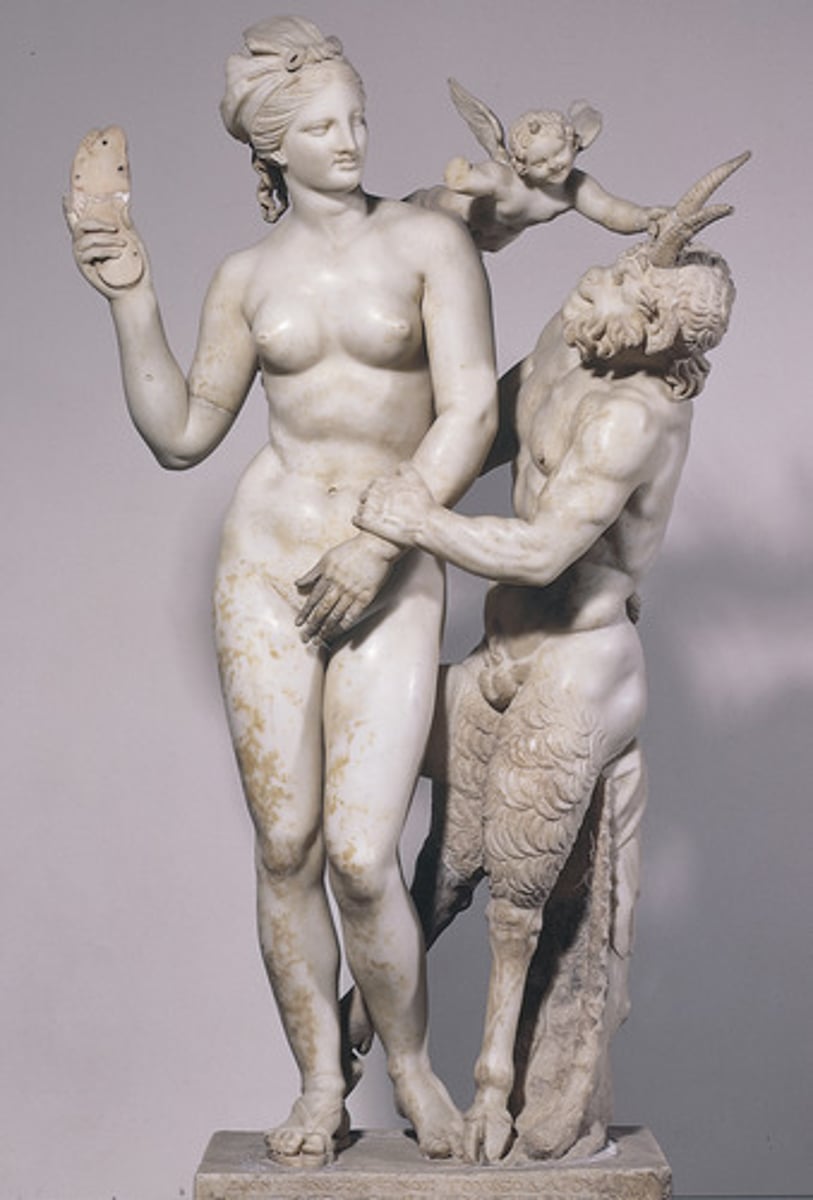
Aphrodite and Pan - Hellenistic
- Pan accosting Aphrodite with Eros pushing Pan away
- Aphrodite holding her slipper ready to slap Pan
- lighthearted & playful scene; playfulness and joyous emotion encapsulated by this sculpture make it distinctively Hellenistic
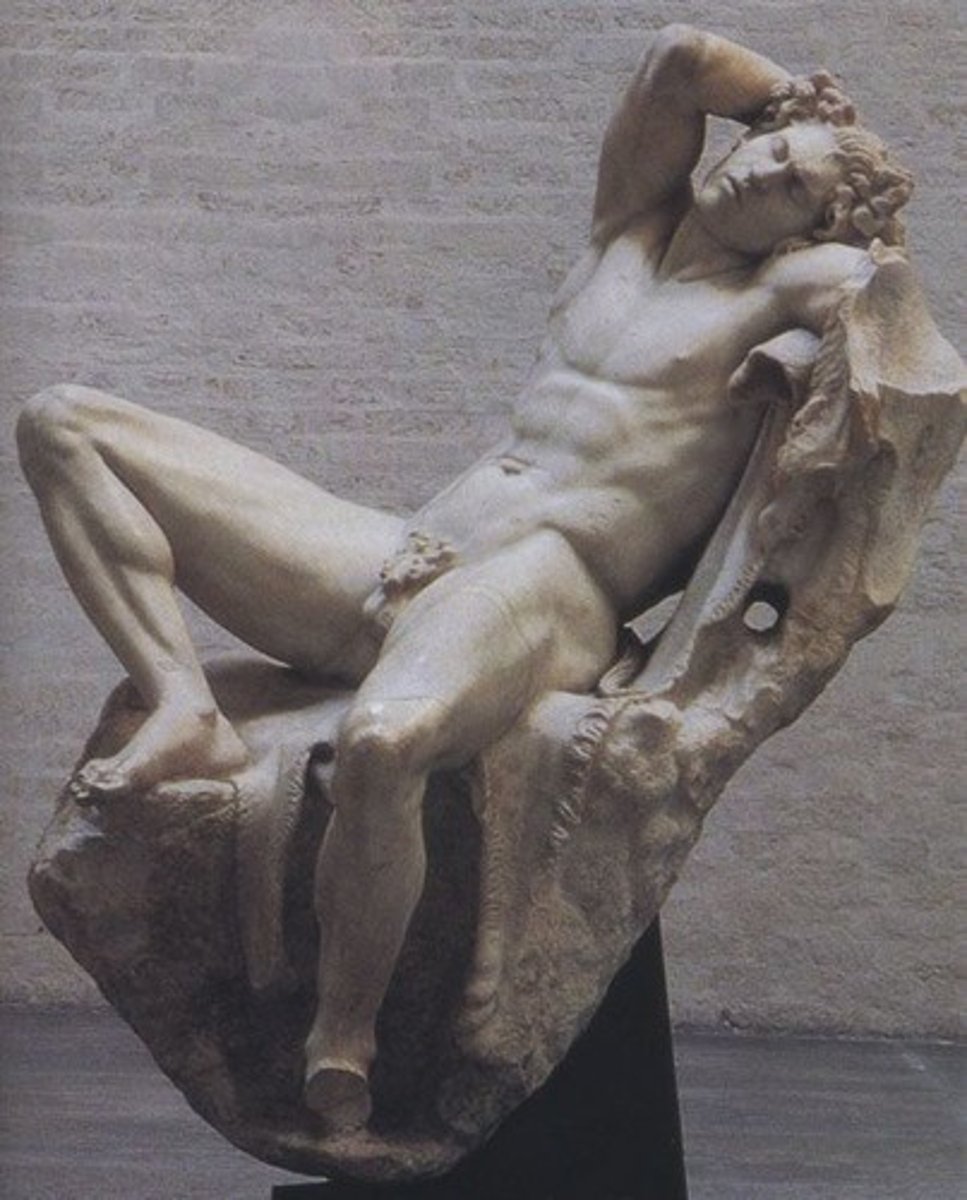
Sleeping Satyr - Hellenistic
- Satyr with human features & a small tail sleeping on a rock
- Looks like he fell asleep drunk; satyrs = followers of Dionysus so they're always getting wine drunk
- powerful & beautiful figure, slightly erotic with legs spread and showing genitals
- his body is contorted in a way that follows stylistic trends of Hellenistic art
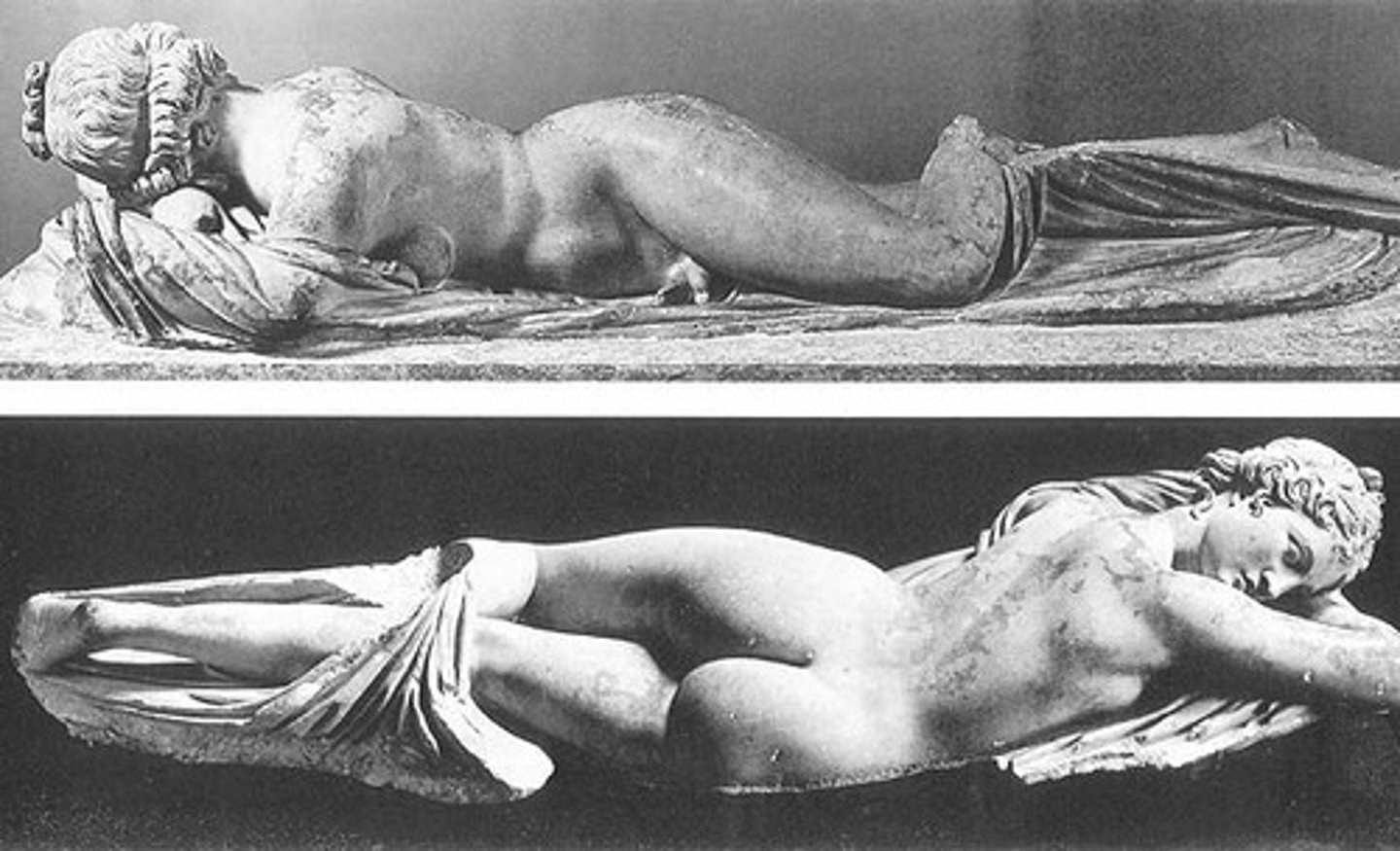
Sleeping Hermaphrodite (Roman copy) - Hellenistic
- Sleeping on a rock; serene face
- Son of Hermes + Aphrodite = Hermaphroditus
- Hermaphroditus + Nymph = Hermaphrodite (Forever united)
- Myth: humans were originally Hermaphrodites, but too powerful to Zeus split us. Go through life feeling incomplete. Temporarily feel complete during sex
 Note
Note  Flashcards (49)