Unit 8 Anatomy Test Study Guide Cardiovascular System
 Call Kai
 Learn
Learn Practice Test
 Spaced Repetition
 Match
Match Flashcards
 Knowt Play
1/11

There's no tags or description
Looks like no tags are added yet.
Name | Mastery | Learn | Test | Matching | Spaced | Call with Kai |
|---|
No analytics yet
Send a link to your students to track their progress
12 Terms
What are the two circuits of the cardiovascular system?
Pulmonary Circuit: right side of heart, delivers O2-poor blood from the heart to the lungs, drops off CO2 and picks up O2
Systemic Circuit: left side of the heart, delivers O2-rich blood from the heart to the body/body tissue
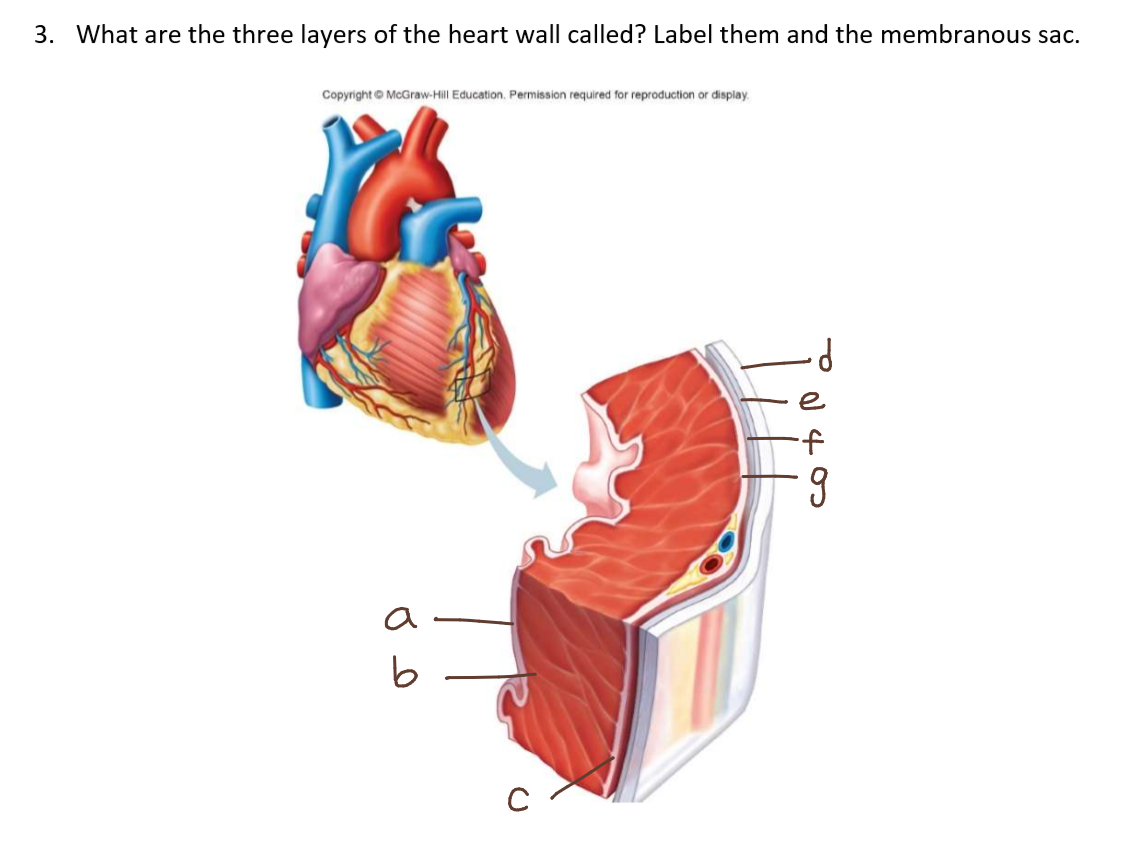
Label the 3 layers of the heart wall and the membranous sac (pericardium)
Heart wall
A: Endocardium
B: Myocardium
C: Epicardium
Pericardium
D: Fibrinous
E: Parietal
F: Pericardial Cavity
G: Visceral
Know the pathway of blood through the heart. (right side)
O2 poor blood from the body returns to the heart via superior vena cava and inferior vena cava, both empty into the right atria
right atria collects the blood and pumps it into the right ventricle through the tricuspid valve
the tricuspid valve closes once the blood empties into the right ventricle and the pulmonary valves open, the blood is pumped from the left ventricle into the pulmonary trunk and arteries
Pulmonary arteries carry blood into the lungs where it drops off CO2 and picks up O2
Know the pathway of blood through the heart. (left side)
O2 rich blood returns from the lungs to the heart via pulmonary veins and empty into the left atria
left atria collects the blood and pumps it into the left ventricle through the bicuspid valve
the bicuspid valve closes once the blood empties into the left ventricle and the aortic valve opens, the blood is pumped from the left ventricle into the aorta
through the aorta the blood travels through arteries and capillaries, where O2 diffuses into body tissues and CO2 diffuses into the blood
What is the difference between the pulmonary and systemic circuit
Pulmonary: carries O2 poor blood from the heart to the lungs
Systemic: carries O2 rich blood from the heart to the body
Know the basic anatomy of cardiac muscle cells and how they differ from skeletal muscle.
Involuntary, short, branched, and striated
Connected by intercalated discs with gap junctions
What is a functional syncytium? What are the two separated by?
Group of cells acting as a single unit for coordinated contraction
Atrial and Ventricular Functional syncytium = separated by fibrous skeleton of heart?
What is the difference between systole and diastole? When does each occur in the atria and ventricles?
Systole is the contraction of the syncytium, pressure rises and blood moves forward
Diastole is the relaxation of the syncytium, pressure falls and chambers refill with blood
Atrial systole: occurs when atria contracts to push blood into the ventricles
Ventricular systole: occurs following atrial systole, ventricles contract and SL valves open to pump blood
Describe how the pressure of blood changes throughout the cardiac cycle.
Atria Diastole: Atria is filled with blood from the body/lungs and pressure in the atria becomes greater than the pressure in the ventricles
AV valves are forced open and allows blood to fill the ventricles
Atrial Systole: atrial pressure continues to rise entering systole (contraction) and the remaining blood is forced into the ventricles
Ventricular systole: pressure in the ventricles increase sharply and AV valves close, causing the S1 sound to occur
SL valves open once ventricular pressure is higher than in aorta and pulmonary trunk and ventricular systole causes blood to be pushed out completely into aorta/pulmonary trunk
SL valves close when pressure is lower than aorta and pulmonary trunk, causing the S2 sound to occur
Heart relaxes for a moment before the AV valves open and cycle continues/repeats
What is the cardiac conduction system? Be able to diagram or describe the pathway of impulses throughout the heart as well as describe what each part’s role is in transmitting impulses.
Know the parts of a typical ECG. Be able to label and describe what is happening throughout the cycle.
What is bradycardia? Tachycardia? What types of things can cause each of them?
Bradycardia: abnormal heart rate lower than 60 beats/min
Causes: sleep, drugs, problems with conduction system
Tachycardia: abnormal heart rate higher than 100 beats/min
Causes: exercise, anxiety or stress, dehydration

