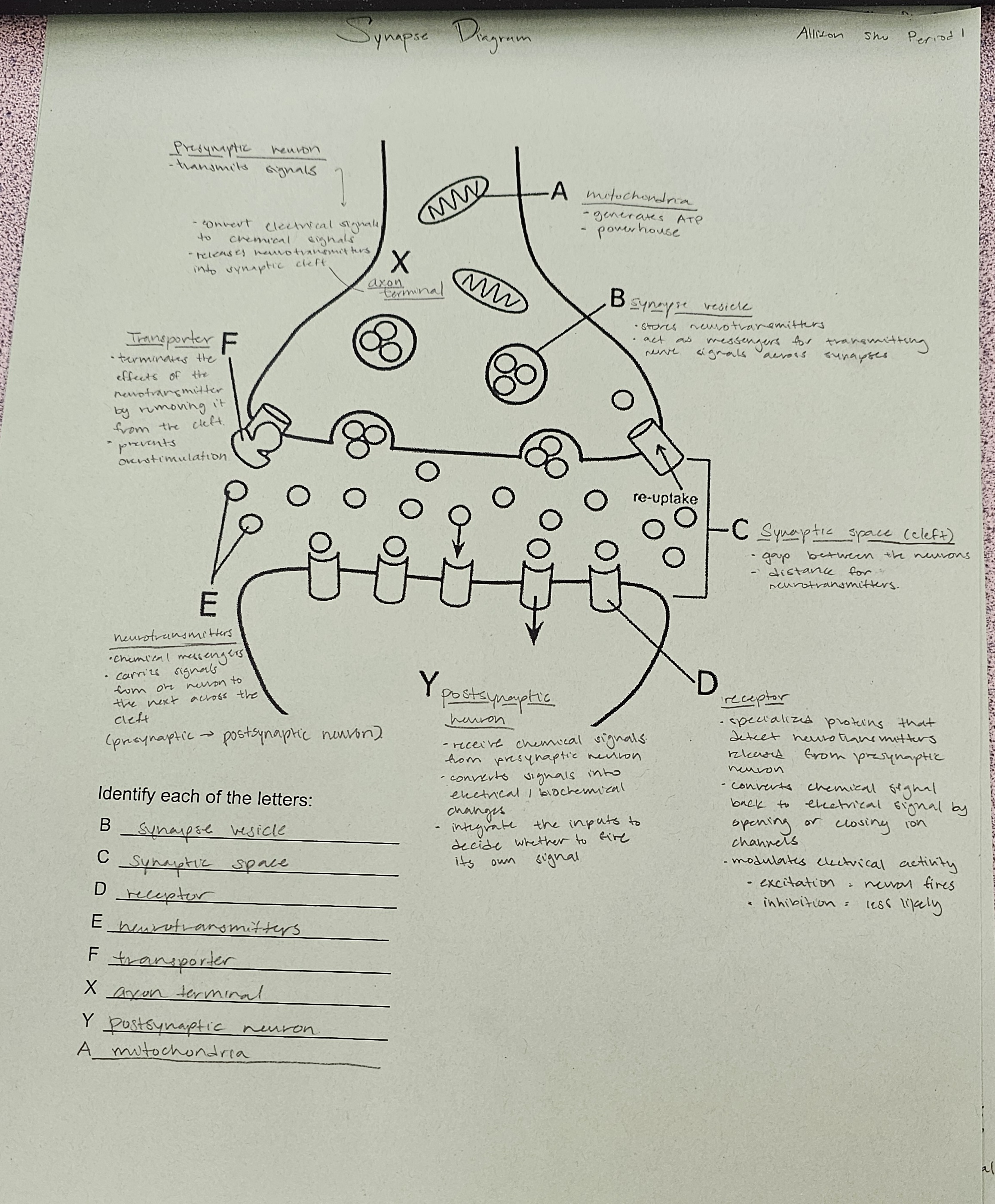
U5(?) Psych. Brain + neuron/synapse (quiz)

0.0(0)
studied byStudied by 0 people
0.0(0)
full-widthCall with Kai
learnLearn
examPractice Test
spaced repetitionSpaced Repetition
heart puzzleMatch
flashcardsFlashcards
GameKnowt Play
Card Sorting

1/40

encourage image

There's no tags or description

Looks like no tags are added yet.

Study Analytics
Name
Mastery
Learn
Test
Matching
Spaced
Call with Kai

No study sessions yet.

41 Terms

1
New cards

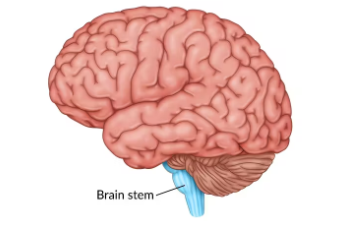
brainstem

  • connects your brain to spinal cord.

  • sends messages to the rest of your body to regulate balance, breathing, heart rate

  • carries signals that regulate body functions
<ul><li><p><span><span>connects your brain to spinal cord.</span></span></p></li><li><p><span><span>sends messages to the rest of your body to regulate balance, breathing, heart rate</span></span></p></li><li><p><span><span>carries signals that regulate body functions</span></span></p></li></ul><p></p>
2
New cards

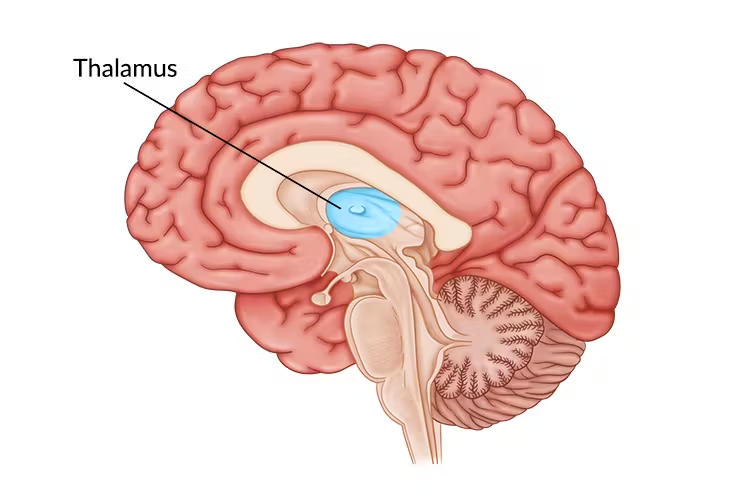
thalamus

  • body’s information relay station

  • relays all incoming motor (movement) and sensory information — hearing, taste, sight and touch (but not smell) — from your body to your brain.

  • All info must first pass through your thalamus before being routed or directed to its destination in your brain’s cerebral cortex (the outermost layer of your brain) for further processing and interpretation.

  • also plays a role in sleep, wakefulness, consciousness, learning and memory.
<ul><li><p><span><span>body’s information relay station</span></span></p></li><li><p><span><span>relays all incoming motor (movement) and sensory information — hearing, taste, sight and touch (but not smell) — from your body to your brain. </span></span></p></li><li><p><span><span>All info must first pass through your thalamus before being routed or directed to its destination in your brain’s cerebral cortex (the outermost layer of your brain) for further processing and interpretation.</span></span></p></li><li><p><span><span>also plays a role in sleep, wakefulness, consciousness, learning and memory.</span></span></p></li></ul><p></p>
3
New cards

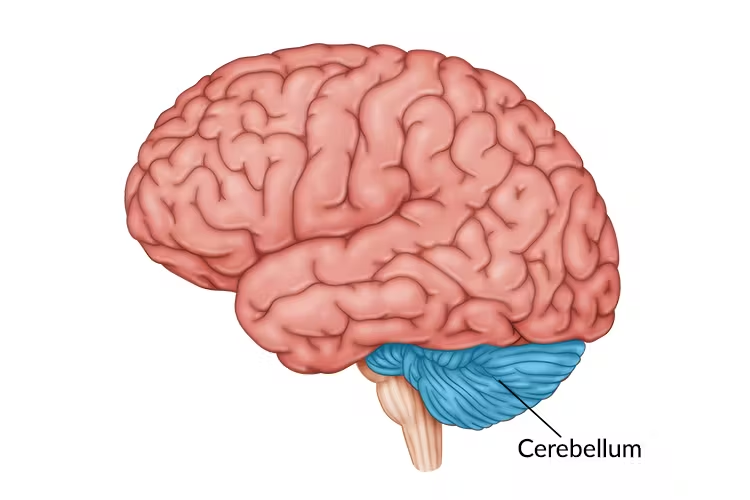
cerebellum

  • coordinates voluntary movement & balance

  • supports skill learning & memory

  • motor coordination & control, balance and posture, fine-tuning of voluntary movements, and movement related learning

    • ex: walking

<ul><li><p><strong><u>coordinates voluntary movement &amp; balance</u></strong></p></li><li><p><strong><u>supports skill learning &amp; memory</u></strong></p></li><li><p>motor coordination &amp; control, balance and posture, fine-tuning of voluntary movements, and movement related learning</p><ul><li><p><span>ex: walking</span></p></li></ul></li></ul><p></p>
4
New cards

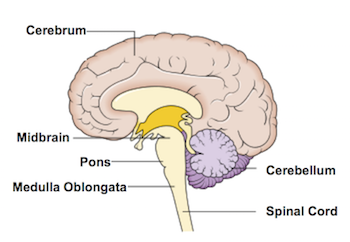
medulla/medulla oblongata

  • control vital processes like your heartbeat, breathing and blood pressure
<ul><li><p><span><span>control vital processes like your heartbeat, breathing and blood pressure</span></span></p></li></ul><p></p>
5
New cards

pons

  • coordination of movements + controls sleep

  • links your brain to your spinal cord & connects cerebellum too

  • contains several junction points for nerves that control muscles and carry information from senses in your head and face.

  • It handles unconscious processes and jobs, such as your sleep-wake cycle and breathing
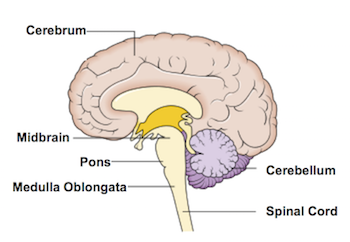
<ul><li><p><strong><u>coordination of movements + controls sleep</u></strong></p></li><li><p><strong><span>links your brain to your spinal cord &amp; connects cerebellum too</span></strong></p></li><li><p><strong><span>contains several junction points for nerves that control muscles and carry information from senses in your head and face.</span></strong></p></li><li><p><span>It handles unconscious processes and jobs, such as your sleep-wake cycle and breathing</span></p></li></ul><p></p>
6
New cards

reticular formation

  • conciousness, sleep regulation, overall alertness

  • pain sensitization, alertness, fatigue, sleep, and motivation

  • Arousal and Consciousness: it filters sensory input and wakes up the cerebral cortex, maintaining alertness and the sleep-wake cycle.

  • Somatic Motor Control: It helps maintain muscle tone, balance, and posture through the reticulospinal tracts.

  • Vital Autonomic Centers: It houses the cardiovascular and respiratory centers that regulate heartbeat, blood pressure, and breathing rhythms.

  • Pain Modulation: It acts as a gateway for pain signals traveling to the brain and is the origin of descending pathways that can block pain perception (analgesia).

  • Habituation: It allows the brain to ignore repetitive, meaningless stimuli (like the background noise of a city) while remaining sensitive to important ones (like a baby crying).
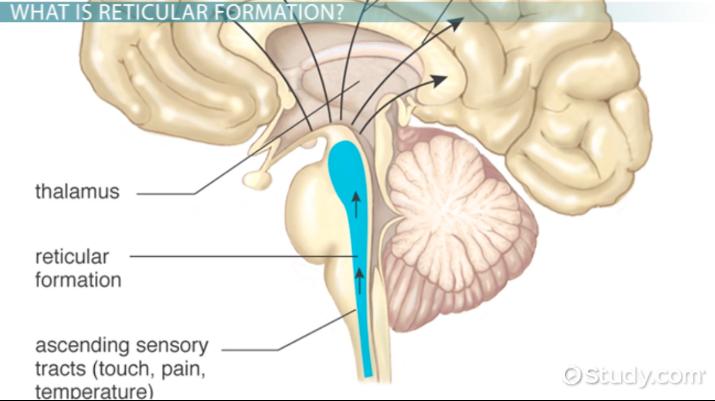
<ul><li><p><strong><u>conciousness, sleep regulation, overall alertness</u></strong></p></li><li><p>pain sensitization, alertness, fatigue, sleep, and motivation</p></li><li><p><strong><span>Arousal and Consciousness:</span></strong><span> it filters sensory input and wakes up the cerebral cortex, maintaining alertness and the sleep-wake cycle.</span></p></li><li><p><strong><span>Somatic Motor Control:</span></strong><span> It helps maintain muscle tone, balance, and posture through the reticulospinal tracts.</span></p></li><li><p><strong><span>Vital Autonomic Centers:</span></strong><span> It houses the cardiovascular and respiratory centers that regulate heartbeat, blood pressure, and breathing rhythms.</span></p></li><li><p><strong><span>Pain Modulation:</span></strong><span> It acts as a gateway for pain signals traveling to the brain and is the origin of descending pathways that can block pain perception (analgesia).</span></p></li><li><p><strong><span>Habituation:</span></strong><span> It allows the brain to ignore repetitive, meaningless stimuli (like the background noise of a city) while remaining sensitive to important ones (like a baby crying).</span></p></li></ul><p></p>
7
New cards

limbic system

  • network of interconnected brain structures that play a crucial role in processing emotions, motivation & memory

  • includes the amydala, hypothalamus, hippocampus, thalamus, and pituitary gland

  • processing emotions (fear, pleasure)

  • forming long-term memories

  • driving reward-seeking behaviors

  • regulating essential survival instincts like feeding and reproduction. It connects the endocrine system and autonomic nervous system, linking feelings to physical reactions.  
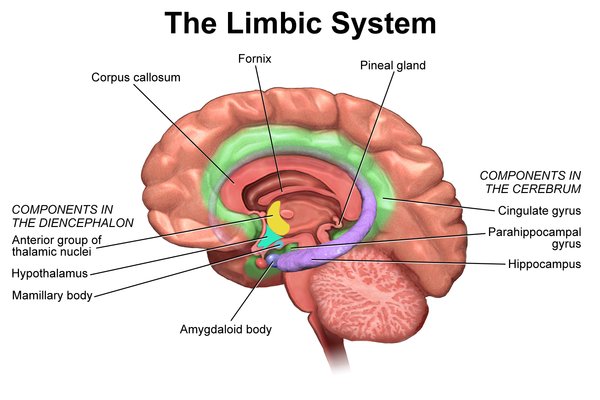
<ul><li><p><strong><u>network of interconnected brain structures that play a crucial role in processing emotions, motivation &amp; memory</u></strong></p></li><li><p><strong><u>includes the amydala, hypothalamus, hippocampus, thalamus, and pituitary gland</u></strong></p></li><li><p><strong><mark data-color="unset" style="background-color: unset; color: inherit;"><span>processing emotions (fear, pleasure)</span></mark></strong></p></li><li><p><strong><mark data-color="unset" style="background-color: unset; color: inherit;"><span>forming long-term memories</span></mark></strong></p></li><li><p><strong><mark data-color="unset" style="background-color: unset; color: inherit;"><span>driving reward-seeking behaviors</span></mark></strong></p></li><li><p><strong><mark data-color="unset" style="background-color: unset; color: inherit;"><span>regulating essential survival instincts like feeding and reproduction</span></mark></strong><span>. It connects the endocrine system and autonomic nervous system, linking feelings to physical reactions. &nbsp;</span></p></li></ul><p></p>
8
New cards

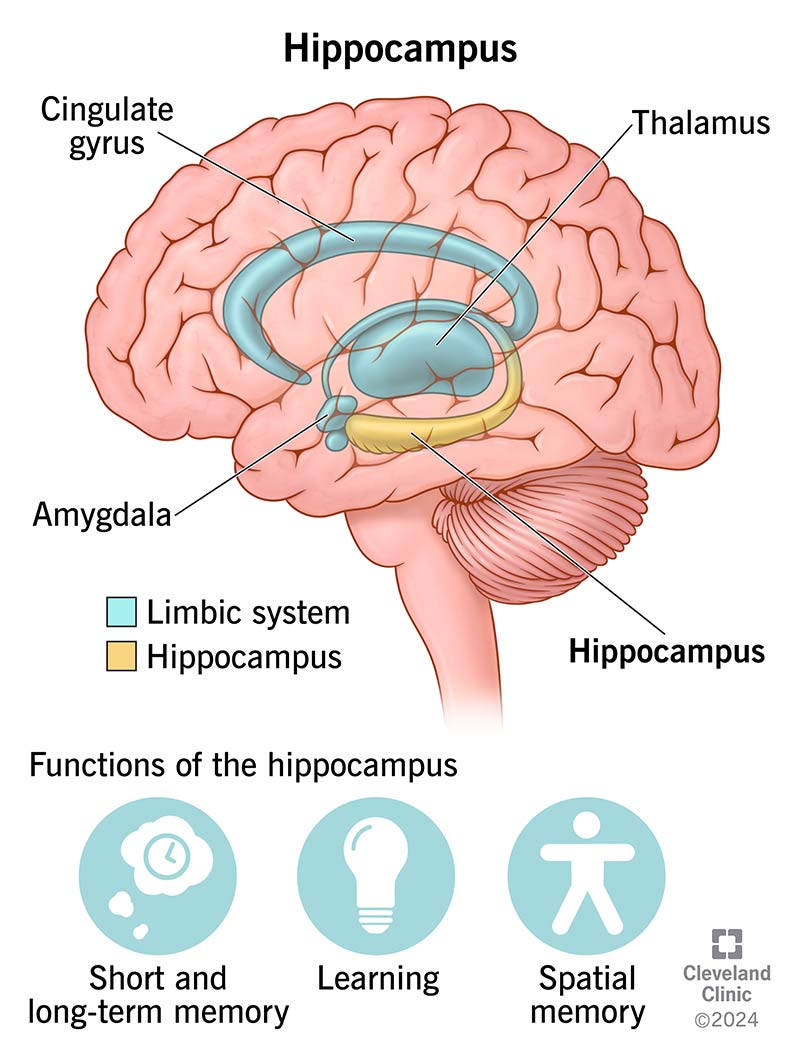
hippocampus

  • responsible for your memory and learning.

  • short term to long term memories

  • This small structure helps you remember, both short- and long-term, and gain awareness from your environment.

  • linked to conscious memory

<ul><li><p><span>responsible for your memory and learning.</span></p></li><li><p><strong><u><span>short term to long term memories</span></u></strong></p></li><li><p><span>This small structure helps you remember, both short- and long-term, and gain awareness from your environment.</span></p></li><li><p><span>linked to conscious memory</span></p></li></ul><p></p>
9
New cards

hypothalamus

  • main function is to keep your body in a stable state called homeostasis.

  • controls maintenance functions such as eating

    • thirst, drinking, body temperature, stress responses

  • governs endocrine system, linked to emotion and reward (AND PLEASURE)

  • influencing your autonomic nervous system or by managing hormones
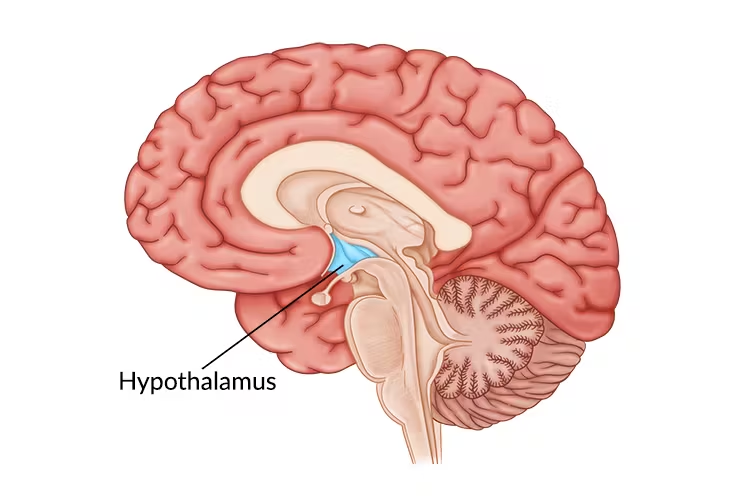
<ul><li><p><strong><u><span>main function is to keep your body in a stable state called homeostasis.</span></u></strong></p></li><li><p><strong><u><span>controls maintenance functions such as eating</span></u></strong></p><ul><li><p><strong><u>thirst, drinking, body temperature, stress responses</u></strong></p></li></ul></li><li><p><strong><u><span>governs endocrine system, linked to emotion and reward (AND PLEASURE)</span></u></strong></p></li><li><p><span>influencing your autonomic nervous system or by managing hormones</span></p></li></ul><p></p>
10
New cards

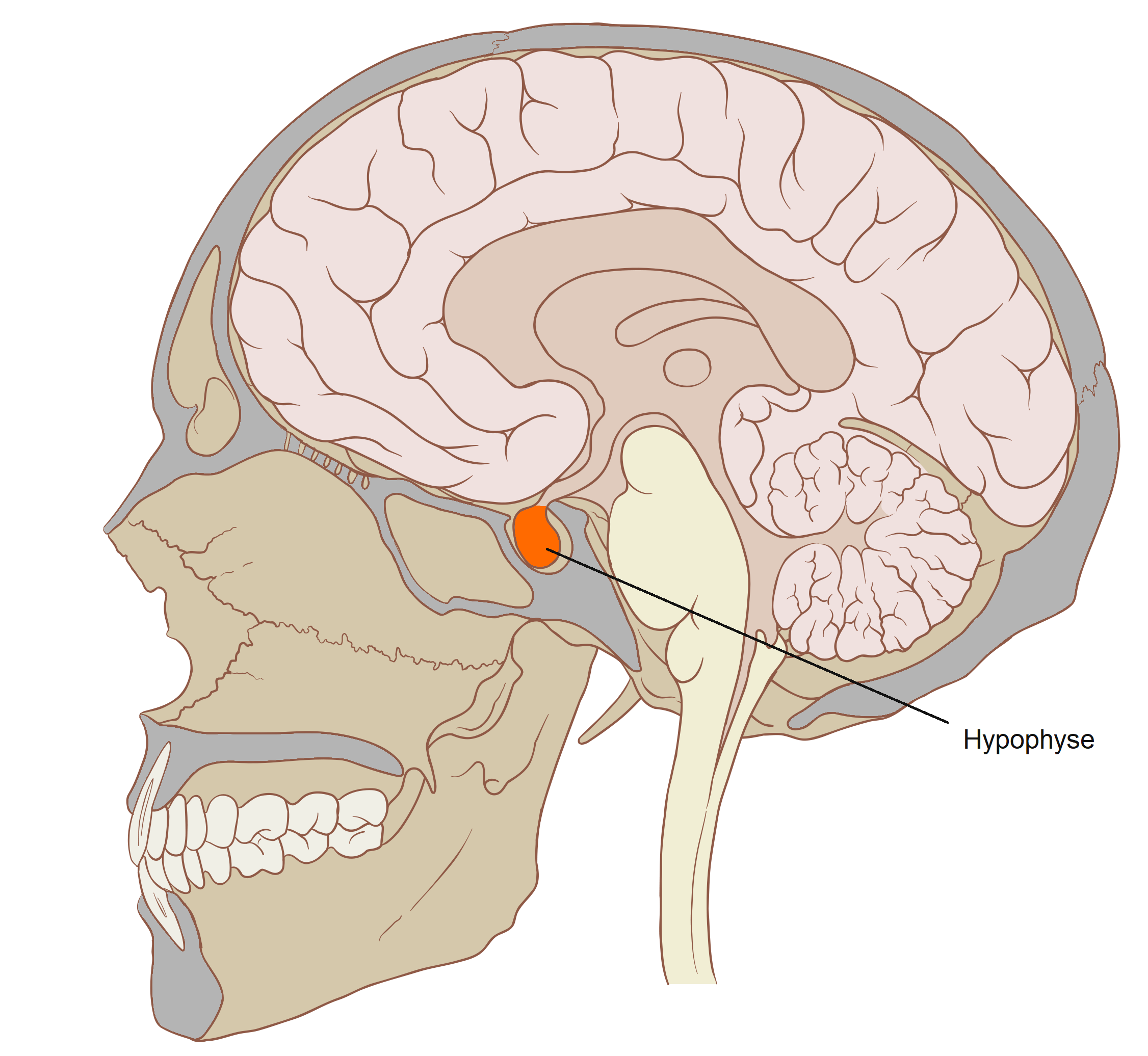
pituitary gland

  • produces growth, etc. hormones in repsonse to signals from hypothalamus

  • in charge of making several essential hormones. Your pituitary gland also tells other endocrine system glands to release hormones.

  • gland is an organ that makes one or more substances, such as hormones, digestive juices, sweat or tears. Endocrine glands release hormones directly into your bloodstream.

  • Hormones are chemicals that coordinate different functions in your body by carrying messages through your blood to various organs, skin, muscles and other tissues. These signals tell your body what to do and when to do it.

  • ex: sweaty armpits

<ul><li><p><strong><u>produces growth, etc. hormones in repsonse to signals from hypothalamus </u></strong></p></li><li><p><strong><u><span>in charge of making several essential </span>hormones<span>. Your pituitary gland also tells other endocrine system glands to release hormones.</span></u></strong></p></li><li><p><span>gland is an organ that makes one or more substances, such as hormones, digestive juices, sweat or tears. Endocrine glands release hormones directly into your bloodstream.</span></p></li><li><p><span>Hormones are chemicals that coordinate different functions in your body by carrying messages through your blood to various organs, skin, </span>muscles<span> and other tissues. These signals tell your body what to do and when to do it.</span></p></li><li><p><span>ex: sweaty armpits</span></p></li></ul><p></p>
11
New cards

amygdala

  • major processing center for emotions. It also links your emotions to many other brain abilities, especially memories, learning and your senses.

    • especially fear (fear/pleasure)

  • part of a larger network in your brain called the limbic system

  • amygdala and limbic system automatically detect danger. They also play a role in behavior, emotional control and learning.

  • Aggression.

  • Learning through rewards and punishment.

  • Handling and using implicit (unconscious) memory, which allows you to remember how to do certain things without remembering how you learned them (like riding a bike or tying your shoes).

  • Social communication and understanding, including how you interpret someone’s intentions from how they talk or act).

  • Emotions that relate to parenting and caregiving.

  • Emotions we connect to memories.

<ul><li><p><strong><span>major processing center for emotions. It also links your emotions to many other brain abilities, especially memories, learning and your senses.</span></strong></p><ul><li><p><strong><u>especially fear (fear/pleasure)</u></strong></p></li></ul></li><li><p><span>part of a larger network in your brain called the limbic system</span></p></li><li><p><span>amygdala and limbic system automatically detect danger. They also play a role in behavior, emotional control and learning.</span></p></li><li><p>Aggression.</p></li><li><p>Learning through rewards and punishment.</p></li><li><p>Handling and using implicit (unconscious) memory, which allows you to remember how to do certain things without remembering how you learned them (like riding a bike or tying your shoes).</p></li><li><p>Social communication and understanding, including how you interpret someone’s intentions from how they talk or act).</p></li><li><p>Emotions that relate to parenting and caregiving.</p></li><li><p>Emotions we connect to memories.</p></li></ul><p></p>
12
New cards

corpus callosum

  • nerve fibers that allow your brain’s left and right hemispheres to communicate

  • It allows nerve signals to move between the two sides of your brain. Nerve signals are like people crossing the bridge. Each person carries a message to a different location in your brain. These messages help you coordinate your:

    • Senses (vision, hearing, touch, taste, smell).

    • Movement (telling your muscles to move).

    • Cognitive function (memory, language processing, problem-solving and reasoning).
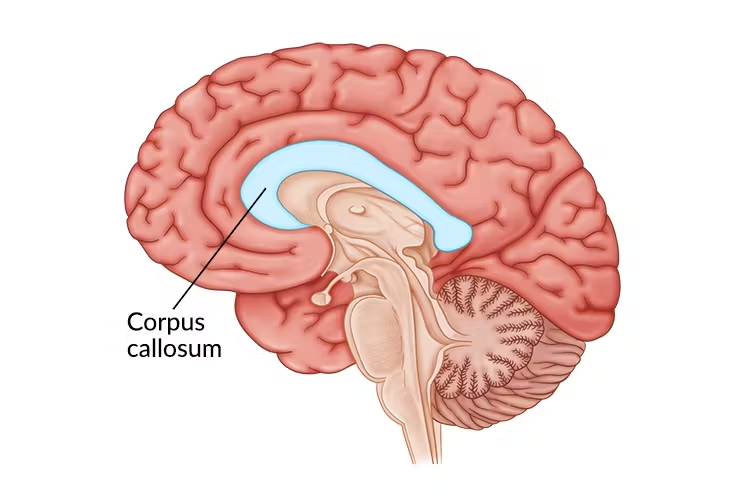
<ul><li><p><strong><u><span>nerve fibers that allow your brain’s left and right hemispheres to communicate </span></u></strong></p></li><li><p>It allows nerve signals to move between the two sides of your brain. Nerve signals are like people crossing the bridge. Each person carries a message to a different location in your brain. These messages help you coordinate your:</p><ul><li><p>Senses (vision, hearing, touch, taste, smell).</p></li><li><p>Movement (telling your muscles to move).</p></li><li><p>Cognitive function (memory, language processing, problem-solving and reasoning).</p></li></ul></li></ul><p></p>
13
New cards

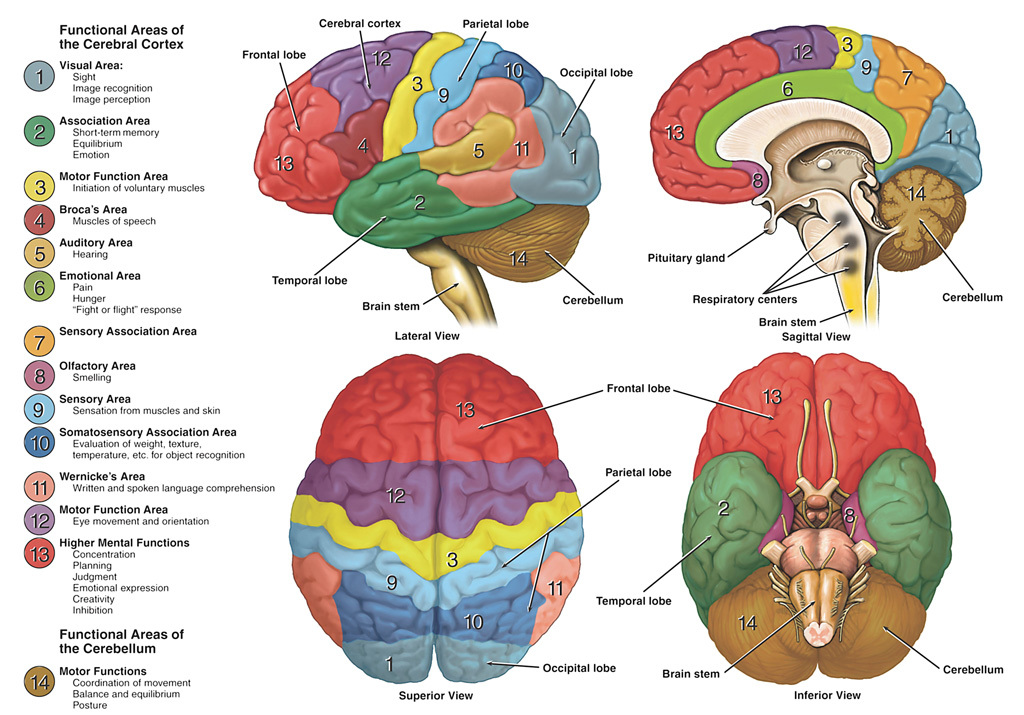
frontal lobes

  • Interprets smell, motor functions, mood, emotions, foresight, and memory

  • manage thinking, emotions, personality, judgment, self-control, muscle control and movements, memory storage and more.

  • anything you do that involves thinking or conscious action relies on abilities contained within your frontal lobe.

  • Reasoning: This includes simple and complex processing of information. Logic, reasoning, judgment, decision-making and creativity all fall into this category.

  • Social understanding: Your frontal lobe controls your understanding of social norms and helps determine what you should and shouldn’t do or say.

  • Executive functions: Some examples of these include self-control and inhibitions, attention span and working memory.

  • Voluntary muscle movements: These are intentional movements, such as moving your hand to pick something up or moving your legs to stand up and walk around. Your frontal lobe also contains the brain area that controls the muscles you use for speaking.

  • Learning and recalling information: This is your brain’s ability to process and learn new information for later use. Your frontal lobe also helps retrieve information later.
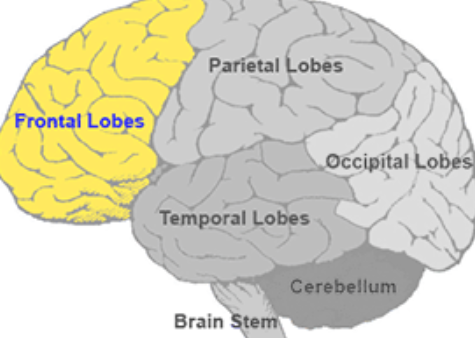
<ul><li><p><span><strong><u><span>Interprets smell, motor functions, mood, emotions, foresight, and memory</span></u></strong></span></p></li><li><p><strong><u><span>manage thinking, emotions, personality, judgment, self-control, muscle control and movements, memory storage and more.</span></u></strong></p></li><li><p><strong><u><span>anything you do that involves thinking or conscious action relies on abilities contained within your frontal lobe.</span></u></strong></p></li><li><p><strong>Reasoning</strong>: This includes simple and complex processing of information. Logic, reasoning, judgment, decision-making and creativity all fall into this category.</p></li><li><p><strong>Social understanding</strong>: Your frontal lobe controls your understanding of social norms and helps determine what you should and shouldn’t do or say.</p></li><li><p><strong>Executive functions</strong>: Some examples of these include self-control and inhibitions, attention span and working memory.</p></li><li><p><strong>Voluntary muscle movements</strong>: These are intentional movements, such as moving your hand to pick something up or moving your legs to stand up and walk around. Your frontal lobe also contains the brain area that controls the muscles you use for speaking.</p></li><li><p><strong>Learning and recalling information</strong>: This is your brain’s ability to process and learn new <span>information for later use. Your frontal lobe also helps retrieve information later.</span></p></li></ul><p></p>
14
New cards

parietal lobes

  • language, spatial orientation, attention (has somatosensory cortex that processing touching, temperature, awareness of body and space)

  • Self-perception: a processing center for sensations you can feel with your sense of touch. These include temperature (hot and cold), pressure, vibration and pain. Also uses your sense of touch to tell you where parts of your body are without needing to see them

  • learned movements: helps you learn each time you plan and carry out complex, precise movements. A big example of this is writing

  • Location awareness: plays a key role in how you understand where things are around you. Knowing if something is on your left or right side

    • ex: seeing a stove, countertops, sink and refrigerator and understanding that you’re looking at a kitchen.
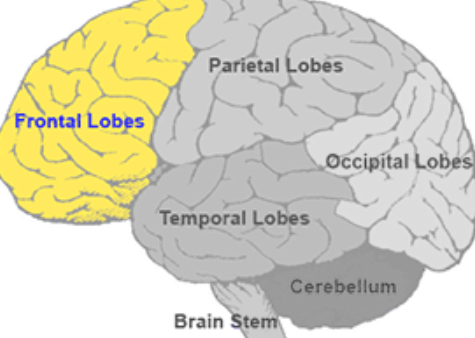
<ul><li><p><strong><u>language, spatial orientation, attention (has somatosensory cortex that processing touching, temperature, awareness of body and space)</u></strong></p></li><li><p><strong>Self-perception:</strong> a processing center for sensations you can feel with your sense of touch. These include temperature (hot and cold), pressure, vibration and pain. Also uses your sense of touch to tell you where parts of your body are without needing to see them</p></li><li><p><strong>learned movements:</strong> <span>helps you learn each time you plan and carry out complex, precise movements. A big example of this is writing</span></p></li><li><p><strong>Location awareness:</strong> plays a key role in how you understand where things are around you. Knowing if something is on your left or right side</p><ul><li><p>ex: <span>seeing a stove, countertops, sink and refrigerator and understanding that you’re looking at a kitchen.</span></p></li></ul></li></ul><p></p>
15
New cards

occipital lobes

  • visual processing hub of your brain.

  • decoding the messages sent from your eyes and turning that information into forms the rest of your brain can use.

  • This area processes visual signals and works cooperatively with many other brain areas. It plays a crucial role in language and reading, storing memories, recognizing familiar places and faces.

  • Spatial processing: This is your brain’s decoding of signals from your retinas. It’s how you see the shapes, textures and other details of the objects in the world around you.

  • Color processing: This helps you see and tell the difference between colors and all the different shades of them (unless your eyes can’t see certain colors, such as with certain types of color blindness).

  • Distance and depth perception: This is when your brain calculates the size of objects and the distance between you and what you see.

  • Object and face recognition: This is your brain’s ability to recognize things you’ve seen before, including the faces of people you’ve seen or met.
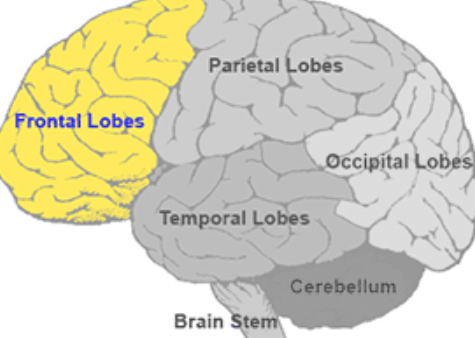
<ul><li><p><strong><u><span>visual processing hub of your brain.</span></u></strong></p></li><li><p><span>decoding the messages sent from your eyes and turning that information into forms the rest of your brain can use.</span></p></li><li><p><span>This area processes visual signals and works cooperatively with many other brain areas. It plays a crucial role in language and reading, storing memories, recognizing familiar places and faces.</span></p></li><li><p><strong>Spatial processing</strong>: This is your brain’s decoding of signals from your retinas. It’s how you see the shapes, textures and other details of the objects in the world around you.</p></li><li><p><strong>Color processing</strong>: This helps you see and tell the difference between colors and all the different shades of them (unless your eyes can’t see certain colors, such as with certain types of color blindness).</p></li><li><p><strong>Distance and depth perception</strong>: This is when your brain calculates the size of objects and the distance between you and what you see.</p></li><li><p><strong>Object and face recognition</strong>: This is your brain’s ability to recognize things you’ve seen before, including the faces of people you’ve seen or met.</p></li></ul><p></p>
16
New cards

temporal lobes

  • higher order processing of visual information, learning/memory, and hearing (precieving sound)

  • auditory +receive info from opposite ear

  • Memory: Inside your temporal lobe is your hippocampus, which is essential for several memory-related processes and abilities.

  • Language: The temporal lobe gives you the ability to understand the meaning of words and objects. For instance, when you see a cup and recognize it as a container to drink out of, your temporal lobe is at work. Your temporal lobe is also home to Wernicke’s area, a part of your brain that helps you understand language and form meaningful sentences.

  • Emotions: Within your temporal lobe is the amygdala (pronounced “ah-MIG-da-la”). It plays a role in how you experience and process certain emotions.

  • Senses: Your temporal lobe processes signals from your senses, especially sight and sound.

  • Visual recognition: Certain regions of your temporal lobe are key to recognizing visual material such as familiar faces and known objects.
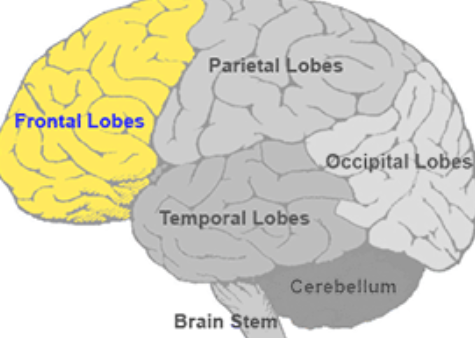
<ul><li><p><strong><u><span>higher order processing of visual information, learning/memory, and hearing </span></u></strong><span>(precieving sound)</span></p></li><li><p><strong><u><span>auditory +receive info from opposite ear</span></u></strong></p></li><li><p><strong>Memory</strong>: Inside your temporal lobe is your hippocampus, which is essential for several memory-related processes and abilities.</p></li><li><p><strong>Language</strong>: The temporal lobe gives you the ability to understand the meaning of words and objects. For instance, when you see a cup and recognize it as a container to drink out of, your temporal lobe is at work. Your temporal lobe is also home to Wernicke’s area, a part of your brain that helps you understand language and form meaningful sentences.</p></li><li><p><strong>Emotions</strong>: Within your temporal lobe is the amygdala (pronounced “ah-MIG-da-la”). It plays a role in how you experience and process certain emotions.</p></li><li><p><strong>Senses</strong>: Your temporal lobe processes signals from your senses, especially sight and sound.</p></li><li><p><strong>Visual recognition</strong>: Certain regions of your temporal lobe are key to recognizing visual material such as familiar faces and known objects.</p></li></ul><p></p>
17
New cards

Wernicke's area

  • language comprehension, specifically the comprehension of speech sounds

  • Recognizing Speech Sounds
    In partnership with the auditory cortex, Wernicke’s area helps identify and organize the sounds of speech. This early stage involves detecting phonemes and matching them to known word patterns, allowing the brain to recognize that a sequence of sounds is, for example, the word “banana.”

  • Speech Comprehension
    Once sounds are identified as words, Wernicke’s area interprets their meaning within context. This function allows us to understand full sentences, grasp implied meaning, and follow conversations—even when language is rapid or informal.

  • Semantic Processing
    Wernicke’s area plays a central role in semantic processing—the ability to link words to their meanings and relationships. It helps us distinguish between similar words (like “book” and “notebook”) and understand language nuances, metaphors, or double meanings.

  • Written Language Understanding
    Beyond spoken words, Wernicke’s area contributes to reading comprehension. When we read, it helps convert written symbols into meaningful language, allowing us to understand everything from short texts to complex articles.

  • Language Integration and Monitoring
    Wernicke’s area helps coordinate with other brain regions—especially Broca’s area—to support fluid language use. It may also assist in monitoring our own speech for accuracy, forming part of a feedback loop that lets us detect and correct mistakes in real time.
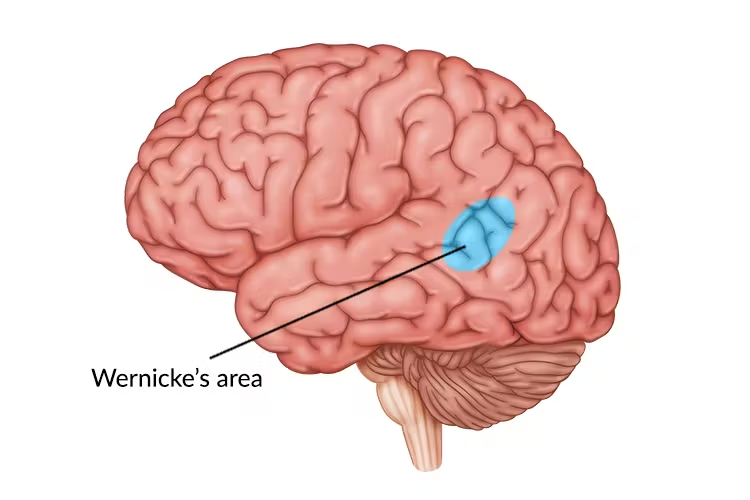
<ul><li><p><span>language comprehension, specifically the comprehension of speech sounds</span></p></li><li><p><strong>Recognizing Speech Sounds</strong><br>In partnership with the <strong>auditory cortex</strong>, Wernicke’s area helps identify and organize the sounds of speech. This early stage involves detecting phonemes and matching them to known word patterns, allowing the brain to recognize that a sequence of sounds is, for example, the word “banana.”</p></li></ul><ul><li><p><strong>Speech Comprehension</strong><br>Once sounds are identified as words, Wernicke’s area interprets their meaning within context. This function allows us to understand full sentences, grasp implied meaning, and follow conversations—even when language is rapid or informal.</p></li><li><p><strong>Semantic Processing</strong><br>Wernicke’s area plays a central role in <strong>semantic processing</strong>—the ability to link words to their meanings and relationships. It helps us distinguish between similar words (like “book” and “notebook”) and understand language nuances, metaphors, or double meanings.</p></li></ul><ul><li><p><strong>Written Language Understanding</strong><br>Beyond spoken words, Wernicke’s area contributes to reading comprehension. When we read, it helps convert written symbols into meaningful language, allowing us to understand everything from short texts to complex articles.</p></li></ul><ul><li><p><strong>Language Integration and Monitoring</strong><br>Wernicke’s area helps coordinate with other brain regions—especially <strong>Broca’s area</strong>—to support fluid language use. It may also assist in monitoring our own speech for accuracy, forming part of a feedback loop that lets us detect and correct mistakes in real time.</p></li></ul><p></p>
18
New cards

Broca's area

  • contains neurons involved in speech function.

  • serves a vital role in the generation of articulate speech.
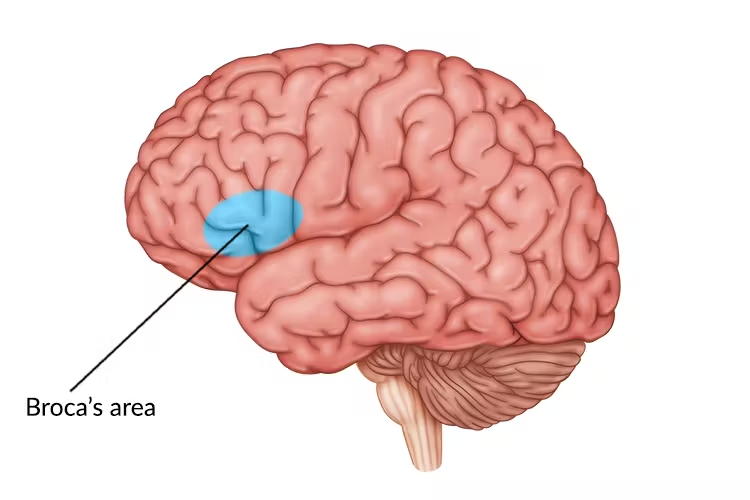
<ul><li><p><span><span>contains </span></span>neurons<span><span> involved in </span></span>speech<span><span> function.</span></span></p></li><li><p><span><span>serves a vital role in the generation of </span></span>articulate<span><span> speech.</span></span><br></p></li></ul><p></p>
19
New cards

cerebral cortex

  • might wanna look at kaitlyn’s pic

  • ultimate control and info processing center

  • Decision-making, problem-solving.

  • Conscious thought.

  • Attention.

  • Emotional and behavioral control.

  • Speech production.

  • Personality.

  • Intelligence.

  • Body movement.

<ul><li><p>might wanna look at kaitlyn’s pic</p></li><li><p><strong><u><span>ultimate control and info processing center</span></u></strong></p></li><li><p>Decision-making, problem-solving.</p></li><li><p>Conscious thought.</p></li><li><p>Attention.</p></li><li><p>Emotional and behavioral control.</p></li><li><p>Speech production.</p></li><li><p>Personality.</p></li><li><p>Intelligence.</p></li><li><p>Body movement.</p></li></ul><p></p>
20
New cards

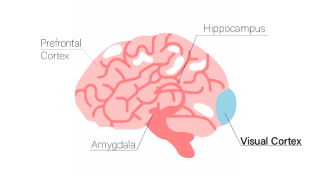
visual cortex

processes visual info

<p>processes visual info</p>
21
New cards

motor cortex

  • cordinates voluntary movement IN THE FRONTAL LOBE

  • coordinates movements across multiple joints and muscle groups to achieve smooth and purposeful action
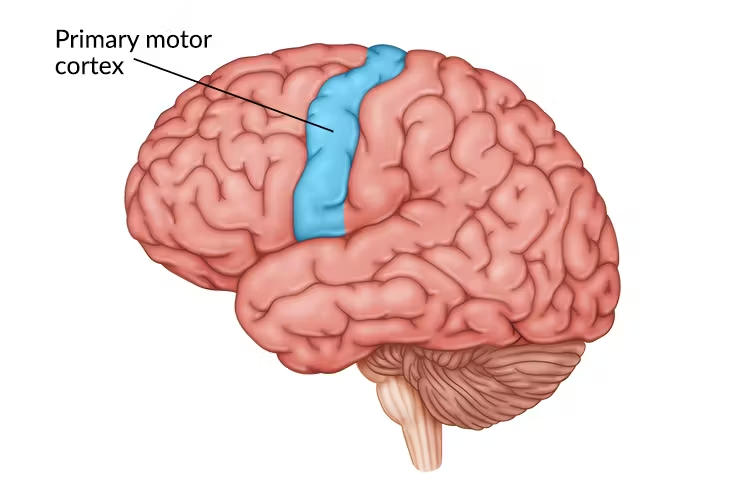
<ul><li><p><strong>cordinates voluntary movement IN THE FRONTAL LOBE</strong></p></li><li><p>coordinates movements across multiple joints and muscle groups to achieve smooth and purposeful action</p></li></ul><p></p>
22
New cards

somatosensory cortex

  • registers & processes body touch + movement

  • bodily sensations, including touch, pain, temperature, and proprioception (your body's innate sense of its own position, movement, and orientation in space, allowing you to move and balance without constantly looking)
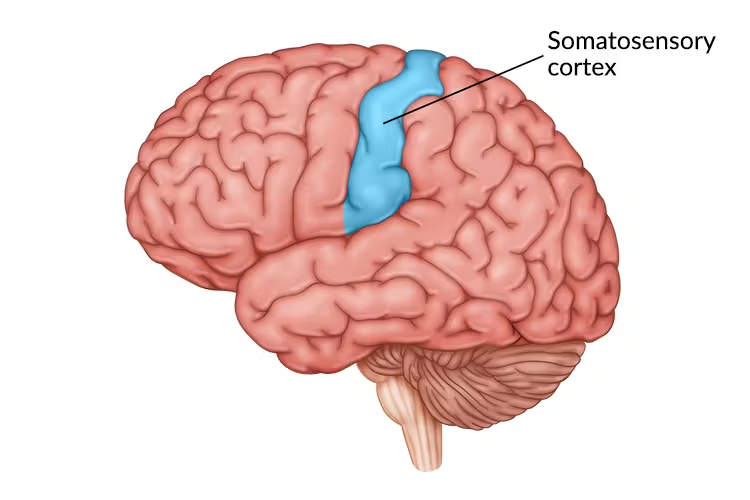
<ul><li><p>registers &amp; processes body touch + movement</p></li><li><p><span><span>bodily sensations, including touch, pain, temperature, and proprioception (your body's innate sense of its own position, movement, and orientation in space, allowing you to move and balance without constantly looking)</span></span></p></li></ul><p></p>
23
New cards

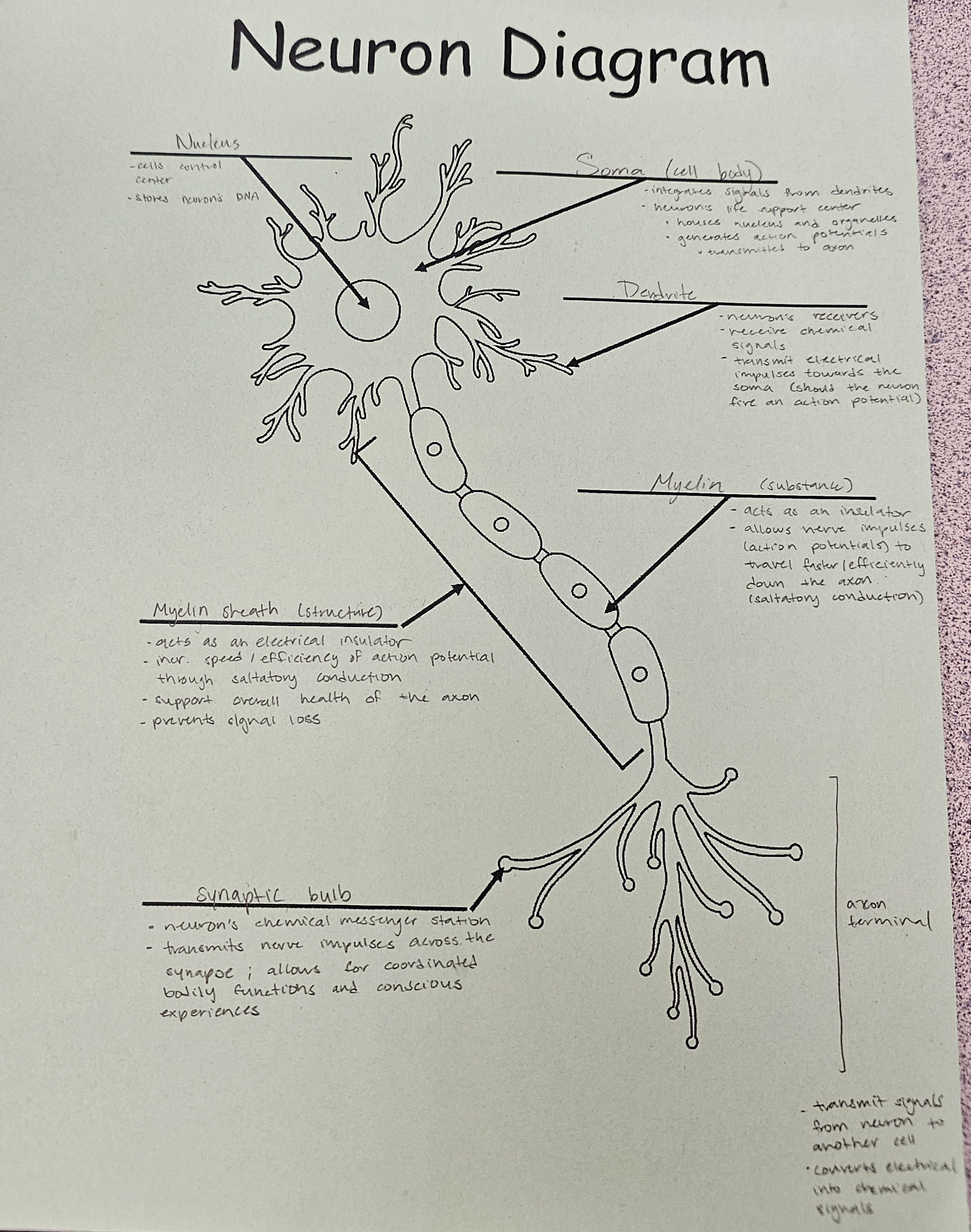
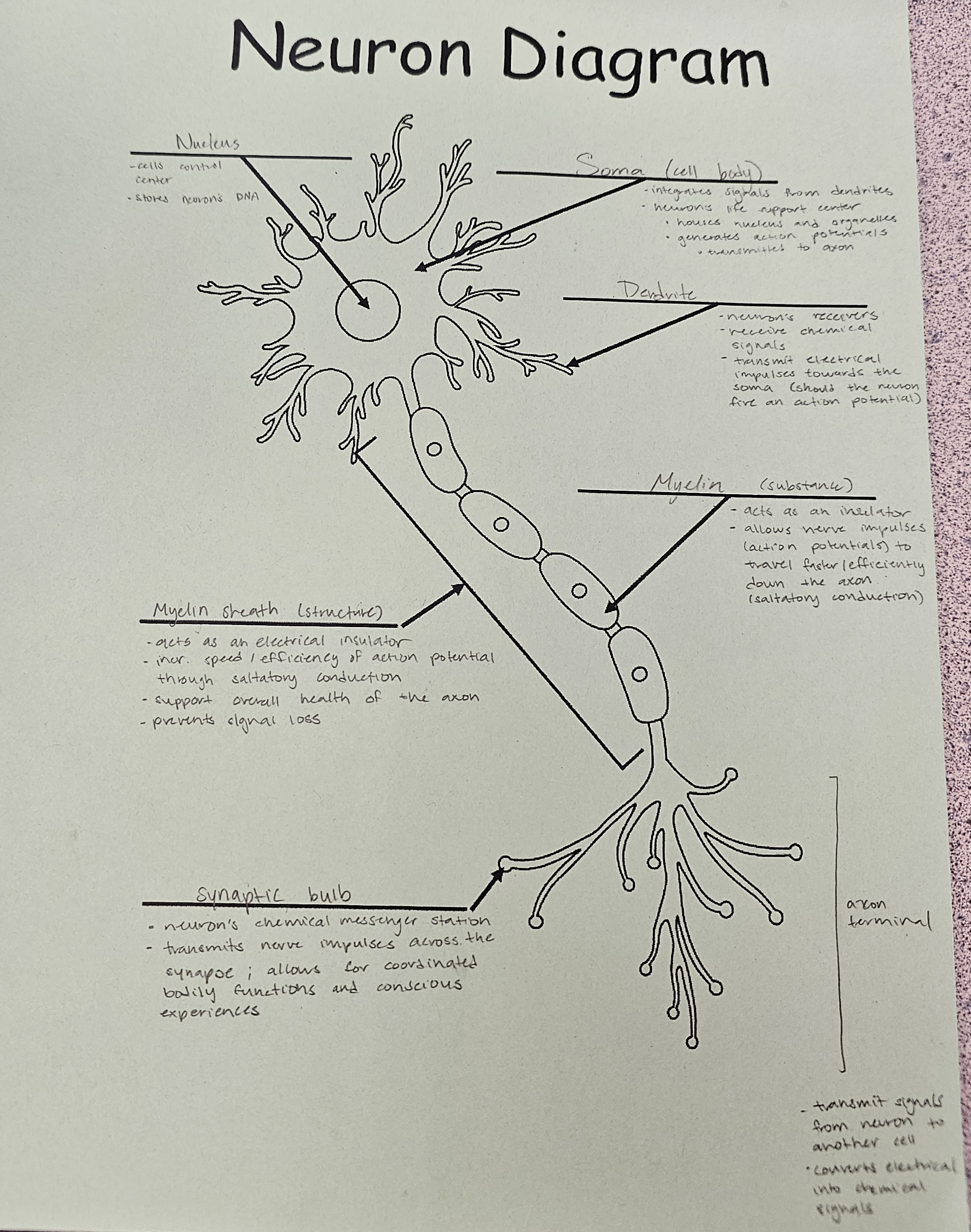
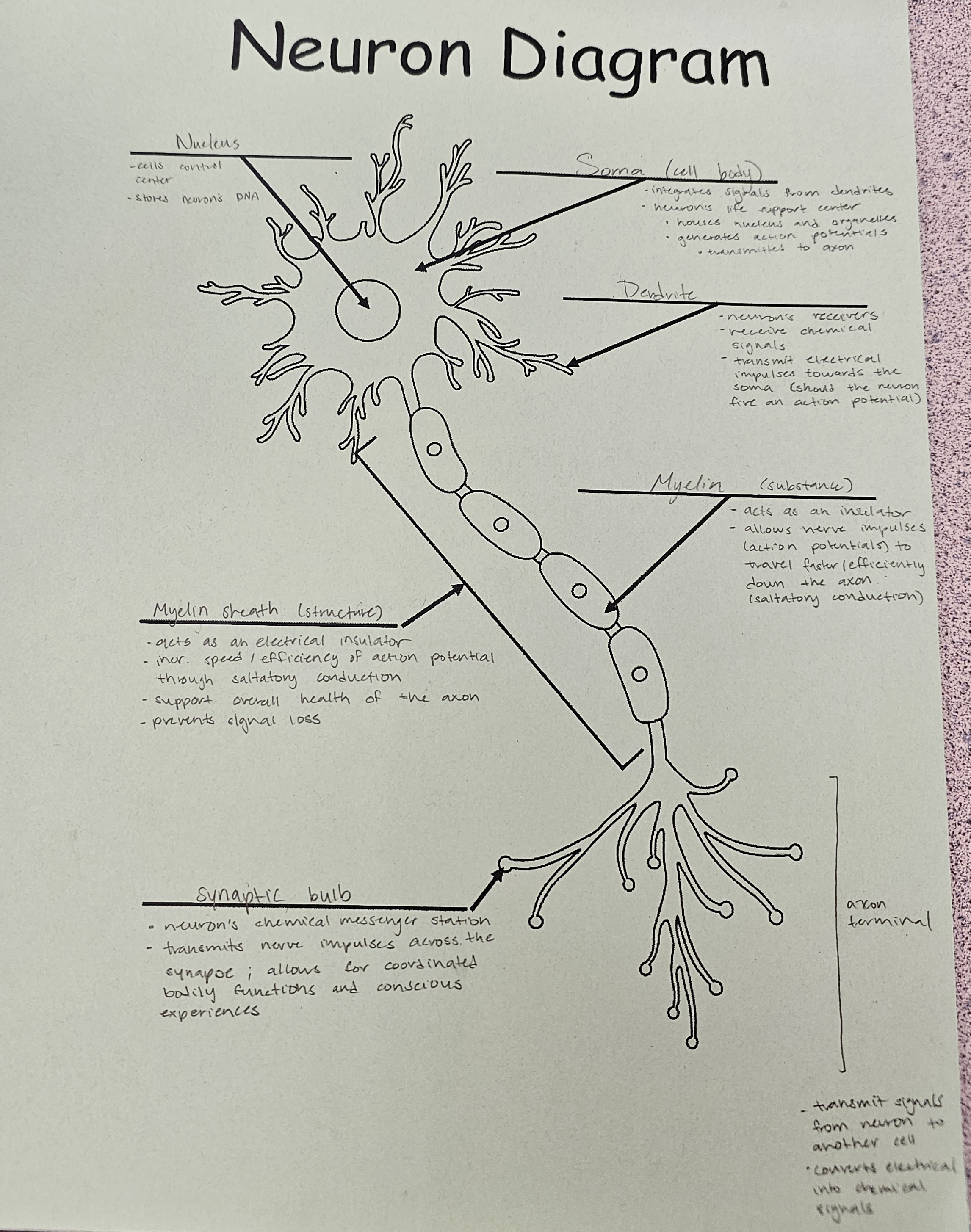
nucleus

  • cells control center

  • stores neuron’s DNA

<ul><li><p>cells control center</p></li><li><p>stores neuron’s DNA</p></li></ul><p></p>
24
New cards

soma (cell body)

  • integrates signals from dendrites

  • neuron’s life support center

  • houses neucleus and orangelles

  • generates action potentials

  • transmitted to axon

<ul><li><p>integrates signals from dendrites</p></li><li><p>neuron’s life support center</p></li><li><p>houses neucleus and orangelles</p></li><li><p>generates action potentials</p></li><li><p>transmitted to axon</p></li></ul><p></p>
25
New cards

Dendrite

  • neuron’s recievers info

  • receive chemical signals (neurotransmitters)

  • transmit electrical impluslves towards the soma (should the neuron fire an action potential)
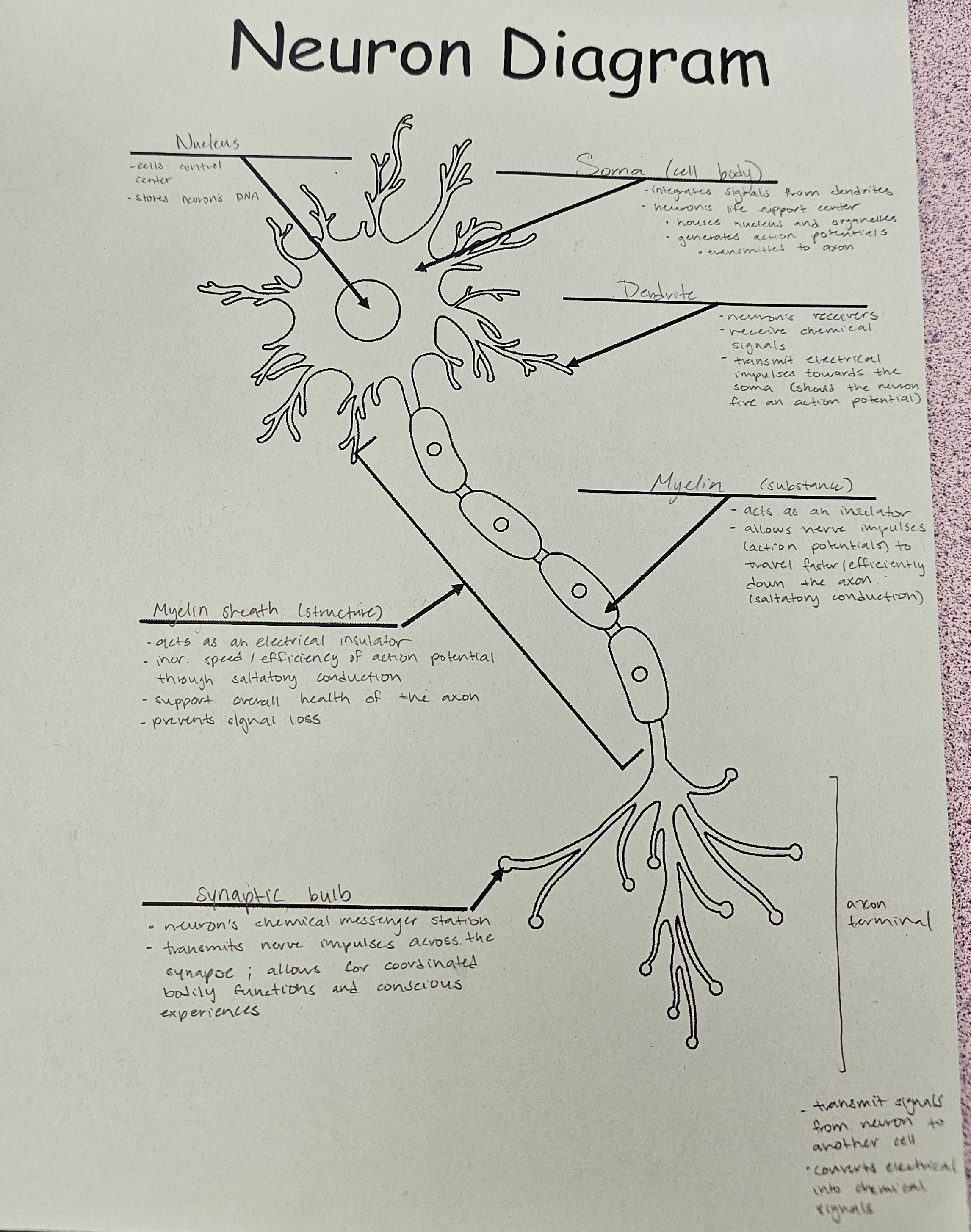
<ul><li><p>neuron’s recievers info </p></li><li><p>receive chemical signals (neurotransmitters)</p></li><li><p>transmit electrical impluslves towards the soma (should the neuron fire an action potential)</p></li></ul><p></p>
26
New cards

Myelin (substance)

  • acts as an insulator

  • allows nerve impulses (action potentials) to travel faster/efficiently down the axon (saltatory conduction)
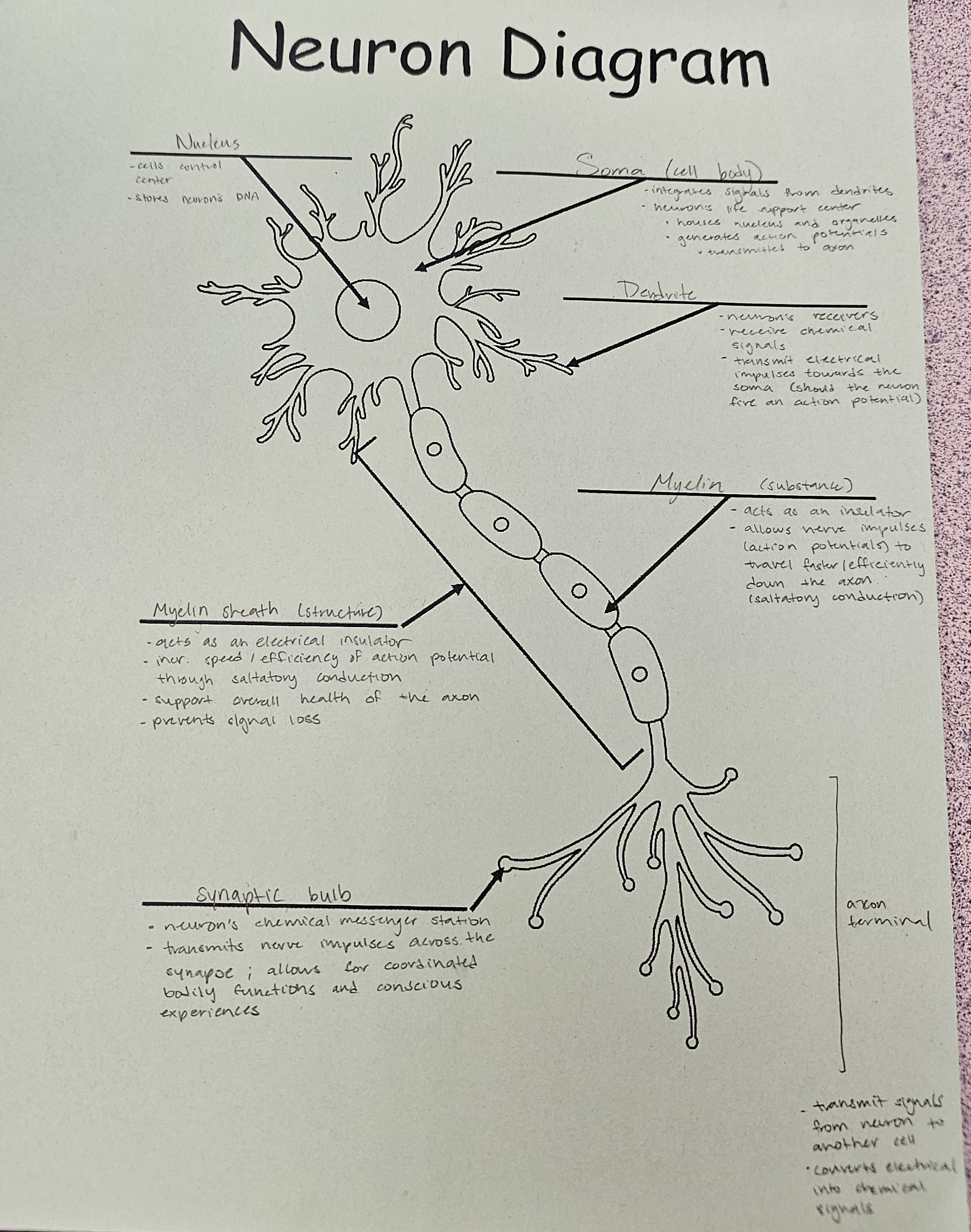
<ul><li><p>acts as an insulator </p></li><li><p>allows nerve impulses (action potentials) to travel faster/efficiently down the axon (saltatory conduction)</p></li></ul><p></p>
27
New cards

Myelin sheaths (structure) / might also be called the axon

  • might also be called an axon: carry signals away from the cell body to the terminal buttons to transmit electrical signals to other neurons.

  • acts as an electrical insulator

  • increasing speed/efficieiceny of action potential through saltaory conduction

  • support overall health of the axon

  • prevents signal loss

<ul><li><p>might also be called an axon:<span> carry</span><strong> signals away from the cell body</strong><span> to the terminal buttons to transmit electrical signals to other neurons.</span></p></li><li><p>acts as an electrical insulator</p></li><li><p>increasing speed/efficieiceny of action potential through saltaory conduction</p></li><li><p>support overall health of the axon</p></li><li><p>prevents signal loss</p></li></ul><p></p>
28
New cards

synaptic bulb

  • neuron’s chemical messenger station

  • transmits nerve impulses across the synapse; allows for coordinated bodily functions and conscious experiences
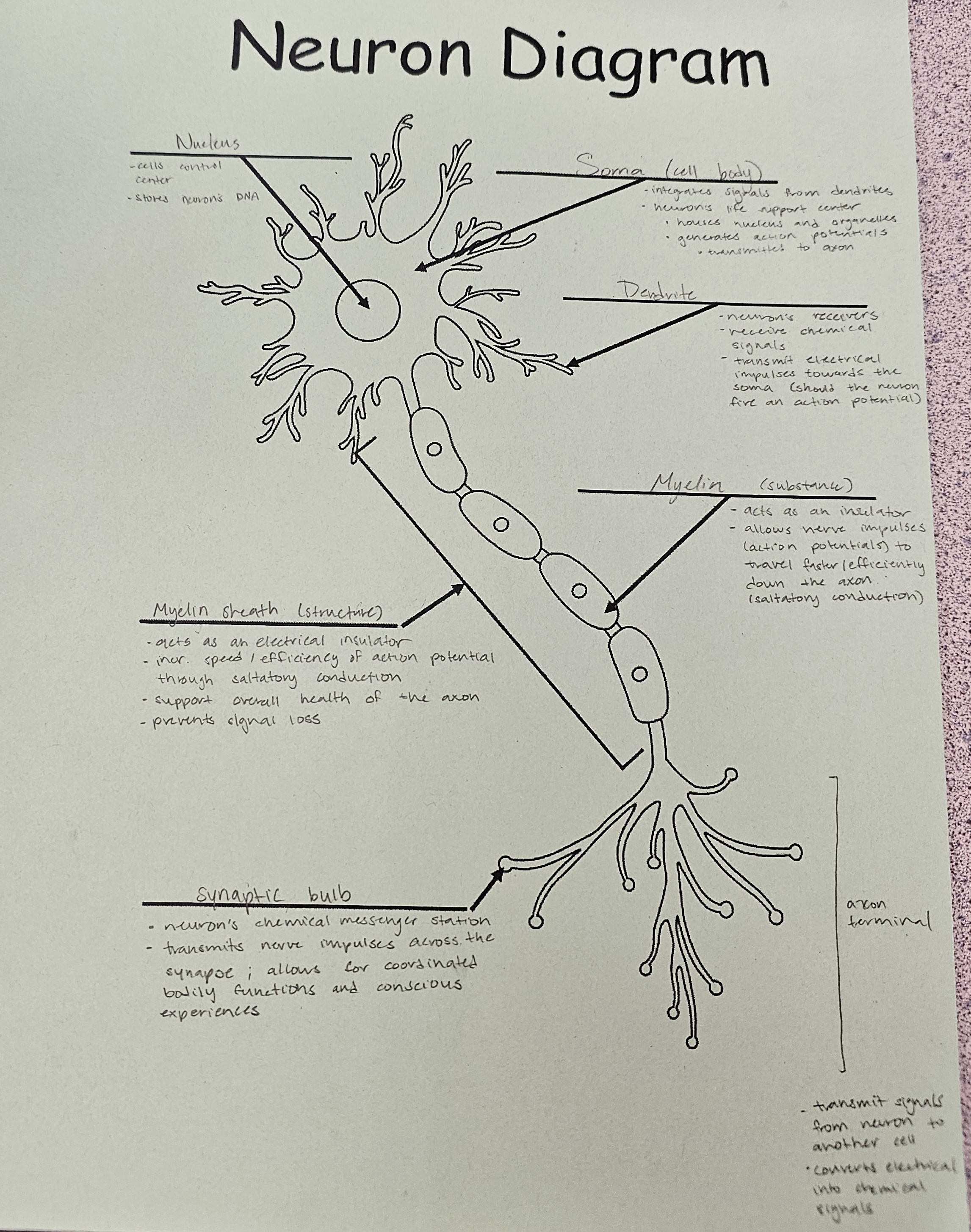
<ul><li><p>neuron’s chemical messenger station</p></li><li><p>transmits nerve impulses across the synapse; allows for coordinated bodily functions and conscious experiences</p></li></ul><p></p>
29
New cards

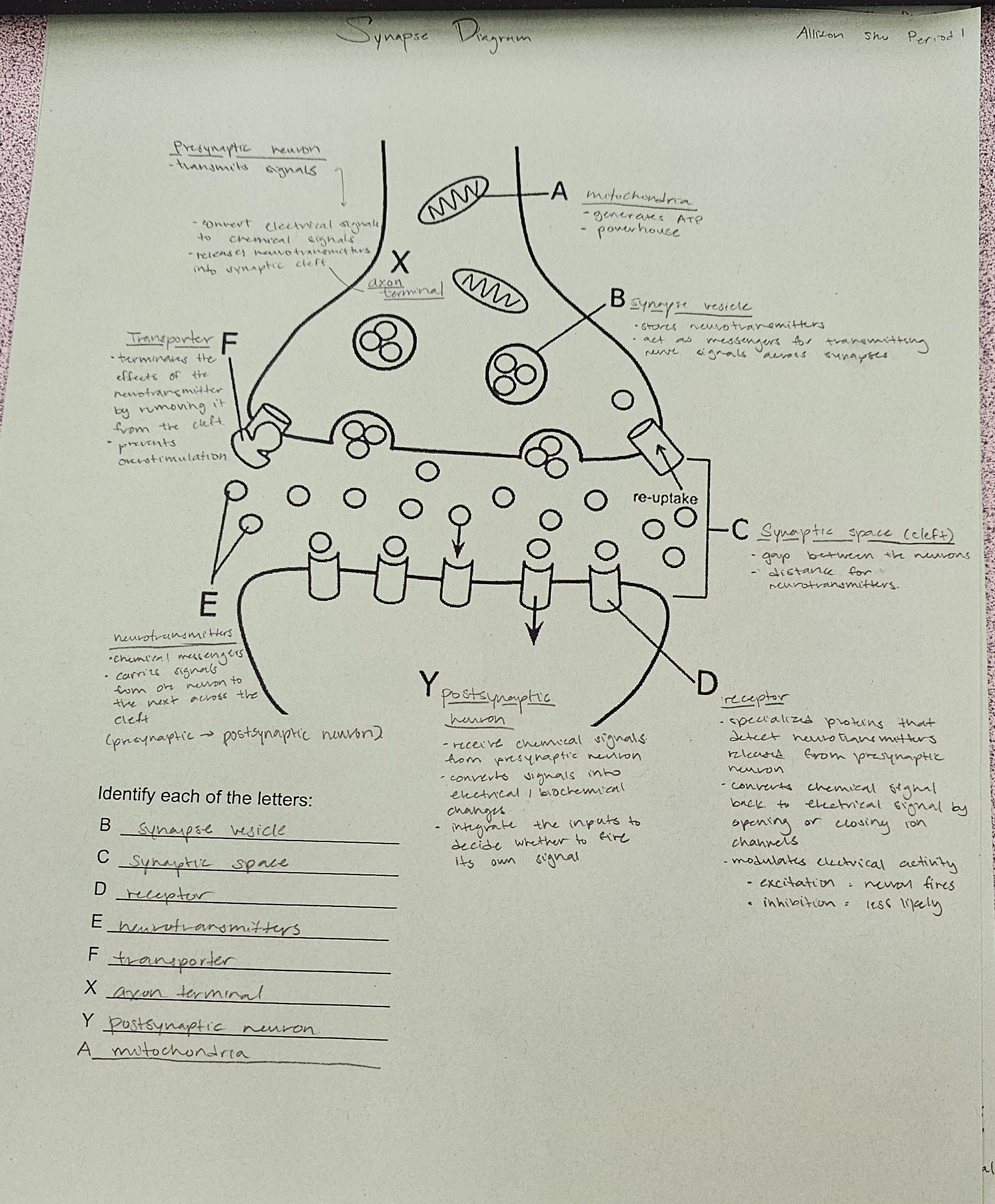
axon terminal

  • transmit signals from neuron to another cell

  • converts electrical into chemical signals
<ul><li><p>transmit signals from neuron to another cell</p></li><li><p>converts electrical into chemical signals </p></li></ul><p></p>
30
New cards

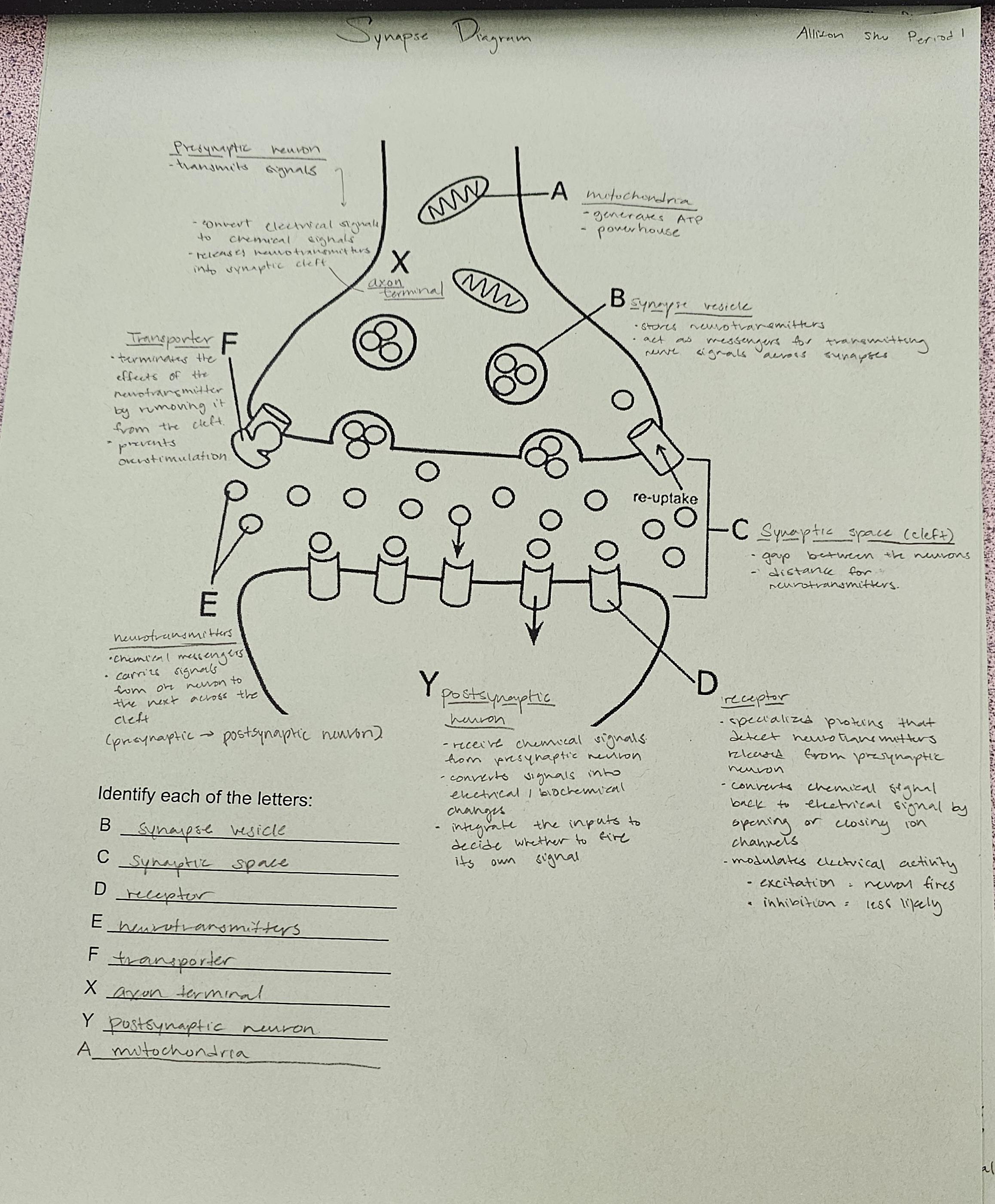
Synapse vesicle

  • stores neurotransmitters

  • neurotransmitters are released into the synaptic cleft when an action potential occured in the presynaptic neuron

  • acts as messengers for transmitting nerve signals across synpases
<ul><li><p>stores neurotransmitters</p></li><li><p>neurotransmitters are released into the synaptic cleft when an action potential occured in the presynaptic neuron </p></li><li><p>acts as messengers for transmitting nerve signals across synpases</p></li></ul><p></p>
31
New cards

synaptic space (cleft)

  • gap between the neurons

  • distance for neurotransmitters

<ul><li><p>gap between the neurons</p></li><li><p>distance for neurotransmitters</p></li></ul><p></p>
32
New cards

receptor

  • specialized proteins that detect neurotransmitters released from presynaptic neuron (receptors usually on the postsynaptic neuron)

  • converts chemical signal back to electrical signal by opening or closing ion channels

  • modulates electrical activity

    • excitation = neuron fires

    • inhabitation = less likely

<ul><li><p>specialized proteins that detect neurotransmitters released from presynaptic neuron (receptors usually on the postsynaptic neuron)</p></li><li><p>converts chemical signal back to electrical signal by opening or closing ion channels</p></li><li><p>modulates electrical activity</p><ul><li><p>excitation = neuron fires</p></li><li><p>inhabitation = less likely</p></li></ul></li></ul><p></p>
33
New cards

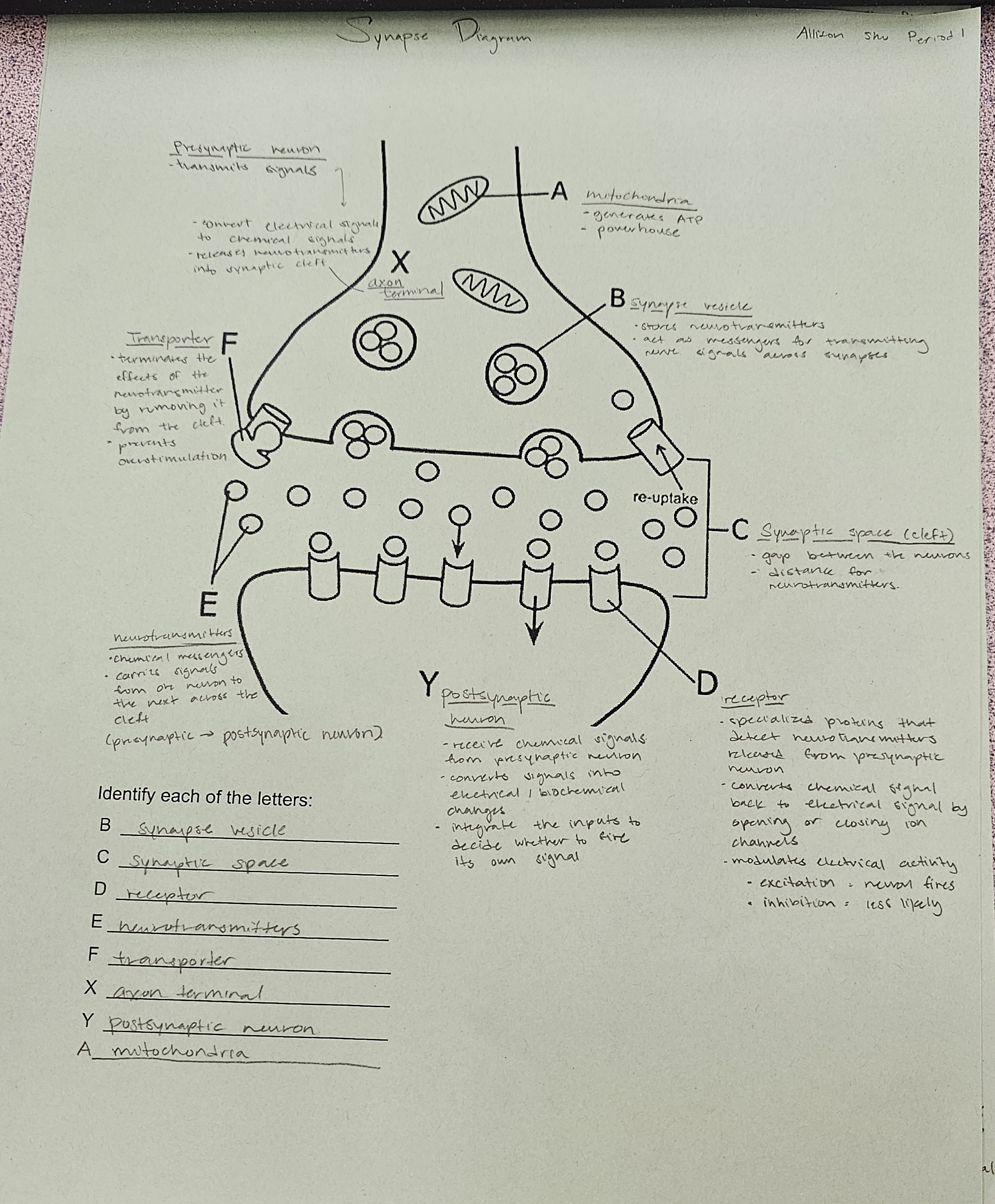
neurotransmitters

  • chemical messengers (chemicals neurons use to communicate with one another) at synpases

  • carries signals from one neuron to the next across the cleft (presynaptic → post synaptic neuron)
<ul><li><p><strong><u>chemical messengers (chemicals neurons use to communicate with one another) at synpases</u></strong></p></li><li><p>carries signals from one neuron to the next across the cleft (presynaptic → post synaptic neuron)</p></li></ul><p></p>
34
New cards

transporter

  • terminates the effects of the neurotransmitter by removing it from the cleft

  • prevents overstimulation

<ul><li><p>terminates the effects of the neurotransmitter by removing it from the cleft</p></li><li><p>prevents overstimulation </p></li></ul><p></p>
35
New cards

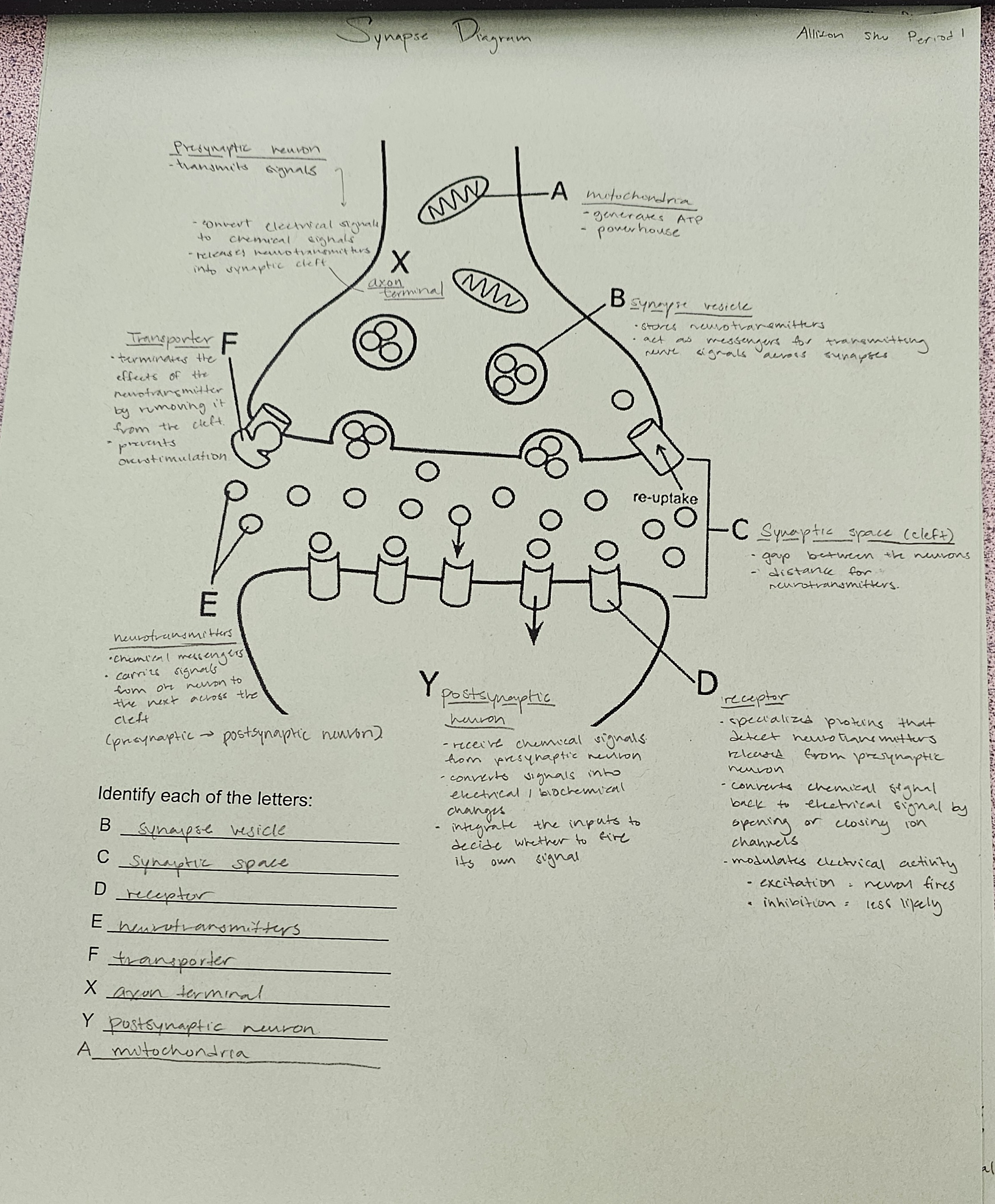
postsynaptic neuron + presynaptic neuron + axon/presynaptic terminal

  • presynaptic neuron: synapses have a neuron that is sending a signal (transmits signals)

  • postsynaptic neuron: neuron recieves the signal

  • axon terminal:

    • converts electrical signals to chemical signals

    • releases neurotransmitters into synaptic cleft
<ul><li><p>presynaptic neuron: synapses have a neuron that is sending a signal (transmits signals)</p></li><li><p>postsynaptic neuron: neuron recieves the signal</p></li><li><p>axon terminal:</p><ul><li><p>converts electrical signals to chemical signals</p></li><li><p>releases neurotransmitters into synaptic cleft</p></li></ul></li></ul><p></p>
36
New cards

mitochondria

  • generates ATP

  • powerhouse of the cell

<ul><li><p>generates ATP</p></li><li><p>powerhouse of the cell</p></li></ul><p></p>
37
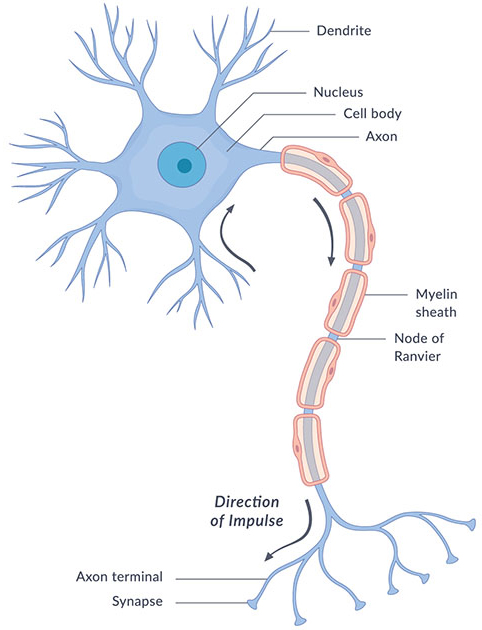
New cards

neuron

info conveyed from one brain region to another through brain cells

38
New cards

helpful image for neuron

here image neuron
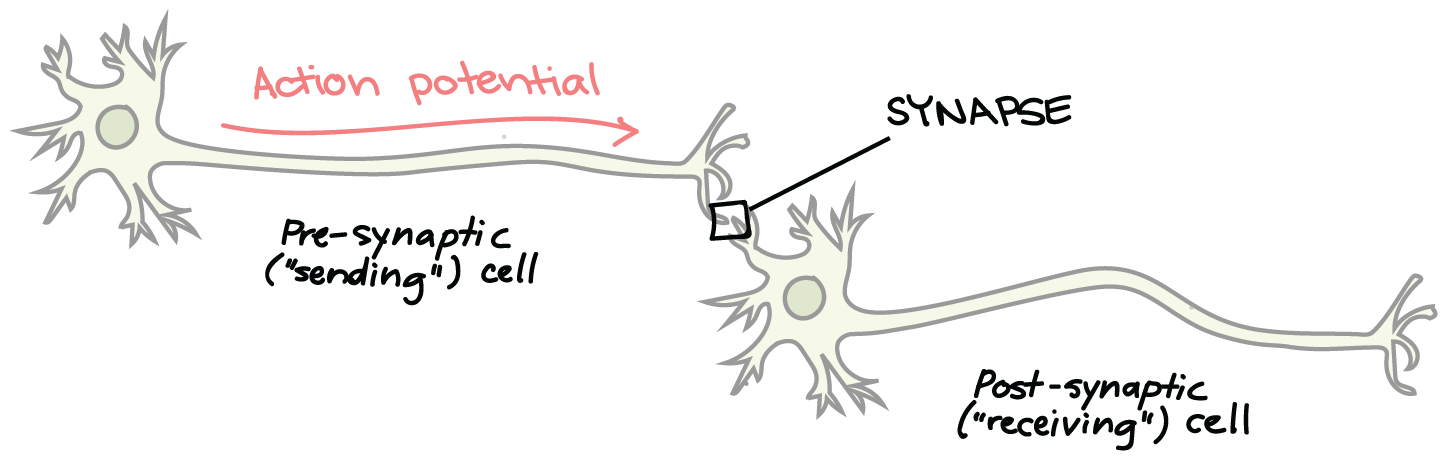
<p>here image neuron</p>
39
New cards

stimulation of the amygdala is most likely to have which of the following effects

A. happiness

b. aggression

c. hunger

d. loss of balance

b. agression

40
New cards

stimulation of which of the following may cause a person to involuntarily move their arm?

a. somatosensory cortex

b. motor cortex

b. motor cortex

41
New cards

what is a synapse

  • a junction between two nerves (one neuron sends and one neuron receives)

  • a junction between two nerve cells, consisting of a minute gap across which impulses pass by diffusion of a neurotransmitter.