lec#6 carbonate
 Call Kai
 Learn
Learn Practice Test
 Spaced Repetition
 Match
Match Flashcards
 Knowt Play
1/53

There's no tags or description
Looks like no tags are added yet.
Name | Mastery | Learn | Test | Matching | Spaced | Call with Kai |
|---|
No analytics yet
Send a link to your students to track their progress
54 Terms
mudtstone
less than 10% grain
What is spar? Micrite?
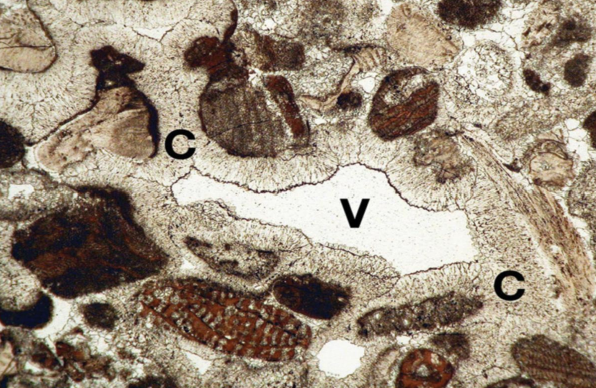
Spar (or Sparry Calcite) is translucent calcite cement that fills pores between grains. Micrite is lime mud matrix.
Grains
(skeletal, intraclasts, ooids, pellets) form the framework
Pores
between grains can remain as pores, be filled by matrix (mud), or be filled by cement (spar = translucent calcite cement
How are terrigenous and carbonate sediments the same and different?
They are the same in that both have a framework of grains and use mud to indicate slow currents. They are different because carbonates commonly undergo surface cementation and significant dissolution/change during diagenesis.
Carbonates
"largely analogous" to terrigenous (clastic) sediments because both are made of grains.
Framework
made of grains like skeletal fragments, intraclasts, ooids, and pellets.
Pores
filled by either matrix (mud) or cement
Higher water velocities
remove mud, leaving pores to be filled by spar later.
There are two main Classification of Carbonate Rock
Folk (1959) and Dunham (1962).
Folk is primarily descriptive; Dunham is both descriptive and interpretive.
Bob Folk
focuses on what the rock looks like in thin section under a microscope.
Be able to use the Folk classification. Know the rock types.
[Intrasparite, Intramicrite, Oosparite, Oomicrite, Biosparite, Biomicrite, Pelsparite, and Pelmicrite]
![<p>[Intrasparite, Intramicrite, Oosparite, Oomicrite, Biosparite, Biomicrite, Pelsparite, and Pelmicrite]</p>](https://assets.knowt.com/user-attachments/6096865b-c372-4c59-bad8-3d1b11b8068a.png)
wackestone
more than 10% grain( mostly mud)
packstone
Grain-supported, but still contains mud.
grainstone
Grain-supported, lacks mud.
Mudstone
Mud-supported, <10% grains.
boundstone
original comps bound together at time of deposition
Dunham assumed that the % mud in a deposit reflected what?
He interpreted the amount of mud to reflect the [environmental conditions]specifically the energy or velocity of the water) at the time of deposition.
floatstone
matrix supported/ allochtonous/ less than 10% grains and smaller than 2mm
Folk: Micrite
Dunham: Mudstone
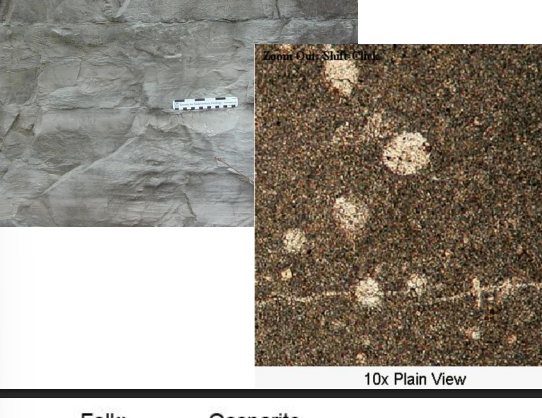
Folk: Oosparite
Dunham: Grainstone
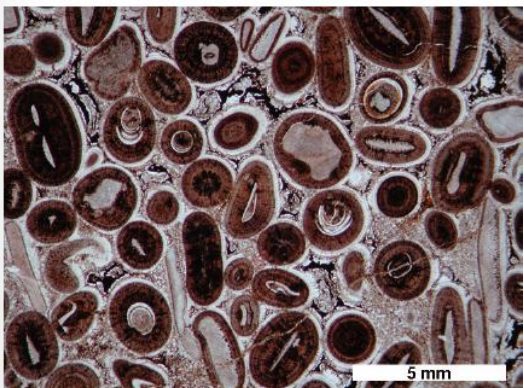
Folk: Biomicrite
Dunham: Packstone
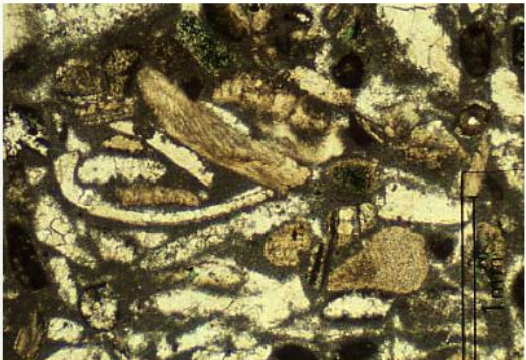
Folk: Biosparite
Dunham: Grainstone
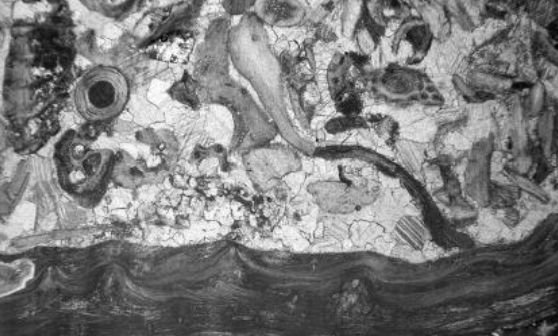
Folk: Pelsprite
Dunham: Grainstone
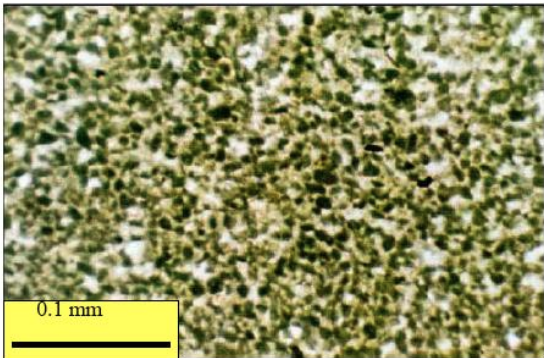
Folk: Intrasparite
Dunham: Grainstone
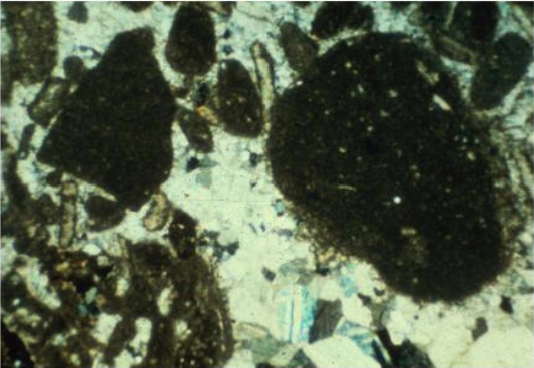
(Embry & Klovan) 1971
Sub-divides Boundstone into Bafflestones, Bindstones, and Framestones.
What terms are applied to different types of boundstones?
[Bafflestones, Bindstones, and Framestones, rudstone anf floatstone
[Bafflestones, Bindstones, and Framestones
Both have >10% grains larger than 2mm. A [Floatstone](Slide 12) is matrix-supported (grains "float" in mud), while a [Rudstone](Slide 12) is grain-supported.
 is matrix-supported (grains "float" in mud), while a [Rudstone](Slide 12) is grain-supported.</p>](https://assets.knowt.com/user-attachments/9c375c12-6755-4c9b-802d-c73ef0a70ef3.png)
rudstone
supported by > 2mm comps/ allochtonous/ less than 10% grains and smaller than 2mm
framestone
would not make a good reservoir, by organisms that build a rigid framework/ authochthonous
bindstone
by organisms that encrust and bind/ autochthonous
bafflestone
fromed by organisms that act as baffle or slow down water or trap sediment/ autochthonous
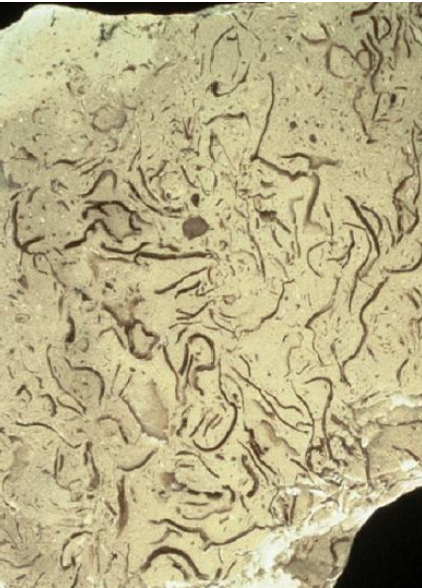
allochthonous
original components not bound organically at deposition
autochthonous
original components bound organically at deposition
embry and Klovan (1971)
further sub-divided Dunham categories into divided boundstone and allochems
bindstone
Formed by organisms (like Cyanobacteria) that grow in layers and "bind" or glue the sediment together.
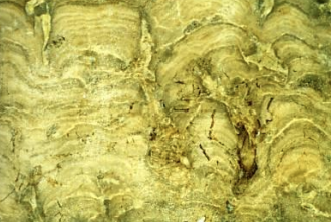
What is a stromatolite?
are layered mounds or columns formed by layers of cyanobacteria that trap and bind sediment in shallow water.
Bob Folk
emphasized what carbonate looks like in thin section and what sorts of particles are seen under the microscope
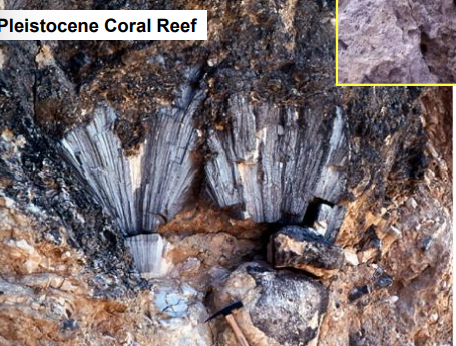
framestone
coral reef
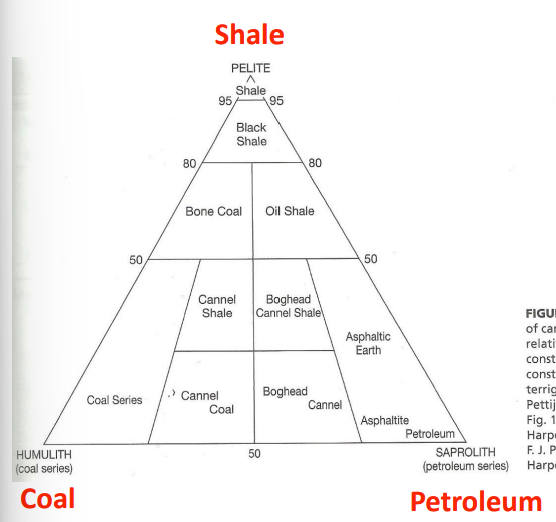
Which rocks have more organic matter: black shale or oil shale?
oil shale contains a higher concentration of organic matter (specifically kerogen) compared to typical black shale.
Carbonaceous Sediments (Rocks) Classification
grainstone
The three main categories are
Shale, Coal, and Petroleum
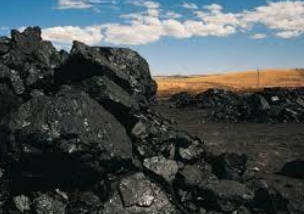
coal
is an organic sedimentary rock formed from the accumulation and preservation of plant materials.
Coal Formation
The process requires Burial, Temperature (Heat), Pressure, and Time.
What is the main component of coal? How is coal formed?
The main component is Carbon. It is formed when plant debris is buried and subjected to heat and pressure over geological time.
What time was prolific for coal formation?
The [Carboniferous]
![<p>The [Carboniferous]</p>](https://assets.knowt.com/user-attachments/cf911eee-fa2f-4401-a1e4-6f0d00dedb95.png)
What are the main types of coal and their characteristics? What is coal classification based on?
The types are [Peat, Lignite, Bituminous, and Anthracite] Classification is based on [Carbon % and energy content]
peat
Low carbon (<60%); partially carbonized plant debris.
Lignite
Lowest rank of "true" coal; brown-black; 60-70% carbon.
Bituminous
Most abundant rank in the US; 70-87% carbon; high heating value.
Anthracite
Highest rank; shiny/hard; >87% carbon.
Which countries have large coal reserves and burn it the most?
Reserves are highest in the [US, Russia, and germany, brazil, south africa]
coal resources
north america(27%), europe(28%), asia(18%)

