Glial cells, nerves, action potentials, synapses, and reflexes quiz
 Studied by 20 people
 Call Kai
 Learn
Learn Practice Test
 Spaced Repetition
 Match
Match Flashcards
 Knowt Play
1/22

There's no tags or description
Looks like no tags are added yet.
Name | Mastery | Learn | Test | Matching | Spaced | Call with Kai |
|---|
No analytics yet
Send a link to your students to track their progress
23 Terms
What are the three main functions of the nervous system?
Sensory input from receptors (afferent nerves)
Congenital insensitivity to pain (CIPA) → someone is born without pain receptors (doesn’t feel pain)
Integration
Motor output to effector cells (efferent neurons)
What are neurons?
Nerve cells, conduct nerve impulses, have cell bodies, dendrites, axons
Sensory, interneurons, motor
What are all neurons?
Excitable
Conductivity
Highly specialized
DON’T DIVIDE INTO AN ADULT
What are glial cells?
Connective tissue in CNS
NOT excitable
Astrocytes
Form tight junctions between cell lining brain capillaries (blood-brain barrier)
Oligodendrocytes
Make myelin sheaths in CNS
Satellite cells
What are the three types of structural neurons?
Unipolar, bipolar, multipolar
What is a unipolar neuron?
Found in ganglia outside of brain and spinal cord
Ganglia: mass of neuron cell bodies, usually outside the CNS
Dendrites and axons are continuous
What is a bipolar neuron?
Rare, specialized parts of eye, nose, and ears
What is a multipolar neuron?
Common in brain and spinal cord
2 or more dendrites and a single axon
What is the difference between a dendrite and axon?
Dendrites
Receive info
Highly branched
Provide receptor surfaces
80%-90% of total surface area
Transmits towards cell body
Axons
Arises from cell body
Axonal hillock
Conducts impulses away from cell body
Has mitochondria, microtubules, neurofibrils
It is a long cytoplasmic process
What do sensory neurons do?
Carry impulses from periphery to the brain and spinal cord
Afferent neurons: conduct inward or towards something
Most are unipolar
What do interneurons do?
Lie within the brain and spinal cord
Transmit impulses to one part of brain/spinal cord to another
Also called association
What do motor neurons do?
Carry impulses out of brain and spinal cord to effectors (muscles and glands)
Efferent neurons: conducting outward or away from something
Most are multipolar
What is the resting membrane potential?
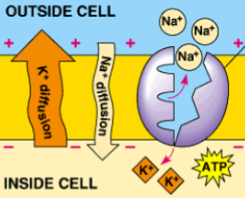
A difference in charge across the cell membrane
Resting potential → -70 mv
Inside is negative compared to the outside
Three Na+ enters cell, two K+ leaks out of the cell
The Na+/K+ pump restores the resting membrane potential
Dumps three Na+ out and two K+ in
What is an action potential (nerve impulse)?
All neural activities begin with a change in resting potential
All-or-Nothing Principle: a neuron either fires or does not fire
What are the steps to an action potential?
1. Resting state
Neuron is at −70 mV (resting potential)
2. Stimulation
Neuron receives a stimulus
Na⁺ channels open at the axon hillock
Na⁺ moves into the cell
Membrane becomes less negative (depolarization)
3. Threshold
If membrane reaches −55 mV, the neuron fires
This is the threshold: minimum needed to trigger an action potential
Na⁺ floods into the neuron
4. Action potential
Membrane rapidly depolarizes to about +30 mV
Inside of the cell becomes positive
This is the big spike on the graph
5. Repolarization
Na⁺ channels close
K⁺ channels open
K⁺ moves out of the cell
Membrane potential drops back down
6. Hyperpolarization
Membrane briefly goes below −70 mV
This is the dip under the resting line
7. Refractory period
Neuron cannot fire normally while resetting
What is the difference between the absolute and relative refractory period?
Absolute refractory period:
From −55 mV to +30 mV
No new action potential possible
Na⁺ channels are open/inactive
Relative refractory period:
From +30 mV back to −70 mV
Neuron can fire again, but needs a stronger stimulus
K⁺ channels still open
What is saltatory conduction?
Myelin increases resistance to flow of ions
Ions can only cross membrane at the nodes of ranvier
AP “jumps” from node to node
Axons have multiple branches, allowing what?
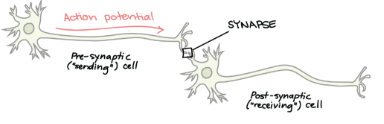
Allowing it to make synapses on various postsynaptic cells
Also, a single neuron can receive thousands of synaptic inputs from many different presynaptic (sending neurons)
How are neurotransmitters (NTs) transmitted?
AP reaches the axon terminal and depolarizes the membrane
Voltage-gated Ca2+ channels open and Ca2+ flows in
Ca2+ influx triggers synaptic vesicles to releases NTs
The NT binds to receptors on target cell
Removal of NT
Reuptake
Breakdown by enzymes
Diffuse off of synapse
What is the reflex arc?
Reflexes: automatic, subconscious responses to stimuli within or outside the body
Ganglion: a collection of nerve cell bodies
What are the parts of a reflex?
Receptor
Sensory neuron
Interneuron
Motor neuron
Effector
What is the receptor and sensory neuron?
Receptor
The receptor end of a dendrite or a specialized receptor cell in a sensory ogran
Sensitive to a specific type of internal or external change
Sensory neuron
Dendrite, cell body, and axon of a sensory neuron
AFFERENT
Transmits nerve impulse from the receptor into the brain or spinal cord
Enter the spinal cord dorsally
What is the interneuron, motor, and effector?
Interneuron
Dendrite, cell body, and axon of a neuron within the brain or spinal cord
Serves as processing center; conducts nerve impulses from the sensory neuron to a motor neuron
Motor neuron
Dendrite, cell body, and axon of a motor neuron
EFFERENT
Transmits nerve impulse from the brain or spinal cord out to an effector
Exit the spinal cord ventrally
Effector
A muscle or gland
Responds to stimulation by the motor neuron and produces the reflex or behavioral action
 Note
Note  Flashcards (77)