Proofs
 Call Kai
 Learn
Learn Practice Test
 Spaced Repetition
 Match
Match Flashcards
 Knowt Play
1/28

Earn XP
Description and Tags
Name | Mastery | Learn | Test | Matching | Spaced | Call with Kai |
|---|
No analytics yet
Send a link to your students to track their progress
29 Terms
Given
Information that’s provided
Addition Property
If a=b, then a+c = b+c
Subtraction Property
If a=b, then a-c = b-c
Multiplication Property
If a=b, then a*c=b*c
Division Property
If a=b, then a/c=b/c
Distributive Property
If a(b+c), then a(b+c) = a*c+b*c
Substitution Property
If a=b then a may be replaced by b in any expression or equation
Reflexive Property
For any real number a. a=a (A value will always equal itself)
Symmetric Property
If a=b, then b=a
Transitive Property
If a=b, and b=c, then a=c
Simplification
Combining like terms
Reflexive Property of Congruence
For any segment AB, Line AB ≅ Line AB
Symmetric Property of Congruence
If Line AB ≅ Line CD, then Line CD ≅ Line AB
Transitive Property of Congruence
If Line AB ≅ Line CD, and Line CD ≅ Line EF, then Line AB ≅ Line EF
Definition of Congruence
Segments are congruent if and only if they have the same measure. If line AB ≅ Line CD, then AB=CD, and If AB=CD, then Line AB ≅ Line CD
Definition of Midpoint
The midpoint of a segment divides the segment into two congruent parts.
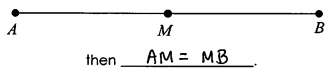
Segment Addition Postulate
If A, B, and C are collinear points and B is between A and C, then AB+BC=AC.

Definition of Congruence (Angles)
The measures of two angles are equal if and only if the angles are congruent. m∠A=m∠B⇿∠A≅∠B
Definition of Right Angle
An angle measures 90° if and only if it is a right angle. m∠A=90°⇿∠A is a right angle
Definition of Complimentary Angles
Two angles are complementary if and only if the sum of their measures is 90°.
Definition of Supplementary Angles
Two angles are supplementary if and only if the sum of their measures is 180°.
Definition of an Angle Bisector
An angle bisector divides an angle into two equal parts.
Definition of Perpendicular
Perpendicular lines form right angles.
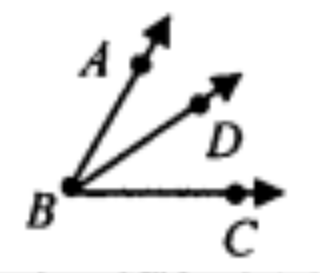
Angle addition postulate
m∠ABD + m∠DBC = m∠ABC
Vertical Angles Theorem
If two angles are vertical, then they are congruent.
Complement Theorem
If two angles form a right angle, then they are complimentary.
Linear Pair Theorem
If two angles form a linear pair, then they are supplementary.
Congruent Complements Theorem
If two angles are complementary to the same angle, then they are congruent. If ∠A is complementary to ∠B, and ∠C is complementary to ∠B, then ∠A≅∠C
Congruent Supplements Theorem
If two angles are supplementary to the same angle, then they are congruent. If ∠A is supplementary to ∠B, and ∠C is supplementary to ∠B, then ∠A≅∠C

