exam 1 sets-Bio 110
 Studied by 1 person
 Call Kai
 Learn
Learn Practice Test
 Spaced Repetition
 Match
Match Flashcards
 Knowt Play
1/176

There's no tags or description
Looks like no tags are added yet.
Name | Mastery | Learn | Test | Matching | Spaced | Call with Kai |
|---|
No analytics yet
Send a link to your students to track their progress
177 Terms
Define mitochondria
Powerhouse of the cell, it has a double membrane and produces energy
Define chloroplast and its function.
sites of photosynthesis in plants and algae
endosymbiont theory
The theory that mitochondria and chloroplasts originated as prokaryotic cells engulfed by an ancestral eukaryotic cell. The engulfed cell and its host cell then evolved into a single organism.
Define cristae
folds of the mitochondrial inner membrane that provide more surface area
define mitochondrial matrix
the space inside the inner membrane of a mitochondrion
Define Thylakoid, granum, stroma
Inside the chloroplast lays a structure called the Thylakoid. Small interconnected sacs stacked like poker chips. Each stack is called a Granum. The fluid surrounding thylakoids is called the Stroma
why do the different compartments in the chloroplast matter
enables the chloroplast to be able to convert light energy into chemical energy
Define peroxisomes
A cell organelle containing enzymes that catalyze the production and breakdown of hydrogen peroxide. used for multiple functions including detoxifying alcohol in the liver, breaking down fatty acids
concept check 6.5- Describe two characteristics between the chloroplasts and the mitochondria. consider both structure and function.
Both work to store and provide energy to cells. another similarity is that both have multilayer membranes.
concept check 6.5- do plant cells have mitochondria?
not all plants do, but it is possible for mitochondria to be present in plant cells. However, it does not go the other way. Animal cells do not contain chloroplasts.
Define cytoskeleton
Network of protein fibers that help the cell maintain its shape and allow it to move
what are the three types of structures found in the cytoskeleton?
microtubules (thickest), microfilaments (thinnest), intermediate filaments (in between the two, inter)
derived from Microtubules, explain the structure of tubulin dimers
they contain two slightly different peptides called alpha and beta-tubulin. This is how microtubules grow
why are microtubules iimportant?
They act as a guide for the transport vesicles to reach the Golgi apparatus from the ER
describe the function of cilia and flagella
membranous protrusions from the cell that help move the cell or other cells; an example of cilia in the human body is the cilia that wick phlegm in your throat
extra research:
https://youtu.be/sVHUO89-sXg?si=LnZFmBHmOZFNt-DA
explain the importance of dyneins
motor proteins which, in this context are responsible for getting materials to the plus end (usually) of a microtubule on a cilia or flagella protrusion
what is the structure of microfiliaments
thin solid rods (thinnest of the 3 kinds) made from the globular protein actin. A twisted chain of actin subunits
how do microtubules and microfilaments differ in their function
microtubules are built to be compression-resistant, the structural purpose of microfilaments is to bear tension (be a pulling force)
what is purpose of the protein myosin
to prompt the contraction of muscle cells
Are intermediate filaments found in all types of cells? explain.
while microtubules/filaments can be found in all eukaryotic cells, intermediate filaments can only be found in some animal cells, including vertabrates
what is the cell wall equivalent found in animal cells and what is its structure.
called the Extracellular matrix. Main ingredients are glycoproteins and carb containing molecules. most abundant glycoprotein is collagen in the ECM.
why is the ECM important
They have the resposibility to communicate with other cells through integrin, they are positioned to transmit signals, the ecm can regulate cell behavior.
in animal cells there are three types of cell junctions, what are they/their funcitons?
tight junctions- forms continuous seals around the cells in this tightly formed junction. Used to prevent leakage of extracellular materials. This explains humans having watertight skin
desmosomes- function like rivets, a fastener. some muscle tears involve desmosome tears
gap junctions- meant for small proteins to pass through, such as ions, sugars, amino acids. These junctions are used to communicate between tissue cells in components such as heart muscle and embryos
What is an isotope? (pg 31)
Atoms of the same element that have different numbers of neutrons, this changes their atomic mass as well
what is the difference between a radioactive isotope and an isotope? (pg 31)
physically, the nucleus is decaying (losing subatomic particles) Spontaneously, giving off particles and energy. Chemically, it transforms the atom into a different element.
how does energy organize itself among electron shells in an atom? (pg 34)
going from the innermost shell to the outer. The inner shell (closest to the nucleus) only holds two electrons, this is the lowest amount of energy within the atom. electrons in the second and third have more energy than the first. when an electron absorbs energy it can move to a different shell further away from the nucleus.
what is important about atoms with full valence shells? (pg 5)
They are going to less/non- reactive. It won't want to interact if it has all the electrons it "needs to function" Those with the same number of electrons in their valence shells are more likely to exhibit similar chemical behavior to each other.
Describe Van der Waals interactions (pg 39)
Very weak forces of attractions between molecules caused by the changing partial charge of molecules resulting from fluctuations of electron concentration.
Concept check 2.3: Why does the structure H-C=C-H fail to make sense chemically?
Carbons valence shell cannot function to double bond; not enough molecules
concept check 2.3: What holds the atoms together in a crystal of magnesium chloride?
If they are crystals it would most likely be an Ionic bond. If broken down chemically magnesium
what is a factor that affects the rate of reaction? (pg 41)
the concentration of reactions. The greater the concentration of reactant molecules
define chemical equilibrium (pg 41)
reactions are still going on in both directions, but there is no NET effect on the concentration of reactants and products. Equilibrium does NOT mean they are equal in concentration. The exchange of products is merely equal to each other.
Define selectively permeable
Only allows specific materials to pass over the membrane,
What makes selective permeability possible?
Plasma membrane and component molecules
what is important about aquaporins
they allow water molecules to pass through. it is a transport protein
Explain ion channels
it allows potassium ions to through the membrane
define amphipathic molecules
includes phospholipids. these molecules have both a hydrophobic and hydrophillic region.
How is the phospholipid bilayer arranged?
It is arranged in 2 layers of phospholipids that are placed tail-to-tail which allows the plasma membrane to exist in the watery environment. The tails are hydrophobic and the heads are hydrophillic.
define the fluid mosaic model
The cell membrane is a mosaic of protein molecules floating within a fluid bilayer of phospholipids. what makes the fluid mosaic model a mosaic is the idea that a membrane is a collage of different proteins often clustered together in groups, embedded in the fluid matrix of the lipid bilayer
describe the bonds of a membrane
typically held together by hydrophobic interactions which are WEAKER than covalent bond
why is membrane fluidity important?
affect both permeability and the ability of membranes to move where their function is needed. too fluid or not fluid enough affects protein function
how do proteins effect the membrane of a cell
while phospholipids from the main fabric of the membrane, proteins are responsible for determining most of the membranes functions.
name the two membrane proteins
peripheral and integral
Define integral proteins
penetrate the hydrophobic core of the lipid bilayer
Define peripheral proteins
protrude from the surface of the cell membrane and are loosely bound to the surface of the membrane, often to exposed parts of integral proteins
What are the six major functions of membrane proteins?
transport
enzymatic activity
signal transduction (send messages to its own cell or others), cell-cell recognition
intercellular joining (using junctions),
attachment to the cytoskeleton and ECM (facilitate extra/intra-cellular changes)
Define glycoprotein
protein attached to a carb, involved in immune response. involved in cell-cell recognition.
both glycolipids and glycoproteins act as a cells name tag
Define Glycolipids and functions
- structure: When a Carbohydrate is attached to a phospholipid it creates a glycolipid
found in the outer portion of the membrane
- function: involved in cell recognition
both glycolipids and glycoproteins act as a cells name tag
what determines membrane sidedness?
the asymmetrical arrangement of proteins, lipids, and their associated carbs in the plasma membrane in determined as the membrane is being built by the ER and Golgi apparatus and components of the endomembrane system.
list some elements/molecules that do not need the help of transport proteins across the selectively permeable cell membrane
nonpolar molecules such as hydrocarbons, CO2 and O2 are hydrophobic as are lipids. they can all "dissolve" easily in the lipid bilayer of the membrane and cross uninhibited without the aid of a transport protein.
polar molecules struggle to pass through the membrane bilayer. explain:
polar molecules such as glucose and other sugars pass through slowly due to the hydrophobic interior of the membrane for molecules with hydrophilic qualities. (this is relative to nonpolar molecules)
why is passive transports passive
no energy is spent getting materials diffused across the membrane
is a concentration gradient representative of potential or kinetic energy
potential energy and drives diffusion too.
how can specific ions and polar molecules that cant normally pass through the membrane enter?
these hydrophilic substances can avoid contact with the lipid bilayer by passing through TRANSPORT PROTEINS that span parts of the membrane
Name the specific protein that helps water pass through the membrane of a cell?
aquaporins. without them only a fraction of the water that gets through normally would penetrate
define tonicity (this is only used to define cell that DO NOT have a cell wall)
the ability of a surrounding solution to cause a cell to gain or lose water
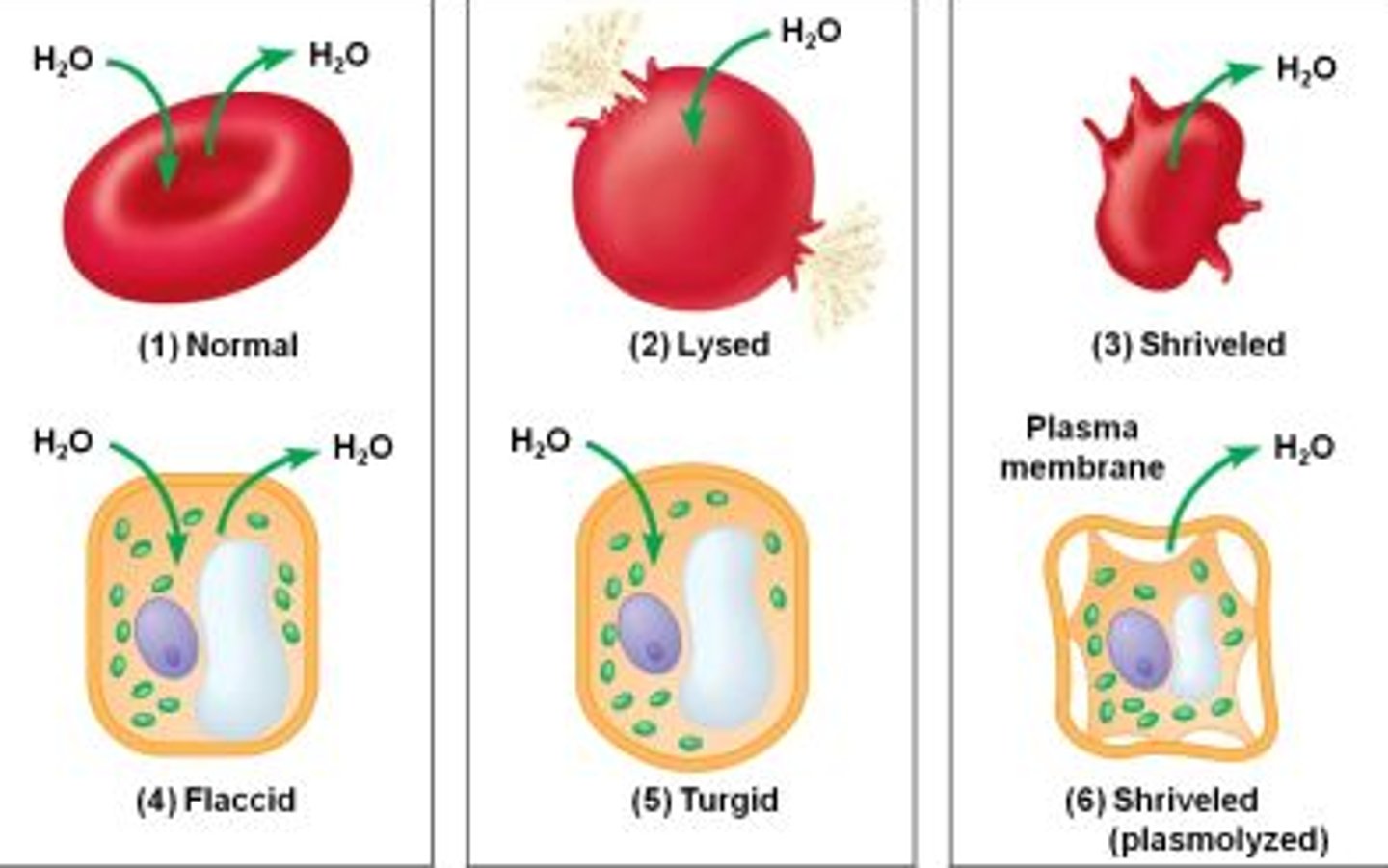
isotonic
there is no net movement of water across the plasma membrane. water diffuses across the membrane but at equal exchange in both directions. in an isotonic environment an animal cell's volume is stable "The cell has been immersed in an isotonic environment"
Hypertonic
the cell will lose water (water flows out of the cell quicker than it enters.) and most likely shrivel and die. This is common in solutes that are overly acidic/salty
hypotonic
Referring to a solution that, when surrounding a cell, will cause the cell to take up water. If too hypotonic the cell can swell and burst with the amount of water entering the cell.
Why is osmoregulation important?
Prevents cells bursting or shrinking when water enters or leaves by osmosis. regulates the amount of water in a cell that doesnt have rigid cell walls
turgid
healthy state for most plant cells. Firm holding of water within vacuoles. cells rely on this for turgid qualities resulting from a hypotonic environment.
flaccid
when the plant's surroundings are too isotonic there is no net tendency for water to enter and the cells become flaccid. the plants wilt due to this.
Define plasmolysis
the process in which cells lose water in a hypertonic solution. causes the plant to wilt and can lead to plant death. as the plant shrivels its plasma membrane pulls away from the cell wall at multiple places
facilitated diffusion
Movement of specific molecules across cell membranes through protein channels using transport proteins
What is a gated channel?
A channel with a gate that allows only certain molecules to pass through
How do channel proteins work?
they form a channel of a particular size and shape that is suitable for a specific ion or molecule to pass through (e.g. aquaporins are channel proteins for water molecules). sort of work as pores for these charged particles to diffuse through.
are channel protein passageways hydro phillic or phobic
they are hydrophillic
How do carrier proteins work?
When certain molecules on the outside of the membrane are needed, the binding site is exposed. The molecules then fill the site and the carrier protein moves to release the molecule into the cell.
Define active transport
the movement of ions or molecules across a cell membrane into a region of higher concentration, assisted by enzymes and sometimes other proteins. This process requires energy. the cell is taking an ACTIVE role in transporting nutrients
why is membrane potential important when looking at ion exchange?
membrane potential acts like a battery or an energy source. this influences the traffic of all charged substances across the membrane. the membrane potential favors the passive transport of cations INTO the cell and anions OUT of the cell.
Define electrochemical gradient
a gradient (biological scale) of electrochemical potential, usually for an ion that can move across a membrane
define cotransport
Uses the diffusion of one substance to drive the active transport of another
a transport protein can couple the downhill diffusion of a solute to the uphill (active) transport of a second substance.
Define exocytosis
Transportation of large molecules out of the cell via the formation of a vesicle. A transport protein that has budded from the from the golgi apparatus moves alonf the microtubules of the cytoskeleton to the plasma membrane.
Define endocytosis
exocytosis in reverse. cell takes in molecules and particulate matter by forming new vesicles from the plasma membrane.
what are the three types of endocytosis?
phagocytosis, pinocytosis, receptor-mediated endocytosis
Describe receptor mediated endocytosis
This is a type of pinocytosis that enables cells to obtain bulk quantities of specific substances. Substances first bind to specific receptors on cellular surfaces before being transported inside. this is commonly seen to take in cholesterol for membrane synthesis and for other steroid synthesis.
Describe phagocytosis
A cell engulfs a particle by wrapping pseudopodia around it and packaging it with a membranous sac called a food vacuole. The particle will be digested after the food vacuole fuses with a lysosome containing hydrolytic enzymes.
Define pinocytosis
a cell continuously gulps droplets of extracellular fluid into tiny vesicles formed by infoldings of the plasma membrane. in this way the cell obtains molecules dissolved in those droplets.
organization: what are the 10 levels of organisation?
in order from largest to smallest: Biosphere, Ecosystem, communities, population, organisms, organs, tissues, cells, organelles, molecules
what is important about the interaction of reductionism and systems biology?
They compliment each other in order to see emergent properties (properties of something that make themselves known under specific conditions)
What are the two main types of cells and what distinguishes them from each other? (pg 6)
Prokaryotes: lacks a nucleus or membrane enclosed organelles. Typically are smaller than eukaryotic cells too. Ex: bacteria, some types of algae, etc,
Eukaryotes: contains membrane enclosed organelles. Ex: skin cells, cell off a mushroom, etc,
Define Genome (pg 8)
the entire "library" of genetic instructions that an organism inherits
What is gene expression and what makes it important? (pg 8)
"The entire process by which the information in a gene directs the manufacture of a cellular product is called gene expression...In carrying out gene expression all forms of life employ the same genetic code.
what is the difference between genomics and proteomics (pg 9)
Genomics study sets of genes within a species or organism
Proteomics study sets of proteins and their properties (think pro in proteomics AND in proteins)
describe the producer to consumer pipeline (pg 9)
The movement of energy from one organism to another.
Ex: A cow (consumer, by converting the caloric energy from the plant) receiving energy from eating grass (producer through photosynthesis)
define feedback regulation; negative and positive feedback loops (pg 10)
Feedback regulation: The output of some sort of "product" in turn FEEDS BACK to the regulation of that process of output.
Negative: The feedback of the "response reduces the initial stimulus." This is more commonly found in natural
circumstances than positive loops.
positive: "In which the end result speeds up its own production"
an example (given in the text book) platelets causing a wound to clot. As more popularize the wound more platelets are drawn to it.
define evolution and contextualize its importance (pg 11)
The scientific explanation for both unity and diversity in organisms. evolution is the concept that organism that exist on earth today are products/ descendants of common ancestors
what are the three domains of life? (pg 12)
Bacteria (most diverse and widespread prokaryotes), Archea (includes multiple kingdoms. Some of these prokaryotes can be found in extreme locations salty lake and boiling hot springs), Eukarya (kingdom plantae, fungi, animalia, protists)
Define natural selection (pg 14)
Simply defined as evolutionary adaption, it is the biological process of a species' heritable traits changing over time to be best fit for the environment.
concept check 1.2:
1. explain why editing is a metaphor for how natural selection acts on a populations heritable variation (pg 16)
as you edit an essay, natural selection employs the same practice over time. changing and adapting to make the inherited traits to be the most "biologically successful" for the environment
Concept check 1.2:
2. referring 1.20 provide an explanation to why the green warbler finches beak (insect eater) came to have a slender beak (reference is not necessary) (pg 16)
possible answer: If the green warbler finch lives on diet of insects than the beak would adapt to catch their food as efficient as possible. Insects of the ecosystem might live in tree branches. A slender beak would be much more likely to catch those bugs than a fat one that would have trouble digging through the holes of a tree.
what is the difference between inductive and deductive reasoning? (pg 17-18)
Think of a funnel. Inductive goes from the bottom of the funnel to the opening of it. Going from specific to general, bringing in more information to the general idea.
Deductive is the opposite. Going from the wide opening to the bottom of the funnel. general to specific.
What is important about building on other scientific work/hypotheses
if results/experiments are not repeatable, the original claim will have to be revised
explain the importance of model organisms
they allow us to trial run and create observations and findings without having a lasting impact. (fruit flies can be made in lab, and so can mice, etc,)
what is the criteria for defining a living organism
1. all organisms must be defined as cells
2. must process nutrients for energy, metabolism
3. grow/develop
4. respond to stimuli
5. evolve over times
6. responds to stimuli (stimulus triggers a reaction)
7. regulation (homeostasis), EX: temperature, sweating
what is a disadvantage of a transmission electron microscope?
After the image is taken the cell is killed off.
What is microvilli and their function?
finger-like membranes that protrude from the cell membrane that can finger-like membranes that protrude from the cell membrane that can be responsible for immune signalinge responsible for immune signaling
Concept check 6.2 - briefly describe the structure/function of nucleus, mitochondrion, chloroplast and ER
nucleus- carry cell DNA and be the control center
mitochondrion- powerhouse of the cell, responsible for generating chemical energy
chloroplast- found in plant life most often involved in oxygen release/energy produced via photosynthesis
ER- mail system of the cell, transports nutrients/waste, protein synthesis (rough ER)
In a Eukaryotic cell, what is important about the nucleus? (pg 102)
houses the cells genome
 Note
Note  Flashcards (20)